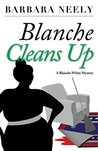
Blanche Cleans Up, by Barbara Neely ****

blanchecleansupBlanche Cleans Up, which is #3 in the Blanche White mystery series, is more than a murder mystery, as the numerous word plays in the title imply. This is a smart, funny-yet-serious series, and I am thrilled to be able to review another one for Net Galley and Brash Books, who provided me with a DRC. This title was released at the beginning of May, and so you ought to be able to buy it right now.

Blanche is a single African-American woman who chooses to do domestic work so that she can select her employers. She is good at her work, and so anybody she doesn’t like, doesn’t get to hire her. But in this episode, she has been roped into a job she otherwise would not do, at the behest of a family member. Inez, their usual cook and head housekeeper, is in desperate need of a vacation, and Inez can’t go unless she can guarantee a good substitute to take her place. Blanche, who sometimes has an acid tongue but also a heart of purest marshmallow, caves in and agrees to step in for a week. Of course, after all hell breaks loose, Inez is gone for at least two weeks. Who wouldn’t be, under the circumstances?

Neely is a seriously brainy writer. Meta-meta-meta-cognition is all over the place in Blanche’s internal narratives. It’s an approachable way to talk about social issues, primarily race, but also about sexism, the rights of gay and lesbian people, and of course, about class. So if you are socially conservative…if you are conservative, why are you reading my review at all? What are you thinking? Are you new here? Get out get out get out. Shoo! Scoot. Skedaddle.

Ah. I feel better now. Gave me quite a turn. Anyway, those who are looking for a mystery because their brain is tired and they just want a cozy read—and I do this myself from time to time, nothing wrong with it—will need a different book, because Blanche books are really about social issues, and the mystery is merely an approachable forum with which to address them. Not that pacing, characterization, and story arc are missing; far from it! I was riveted from the seventy percent mark and had to finish it. It’s a solid story, not literary fiction, but a good mystery. But if you are looking for a good story and think you will just ignore the issues under discussion, you are mistaken, because they are so strongly interwoven here that it’s impossible to just read it for the mystery aspect.

I should also mention that the intended audience appears to be Black folk and other people of color. That doesn’t mean Caucasians can’t enjoy it, and it may be a good lesson in empathy, especially if you haven’t done a lot of introspection. At times, Neely echoes WEB DuBois on the color line; in the elite white folks’ household, a young Black man who was close to the child in residence was welcome through the front door…until.

Neely weaves a lot of plot points and a lot of issues into one deft tale. It’s really well crafted. I especially enjoyed the development of Blanche’s adopted son (nephew whose mother is dead) along with neighborhood activist Aminata. And I liked what she did with her teenage relative who developed a serious problem.

When you finish the book, you almost have to have a heart and mind that is a little more open to types of people you might have unthinkingly dismissed before. There’s really nothing else like it. How often do you get the opportunity to improve yourself and have fun at the same time? Do it!

Die for Me, by Jack Lynch *****

dieformePeter Bragg, old-school detective, gets a visit from someone he used to know. She’s working as a psychic now, and the spirits are restless indeed. Not only does she see disquieting visions of dead people that haven’t been discovered yet, but she also sees a threat that is closer and more personal. She fears she may become a victim as well. Thanks go to Brash Books and Net Galley for permitting me to read this via DRC; originally written in the latter part of the 20th century, they are being re-released digitally now.

I confess that a few times, in reading this absorbing novel, my BS meter started ticking. This detective apparently has no income, yet he is spending plenty and refuses to bill Marianne, the psychic with the unsettling news. And as the hillside is combed by legions of cops, I wondered where the cadaver dogs are. Couldn’t they just bring them out to the site, once it is found, and let them sniff up the bodies?

But as I may have mentioned before (and before, and before), a really good writer can make me believe anything, and a lousy one can’t sell me a thing. And the fact is, Lynch is a good writer. So I set aside my snarky moment of disbelief and dove in to see where this story was headed.

Ultimately, there are a surprising number of unquiet spirits resting in the hills near Sonoma. Who could have a grudge against this many people? Is it possible Marianne is involved in it somehow? The suggestion that one person may have been the intended victim and the rest merely killed as window dressing is quickly laid to rest. That’s not it. And just wait till you see what’s behind it all!

Well my friends, the world is full of crazy folks. Fortunately, it’s also full of mystery and detective novel mavens. And as I gnawed voraciously at this episode in the Bragg series, I found myself wishing Lynch were still among us so he could introduce us to a few more fictional nut bars.

Sadly, he isn’t, and he can’t, but the good news is that you can get this one. If you love a good detective novel, you should snap up the whole series. It’s hard to put down once you begin! And it’s available in August. I’ll bet you could order it now. By the time it comes, it will be a surprise, one you gave yourself.

Are you still here? Go! Get this story. You’ll be glad you did.

Memphis Ribs, by Gerald Duff ****

Memphis RibsIt’s tourist season in Memphis; the Mississippi Delta land is filling up with convention-goers and barbecue lovers. They’re fixing to parachute in a couple of whole hog carcasses, but not until after the Cotton Queen goes by on her float. And this being Delta country, the float really is a float; it is a barge made over, and she is much more concerned about keeping every hair exactly where it belongs than she is about finding out who killed Daddy the other night. Okay, actually she pretty much knows, and it was badly done. But damned if it’s going to spoil her special day. As for me, I just want to say thank you to Net Galley and Brash Books for the DRC. It’s been a dark but enjoyable viewing.

So let’s have a chat, just the two of us, about the best way to break into an ATM machine. Never tried it myself. I would never have thought to do it the Memphis way, so maybe it’s just as well I turned out to be more the sort to read and write things and less the criminal type. Because frankly, I never would have considered just ripping the thing off its moorings with a forklift and driving it away to where I could tear it apart in privacy. Franklin Saxon is more suited to this kind of activity. We’ll let him do it, or at least direct the hired help to do it. Well, for as long as he can, anyway; things don’t go well for him up the road a fair piece.

As for our local cops, JW Ragsdale just wants to get out of Memphis for a bit. It’s so humid, so crowded. The bugs alone will make you crazy. If he can launch an investigation that will take him out of town, preferably with a fishing pole and a six-pack in tow, he’ll be happy to fill out the paperwork saying he’s been on the job, been conducting critical interviews.

How sad for him, then, that he is so good at his work. One interview leads to another, and before you know it, the man is right in the thick of all sorts of drug smuggling, fraud, thievery and yes, oh yes…murder. It ain’t so much a holiday after all, and looky here, even the barbecue done turned rancid. It really isn’t his day.

The Bones family figures prominently; they’re employees of Franklin Saxon, recently bereaved son of Aires Saxon. The hard part is not sampling the merchandise.

“ ‘Shee-it,’ said Stone Job. ‘Shee-it. Merchandise. Why you call it that?’
“ ‘Fool, that’s what it is. That’s what we be buying and selling. Why you think we
done made a withdrawal from the ATM the other night?’”
“’To pay the white man the money for the rock. That’s why.’”
“’Right, you getting it. That be the Bones business…Free enterprise, motherfucker.’”

At first, with my political antennae always on alert regardless of genre, I was concerned about the negative depiction of African-Americans in the story. Were we going to veer toward stereotypes here? And what is up with the use of the word “honky”, which I hadn’t heard since the 1970’s?

But not to worry. This little tale treats everyone with equal irreverence. In fact, the very best, sickest humor, to my way of thinking, was the scene at the pork processing plant, when JW indulges in a little fantasy of his own regarding the speed-that-line-up foreman.

Trust me.

If you are squeamish, if you can’t deal with sick humor or gruesome interludes, give it a pass, already. It isn’t half as gross as most of what’s on television, but never mind; the point of dark humor is to enjoy it, and we want you to have a good time here.

If, however, you can read Janet Evanovich and The Onion and come away holding your sides, then this little goodie just might be up your alley. Originally published in 1999, it will be released in digital format May 5.

I recommend you read it separately from meal time, though.

Truth or Die, by Jack Lynch *****

truthordie“These fellows in their cammies offering their guns for hire would know about things like T-ambushes, wind drift and long-range rifle fire, and maybe a boobie trap or two. I knew about close-in fire, street work and fear.”

Originally published under the title “Monterey”, this is the sixth installment in the Peter Bragg series, and the pace is as taut as piano wire. Don’t count on falling asleep just after you finish it; allow time for your heart to stop pounding and your blood pressure to ease up a bit. It’s an outstanding thriller that left me breathless.

It’s a shame the writer is no longer living and can’t write a bazillion more novels for us to enjoy; he could wiggle a finger and I would follow him anywhere. His series does not have to be read in order; this one is great as a stand-alone novel. And by now I am also supposed to have told you that thanks to Net Galley and the lovely fellows at Brash Books, I read this free as a DRC. Had it cost me actual dollars, it would have been well worth it.

Bragg is back in California where he belongs, and he’s spending some time with girlfriend Allison Stone. Whilst on vacation, however, an old friend of Bragg’s is widowed, and is a suspect in her husband’s murder. She’s not a very nice person; in fact, she’s a pain in the ass. But Bragg is convinced of her innocence, and she has even gone to her relatives, hat in hand, in order to come up with his fee. He’s in it now, and Bragg always plays to win.

Though it’s set in the 1980’s, the lack of technology (no satellites; when you are stuck out there alone, you are seriously alone!) and Bragg’s hard-boiled demeanor give this series a strong noir flavor. I appreciate a detective that knows he needs to have his gun handy. This is the USA, for heaven’s sake! Bad guys always pack heat. We retired school teachers can stay inside, lock the door, and let the dog guard our homes, but Bragg is chasing bad guys, and he goes in prepared. It’s a good thing he does.

When things start to heat up, he tells Allison that the situation has become dangerous, and she should hop a plane to San Francisco. He’ll take her to the airport himself. And she says she’s not doing that anymore; she needs to know what it’s like to live with his vocation. They’re getting serious; he wants her to marry him. Let’s find out right now what this whole thing is like.

Turns out, that’s a terrible idea.

Bragg is such a strong protagonist, and the way Lynch bounces his street-smart persona off the smug, wealthy folk that live in Carmel, Bel Sur, and other hoity-toity beauty spots is masterful. The climax made me want to stand up and cheer. What a total bad ass! Way to go.

The best news of all is that this little hummer was released digitally in February, so you can have it right now.

Don’t leave home without it!

Yesterday Is Dead, by Jack Lynch ****

yesterdayisdeadPeter Bragg is a San Francisco private eye. He is originally from Seattle, but he left all that behind: the rain, the grey skies, the depression…and Lorna, his ex-wife. Now a case brings him back. He isn’t eager to make the trip, but an old friend is in a spot and needs his help. And for the reader, it is a trip indeed, since the story is set in the 1980’s, when it was originally published. This established mystery series is now available digitally, and I was lucky enough to jump on Net Galley’s offer to read it free. My thanks go to them, and to Brash Books, for the DRC. What a fun romp!

These are modern times alrighty. There’s a new Interstate connection to Bellingham; a guy can hop on the I-5 and be there in two hours. Neat!

Those that have been to Seattle lately understand how wry this is, since a person can sit that long in gridlock just trying to get to the outermost suburbs now, at least during rush hour.

In addition to a trip back in time, Lynch serves up all sorts of twists and turns that keep the plot moving nicely, but also keep the game fair for the reader.

When all was said and done, I found myself wishing I could read the whole series. Recommended to anyone that enjoys good detective fiction. You can get it for yourself May 5, 2015. And you should!

Officer Elvis, by Gary Gusick *****

officerelvisThat was absolutely ridiculous…and just in the nick o’ time! Many thanks to Random House Alibi and Net Galley for the DRC. This second installment of the Darla Cavannah mystery series reads just fine as a stand-alone novel.

I like to read several books at a time, and it was getting a little dark out there. The Blitzkrieg had broken out in the master bathroom, with Hitler’s troops having overrun Belgium and Poland and on into France. On my e-reader, Bull Connor had sent huge attack dogs and fire hoses against the teenagers of Birmingham, and Dr. King already understood he would not make it out of the struggle alive. And by bizarre coincidence, Elvis was already perched on my nightstand. We were in the Vegas years, and Priscilla said that on the nights he wasn’t performing, the man just ate and took pills out of boredom. And downstairs, even my fiction and humor were looking a trifle grim.

In situations like that, some foot-stomping humor is not only welcome, but necessary. In Officer Elvis, someone has murdered an Elvis impersonator in Jackson, Mississippi. The case goes to Damn Yankee transplant Officer Darla Cavannah. “Damn Yankees were the ones who came to the South and stayed.” She is assisted by her newbie partner, Rita, who “…might be a licorice stick short in the judgment department, but she ain’t afraid of the devil.”

Darla doesn’t fit in well in Jackson, but she has to stay because her husband is the last doctor in the state that will help women who want to terminate a pregnancy. If he leaves, they lose their access. And as if we hadn’t irony enough, Darla and her spouse are trying to get pregnant…but who has time?

I will grant that my fondness for this ham-handed satire is assisted by my own Yankee urban snobbery; and yet, I did have an Aunt Sister and not one but two Uncle Brothers of whom I was quite fond, thank you very much, and so if you are a Southerner, you just might enjoy this as much as I did…bless your heart.

It was a quick read and extremely accessible.

Who doesn’t need a laugh? You get online now, and you order you a copy. It’s up for sale April 21.

It’s for your own good!

Blanche Among the Talented Tenth: A Blanche White Mystery, by Barbara Neely ****

“Everybody in the country got color on the brain…white folks trying to brown themselves up and looking down on everything that ain’t white at the same time; black folks puttin’ each other down for being too black; brown folks trying to make sure nobody mistakes them for black; yellow folks trying to convince themselves they’re white.”

Timely? Why yes! So isn’t it interesting that this book was initially published in 1994?

My many thanks go to Net Galley and Brash Books for a fascinating DRC.

blancheamongThe Blanche White series is a mystery series, but Neely uses this approachable medium as a forum to discuss race, primarily the unspoken caste system that has developed about and among people of color in the United States.

In our story, Blanche is invited to visit a black resort on the coast of Maine. Her sister is dead, and Blanche is now a parent to her two children. This book is the second in the series, and we are told that during the first, Blanche had come away from a bad situation with a bundle of money that she dedicated to the excellent education of her two elementary-aged children. Now Taifa, her daughter, is anxious that she use a hair “relaxer” to straighten her ‘fro. It’s bad enough that Mama Blanche is eggplant-dark. Bad enough that she is not part of the black petit bourgeoisie, but a working class woman…a maid, no less! And so Taifa’s loyalty is divided; she wants to fit in with these pale, wealthy folk, but she also loves her Mama Blanche. Blanche in turn is torn. She doesn’t fry her hair, but she does have a conversation about it with the children.

Meanwhile we learn that a woman named Faith is dead, and it may not have been accidental. Like Agatha Christie’s Murder On the Orient Express, it seems just about everyone here has a reason to want Faith dead. That isn’t Blanche’s business, of course…until it is.

I do love a good mystery, and will cheerfully sit down to a tower of Blanche books if I can find them.
The cover is what drew me initially; I looked at the wide hips and thought this was surely my kind of woman.

But race is more than academically interesting for me; my own family is blended and my Caucasian children grown and gone, which has left me the only white person in the house. Most days I don’t think about it, but for years, planning the family vacation was both eye-opening and interesting. One child at home is Caucasian and Japanese; the other (was) African-American. We enjoyed Yellowstone, but heartily regret having been forced to stop for gas in the Idaho panhandle, an experience we will avoid in the future. Now my African-American son is grown and out of the house, but I will never look at the world the same way. It’s been a real education.

Surely anyone who looks at this book’s title understands that s/he is in for more than just a mystery story. The depth of analysis kept me flagging pages and rereading passages. I love the feminist spirit our hero embodies.

I did find it interesting that although skin, hair, and attitude were discussed freely, African immigrants never even made it into the discussion, let alone into the exclusive resort.

The social message somewhat dominates the plot, but the mystery is also a fun read. Highly recommended for those willing to confront today’s issues.

As for me, I loved the blend of story and message. Because really, until the United States deals with the escalating issue of racial inequality, particularly regarding African-Americans… I can’t breathe.

The 19th Wife, by David Ebershoff ****

19thwifeEbershoff is a strong story teller. In The 19th Wife, he weaves the stories of polygamy in and out of one another, often to hilarious result, and at other times thought provoking.

Ann Eliza Young was the 19th wife, at least according to some accounts, of Brigham Young, famous pioneer leader of The Church of Jesus Christ Latter Day Saints, referred to by members as LDS, and to most others as Mormons. Ann Eliza was a rebel, and she left Young, refusing to be stuck in a polygamous marriage. Ebershoff has used this real-life bit of history to create a fictional journal for her and other historical figures that played a role in her life, some of whom were real, and others who weren’t.

The formal prose that he uses in spinning her first person narrative, and that of others in her story, creates a startling juxtaposition with his present-day characters, chief among them Jordan Scott, one of the so-called lost boys who have been booted out of a current day polygamous sect in order to scale down the competition for young, nubile brides so that the old farts can have a greater supply of women. But the geezers didn’t really have to worry about Jordan taking their ladies, since he is gay. So honey, go from the formal speech of religious people in the 19th century, to that of a gay Californian in the year Y2K, and well there you go. The leaps that Habershoff depicts between their speech mannerisms almost have to make you laugh out loud.

I accidentally read this book twice, once around the time it came out, and then, having forgotten I’d already read it and given it away, I got another copy from the library and was almost done by the time deja vu struck.

Both times I read it (oh yes, I remember now) the story and dialogue were drop-dead funny at first, but by the end I just wanted to be done. Since I have a greater than average attention span and am generally fine with a really long book, I took a day to think about why the joy went out of this juicy novel toward the end.

There are two reasons, I think (though it is still a really good tale) that it loses steam. One is that Ebershoff goes from building situations for their hilarity, to trying to solve his character’s problems in a way that makes sense. My own opinion is that if he was starting with chaos–and the set-up is that Jordan’s mother has been framed for murdering his father, and he sets out to Utah in order to rescue her–then he should have stuck with chaos. It’s all outrageous in the beginning, but toward the end we seem to be veering toward a reasonable ending, at least in many ways, and a moral to the story that isn’t needed and is almost out of place.

The other reason is that the toxic waste that is polygamy isn’t something I want to steep in for very long. It’s a little like a trashy tabloid that momentarily excites our curiosity but leaves us feeling a little soiled if we flip through it for too long. For me, then, had this been wrapped up more quickly, the pacing would not have been lost and I could have emerged laughing as hard at the end as I was at the get-go.

All told: a fun romp that could have been even better.

The Death of the Detective: A Novel, by Mark Smith *****

deathofadetectiveMark Smith is one helluva writer. The Death of the Detective is complex yet hazy, with a million details both enumerated and obfuscated, not unlike a day in Chicago, the city in which it is set. All told, an enormously satisfying read. Tremendous thanks go to Net Galley and Brash Books for the DRC.

The time period is the post-war era. With the Great Depression well behind it and World War II a recent triumph, the USA is at the pinnacle of its wealth and worldwide power. The Death of the Detective is spun around the lives of a handful of men , all in Chicago during this time period, men whose lives intersect and then trail away from each other, sometimes joining again, and sometimes not. The style is a lot like that last sentence, compound sentences that last a long time and yet build up to something rather than becoming unwieldy. I have never read a voice like his before.

But back to our story. First we have the protagonist, Magnuson. He is retired from his life as the head of a locally famous security firm, and life has not been the same after his wife died. He is depressed. He’s invited old friends over to play cards and perhaps talk about their glory days, but the evening is ruined, because one of them has invited a man he detests without consulting Magnuson first. He is so irritated that eventually he abandons his guests and goes to bed. If only he would stay there!

Next up we have Farquarson, at least for a short time. Farquarson is a wealthy old man, and a mean one. Perhaps it is fortunate that he is dying. Unfortunately, he has just enough time and evil intent to send out a number of extremely unkind messages, some of them whispered, others sent as poison pen letters through the US mail. Once he is gone, his parting actions send things spinning in all sorts of directions, disrupting and ending the lives of good and decent people…and others’ also.

In addition there is Cavan. Cavan has lived his life in the self-absorbed, irresponsible, idly dilettantish manner of a sole heir to a vast fortune. After all, Farquarson has no children, and he is the only nephew. He spends and drinks recklessly while planning his scholarly (and expensive) trip to Africa. His field is anthropology, and his budget is one he assumes to be bottomless. What a surprise he has awaiting him.

Finally, we have our assassin. The man would probably be considered bipolar today; he has delusions of grandeur and a lot of other strange notions too. He was committed to a psychiatric hospital, but then getting over the wall is sometimes just a matter of persistence and athletic ability. Once he is out, he takes on a number of identities, foremost among them, Death. How fortunate, then, that he has wandered into a murder mystery where he can be useful.

At times, Smith’s noir fiction is reminiscent of the late, great Donald Westlake. At one point I was surprised to find myself laughing out loud over a wry turn of events.

Smith’s well-braided story also pulls in additional supporting players with more limited roles. We have a klatch of criminals, members of an organized syndicate, and we also have some hoods that want in and will do terrible things to prove themselves. We have local cops. We also have an assortment of young people associated with Cavan, as well as ordinary people across whose paths our story marches.

Because we’re all in this together, ultimately.

One thing of which the prospective reader should be aware is that the main characters are all Caucasian, and they are generally racist. The “N” word drops in now and then, and although its use is entirely consistent with the characters who are either using it out loud or thinking it—think of white Chicago businessmen and cops during the 1950s and 1960s—it is jarring. Perhaps it would have been more offensive simply to assume, as many writers still do, that characters in the story are all Caucasian; yet I think I would have enjoyed the novel more without that particular word, and perhaps with fewer racist statements and thoughts by the characters involved. This is my sole complaint about what is otherwise a truly outstanding mystery.

Smith is brilliant at conveying the emotions and thoughts of his characters through action. This reviewer was hooked at the end of the first paragraph, when the man in the diner cut his meat and then stole the knife. Smith’s internal dialogues are lengthy but so well done that rather than reacting with impatience, the reader must instead feel as if she is getting extra time with a remarkable story for no extra cost. His facility with figurative language, particularly simile, metaphor, and repetition are so skillful that I found myself flagging pages to share with students I no longer teach. It was both wondrous and disappointing.

I no longer have my students, but I have you, reader, and unlike most of them, you read what I have to say by choice. Pay attention! Sit up straight! Spit out your gum! Oh hell, I’m sorry; I forgot myself for a moment.

What I really want to point out is that not only do I consider this book well worth your time and money, but it was nominated for a National Book Award, and the author has an impressive list of credentials. But had he not, I would still recommend this amazing novel on its own merits. Originally released in 2007, it was re-released February 3, 2015. Get it and enjoy!

Rhode Island Red, by Charlotte Carter *****

rhodeislandredNanette Hayes is a musician working the streets of New York. She doesn’t intend to become a sleuth, but when a Caucasian cop follows you home and is murdered in your front hallway, it’s hard not to get involved. And that’s only for starters! This savvy, sassy detective novel, the first in the series, will be released January 27, and you won’t want to miss it! My great thanks go to Net Galley and Open Road Media for the DRC.

I was initially drawn to this series by the cover, which is unusual in that it actually appears the artist knows what is in the book. I was looking for urban and gritty, and at first was taken aback when I got urbane and French instead. I have never been to France and don’t like jazz music, so most of the cultural references weren’t useful to my understanding of the character or her story.

But a good writer can pull in anybody from anywhere, just about, and that’s what happened here. Somewhere between the 20 and 30 percent mark, I felt the pace of the story quicken and deepen, and I was hooked. By the story’s last half, I was making notations so that I would not forget particular bits of linguistic and story-arc genius that showed as Carter’s tale unfolded.

Hayes is artistic, “self-involved, mercurial, emotionally unstable”, and she’s a chronic liar to boot, especially when speaking to her mother. But the tough stuff only runs so deep: her conscience, that smaller inner voice that she has named “Ernestine”, tells her to do the right thing, even when the reader is mentally screaming for her to go with naked self interest. Doing what seems to be right doesn’t always pay off, though, and before she knows it, everything has gone to the dogs.

As the bodies pile up, Carter uses a subtle, muted kind of House-That-Jack-Built method to build tension and focus the reader, repeating questions and issues and sometimes adding one more to what was there before. I have never seen it done quite this way, and it is fiendishly effective. Her use of figurative language is among the strongest in the genre, and all of this caused me to wonder why she was passed over for an Edgar the first time this was released. It must have been poor marketing, because the writing is certainly worthy.

This is about to be re-released January 27. If you enjoy a good mystery story, do yourself a favor and order a copy. Even if it costs you a good night’s sleep, you’ll be glad you did.