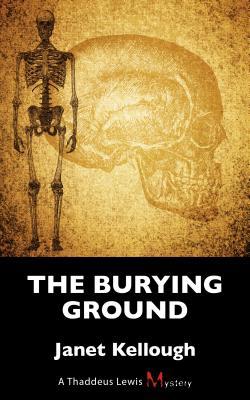
The Burying Ground, by Janet Kellough ****

theburyinggroundThis is the fourth book in Kellough’s Thaddeus Lewis series, but it was brand new to me, and I was able to follow the story quite well as a stand-alone. My thanks go to Net Galley and Dundurn Group for the DRC. This book comes out in early August, and I will run my review a second time on my blog then to remind readers that it’s available.

Kellough has merged two enjoyable genres, mystery or detective fiction and historical fiction, and added a splash of social justice–the sort that slides into the story neatly and without preaching. Lots of different story threads eventually braid together elegantly into an ending that satisfies deeply.

The settings are Montreal close to the time of the Industrial Revolution, and outside of Montreal in a village called Yorke. Our protagonists are Thaddeus Lewis, a Methodist Episcopal preacher who travels the circuit, and his son Luke, a physician who serves as the junior partner to a taciturn elderly doctor named Christie. At times Luke has his hands full; there’s a typhus outbreak, but it seems to be a mystery in itself why some entire households are spared while others are consumed and nearly none left standing. But no worries; that is not our only mystery, nor our chief one.

The primary mystery is that of the grave robbers. The sexton for the local cemetery, The Burying Ground, Morgan Spicer, has interrupted robbers who dig up the interred, but leave the body. Yet there are also some caskets that have two bodies in them. What’s up with that? An invigorating combination of red herrings mixed with interesting historical minutiae spice up the tale as it unfolds.

What’s up with the overly eager woman who resorts to a form of blackmail to lure eligible bachelors into her parlor? Why isn’t the local law protecting local Black folk from marauding American slave catchers looking to put them on the auction block back in the States?

Kellough tosses it up all up and keeps us on our toes. And now that I have enjoyed her work, I will look for opportunities to read the other three novels in her series.

Watch for this title, on sale this summer.

Long Way Down, by Michael Sears ***-****

longwaydownMichael Sears’ Wall Street spy thriller is an interesting and enjoyable read; 3.5 stars. Thank you to Putnam Adult Books, Above the Treeline, and Edelweiss books for the ARC. This book will become available in early February.

Jason has gone to prison for insider trading, and now he’s out. In reading this first person narrative, I learned a few basics about the capitalist market system, including the definition of an insider trade. In years gone by, I always told my students that there was never going to be a time when they felt they had accidentally gained too many (legal) skills or learned too much, and so I took that advice, Marxist though I am, and looked on with interest.

That said, the protagonist was only mildly sympathetic to me. The development of the character via his child, a first grader with autism (specifically Asperger’s Syndrome) made him more real and more likable. The writer injected just enough of this aspect of his character’s life to help shape his character, without permitting it to become a diversion. I was also very grateful that he didn’t take the cheap-way-out many mystery and thriller writers take, in having a bad guy kidnap, scare, or hurt the child. When the time came that it could be a threat, our affluent business consultant took his son and the nanny and flew them to the tropics, out of harm’s way.

And yet this is where an obstacle presented itself. Because he went to jail with a tidy sum salted away in an off-shore bank, our protagonist has far more money than many of us will ever see, even over the course of our lifespans. I was distracted by the number of coats he destroyed and then threw away, gave away, or just left lying somewhere. Cars, wardrobes…one can understand how anyone would do such a thing if his life was on the line; there’s surely no coat I’d die for. But it came to a head for me when the narration whined about the flight to Washington D.C. being too long, even for those in first class. I weep for you, I wanted to respond. Try flying from the West Coast to DC on the red-eye flight. Fly coach. Stand in the sun for six hours waiting for your part of the human chain to start marching and chanting; then repeat the red-eye flight home, and then go to work. Don’t snivvle over the hardship faced by first class passengers. And for heaven’s sake, don’t tell me about how the first class passengers look down their noses at business class.

It was telling that on his many airline flights, our fancy man never even mentioned flying coach as an option.

The story line follows our protagonist as he seeks to defend the man he’s working for when the latter is suspected of murder. All sorts of chase scenes, internet hacking, ducking into doorways, hiding, chasing, and fighting abound. And I have to say it kept my attention. The writer’s environmental concern is well integrated into the character’s narrative most of the time, but there is a scene at the end where it feels as if a public service announcement has been interjected. You’ll know it when you hit it.

Would I read more of Sears’s work? I most likely would, if I could find it at the library or used bookstore. I think he falls into the category of second-tier writers on my wish list: I would prefer to read his work to that of an unknown writer’s, but I also wouldn’t pay full jacket price for his work, or put it on my Mother’s Day wish list.

For those who enjoy a fictional romp among those with money and privilege, though, this will be a surefire hit.

Flesh and Blood: A Scarpetta Novel, by Patricia Cornwell *****

fleshandbloodOnce I finally polished off Napoleon, I permitted myself to dive into the treasure trove of lovely brand new books that Santa brought. This little gem was right at the top of my “wanna” list. At this point, while she may be picking up some new readers, Cornwell is largely banking on her substantial fan base. Once more I found myself reflecting on what makes her novels so successful.

Because as she pointed out during an interview awhile back, this is completely unrealistic. Sure, she has carefully followed the procedures and science that govern what a forensic coroner does on the job; yet if she were entirely realistic, it would make for dull reading. A forensic coroner does not visit crime scenes, chase bad guys, partner with cops. She is no more likely than anyone else to be stalked, harassed, or threatened, nor would her family members be. (Although if it helps us here, we can accept that all of these things could happen to just about anybody.) Surely, she would not repeatedly engage in shoot-outs, pack a firearm, or be kidnapped repeatedly.

So what is it that keeps the reader coming back?

For me, it’s all about character development. Not only Kay, but also Marino, Lucy, and to a lesser degree Benton (whom she fleshes out a bit more here) seem almost as real to me as seldom-seen relatives about whom I hear stories second or third-hand. And the fact is, by the time we find ourselves reading #22 in a series, we have bought the premise, and she would have to mess it up pretty badly to shake us loose. Needless to say, that did not happen here!

In turns I read for hours on end, ignoring my family (and my blog); then I would realize how much of the book I had read, and I would parcel it out to myself in chunks to make it last longer. Finally I just had to know how it ended.

We start with six shiny pennies on the stone wall that surrounds Kay and Benton’s Boston home. They are about to leave for a vacation, but of course that won’t happen now. Because there’s something about those pennies. For one thing, though all are dated 1981–the year Lucy was born, and this hooked me even more, since my eldest son was also born that year–they have all been polished in a tumbler of some sort. They’re all lined up exactly evenly on the fence. And wouldn’t you know it, a serial killer appears to be loose, and he is using an unusual sort of copper bullets to do his dirty work.

I won’t ruin the rest for you.

Should you pay full jacket price for this book? I guess that depends on how much money you have, and whether you have read the rest in the series. I can tell you that popular series like this one often create a year-long back-up in the Seattle Library system.

If you haven’t read anything else by Cornwell, then go to the library or used bookstore, if this sounds like something you would like, and start with #1. That’s a cheap, easy way to get your feet wet.

But if you have read the other 21 with the same avid ferocity I have, you should probably just get a copy now. If the nearly thirty bucks it will run you is too rich for your budget right now, wait a bit; the hard cover price will drop dramatically when it goes to paperback, and we know it will.

Great escapist fun!

Just One Evil Act, by Elizabeth George *****

justoneevilact Barbara Havers has gone in over her head, and the morass into which she has slogged out of love and friendship is only getting deeper.

I’m a long time fan of Elizabeth George, a writer I would never have tried on my own initiative, preferring stories that star working class heroes, but one of her early works was given to me at Christmas one year, and I was sucked in by her combination of palpable settings rendered in a painterly fashion, and what at times is intense, tightly plotted crime fiction.

Every writer who maintains a successful mystery/crime/detective series of any length faces a conundrum, sooner or later. For the sake of a good story, they’ve already been forced to twist the real lives of their police officers (or their whoever) to make them more exciting, but in the beginning, it’s easier for the reader, who also wants a good yarn, to buy the premise. Sure, someone might become a hostage, or be forced to dig their own grave while the minutes tick by and we wait for the cavalry to charge in and save the protagonist. Certainly, a person could be pistol-whipped and stuffed into the trunk of a car.

But to no one will these things happen over, and over, and over. Eventually even the most faithful reading audience will roll their eyes and say, “What, again? Oh, I don’t think so.”

There appear to be two successful ways around this, and the author can utilize one or both and if they are skillful, they can keep their series going strong. Noteworthy writers like Sue Grafton, James Lee Burke, Sara Paretsky, Ed McBain, GM Ford, and a host of others have carried them off well.

One way to keep the string going is to create stories that are not only thrillers or mysteries, but are more novel-like in many ways. The protagonist’s personal life is further developed, and if this is done successfully, it gives us still more buy-in to the mystery plot into which it is woven. And here, George has been more successful at some times than others. There is always the danger that in presenting us with the protagonist’s deepest emotions, the story can turn into a soap opera. Mystery readers don’t need the corn. They’ll pass on the series if the writer crosses a line or is not credible. But referring back to most of the writers in the list above–and if you love a good mystery series, you can probably name others–it’s clear that it can be done.

The other way to keep the string active without burning out the protagonist is to further develop secondary characters and turn them into protagonists themselves. I have been greatly cheered to see George develop both Winston Nkata and Barbara Havers in this manner; this particular book has original protagonist Thomas Lynley working in the shadows, and his life pops up from time to time as well in ways I found appealing, but the chief protagonist of this work is Barbara Havers.

And Havers is beyond question a working class protagonist. She came from no money whatsoever, and her only living family is her mother, who is in a care home and partially dependent upon Barbara, whom she does not even recognize any longer. It’s one lonely life. What do such people do? They may become self-absorbed or clinically depressed, or both. Or they may get by with a little help from their friends.

And this is the crux of this particular episode, #18 in the Lynley series. (No ARC here; I got my copy from the library, but would otherwise have requested it at Christmas.) Havers has long had a friendly relationship with Lynley, her former partner. He’s a lovely bloke, but he doesn’t come from the same side of the tracks as she does, and there are definite limits to their friendship. His love life, and hers if she had one, are not up for discussion.

Her closest friend is her neighbor, Taymullah Azhar, and his daughter, Hadiyyah, a precocious nine-year-old who has become nearly a surrogate daughter to Havers. The two of them are often the bright spot at the end of a long, often thankless day at work.

When Hadiyyah is kidnapped, Havers is beside herself. She has to help. When her boss tells her that she is to stay away from this investigation, from which she has absolutely no professional distance, she looks for ways around the order. She can investigate when she is off-duty, right? Except she uses her police credentials to open doors. Well, she probably would not be the first.

But again, and again, and again she pushes the margin of what she may do and keep her job. The result is a tightly packed psychological thriller that at times kept me awake. Was that really 700 pages? It surely didn’t seem that long!

Because it is so easy to relate to Havers, the reader is likely to feel that frustration, the one we felt when we went to the horror movie at the local theater. You know the scenario I mean: the two youngsters are out on a date and they’re caught in the rain. There is no shelter anywhere in sight except for a house that appears to be empty. The rain pours down, and the background music takes on minor strains. We say to the teenagers, “Don’t go in the old dark house! Don’t do it! Better wet than dead. Don’t turn that doorknob!”

And here we are. Havers does, metaphorically of course, go into that house, the one with no lights and things that go bump in the dark. And all sorts of interesting ethical issues bump up against her.

When is lying to your boss justified? Well, that’s not so hard…but what about lying to a friend? What if, in lying to one friend, one may save the life of another…but the life of the friend to whom you have lied may be damaged? When should journalists be called in, even if they cannot be trusted not to assassinate the character of an innocent individual while carrying out your important mission? What if there does not appear to be any other way to save a life? To stop a killer?

I was surprised to read some fairly vicious reviews of this novel. I loved it, for the outstanding manner in which setting was incorporated so palpably without slowing the course of the plot; for the development of characters (and Isabelle Ardery, boss back at Scotland Yard, is another). And I enjoyed the ambiguity of the questions it raised.

Immensely satisfying, and highly recommended.

Betrayal of Trust, by J.A. Jance *****

betrayaloftrust Jance’s JP Beaumont detective series is one of my all-time favorites. Set (usually) in my own home town, it carries a gritty yet human, thoroughly believable flavor that I just can’t find anywhere else.

In this case, Beaumont is roped into a scandal unfolding at the governor’s mansion; it turns out he knows the governor. She was the girl who was too important to talk to him in high school, but now she wants his skill in discreetly looking into some things she’d rather not see on the front page.

It doesn’t work out that way.

This title has been re-released, and so I accidentally read this twice, but even once I had realized my error, I decided to plow through and finish it a second time. It wasn’t that I had no other books; but this series is on my very short list of things I don’t mind seeing a second time around.

Highly recommended to anyone who enjoys good detective fiction.

The Boyfriend, by Thomas Perry ****

TheboyfriendThree and a half stars, rounded up.

I’ve been a fan of Thomas Perry’s for decades. In the past, he has written such adrenaline-coursing thrillers that I’ve actually had to put his novel down in order to calm down and breathe normally for a moment. And while The Boyfriend is an interesting story, it doesn’t measure up to the body of work I associate with this writer.

Here is the premise: we have two protagonists, a good guy and a bad guy. Our bad guy is a hit man and a serial killer. At first I really liked the author’s work here. It’s a twist I hadn’t seen before. The bad guy is hired by clients from Latin America who he hypothesizes are perhaps having him take out individuals who are also from Latin America, but who fly north to assist Washington D.C. in its attempt to take those cartels apart. He doesn’t really know, though. He was recruited by an American who also worked for them, and who became his partner. The partner was killed by one of the targets, and now our hit man, who takes a variety of names throughout the book, is a one-man killing squad. He makes a lot of money, but needs to stay below the radar and be impossible to track. The women he kills are escorts that he persuades to trust him. He behaves like the opposite of a typical john, nonthreatening, considerate, and gets them to invite him to live with them. Voila, free lodgings where the Feds won’t be looking for him. And each time he leaves, he kills his hostess in order to avoid leaving a witness behind, even though they have no idea he is a killer. The dead men he has assassinated cause a lot more flash and ruckus, so the death of a high-priced hooker doesn’t get much air time on the news or much attention from police.

I had a little trouble buying this scenario, but the author also draws out a story from the killer’s youth that shows that in shopping for an escort wherever he is staying, the man subconsciously looks for the same woman over and over again. They look alike. Again and again, he finds and kills this woman. Taken from that sort of perspective, I could buy the premise. But this part of the premise falls apart halfway through the novel with a one-sentence explanation that left me scratching my head. What the hell?

Our second protagonist, of course, is the guy who is tracking the killer. He Needs to Find Him Before He Can Kill Again. Jack Till is our good guy. Till is a private detective working for the parents of one of the escorts. They loved their daughter; they have money; they want their daughter’s killer found and brought to justice.

Till uses the internet to track where he believes the killer will go next. The clues he uses at first are believable, and the story line, if not gripping, is interesting. But I had real problems buying into the amount of wealth he was able to expend in order to not only travel all over hell and back, but in buying breathtakingly expensive gadgets to assist him:

“He drove into Boston and bought several items: a night vision scope, a sixty-power spotting scope, and a plug-in microphone that he could listen to by telephone.”

We don’t have a sense that Catherine Hamilton’s parents are members of that bottomless, one-percent, ruling rich. They give him 100k and tell him to let them know when he needs more, but for all we know, they could be looting their retirement accounts or double-mortgaging their home. It’s believable that grieving parents would do these things. But multiple plane tickets, hotels, and expenses like the ones in the quote above (not his only stop, not his only purchases) gave me pause.

In addition, I wondered at the blithe assumption that a store, even in a major metropolis such as Boston, would have these items sitting under glass ready to be sold. Wouldn’t some of these items have to be special-ordered? That’s expensive, very specialized stock. But I will admit I don’t know a lot about firearms or spying devices; it just felt like a stretch to me.

If you are concerned about spoilers, by the way, I have confined myself to the first twenty percent of the story. Most of it is not in this review.

But I am thinking back now to the series that hooked me and a lot of other readers, when Perry was a relatively new writer. This man wrote the Jane Whitefield novels, stories about a modern-day Seneca Indian woman who uses the skills of her culture to cover the trail of endangered individuals. The series was absolutely riveting, but the nature of her work also kept it from being a more or less permanent series. Each time she did her good deed, she was that much closer to being discovered and murdered. Perry had to close that series off and write some other things, and he came up with a number of other really strong novels, some of them on par with that beloved series. And because of his sterling track record as one of the best thriller writers out there, I came to this novel with higher-than-usual expectations.

The Boyfriend holds together really well in places, and is a little clunky in others. I was lucky enough to read a free copy, not as an ARC, but as a library book brought home for me by a thoughtful family member. As such, I enjoyed it, even though I was a trifle disappointed. But at the same time, I was glad I had been able to knock it off my Christmas wish list, because there are many things I would rather unwrap than this book.

My advice to you, reader, is similar. If you find this book lying on a table of 99 cent paperbacks, or if you can read it free from the library or borrow it from someone, give it a try. See what you think. If you are new to Perry’s work, you can read it free of the high expectations I brought with me when I read it.

But don’t toss the full jacket price on the counter unless you have a budget as generous as Jack Till’s.

Gone Girl, by Gillian Flynn ****

gonegirlGone Girl is famous and has had numerous awards heaped on it, made its way to the top of best seller lists, and been lauded by reviewers far more widely read than I am. Rightly so. It’s one hell of a story, and just when I thought perhaps I saw what was happening, I would find that I had merely played into the writer’s clever trap, and that the roller coaster was about to go around a bend or through a tunnel entirely unexpectedly.

Since so many others have reviewed it before me, and since I did not read the book as an ARC, I’m going to approach it in a slightly different way than usual. I want to look at how this story reflects today’s society, because that part of it jumped out at me, grabbed me by the hair and told me that these are tense times, and they aren’t improving any, not right now. And how we deal with certain issues in fiction is perhaps not as well partitioned off from real life as we might prefer to believe.

The assumptions inherent in my definition of “society” are that we are looking at the English-speaking world, and my own experience is limited to North American English-speaking society. I can’t really speak for what lies elsewhere, since the media often distorts the real picture, and I haven’t gone anywhere.

Two things jumped out at me, and one of them is something that is popping up in literature all over the place now. It’s like playing whack-a-mole: there it is! Whoa, there’s another example! And another! And another! Here’s what I see in this book, and all over the place: the police can’t help you. Or they won’t. In many situations they are equal parts disinterested in exacting real justice, and perfectly happy to do what seems easiest and most likely to complete their task with the least exertion and unhappy attention from their superiors. And not only are you not going to get help from the cops, but that means it’s okay to just go take care of it, using whatever means you deem necessary. That’s point number one of two.

So when Amy gets gone from home in a small Missouri town, the local cops do a serviceable job and look at all the possibilities. They aren’t crooked or brutal as often happens in large cities, but they also lack imagination. Our male protagonist does not really trust them very long.

I don’t mean to belabor the point, but it does bear examining, this trend in contemporary fiction. During the 1950’s, 60’s, even the 1970’s, the police, when depicted in fiction and in film, were 99 percent of the time really decent and extremely clever. They put in extra hours of their own time, went sleepless, and let their personal lives deteriorate because Catching the Real Killer consumed them. But they succeeded, in the end, and the reader (or the viewer) fully expected that to happen. They did it all within the letter of the law, because that was what good guys did. It was fiction, of course, but we believed it.

These days I read story after story, from funny capers like the Stephanie Plum series, to any number of gritty urban tales (you can probably think of half a dozen without trying too hard, if you read a lot of crime thrillers and mysteries) in which someone else has to step in and take care of the job because the cops are not up to the task. These cops aren’t always bad guys; sometimes they are underfunded, understaffed, or just plain dumb as a box of rocks. But it is the vigilante (the word is seldom used; it’s not a nice word, but it’s accurate) who will ultimately solve the crime. Sometimes there are variations, like some of James Lee Burke’s more recent work, in which a rogue cop of sorts gets sick of the rule book and goes off on “vacation” time in order to do the things that cannot be done on the clock.

The oldest story in the book is the I-have-to-solve-the-crime-cause-I’ve-been-framed plot line, although a writer who is fresh and original can still sing that same old song and make it seem brand new, not unlike the-killer-has-got-my-loved-one as a vigilante motivator.

Here’s the part that I hate and try not to think about too often, but because I see it recurring so much right now, I feel as if I have to mention it: in well-written novels such as this one, I just love it when someone who is not a cop takes matters into his or her own hands and metes out justice. That’s not sarcasm. A good writer can sell it to me and make me enjoy it, and I will look for more of that writer’s work. Because I can tell myself it’s just fiction.

In real life, when some frustrated unemployed neighbor takes to stalking the local teens to try to catch them doing something illegal; when Stand Your Ground laws enable some insecure, bumbling ass to follow young Black men around till he’s had the satisfaction of shooting one dead, once he has sufficiently goaded the man into taking a swing at him; it’s absolutely nightmarish.

One could argue that this is what fiction is for; it gives us the chance to see wrong things done right, if only subliminally. But it disturbs me that it has become so popular, and even more so that it has become thrilling to me personally. It can’t be a good sign.

I should end this here because it’s plenty to think about, but I need to talk about the equally disturbing issue number two . In Gone Girl, there are some really amazing, excellent feminist mini-manifestoes squeezed in between the many damning things that our bad-girl protagonist says and does. Again, I find myself bothered that we can’t see a strong, wonderful woman who notes that “I like strong women” is usually said by a man who hates strong women; that expecting one’s husband to tell her why he was out all night is deemed ‘shrill fishwife’ behavior that will destroy a marriage (because goodness knows, the marriage can’t fail over a guy who can’t find his phone or his front door at night.)

In this harrowing so-called era of post-feminism, when the states are shooting down women’s right to control their own bodies with abortion laws that are so restrictive as to be either very expensive or impossible, and ‘personhood’ amendments (which I was happy to see fail) that order the woman to honor a garbanzo-bean shaped spot of tissue and blood more than she values herself, her family, and her future, why oh why must the character who issues some genuinely truthful and brilliant statements regarding the worth of a woman also be a conniving, manipulative, narcissistic monster? With domestic violence not in abeyance and the word “bitch-slap” being considered only slightly edgy when included in a joke, why can we not have real heroes who are strong women—not slinky, young femme fatales who use their bodies as bait, but women who use their brains and social skills to get at the truth?

If I sound like it haunts me, it’s because it does.

If you want to know the standard book review information about story arc, character development, and setting, go and read what the New York Times had to say, or better still, go look at the string of awards garnered by this novel. It’s very strong writing, and of course it is not (as far as I can see) intended to make a political point.

On the other hand, people that live in war-torn nations will tell you everything is political. At dinner time, who eats and who doesn’t, that is political. Who lies, and who tells the truth; who can see a doctor and who can’t; these are every day issues that are also massively political.

As for me, I frowned and flagged the pages when I saw these hot buttons pop up, but I kept turning the pages, because I wanted to see how the story would end. And it’s a great book, sure to keep you up way past your bedtime if you aren’t careful.

But there is no ducking the fact that it is also a product of the time in which we live. Let us come up for air from time to time, and view things as they are, lest we get sucked into the oily abyss of socially sick ideas without even realizing we’ve been had.

Top-Secret Twenty-One, by Janet Evanovich *****

topsecrettwentyone“Hold on here,” Lula said. “Are we talking a rocket like ZOOM BANG! and everything’s blown all to hell?”

“It was more like BANG WHOOSH!” Briggs said…”And at great personal risk to myself I rescued the hamster.”


“No shit?” Lula said. “Is that true?”


Oh, great literature is good for the mind, but once in awhile we just need a little mind candy to perk up our day, and at that, Evanovich’s Stephanie Plum series excels. We’ve got the usual cast of crazies as well as a war of vengeance between Grandma Mazur and Joe Morelli’s Grandma Bella. We have attack chihuahuas, plenty of explosives, and a trip to Atlantic City. What more can we ask for?

For those reading in digital format, be aware that a teaser for one of Evanovich’s other series books takes up the last 11% of the book. I was crushed when it ended at 89%, because I had expected it to keep going.

Now I will have to read something else until #22 comes along!

All That Glitters, by Michael Murphy*****

allthatglittersThis was a quick read, and a fun one. Don’t be left out in the dark when it hits the shelves in January!

Jake Donovan and Laura Wilson have left the Big Apple in their dust and gone to Hollywood, where Laura is about to enter a new phase of her career with a lead role in one of the new talking pictures. All That Glitters, the new episode of Michael Murphy’s Jake and Laura series, a cozy mystery  if ever there was one, is full of Depression-era flavor, complete with celebrities from the time and place in which is it set. The writing is tight and sassy. Murphy has penned a winner! My thanks go to Net Galley and Alibi Publishers for the ARC.

Jake has promised Laura that his risky gumshoe days are over; he is a novelist now, a new leaf turned over for the woman he loves. Who would dream that Blackie Doyle, the protagonist of his series, would have to solve a real-life murder to clear author Donovan of a murder charge that has been tethered to him by scant evidence and lazy cops? Louella Parsons, a real-life celebrity journalist whom Murphy has borrowed to add spice to his already spunky story, wants to see him behind bars; just think what a scoop it represents!

The story is enhanced by one detective who carries a torch for Jake, and another who creates all manner of ridiculous situations with his obvious, bumbling surveillance. Murphy peppers the narrative and dialogue with generous applications of Depression-era slang that sounded to this reviewer as if it had fallen from the lips of her late parents. In other words: it’s a doozy!

Cold weather has come, and now is the perfect time to curl up in your favorite warm hidey-hole with this extremely entertaining mystery. You never know; you may become addicted to the series.

Stranger things have happened!

Taking the Fifth, by J.A. Jance *****

takingthefifthJ.A. Jance has three series running. This one, with protagonist J.P. Beaumont as the detective who works the damp shadows of Seattle, is the best. All of the books in this series are really good, but this particular novel signals a sea change that will affect how the rest of the series plays out. It is also one of the most memorable (of 600+) mystery, detective, or thriller novels I have ever read.

Taking the Fifth has a strong flavor of noir, and J.P. Beaumont is one of the last of the really good guys. Jance weaves the reader through a brutal story involving the drug trade. You may put down this book once or twice just to wash your hands and rinse out your mouth. And yet, like the junkies in Seattle’s back alleys, you’ll be back for more. The author hits the ground running, and the ending is entirely believable, yet not obvious or expected.

If you haven’t read up to #4 in this series yet, you are running behind. If you are quick about it, you can get through the first three in time to read this one before October runs out. Get busy!