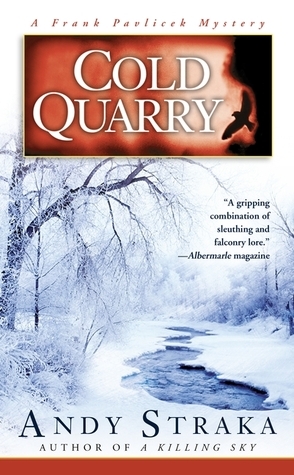
Cold Quarry, by Andy Straka**

coldquarry

This is 1.5 stars rounded up. No, no, and no.

I received this DRC free from Brash Books in exchange for an honest review.

I was attracted to this mystery, which is set in West Virginia, because it has the novel element of hunters that use falcons, in addition to white Supremacist bad guys known as the Stonewall Ranger Brigade. And it started out as a promising read, with detective Frank Pavlicek and his former Navy Seal partner, Jake Toronto, looking to find out who shot Chester Carew in the back, leaving him dead on his own land. The birds of prey stand as metaphors for Pavlicek and Toronto, who will now hunt the killers as “cold quarry” in order to exact justice.

Who was to expect, then, that the entire novel would be riddled with blantant sexism, with only one positive depiction of a female? It is this one redemptive moment that saved this mystery from a one star rating, a rating I save for the illiterate and the blatantly offensive.

Before I explain further about the stereotyping of women in this work, I should also mention that the N word is used twice–once by a bad guy, once by a more complex figure–and our hero is known to have shot and killed a young African-American man when he was a cop. We are told this was a righteous shooting that gives our hero terrible nightmares nevertheless.

What timing.

But back to the women. Because I wanted to enjoy this book–who picks up a murder mystery without wanting some escapist enjoyment?–I withheld judgment until the 75 percent mark, and even then I read the whole thing to see whether there would be some sly move in which the sexist behaviors of the main characters were called out, or in which the protagonist found himself reflecting that he’d misjudged some women and situations. But the entire narrative was loaded with it, not just the main character’s dialogue and behaviors, so I didn’t think it was likely, and in the end, there was only one good moment for a female character, and the rest were endless cliches.

We have Betty in her apron (“It’s all right, I’ll just be in the kitchen”); nutcase bar owner Roswell Parker; seductive reporter Kara Grayson, who goes to pieces during a violent scene in which she is not injured.

“You stay here with the woman…” Frank tells Jake.Kara tends to an injured animal, and when the dust has settled the two menfolk rush out to save the world while “A female sergeant had also arrived and seen to it that Kara Grayson and the German Shepherd were taken care of.”

We often hear of women that occupy professional positions; we just never see them do their jobs, or if they do, they mess it up. Federal agent Colleen Briggs is one such character, and everyone feels great when she is openly dissed by the deputy sheriff, since she is “a robotic clone of a federal agent”.

Pavlicek has a grown daughter who’s out of state doing some work for him online, but when he gets her on the phone she “pouts”, and he tells her, “You let me worry about that, honey.”

Chester Carew’s son Jason is just old enough to read The Cat in the Hat, but he is old enough to protect his mother, who is helpless, apparently.(Remember Betty? In the kitchen?) Pavlicek gets her permission to speak to her son alone, but he doesn’t tell her what the kid knows or what the kid has seen. And the kid doesn’t want her to know.

We meet Jake Toronto’s girlfriend, who is an attorney, but when we run into her at home, she is cradling a baby. Frank’s daughter Nicole, who has arrived in town, takes time for “the appropriate oohing and ahhing over the baby”, and then follows her father and Priscilla into…where else? The kitchen. At this point–and I don’t want to give a spoiler, so I’ll use broad strokes–Frank needs to take care of something for Jake that Jake isn’t available to do, and this includes getting confidential material out of the house. Priscilla is concerned because Jake keeps that door locked; of course she wouldn’t have a key, right? But Frank does. When his daughter asks what is in there, he says, “It’s just Jake’s little office.”

Priscilla does help, though, by getting “‘Just, um, some personal stuff I already knew about in the bedroom’…she looked at Nicole and the two of them giggled.”

Oh, but it isn’t over yet. Not by a far sight. “Priscilla’s hands were dwarfed” by Jake’s shotgun, so of course, Frank took it from her.

It occurs to me during all this that since Priscilla is–we are told–an attorney, perhaps Frank is protecting her professional credibility by having her not know some things, or else maybe Jake was, but the word “attorney” is mentioned just once and never comes into play again.

We have a number of promiscuous women, all of whom are morally compromised. We have lazy nurses. And in a confrontation with bad guys, the uglies hurl the ultimate insult and Frank and Jake by calling them “little girls”.

Excuse me now. I am going back to my DRC of Gloria Steinem’s memoir. I need something to read that will remind me that women are worthy of dignity and respect.

If your ideas about gender are lodged in the 1950’s, by all means, get this book, and have a real good time.

As for me: no more Andy Straka!

The Miser’s Dream, by John Gaspard*****

themisersdreamThe Miser’s Dream is the third in a series featuring magician Eli Marks. Once I got into it, I did a forehead slap because I could also have read the first two in the series free and reviewed them, had I been paying attention. Thank you to Net Galley and Henery Press for hooking me up with this enormously entertaining novel. It’s billed as a cozy mystery, but were the humor placed around the killer rather than the sleuth, it could have been a comic caper. The title will be for sale October 27.

Marks runs a magic shop and works as a magician locally. He lives over the shop, and the quirky placement of its windows permits him to see into the projection booth of the adjoining theater. Imagine his surprise one fine day when he looks out his window to see a corpse—the projectionist—on the floor of the projection room. It is a locked room mystery, since the man could not have killed himself; the weapon is there in the room; and the door is locked from outside, showing no sign of forced entry.

Just like magic.

Gaspard occupies common country with Grand Master James Lee Burke in his cleverness at choosing engaging, oddball names for his characters. In addition to Detective Sutton-Hutton, we also have the sinister Mr. Lime and his assistant Harpo. The latter two seem to have some inside information. Whereas the character descriptions for these two were a trifle overdrawn, putting me in mind of a Tim Burton animation, the dialogue was sometimes quite splendid, and their role in the story is interesting and well played.

For the first half of the book, I didn’t care at all who the killer was. I was having such a good time with the double features, which I highlighted in my DRC and added to at length, but you’ll have to get the book because I’m not going to post a spoiler. There were other odd bits of hilarious detail in unexpected places, perhaps the best, in my view, being the scene with the flower pot. I had begun to wonder whether there was so much extraneous hilarity here that the murder was becoming obscured, but then it all came into focus just when it needed to, and I didn’t have to retrace the thread to figure things out. The plot is mostly linear and Gaspard has used just the right number of characters, not enough to confuse or clutter.

If you need a good laugh, get this book when it comes out. If you like a good cozy mystery, I likewise recommend it. And for those that have precocious pre-teens and adolescents that sometimes read adult-reading-level material, this one has no explicit sex and relatively clean language, and so it is safe to pass on to your budding bibliophile.

To sum up: this is hands-down the funniest thing I have read in a long time, expertly paced and hilariously detailed. Do it.

Blanche Passes Go: A Blanche White Mystery, by Barbara Neely*****

blanchepassesgo“Blanche’s mind rang with remembered slights and taunts, and echoes of that awful, heartbreaking instant of fear that was a part of every trip into the white world—a fear of being refused or given poor service because she was black, stopped by a cop because she was black.”

I finished reading Blanche Passes Go on the second anniversary of the death of Michael Brown, who was shot dead by a cop for jaywalking. Bernie Sanders, the candidate who fancies himself the liberal savior for all progressive-minded Americans, spoke here in Seattle that day. The purpose of his talk, apart from campaigning and fundraising, was to celebrate the birthday of Social Security. The speech was disrupted by a pair of African-American women who took exception to his myopia.

So I guess you could say that everyone, even those that don’t generally enjoy mysteries, ought to be reading this book right about now. In particular, if the reader is still trying to figure out why so many people, particularly people of color, get upset with the clueless slogan “All lives matter”, this book is here, just for you. Neely approaches issues of race, class, and gender in a way that is clear but not unkind. It’s her best work to date, and could not have been published by Brash Books at a more appropriate time. My great thanks go to them and the people at Net Galley for providing me with a DRC, and to Neely for laying it all out so that anybody who has a willing heart can get the picture.

In this fourth Blanche White mystery, Blanche has gone home to Farleigh, North Carolina for a vacation, and to try partnering a catering business with her best friend, Ardell. But Farleigh is a small place, and she can’t avoid running up against David Palmer, a Caucasian man that raped her. She never reported it, of course; were they really going to haul the well-heeled, powerful white man for a sperm sample, given the long history of Caucasian men raping Black women with impunity? Not likely! So when her long-simmering rage is ignited by the sight of him, she vows to not only get mad, but to get even as well.

Blanche White novels always have multiple threads that weave in and out of the plot line, but this is the most complex and impressive yet. Not only does Blanche have to grapple with Farleigh and Palmer, she is back in her home town, and her mama is still here. Like many women, Blanche has hit middle age and menopause with a renewed, powerful yearning to know more about her mama, who never stops talking but never gives away the personal information Blanche is almost begging for, and about her father, about whom virtually nothing has been told her. Blanche decides that once a person has children, their privacy is no longer as sacred as it was before, and a lot of personal information becomes family property. I loved that.

Well into the book, Ardell accuses Blanche of sounding exactly like her mother, and Blanche is dumbfounded to realize it’s true. I threw back my head and laughed out loud. It’s the rare woman that doesn’t hear her own mother coming out of her mouth sooner or later, and the moment was built so deftly and executed so well that it landed hard on my funny-bone.

Other Blanche novels have accentuated the protagonist’s tightly held independence. Here, she meets a fine man named Thelvin on the Amtrak coming into Farleigh, and at some point, she has to decide just how flexible (or inflexible) she is going to be.

Another component is Mumsfield, an acquaintance that has Down’s Syndrome and is about to be married to someone who may be after his money. This aspect of the story, like the others, is skillfully crafted. Mumsfield is not completely helpless, and the fact that he has Down’s does not make him Blanche’s friend, as he claims to be. There is still that division of white privilege. It’s not that Blanche could not have a white friend, but it would have to be someone with ownership of what that means.

Because all of these components are told in the third person omniscient, and because the writer is a complete badass, we are privy to all the intricacies involved here. Add a problem with domestic abuse next door to the Miz Alice where Blanche is staying, and you have an interesting stew indeedy.

Highly recommended.

Gold Coast Blues: A Jules Landau Mystery, by Marc Krulewitch****

goldcoastblues“Tanya Maggio’s a missing person, and I got a feeling she’s missing on purpose.” This third entry of the Jules Landau series finds Landau searching for Eddie’s missing girlfriend. There’s a faded noir feeling in its pages as Landau bounces between Chicago and New Jersey trying to trace back the thread. Though confusing at times, a trifle overburdened by excess characters, it’s a fun, original story. Thank you once and thank you twice to Net Galley and Random House Alibi for the DRC. This title is available for purchase September 22.

The search for Tanya leads Landau to the mean streets of Irvington, New Jersey, where a crooked cop named Cooper explains that in their town, they don’t try stamp out crime…they manage it. So anyone that is hooked up to the criminal world is fair game; the idea, at least ostensibly, is that bystanders should not be caught in the crossfire.

Right.

Turns out the New Jersey people are running a scam. Those among the one percent that have more time and money than good sense invest in fine wine, wine that is worth hundreds of thousands of dollars for a case of a dozen bottles. Hey, its value appreciates, and some liken it to gold or silver. If a bottle gets busted, then that’s what insurance is for.

With a bizarre scenario such as this one, it’s only to be expected that someone would come up with the idea of counterfeiting labels and brewing up some fake stuff. After all, no one is going to drink it anyway, right? Who’s to know?

The plot twists, and it turns sometimes enough to confuse me. Hold up…are we in Illinois, or are we still in Jersey? But when push comes to shove, this romp is too enjoyable to walk away from. “That little shit Spike”, an heir to the Irvington mob, is one character that shines bright enough to keep those pages turning. Another, of course, is Landau’s ridiculous cat Punim, for whom he sits down to compose a legal trust fund when he is depressed and in danger. His own life may be on the line, but by god someone has to be paid to feed Punim his chicken hearts every day. And then there is Amy. Is she an enemy? A spy? She sure as hell isn’t really a psychic, but she knows enough that she has to be something. Maybe she has Tanya tied up in her closet. You never can tell.

The originality of the plot is assisted by Krulewitch’s affinity for figurative language. I loved his description of the “horror hotel” and the “stunningly verdant” house located on…wait for it…Bunnybrush Lane.

September is a good time to curl up under the quilts with a good book, or for those in warmer climes, it’s not too late to stretch out on the beach with one. Either way, if you need an escapist beach read, or a good noir mystery, this might be the book for you.

All In, by Joel Goldman and Lisa Klink *****

all inThis one is 4.75 stars, rounded up. Thank you to Net Galley and to Thomas and Mercer for the DRC. This absorbing thriller will be available September 8 for purchase.

Cassie Ireland is an asset recovery specialist; she views herself as a modern-day Robin Hood whose job it is to steal back money, goods, or even really embarrassing videos from those that originally stole them. Her employer is a shadowy individual code-named Prometheus–a moniker chosen because Prometheus was the sneak thief of the gods. Ireland’s nimble, silent in her work, and careful in trusting others. She really can’t be played.

Her job here is to steal select items from the home safe of crooked-wealthy magnate Alan Kendrick. In order to gain access to his treasure trove, she must first make it past a sophisticated security system, to which she gains access by deceiving Kendrick’s wife, Gina. Once Cassie found her way into that safe, I stopped breathing until she was out again. I think my fingertips turned blue. But once she’s been in and out, things once more begin to unspool at a heart-pounding pace.

Jake Carter is a professional gambler, and he too has a grudge to settle with Alan Kendrick. He plans to beat him at poker; he’s fast, smart, and fair. Unfortunately, the last whale he took down has sent goons after him. They want the money he took from Theo at the table, and they also want him dead. Jake’s challenge is to go after Kendrick while dodging Theo’s assassins.

Ultimately, Cassie, Jake, Theo and Kendrick all land on the same enormous floating gambling casino. You can run…but only so far. You can hide, but sooner or later, you’ll be found. On the other hand, you can also turn your stalkers into your prey, if you’re cunning and well organized, and if you can gain the loyalty of others nearby. And then too, you might be able to grab a helicopter!

All In is fast, escapist fun. Ordinarily I would call this a four-star review. Four stars are my default for books that are anywhere from pretty good to really good, but that don’t meet the gold standard of five stars. My four star reviews are big houses with a lot of rooms. If I hate a book but concede that others are likely to enjoy it, I will go with four stars and explain what I didn’t like. I also give four star reviews to books like this one that I like a lot, but can’t see them as the very epitome of their genre. Five stars means excellence that is above and beyond ordinary work.

The tipping point here that knocked this up to five stars is the use of race and gender. Nobody wants to be preached at in the middle of a thriller, and Goldman and Klink don’t do that. Rather, it is by the assumptions that are inherent in their choice of protagonist (Ireland is African-American, female, smart as hell and way more fit than any gum shoe I can recall); the way the plot unfolds, with no helpless damsels waiting for great big men to come save them; and the way secondary characters are handled, the butler foremost among them. It reminded me a bit of Barbara Neely’s writing, and so I wanted to stand up and cheer.

Fall is coming, and whether you are still basking in the sun on weekends or huddled by a fire, it’s a great time to treat yourself to a tightly paced, accessible thriller by authors that show their respect for all people, especially the working class, in the way they sculpt their characters and plot. It looks like a winner to me.

Why not order it while you can?

Off and Running, by Philip Reed****

This little gem was released digitally today. Funnier than hell!

seattlebookmama's avatarSeattle Book Mama

offandrunningOff and Running is a comic caper set around Y2K. Jack is a writer looking for his lucky break; Walt is an old man, a beloved American icon who hasn’t published a memoir yet. Garrett is Walt’s ill-begotten, bad-tempered adult son, the worst celebrity brat imaginable. Reed tosses them all into his literary blender and what comes out is both hilarious and at times, genuinely suspenseful as well. Thank you once more to Brash Books and Net Galley for permitting me a sneak peek; this amusing tale will be for sale in August.

Jack has had one project after another not work out. His wife, Sarah, has had it with him, and wants him to go out and get a real job. Every day she schleps out to her full time job, coming home tired and ill tempered, and she doesn’t want to hear anymore about how Jack’s latest book…

View original post 389 more words

Trust No One, by Paul Cleave *****

trustnooneMany times my daughter has come upon me reading a book and asked, “How is it?” And almost every time I have said, “I don’t know. I haven’t read the end yet.” This is completely true for this one. And oh my my my, what an ending. No, stop worrying, I have no intention of giving away anything.

But I will thank Net Galley and Atria Books. I appreciate the opportunity to read a free DRC in exchange for this honest review.

You can purchase this book Tuesday, August 4, or you could save the hassle and order it now.

Above all…you don’t want to forget. If you forget this, you might be forgetting other things, too. That’s a slippery slope that nobody wants to slide down.

Jerry is just 49 years old, and he has Alzheimer’s. After the diagnosis, he starts a journal, partially with the idea of recording all the things he doesn’t want to forget so that he can come back and find them later. But fate has other ideas for our protagonist, and for his nom de plume, Henry Cutter–a cute play on the actual author’s name…or is it his pen name?

As we find ourselves gradually creeping down that long dark tunnel with poor Jerry, the journal becomes more and more confused. Is he a killer? If so, how many people has he killed? Why can’t he remember doing any of it?

But then, he can’t remember much of anything these days…

Trust No One is a brilliantly paced, tautly written piece of psychological fiction, and it is proof that, contrary to the old saying, not all stories have already been written. And the title answers his question, a very good question: who can he trust?

The problem here is that someone in Jerry’s position has to be able to trust someone. And as the plot moves further along, the reader can’t help wondering whether all of the characters in the story actually exist.

Those searching for an absorbing vacation read—or even one to curl up with at home, hunkered under the air conditioner or fan on a dog-hot day—can’t really ask for anything better than this. Cleave gives the reader every possible frisson in this impossibly complex, yet strangely accessible novel.

Highly recommended.

The Eight, by Katherine Neville****

theeight Katherine Neville is one of those people that does everything well. She’s been a model, a computer wiz, a photographer, and she’s also an impressive author. I was lucky enough to read this first in the series since Open Road Integrated Media has just re- published it digitally. Thank you to them, and to Net Galley, for permitting me a free copy in exchange for my review. This book was released Tuesday, and is for sale now.

Our protagonist, Cat Velis, lives in New York; the time is 1970, at the height of the Vietnam War. Cat lives in New York City and works for Con Edison. Since she has refused to do something illegal for her boss, who is engaged in some sidelines back-scratching with a client, she is being shipped off to Algeria. Before she can pack, however, a fortune teller warns her that she is in great danger. She scoffs, but less than a week and two corpses later, her irritation has turned to fear. She calls in her mentor, a mysterious man that seems to travel Gandalf-like, practically appearing in thin air. He comes and talks to her in much the same way as the fortune teller did, but he also tells her that she has to go to Algeria and fulfill her destiny.

Transposed with this story is a tale that takes place around the time of the French Revolution. The Montglane Abbey is closing its doors because of the Bill of Seizure. Buried beneath its floor for centuries was a legendary chess set whose worth is beyond anyone’s wildest dreams. Composed of huge gems, gold, and silver, it is all the more valuable for a formula that its individual parts, when put together, have etched on their undersides. Is it a secret weapon? Is it a supernatural curse that is activated when the pieces are together? The Abbess only knows that she must separate the pieces and get them out of France, along with herself. She takes herself to Russia, to her closest friend, who is Catherine the Great. From there, the parallel story to Cat’s unfurls itself. Eventually the two part of the story come together.

Here’s a clip of the author discussing her novel, and the life experiences that shaped it:

This is ordinarily not the sort of historical fiction that attracts me; there are really well-developed, highly sympathetic royal characters, and then there are the savage, dirty masses. It grates. While it’s true that the French working class and peasantry really did tear royals from their splendid carriages and either kill them on the spot or take them off to the Jacobins to be killed later, Neville paints the royals in such an idealized fashion that the reader, if not already informed, might wonder indeed just why the masses would do such a thing? Unless, of course, it’s in their inferior DNA. I ground my teeth and read on.

Add a reference to the Freemasons and the number 666, and I was ready to hurl my kindle across the room! But I had an obligation to the publisher, and so I persevered, and I am glad I did, because what Neville does with the plot is quite cunning. If one were going to chart the book into a grid, it would correlate with the grid that is part of the story itself. And if this makes no sense whatsoever to you, all I can tell you is that you have to read the book and watch closely. Watch for the patterns; this is actually slick as hell! And so in the end, I was glad I had seen it through. Though maybe more famous people are worked into one novel than is natural, the elegance of the plot itself (and the chess detail), rather than historical veracity or character development, is what sustains this substantial work.

The reader’s understanding of this hyper-literate story will be aided by knowledge of chess. In fact, I found myself taking a few notes, though I haven’t played in years! Those unschooled in chess can also enjoy the book, but I do not recommend this book to anyone for whom English is not the mother tongue. The vocabulary and historical references will be so much work for you that you won’t enjoy it.

But I did.

Recommended to those that appreciate symmetry and precision in a novel.

Giveaway: Black-Eyed Susans, by Julia Heaberlin

BlackEyedSusansThis giveaway ends Friday, July 31 at midnight! Thank you to my sponsors for permitting me to extend the deadline. Hot new psychological thriller won’t go for sale until August 21, but thanks to Net Galley and Ballantine, you have a shot at your very own advance copy! If you live in the continental USA and have a snail mail address to give me if you should win, then you are eligible.

This is my first giveaway ever, and I began it on the review page, but so far only 5 people have expressed interest, and only one has left the contact information necessary for me to notify the winner. That means that by entering your contact info–which I will not use for any other purpose but to notify you that you’ve won and get your address to the sponsors–you have an outstanding chance of winning. Just a few days, people! Come on in!

Black-Eyed Susans Giveaway; My Very First!

I am pumped about this! I was contacted by a rep from Net Galley and offered a copy of Ballantine’s hot new mystery for a blog giveaway, which I have not done before. I hope a lot of people will enter. If you’d like to be included in the drawing, which will occur at the end of this week in a totally random manner, please go down to the bottom of the page where it says “Leave a Reply”. Type in your name (or a pseudonym for now if you prefer) and an e-mail address where I can reach you. If you win, I will send a message to your e-mail, and at that point you need to give me a real name and snail mail address, which will be released only to the Net Galley rep.

I promise not to use your e-mail address for anything else. Actually, I don’t have an e-mail list to sell, and I don’t have anyone to sell it to. But if someone pops up and offers me great riches, I will turn them down…I promise!

This page will dominate my blog for the whole week. As a refresher, here’s the review again, and the attention-getting cover:

BlackEyedSusansTessa is the sole survivor of a group of young women who were left for dead in a mass grave, which was then planted with flowers. The Black-Eyed Susans became a metaphor for the trauma she experienced. This thriller, Heaberlin’s first following a highly respected career in journalism, is a great read with a few problems, most of which have to do with trying to cram too many details into a single novel. It was looking like 3.5 stars to me until it passed the halfway mark; then it hit its stride. Ultimately, the eloquent manner in which issues surrounding the death penalty were braided into the narrative won the final .5 star from this reviewer. And at this point, I have an obligation to tell you I read the book free, and to say thank you to Net Galley and Random House Ballantine for the DRC. The book will be available to the public August 11.

Tessa is an adult, a single parent, and it’s been twenty years since her abduction and attempted murder. There are memories she tries to bury, and there are other niggling details that she can’t make sense of. In a writing style somewhat reminiscent of Jodi Picoult, Heaberlin flashes us back and forth from Tessa’s adolescent memories to the present, a life in which her sole objective at first is to protect her own teenage daughter, Charlie, whom she is afraid may pay the ultimate price. Because Tessa’s stalker has been planting Black-Eyed Susans in her yard and various other places, and she is scared half to death.
Strange, threatening packages appear in the mail. And her best friend Lydia disappeared mysteriously not long after the trial. There are so many shadows, so many possible threats out there that her inclination is to retreat into her artist’s studio, and into her home. Don’t rock the boat.

The problem is that an innocent man is about to become one more victim of Texas’s capital punishment. Her supposed attacker, the supposed killer of the other Susans, waits on death row…and the clock is ticking. She knows he didn’t do it, and she’s been holding out. Once she decides to testify to his innocence, will she be believed? Can she get there in time?

A tremendous amount of research went into teenage trauma and its possible affects, and the capital punishment process (and the process of its defense) in Texas. Heaberlin has done her homework; if anything, she may have done a little too much, or tried to incorporate too much of her work into one novel. Somewhere around the 37 percent mark, I found myself not mystified, but confused. What were all these references to the OJ Simpson trial doing here? Who the hell is Jo? Is Lydia dead, moved away, or what? The suspense fell away while I stopped reading in irritation to go back over the book and try to discern what I had missed or forgotten.

However, just before the halfway mark, the author found her stride and everything came together. From that point till ninety percent, I was riveted. Portions of the text approached the level of literary fiction. I found myself questioning my earlier complaints, and went back and reread the passages I had marked earlier to see whether I had just been distracted, or in a snarky frame of mind. But no, the inconsistency is really there.

The supernatural bits about the other Susans being in her head, talking beyond the grave, may have turned up in the author’s research as a possible outcome of trauma, but they felt extraneous to me, as if they had been shoe-horned into the text. If I had been her editor, I would have cut them.

I was not entirely happy with the ending, which felt a bit contrived, but I was so deeply satisfied by what I had read up to that point that I didn’t feel let down.

My advice to the reader is this: if you are opposed to the death penalty and love a good thriller, get a copy of this novel. I think you’ll find it as satisfying as I did. You may want to flag pages where you have questions with sticky notes, or mark it digitally if you read it that way; later on it will all make sense.

And whatever you do, remember: there are no millionaires on death row. Not in Texas, and not in any other state that has capital punishment in the USA.