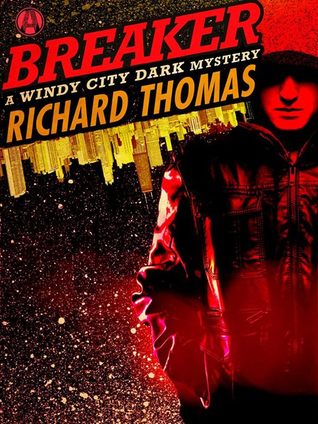
Breaker: A Windy City Dark Mystery, by Richard Thomas*****

breakerawindycityRichard Thomas is a monstrously great writer. In Breaker, a Windy City Dark mystery, he presents us with Ray, a man of unusual and intimidating appearance; a sinister stranger in a white van who victimizes Chicago’s working class school girls; and Natalie, the girl that lives next door to Ray. Though this is the first Windy City Dark mystery I read, I fell in, only extricating myself close to bedtime, because this is not the kind of thing you want entering your dreams. This smashing thriller came to me free of charge from Net Galley and Random House Alibi.

The first thing I usually look for in fiction is strong character development. In excellent fiction, sometimes the setting drives the character; sometimes the setting and character drive the plot; sometimes the plot is driven by character. Breaker definitely falls into the last of these categories. Told primarily in Ray’s first person and counterpointed by Natalie’s, along with a narrative that pops in and out surrounding the white van, the suspense is almost unbearable. The character is so palpable that I impulsively reached into my Goodreads account and checked the “literary fiction” box among my own library categories. The story is dark and haunting; fans of Stephen King, a writer Thomas lists among those that have influenced him, won’t want to miss out on this story. Though it is not driven by the supernatural, the tone and level of nightmarish suspense are quite similar.

Part of the hook is the affinity the reader must feel for Ray after just a short time. He lives alone; others are often afraid of him on sight because of his enormous size and ghastly pallor. His mother is dead, and we learn more about this eerie aspect of Ray’s past as the story progresses. He lives in the city’s gritty underbelly, spends almost nothing of what money he makes as a cage fighter—a sport so much more horrible than boxing—on himself, and he is constantly alone.

Meanwhile, Natalie, the 15-year-old next door, is being stalked by the white van. Because Natalie is kind to him and does not fear him, Ray reaches out to her in an uncharacteristic way and teaches her the self-defense tips none of her high school teachers will ever be able to provide. Their friendship is platonic but the bond is tight.

Meanwhile, the white van has Chicago even more on edge than it usually is; girls are disappearing, and no one knows who is taking them. Every white van begins to look sinister. I found myself gripping my electronic reader, and though I had been resting the arm that held it on a pillow, I found myself holding it up in the air because my hand had nearly tightened into a fist.

It’s that creepy.

I marked a number of really stellar passages—this guy is fantastic with gripping figurative language—but at the end of the day, I am not supposed to reveal any quotes till the book is on the shelves, and I want you to know about this one right now.

It’s up for sale January 5, 2016, and it will help you forget all about your post-holiday blues. Get this book!

The Lake House, by Kate Morton *****

thelakehouseAs a rule, I am not fond of British fiction; I prefer working class protagonists to the silver-spoon variety; and I like urban settings more than pastoral ones. But The Lake House is written by the author that produced The Forgotten Garden, and so when I had the chance to grab the galley, I went for it. And once more, experience proves that a brilliant writer can sell any story, in the setting of her choice, with the protagonists of her choice, and she can make it flow smooth as warm butter.

This deep, luminous story came to me from Net Galley and Atria Books, a division of Simon and Schuster. Thank you once, twice, and a third time too, because Morton has done it again. The book is a must-read for all that love mysteries and literary fiction.

Sadie Sparrow works for the Metropolitan Police, but her job hangs by a thread because she has become over-involved in the case of a missing woman. A toddler was found abandoned in her home, and Sparrow is haunted by the insistence of the child’s grandmother that her daughter would never, ever leave the child intentionally. Sparrow has been told to take some time off and stay away from the case; she retreats to her grandfather’s home in Cornwall, and becomes transfixed by an older, colder case, that of the mysterious disappearance of a child that lived in the beautiful old home nearby, Loeanneth, where a baby boy vanished many years earlier. Sadie sublimates her urge to follow up on her current, forbidden case by poking into the old mystery in Cornwall.

Morton takes us deftly from one setting, both time and place, to another so seamlessly that we cannot help being spellbound; this is literary fiction at its best. We meet the various members of the family that once summered in the once-lovely, now neglected Cornwall estate, and we watch across the years over three generations of the Edevane family that lived there, both in the years before World War II up to the present, with its elderly descendants that remain living.

Rather than a gripping page-turner, this is a well-crafted tale to be sunk into, like a feather bed or one’s favorite chair, with the phone turned off and a steaming cup of coffee (or tea, if you must) to go with it. Those without the stamina for a complex, well-developed story of the necessary length will find themselves frustrated; this one is for true literature lovers, so be prepared to give it the time it deserves.

The characters are developed so expertly that they feel like people we have known a long time. My favorite was Eleanor, who in my own mental movie appeared as a young Vanessa Redgrave; readers of a later generation than mine will choose some other face to match Morton’s description. Every possible stereotype one might create having to do with women of that time and social station has been cleverly sidestepped in a fully credible manner. Even the haughtiest among them is presented with dignity and a certain grace.

Some will find the ending a little too perfectly resolved perhaps; I find it congenial.

For those that like visuals to go with their fiction, here’s a clip of grand homes in Cornwall:

A Cold White Fear, by RJ Harlick***

acoldwhitefearMeg is alone with a 12 year old in her isolated cabin during a Canadian blizzard, when three escaped prisoners land on her doorstep, one of them injured. She helps dress the wound of the injured man, but then is held hostage, along with Jid, who is like a son to her, and her puppy. This mystery is the seventh in a series, but it was the first I had read, and it is easy to follow as a stand-alone thriller. Thank you to Net Galley and Dundurn Publishers for the DRC, and my apologies in being so tardy with my review. The book has been released and is available for purchase now.

Those that enjoyed The Shawshank Redemption or that are fans of Val McDermid’s mystery series will probably enjoy this story a great deal.

Each of us has a threshold of tolerance for how much terror and violence they can stand in a novel before it stops being entertaining and starts to be just scary and violent. That’s what happened to me here. Roughly eighty percent of this book is set in and near Meg’s cabin, with one aborted effort at escape after another; the writer wants us to also be worried about the puppy, and she played the card well, maybe too well for me. The small moments in which interesting tidbits of Algonquin culture are released, or in which one of the escapees does some small, compassionate deed are eclipsed by the sheer weight of the isolation and brutality present, and I finally got to where I could not stand it anymore around the 65 percent mark, and I skipped to the end and traced it back. That said, I also know that my own tolerance is lower than most. I watch very little television and few movies, and so a little goes a long way where I am concerned.

Harlick deserves a lot of credit for being able to spin a linear plot line with a limited setting, time span, and for most of the story with a limited number of characters. She never loses the reader’s interest or wanders off on a tangent; her facility with setting is good, and the tangibility of the place and people add to the terror experienced by the reader on behalf of the protagonist.

Scary-as-hell fiction from a series writer worth following in years to come.

Flashpoint, by Lynn Hightower*****

flashpoint“Anybody talk to a doctor?”
“Guy came out of emergency and talked to the brother.”
“Hear what he said?”
“Just that they were very concerned with Mark’s condition, and were doing all they could.”
“Shit. Mark won’t make it then. They’re already hanging the crepe.”

Sonora Blair is one of the most kick-ass female detectives to hit the shelves in a very long time. Lucky me, I read it free, thanks to Net Galley and Open Road Integrated Media. The original publication date was 1995, and so the initial publishers must have dropped the ball big-time when it came to promotion, because I know this is the kind of story that resonates with large numbers of people, especially women. And I am glad to see it being resold by Open Road, because they know how to do the job right.

So back to Sonora. No wait, let’s go back to Hightower first. What a total bad-ass when it comes to setting! I loved seeing her enter the home where her children were asleep, and the explosion of naked Barbie doll parts in her daughter’s room. I loved the moment when her elderly dog had an accident in the living room, and she was so distracted by the hundred other things, personal and professional, all colliding at once, that it was not even the first thing she took care of once she found it.

So we have two interesting threads here. One is the problem. A killer out there has murdered a man by handcuffing him to the steering wheel of a vehicle and setting fire to it…and him. It’s grisly business, but Hightower doesn’t overwork the detail to where it triggers my “ick” button; in other words, although it’s terrible, it is never so terrible that I just don’t want to read it anymore. And the problem just becomes thornier and trickier the longer she works on it. Clues drop here and there, and the stakes go up.

The other thread is Blair’s personal life, and the problems she faces in dealing with home and work. It sounds like a tired old song when I put it that way, but like any really skillful writing, it sounds brand new when the author rubs her own brand of English on it and sends it spinning.

After having read several hundred mystery, crime fiction, police procedural, and thriller novels—okay, if I had starting keeping track sooner, I know it would be well over a thousand—there are a handful of devices that are so frequently used that my eyes auto-roll when I see them utilized. I was watching for them. But Blair never gets tossed into the trunk of anybody’s car; she never gets the phone call saying the killer has her kids; there is never a moment when we realize she has been framed for the killing herself, and has to solve it to save her own butt. I’m not saying a great writer can’t get away with any of those; there are some Grand Masters out there that have done it and before my eyes could make the full roll, they were glued back to the page. But once someone reaches into that worn, soiled bag of tricks, it becomes a lot harder to engage me, and I was delighted that Blair never went there.

Her facility with setting is consistently brilliant throughout the book.

One tiny odd bit: for the first chapter or two, I was convinced that Blair was African-American. When she turned up blonde later, I had to mentally reinvent her. It didn’t take long though, because I was riveted and had to get back to the story.

For fans of outstanding detective fiction, this is a must-read. Order it now for yourself, or as a gift for someone you know will love it.

Finders Keepers, by Stephen King *****

finderskeepers“For your family, you do all that you can.”

When I read that one, simple sentence, it occurred to me that this common thread runs through a lot of Stephen King’s work, and it’s one reason he has developed such an easy simpatico with much of his readership, despite the murky waters his books bob into. It’s about our family, and about our common humanity, and the bad guys are the ones that can’t be tapped into, that violate that sacred reality.

As the book opens, we have our killer—or one of them—from Mr. Mercedes. And at this point, I have to tell you that if you haven’t read Mr. Mercedes yet, do that before you do this. (Mr. Mercedes is reviewed by me here: https://seattlebookmamablog.org/2015/04/24/mr-mercedes-by-stephen-king/.) Seriously. I’ve seen clueless-seeming individuals out there on social media wondering if it makes a difference, and oh my stars. Why, why, why.

I suppose if you are just stone flat broke and have no access to a public library, and by some stroke of luck you have a free copy of this book but cannot get the first in the series, then yes, King gives you just enough of the back story here to enable you to start midstream. But if at all possible, you really ought to read the first book first. There were so many little poignant moments—for example when Hodges thinks about Janey—that just made my insides do a back flip, and if you plunge into this story first, you’re going to miss so much of that. And in the end, you’re going to want to hunt down Mr. Mercedes and read it anyway, so why not try to do it in order?

All righty. So as our story opens, Morris, one of the murdering thieves from Mr. Mercedes, is an old man now, and he’s just getting out of prison. He’s been waiting a long, long time for this, because he has buried a whole lot of money as well as the last, hand-scribed novels of John Rothstein, a now-dead author whose work he has loved his whole life. He isn’t sure what he wants more, the money—well yeah—or oh my god, those notebooks! To read them! He knows the sensible thing to do is try to sell them, because they’re doubtless worth a small fortune, but first, just to read them. And now he’s out.

What he doesn’t know is that all those buried goodies have been found by a kid who happens to live and play in the area where Morris buried all of that. Nature has changed the contours of the woods where the trunk was interred, and a corner was revealed, just enough to make a naturally bright, curious kid want to know what it was. So that money is gone. It’s gone. In fact, it’s all gone.

The tension in this story builds a lot more slowly than most of King’s work, and at first I thought it was a sign that our author was slowing down. Au contraire, Pierre. Because really, it’s more about the pacing of the genre. When King writes his supernatural baskets o’spiders, he puts that pedal down on the floor, sometimes on the very first page, and it’s like the world’s most terrifying roller coaster until after the climax. The reader’s heart won’t stop slamming till the problem is essentially solved, at least for the moment—I’m talking about his horror novels here, not his mysteries, including this one—until that brief period at the end in which the loose ends are tied up, and the protagonists can laugh about the whole thing over coffee, or whatever.

The tension in a mystery like this one, on the other hand, is a much more gradual climb. It’s supposed to be that way. We get the tingle of dread, the near-misses, but instead of going from zero to eighty in chapter one, it’s more of a traditional hill, building, building, building. It never gets dull, but the reader will actually be able to put the book down to go make dinner, to do homework, to answer the phone. And that doesn’t make it weaker writing; it’s just a different type of story.

Once King gets to the top of that hill somewhere close to the 80% mark, we really have to stay with the book and finish it. Just finish it.

I did not read this as a galley; it was a Mother’s Day gift from one of my sons. They never miss a year, my boys, and they almost always get me one of my most coveted titles. I don’t put a lot of books on my wish list these days because I can get so many outstanding books free, but I had to have this one, and am glad my eagle-eyed son ferreted it out of my list and ordered it for me. Thanks, Benj.

Is it worth your hard-earned dollars? If you like really good mysteries and thrillers, absolutely, positively yes. BUT. You have to read Mr. Mercedes first!

The Last Good Place, by Robin Burcell****

thelastgoodplaceWhat a treat! They say all stories have already been told once, but I’m telling you, this one hasn’t. Oh, trust me! And my thanks go to Net Galley and Brash Books for a wonderful DRC. This one will be up for sale November 3.

Some may recall the TV series “The Streets of San Francisco”; the show was based on a set of police procedurals by Carolyn Weston. Characters Casey Kellog and Al Krug became TV characters Steve Keller and Mike Stone. In bringing the series back to us in the twenty-first century, new co-author Robin Burcell was asked to update it, since some of the over-the-top methods used originally could get a cop fired these days, and the old methods would not resonate with the public. Burcell has a lengthy background in law enforcement, and now I know that she is also a capable novelist. The pages flew by, and I enjoyed her improvement of the old series.

As the story commences, there have been a series of murders at famous landmarks in San Francisco, and it has been inferred by the media that tourists are at risk. While sometimes life may be cheap, the tourist industry is key to the local economy, and there’s heavy political pressure set to find someone and solve this crime, preferably accurately, but if not…just get someone, haul them in, and charge them.

So when Marcie’s neighbor and good friend Trudy turns up dead, there is speculation. Has she been a victim of this killer, or is it a copycat killing?

We find out right at the get go that Marcie knows a thing or two. For example, she knows that Trudy and her husband are getting a divorce; they are no longer in love. And Marcie also knows that her buddy has been spending some private time with Marcie’s husband. And so while Trudy and her soon-to-be-ex are going to sell their house as part of dividing the spoils of a marriage gone bad, Marcie won’t sell her house. Because it is her house, along with the eucalyptus grove out in the backyard. Her grandfather left her the house, and he left her the trees. He used to tell her that this humble, quiet spot out back was “the last good place”, and Marcie won’t part with it. Not ever. Not even to increase the property’s value—for herself and also for friend Trudy—by making their homes bay view property. Her grandfather preferred the trees to the water view, and so does Marcie.

It’s time to go jogging with Trudy, but Marcie hangs back and hides for a bit. We aren’t quite sure why, apart from the fact that she is suspicious that things are not what they seem to be. Trudy’s been a little strange toward her lately. And what do you know…Trudy dies on the morning jog before Marcie catches up to her.

This is a really accessible story, and I thought I ought to be able to solve the mystery. Goodness knows I read enough of them! And yet, I really didn’t get it. The author doesn’t pull the rug from beneath the reader by introducing a lot of new information at the end, or any of the other unfair devices writers occasionally use in order to make their story’s ending a certain surprise; I had a reasonable shot at it, but I didn’t get it. And I loved the ending!

The characters—the experienced, fatherly, crafty interrogator Al Krug, and his ambitious partner, Casey Kellog, are well developed and personable, but their personal lives don’t distract from the problems at hand. There are a couple of red herrings, but the plot is essentially linear and easy to follow.

All told, this one is a humdinger, and you should read it!

Treasure Coast, by Tom Kakonis*****

TreasureCoastHugely imaginative, terribly funny, and utterly tasteless, Kakonis delivers the chortles with Treasure Coast, a comic caper that juggles numerous entertaining characters with surprising deftness. Thank you twice, first to Brash Books and second to Net Galley, for providing me with the DRC to review. This title will be available September 14, 2015 to the book-buying public.

Our tale begins with Uncle Jim Merriman, a professional gambler who can’t even manage to break even these days, and “his numbnuts nephew”, Leon Cody, “…this kid with the crop of wild hair and Magoo glasses and dippy grin”, who is in debt to loan sharks. Leon’s mother has died and left not only her body, but also her foolish son, to Uncle Jim’s care and keeping. And of course we have the shark’s collection agents, Morris “Junior” Biggs and “your badass Hector Pasadena”.

On the other hand, we have Bryce Bott, hustler of gravestones that once purchased, will never arrive and “séances” delivered with the help of his hillbilly sidekick, Waneta Jean, who feigns nearness to death as a part of the séance scam.

Of course, ultimately, the characters wind up in a messy pile trying out-scam each other. “Circles inside of circles, games within games.”

But oh, that’s not enough! We also have trophy bride Billie Swett, who within my mental movie soon became Bernadette Peters, and her obnoxious, porcine, but almost infinitely wealthy spouse, Big Lonnie Swett. Eventually we add Cheetah, to whom Reverend Bott referred as “that other intrusive fellow”. Their roles in all of this, you will have to find out on your own.

“And how do you count the ways of weird?”

This was a story worthy of patience. There were so many nasty racist comments made about almost everyone you can think of; however, they are used within the context of Junior’s vapor-brained, “Aryan” sensibilities. There are several horribly ugly sexist remarks using the worst possible terms you can imagine, but again, it is only the bad guys that use them…and a reckoning comes down in a manner I found deeply satisfying.

To put it another way: we were halfway through before I was even sure I liked this novel, but once I was on board, I was in it for keeps, flagging one clever passage after another, most of which I can’t share here. I can share this YouTube promotional clip, though:

So although I was ultimately dumbstruck by the creativity with which Kakonis wove all of the complicated strands of this story together without dropping a single one, I also caution the reader. There are some really crass, fairly specific references to corpses in this book. If you have just lost someone and the wound is still raw, this is probably not the title with which you should escape. There are repeated references to the joys of rape. If you or someone near to you has been down that brutal path, maybe this is not your story, either. And one more caveat before I can go back to singing praises: if your mother tongue is not English, you may not want to embrace this challenging novel, which despite its Keystone Cops-like atmosphere requires exceedingly strong vocabulary skills. For those that enjoy word play, it’s a real treat, but any time you have to look up more than 3 words per page, the effort will outweigh the enjoyment you receive.

With the above caveats in mind, this new release comes highly recommended by this reviewer. The only real question is how you will wait until Monday to get your copy!

For the Dignified Dead, by Michael Genelin****

forthedignifieddeadThere’s a murderer on the loose, one that has killed across international boundaries. The weapon of choice? An ice pick. Happily, the case is assigned to total bad-ass Commander Jana Matinova, the best new female detective I’ve seen in emerge in crime fiction in decades. Thank you to Net Galley and Brash Books for the DRC. This title will be available for purchase November 3.

Part of what initially attracted me to this novel was the setting. Though Matinova finds herself crossing into various parts of central Europe, she is based in Slovakia, a country not even on my personal radar. By way of apology, I will point out that for most of my life, a giant swath of Europe and Asia was designated as USSR, and the satellite states lined up like faithful guardians around its perimeter included Yugoslavia and Czechoslovakia, both of which have been carved into different nations since the Stalinist realm crumbled. So I thought I’d learn a little bit about the contemporary contours of central Europe in the most enjoyable way possible—through fiction.

Genelin doesn’t disappoint. Along with Matinova, we have a collection of other cops, some of whom garnered truly fetching descriptions, such as this one: “With his thinning hair and lopsided smile he looked like a harmless, slightly unkempt beagle without its long ears.”

In addition we have the sinister Koba, a master criminal that Matinova considers akin, perhaps, to Holmes’s Moriarty. Koba’s role in Genelin’s story is complex and fascinating.

But most of all, I appreciated the development of Jana Matinova, both for her silver-bullet speed and cleverness, and also for that which is not included. We never hear about her hair, makeup, or her figure; we don’t need to know anything about her love life, and if she experiences any ambivalence about her lack of a domestic life, we don’t hear about it. In fact, Genelin treats his protagonist just as he would a male protagonist.

Now isn’t that a breath of fresh air?

The fifth star, which I would have loved to be able to add to this engaging story, is denied because of problematic passages that popped up often enough to warrant ten different notations in my kindle: “Too wordy! Tighten it up!” It seemed either as if there were two writers, one more capable than the other, co-writing the novel, or as if someone whose mother tongue is not English was struggling to say what needed saying. I noticed this was most frequent during passages of narrative, and less likely to occur during dialogue. Whatever it is, it could benefit greatly from either some rewritten passages or strong editing. But every time I found my eyes jerking through one of these verbose areas in the text, sooner or later we would come out slick as a whistle, and everything would commence to flow again. I don’t think a published text has ever confused me so much in this regard.

That being said, I would cheerfully read other books in this series given the opportunity. Because when push comes to shove, Commander Jana Matinova is a champ!

The Suicide Murders, by Howard Engel****

thesuicidemurdersThe cops said Chester killed himself. The gun was there, and he had powder burns on his head, powder on his hand. Everything tested out right. But he’d ordered himself a brand new bicycle just two hours earlier. Does a suicide do that? And then there was the very lovely wife that had been to see Cooperman, our detective protagonist, just before the unfortunate event, concerned that her man had perhaps been unfaithful. She’s caught him lying to her, and that makes a lady suspicious.

These things leave a guy like Cooperman with questions. True, he’s not a cop: “Me? I’m just a peeper. Divorce is my meat and potatoes.” But when something stinks, it’s in Cooperman’s nature to go find the source of the smell and air it out. And when others die after Chester, it makes Cooperman, who’s nobody’s fool, ask even more questions.

I received the DRC for this vintage novel, now available digitally, from Net Galley and Open Road Integrated Media. It became available for sale August 24, so you can get it now.

Engel is an experienced writer, and as he plays the thread out, with murder upon murder integrated deftly into the everyday life of Benny Cooperman, he strikes an excellent balance, building suspense and driving the plot forward with the occasional humorous reflection to keep things from becoming too ugly to be fun for the reader. And his character descriptions are particularly memorable, as with this local politician:

“He was a big man by anybody’s scale. His face looked like a roast beef dinner with all the trimmings, with a huge portion of nose in the middle. “

There were a couple of moments when the predictable occurred, but it wasn’t so dead obvious—excuse the pun—as to be an eye-roller. Rather, I experienced the satisfaction of having seen it coming and been right. And to me, as long as there isn’t too much of it, and there wasn’t, that is a sign that the writer has been fair to his audience. There are no sudden introductions of new characters during the last ten percent of the novel that change the solution in a way impossible to predict, and a lot of us like working the puzzle as we read. There are a couple of sexist references—“the kind of girl”, “bimbo”—that were commonly used in 1980 when this was first published that I didn’t care for, but they were infrequent enough that I was able to make a note to myself, and then continue to read and enjoy the story. In the end, the wry humor and up-tempo plot line makes this one a winner.

Although there are vague sexual references and infidelity is part of the plot, there is no graphic sex that should prevent a parent of a precocious adolescent mystery maven from handing the book down once they have finished it themselves. It’s hard to call any story that contains multiple murders a cozy mystery, but this one is in or near that ballpark.

Altogether a satisfying read.

Storme Front: A Wyatt Storme Thriller, by WL Ripley*****

storme frontStorme Front, the second mystery in the series featuring former NFL player Wyatt Storme and his buddy, Chick Easton, is smart and sassy. Ripley proves that an action-packed thriller with a he-man protagonist is stronger, not weaker when it treats women respectfully, as equals to men. Thank you twice, first to Net Galley, and second to Brash Books. I received this DRC from them in exchange for an honest review. This title was released August 4, so you can get it right away.

When someone offers one a thousand dollars to make a single, simple delivery, it’s natural to be suspicious. But when it appears to also involve pulling a good friend’s cojones out of the fire, an experienced badass will sometimes agree, however cautiously, to tag along. So it is here. Drugs, guns, and bodies pile up, and all through it runs some kick-ass banter that made me laugh out loud a number of times. The exchanges are typically between Wyatt and Chick, but there’s some pretty strong humor, at times, in the interactions between Wyatt and his fiancée, Sandra Collingsworth, as well. As well as respect. I like the respect even better.

“No one likes smart, self-assured women, you know.”
“Except you,” she said. “And I’m glad.”

Complicating the picture without making it into a soap opera is the involvement, however peripherally, of an old flame of Wyatt’s. They split up a long time ago, and she married the man whose afore-mentioned cojones Wyatt is trying to salvage.

“His wife?” said Billy, smiling. “Ain’t she a sweet piece of—“
“Her name’s Kelly,” I said, interrupting. “But you can call her Mrs. Jenkins.”

The action is linear in format, so the fairly sizeable number of characters doesn’t create confusion. Then too, Ripley’s memorable character sketches certainly help:

“Snakeskins came around the truck. He had a big face, crooked nose. About thirty. A little overweight. Too many Coors in cowboy bars. Blond mustache, untrimmed, and a diamond stud in one ear. His hands were immense.”

Oh, there are so many more memorable passages, and I highlighted 78 of them, just for giggles. But the fact is, I would just hate to ruin it all for you. All told, the flavor is a bit like Sue Grafton’s, but with male protagonists in Colorado.

The examples I’ve provided show up early on, but the pace never slows till the last page is turned. In the end, I just wanted to read the next book in the series. And so will you.

Highly recommended for mystery and thriller lovers, or for anyone that needs a snappy, amusing beach read.