
As I came of age in the late 1970s, Barbra Streisand was a tremendous star, and when it came to movies in which she sang, she was peerless. She still is. I was starstruck by her brilliance, her charisma, and her astounding voice, and even so, I didn’t know the half of it. She wouldn’t accept glass ceilings, and when she encountered one, she kicked it in, and she did it with style.
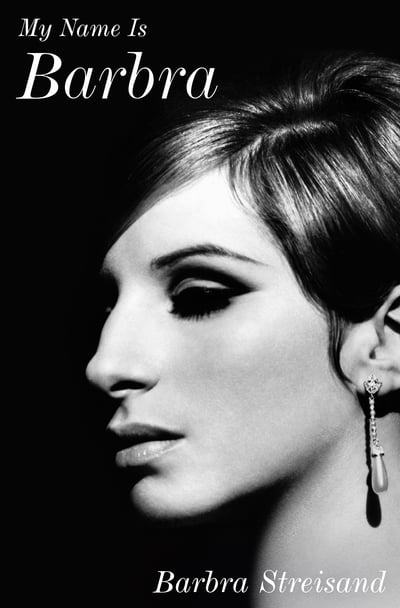
Once her place in the industry was established, Barbra tried to erect a few boundaries around her private life, but it wasn’t easy; when she declined interviews whose focus was her relationships with men, some members of the press chose instead to portray her in an unfriendly light. And some people were threatened by her. A woman director? A woman producer? Who did she think she was, anyway? And she showed them who, sometimes wearing multiple hats in a given film, directing and acting, or…well, you get the idea. And thanks to the resistance she encountered, she grew to be a fierce feminist activist as well.
The autobiography is done in linear form, which I appreciate. I chose not to request the galley, because the book exceeds 1000 pages, and I’d have had only a month till it was published. Instead, I put it on my Christmas list, and Santa delivered it both in print and audio. Both are wonderful, but the audio is read by the author, which makes it my favorite. One more thing I greatly appreciate: when she discusses her music, we get to hear a brief, seconds-long excerpt. A pet peeve of mine is when song lyrics are spoken on audio books, and it is triply aggravating when the book in question is written by and read by the musician that made it famous. I’m sure there are hoops that must be jumped through to be allowed to include these snatches of song, but I know it can be done, because Barbra did it.
We begin with her childhood, the loss of her father, the unavailability of her mother, and I marvel that she grew up to be a good person, and that she nevertheless found the inner strength and confidence to pursue a career as a performer.
A good person? How would I know? We’ve never met. Surely authors do their damnedest to shine the light on their better qualities when they scribe their memoirs. But ultimately, it’s the way that Barbra’s own character makes its way into her productions that convinces me. She has no use for pretension, for one thing, even after the millions she’s made (and given away a lot of.) And she’s spent decades as an activist, using her talents to raise funds for AIDS research, to combat climate change, and to promote women’s equal treatment.
One word about that: there are long passages, at least one whole chapter and parts of others, where she discusses her causes and the politicians she admires, and I must confess that her adoration of various Democratic politicians is my least favorite part of the book. I actually lean further left than she does, and as she gushes over the Clintons, I find myself arguing a bit with her in my head. Sure, Bill Clinton did A and B as president, but he also did C and D, which are dreadful. And so on. Ultimately, I skipped to the end of one such chapter, and I was able to enjoy the rest of the book just fine.
I was fascinated by her explanation of why The Way We Were, one of her massively successful movies, is curiously devoid of politics, even though that is the point of the movie. She tells us that there was a lot of excellent content that landed on the cutting room floor. Nixon’s people had leaned hard on the studio not to disparage the McCarthy witch hunt, for example, and they folded. Happily, Streisand thought to ask if she might keep the portions that were cut, and a new version is being published for its 50th anniversary, so that we can see what it was supposed to look like. And it was this travesty, the way the original film was butchered without her input or consent, that made her determined to direct, and not to make any more movies unless she could have the final cut in her contract.
In her old age—she is in her eighties now—she is willing to talk about her private life in ways she would not do earlier, and she finds just the right level of intimacy to describe it. She speaks well of most of her past loves and many, many fellow performers, and has met and spent time with just about every public figure you can imagine. At one point I challenge myself to think of someone famous that isn’t in her book. Ha, I’ve got it! Nelson Mandela. Then I flip through the vast trove of photographs at the end of the book, and there she is with him.
Her harsh words are very few, and even so, she can often find some positive words to round out her discussion. Sidney Chaplin, son of Charlie, was monstrous, and he terrorized her just as her career was taking wing. Her longtime boyfriend, the hairdresser-turned-producer, Jon Peters, is the other major entrant on her unhappy list, but she recognizes the good things that he did, too, and the fact that he—and every one of her exes—sends her flowers on her birthday says it all.
I could go on even longer about this book, but it won’t be as fun for you as if you get the book for yourself, and I want to go back and re-watch her movies, especially Yentl. As for you, this audio book could make your daily commute much more enjoyable. Highly recommended.
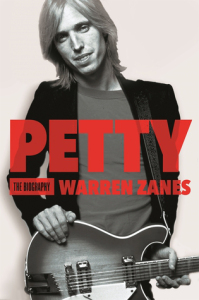 I posted this review almost two years ago, and at the time most of us considered that Petty had a lot of gas left in his tank. Of all the musical memoirs and biographies I have read–and there are many–this is the one I loved best. The loss of this plucky badass rocker hit me harder than the death of any public figure since Robin Williams died, so reposting this here is my way of saying goodbye to him. Hope he’s learning to fly.
 Seattle Book Mama