
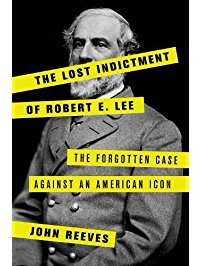
 I’ve never understood why so many Americans revere the memory of Robert E. Lee, the general that turned Lincoln away at the outbreak of the American Civil War and instead commanded the treasonous Army of Northern Virginia. When I saw this title, I leapt at the chance to read and review it. Thanks go to Net Galley and Rowman and Littlefield Publishers for the DRC. The book will be available to the public June 1, 2018.
Before reading this book I wasn’t even aware that an indictment had ever been issued. This is particularly odd given that a good part of my teaching career involved teaching American history and government. I even wondered, before opening it, whether this indictment would be metaphor; no indeed. Reeves did a lot of digging in order to write this book, and that’s what makes it worth having. His sources are ones that I cannot find myself through a quick Google search or a trip to the library or bookstore. Reeves uses sources that require traveling hither and yon in order to access special collections that libraries won’t check out to anybody ever, that’s proof that this writer had done the legwork.
Back to the indictment. Following the end of the war and the death of Lincoln, the North—contrary to mythological retellings—clamored for retribution. Let’s all be brothers and have peace? Oh hell no. Who had not lost a brother, a son, a husband to this terrible conflict? And President Andrew Johnson, working hand-in-glove with the passionate abolitionist, Judge Underwood, set out to “make treason odious.” At a bare minimum, Lee, Jefferson Davis, and the members of the Confederate cabinet most closely linked to the war itself needed a day in court. Afterward, they needed to either hang, or rot in prison for a goodly while. So the thinking went.
As usual, the devil was in the details. Why is it so difficult for government to move swiftly? A lot of terrible decisions were made here, the most noteworthy being to try these men in a civilian court rather than in a military tribunal. Too late they realized that Lee must then be tried by a jury of his peers in Virginia. This would have been disastrous, since Lee was regarded by most Caucasian Virginians as a hero, much the way we now look at Lincoln. After all, when the war broke out, most antiwar or antislavery advocates had to move North in fear of their physical safety, and only the diehard Dixie whistlers remained, so a fair and impartial jury in Virginia was a nonstarter. What could possibly be worse than letting Lee off scot-free? What would be worse would be for him to be exonerated.
Added into the stew was a heap of political scandal and the unraveling of Johnson’s presidency, and the tarnishing of Underwood’s reputation, a man controversial from the get-go. At the end of the day they were too busy salvaging themselves to bring these men to justice.
I find some measure of comfort in the knowledge that Arlington, the huge, fancy estate that had been passed down to Lee’s wife and of which he never stopped bragging, as if property ownership and family history made his family American royalty, was expropriated by the Union, and its extensive grounds became Arlington National Cemetery. After Lee’s death, there was considerable talk among the public suggesting that the widow Lee should get her old house back; however, she overstepped when imperiously telling Congress that she also wanted the remains of all those poor boys dug up and interred some other place. There was almost nothing she could have said or done to lose the sympathy vote more quickly.
This excellent book is highly recommended to those that are interested in the American Civil War and its aftermath.
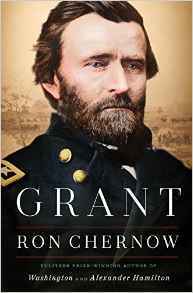 I’m tempted to add this title to my Southern fiction shelf. For a Pulitzer winner to be so careless with his facts is egregious. I got 200 pages or so in, and I found a glaring error. To be honest, I thought maybe it was me. I haven’t taught the American Civil War in 8 years now; am I slipping? Because I could swear that the famous tidbit about a single battle killing more soldiers than the American Revolution, War of 1812, and war with Mexico all added together was about the battle of Antietam, yet here is Chernow, saying it’s Shiloh.
 Grant and Sherman are my favorite generals of all time, and Flood is a highly respected author. This book was on my must-read list, and so I searched it out on an annual pilgrimage to Powell’s City of Books, and I came home happy. It turned out to be even better than I anticipated.
 Hannibal was the first general to defeat the forces of Rome, and Hunt is the man qualified to tell us about it. I read my copy free and early thanks to Net Galley and Simon and Schuster. This book becomes available to the public July 11, 2017.
 “’All right. They’re on our left. They’re on our right. They’re in front of us, they’re behind us. They can’t get away this time’.”
 I want to give a shout-out to Open Road Media for the way they value the First Amendment. Every now and then I review something they’ve given me and rate it with one or two stars, and each time I wonder whether my outspoken criticism will get me knocked off their list of auto-approved readers. It’s never happened. It gives me a little extra joy, therefore, when I’m asked to read and review a book that is straight-up excellent, because everyone will know my five star rating is the real deal. Thanks, Open Road…and happy holidays to you, and to my faithful readers, too.
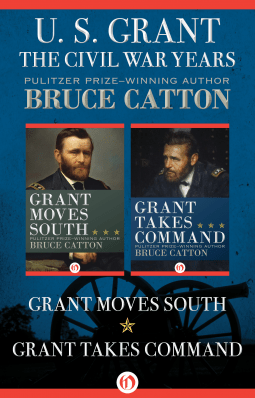 I was fortunate to receive a DRC of this two volume biography of America’s greatest general, US Grant. Thanks go to Open Road Media and Net Galley for providing it in exchange for this honest review. This is the sixth Grant biography I’ve read, and aside possibly from Grant’s own memoirs, which are valuable in a different way than this set, I have to say this is hands-down the best I have seen. Catton won the Pulitzer for one of his civil war trilogies, and this outstanding biography is in the same league. Those with a serious interest in the American Civil War or military history in general should get it. It’s available for purchase now.
 In Mission: Jimmy Stewart and the Fight for Europe, Robert Matzen provides an engaging, compelling memoir that focuses primarily on Stewart’s time as an aviator during World War II. Thanks go to Net Galley and to Goodknight Books for the DRC, which I read free in exchange for this honest review.


 Bryan was a journalist and author during the mid-twentieth century, and Friendly Fire, which originally began as a story for the New Yorker and grew into something more, tells the story of the Mullen family and their response to the death of Michael, a clean-cut young man that answered his draft notice, dutifully served and was killed by friendly fire not long after he was sent to Vietnam. Thanks goes to Open Road Integrated Media and to Net Galley for the invitation to read and review. This is right up my alley and I found it compelling. It was published digitally May 10, 2016 and is now available for purchase.
