
Our Man in Tokyo, by Steve Kemper****

My thanks go to Net Galley and Mariner Books for the invitation to read and review; Our Man in Tokyo is for sale now.

For the most part, my curiosity about World War II has been slaked, but this book has a different point of view than any other I’ve seen. American history students know of the miserable experience of the two Japanese ambassadors to the U.S., whose own government did not even give them a clue that Japan was about to bomb Pearl Harbor, right there on American soil. But I had never heard a word about their counterpart, the U.S. ambassador to Japan. Joseph Grew was a skilled and seasoned diplomat, and he tried mightily to find common ground between the two nations. Of course, in the end he was more or less shouting into the wind. But I had never read a single thing about him, and so this biography caught my interest.

Readers should know that the last two thirds are much more interesting than the beginning. I don’t care about Grew’s early life, or his marriage, or his golf game. I’m in this strictly for the historical record regarding the U.S. and Japan during the period leading up to the war; also, of course, I wanted to know what happened to him, stationed over there as he was, once war broke out. All of these things are explained clearly and in a conversational manner that is easy to read or listen to. (Since I had fallen behind, I checked out the audiobook from Seattle Bibliocommons, and it sped things up for me.)

The various politicians with whom Grew dealt are interesting indeed. The divisions within the government itself, and also within the Japanese military, created all manner of problems with communication and decision making. There are some bizarre circumstances, and they’re well described. But also interesting to me are the less historically necessary, yet fascinating tidbits that he picks up along the way, living for a decade or so in Japan. Here’s just one nugget for you: Mt. Fuji was (and is) a popular vacation destination, but just prior to Japan entering the war, a terrible trend developed. Young people in their twenties and even their teens went to Mt. Fuji in order to throw themselves into the volcano! When 500 young lives had been lost, the government acted. There were no mental health clinics, and no counselors. Instead, they simply made it illegal to sell anyone a one way ticket to Mt. Fuji. And the really weird thing is, it worked! I am still shaking my head over this one. Kemper’s biography is full of these odd little bits that I doubt you will find anywhere else. His research and documentation are sterling.

As to the audio book, the reader does a serviceable job, apart from his dreadful pronunciation of Japanese names. Shudder.

I recommend Our Man in Tokyo to anyone interested in reading nonfiction about American diplomacy in Japan just prior to the outbreak of war between that country and the U.S. Don’t be ashamed to skip a couple of chapters at the outset if you wish; there’s not much there that will become important later.
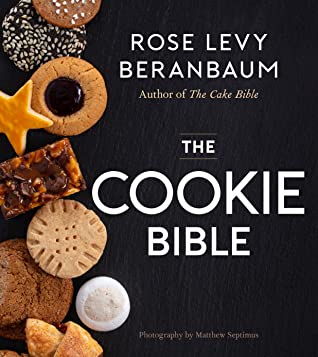

The Cookie Bible, by Rose Levy Biranbaum***

Biranbaum is the author of The Cake Bible, a book that I used to own, never used, and finally handed off to my daughter. Had I realized this at the outset—and I should have, as it was included in the promotional blurb—I probably would have stepped away from this cookbook. However, cookies are generally an approachable baking project, and it didn’t occur to me that this author might provide recipes that are not.

My thanks go to Mariner Books and Net Galley for the review copy. This book will be available to the public on Tuesday, October 18.

My rating is a compromise, because recipes such as these will elicit a variety of responses, none more valid than another, and so I can see this collection as two stars for unpretentious and somewhat lazy souls such as me, and four stars for those looking for a tremendous challenge, or an opportunity to impress.

I was on a weight loss regimen during the warm months, looking forward to fall and the chance to get back in the kitchen and bake. I held onto this galley as a reward for all the weight lost, and I planned to test a couple of recipes before writing a review. That hasn’t happened, nor will it. I confess I didn’t understand what I was in for. These recipes are the sort one uses for a grand occasion if at all. If there’s a dessert auction on the horizon, or if you are simply looking to flex your baking muscles, or even intimidate other bakers, this book is your book. Be prepared to buy a LOT of ingredients that aren’t standard. Super fine sugar; candied lemon peel; brandy or freshly squeezed orange juice, strained; unbalanced hazelnuts! I believe I’d have to be unbalanced to attempt any of this. Fine sea salt; hulled sesame seeds; Muscovedo light brown sugar; sour cherry preserves. Mine are ordinary cherry preserves. Fail. Crystalized ginger. Oh, and once you procure your super fine sugar, you’ll need to grind it in your spice grinder. You have one of those somewhere, of course.

I found one recipe that I thought I could manage. There were 2.5 pages of densely printed instructions.  I could see that I was supposed to have 60-62% cacao dark chocolate, but after reading the recipe four times, I couldn’t find the place where I was supposed to have added it. I did find the place where I should have added something else on top of it, but as far as I am concerned, if the recipe isn’t clear after four readings, then it’s not clearly written.

Next!

Once again, if you have occasions when you are ready to pull out all the stops, you may like this thing, but do make sure you read your recipe well in advance, as I suspect you will have to special order tools and ingredients.

Not for me.

Let’s Do Dinner, by Antoni Porowski

I’ve got a soft spot for cookbooks. Some are useful, and some are less practical, but fun to read anyway. Fans of Antoni’s television programs can hardly go wrong with Let’s Do Dinner, but his work is new to me. My thanks go to Net Galley and Mariner Books for the review copy. This book is for sale now.

The promotional blurb for this cookbook tells us that some of these recipes will be decadent, whereas others are designed for weekday dining. Apart from a couple of nice egg dishes (omelet, scramble,) I don’t see anything here that I would make. Some involve great loads of dishes, and others involve unusual flavor combinations, and I am a coward. That being said, I am plainly not his target audience. I suspect that his cooking tips are geared toward the young and childless; I, on the other hand, am a Grammy. For me, this cookbook is more of a three star read—the sort of thing I’d browse through, but wouldn’t spend money on. However, for twenty-and-thirty-somethings, I suspect the appeal will be greater, perhaps a four star read, and for his loyal fans, five stars.

I recommend this cookbook to Antoni’s fans, and to the young and adventurous cook that wants to try new things.

Bare Minimum Dinners, by Jenna Helwig****

What a good idea! Helwig’s approachable, practical guide is one of the most useful cookbooks I’ve seen in recent years. My thanks go to Net Galley and Mariner Books for the review copy. This book is for sale today.

One of the drawbacks to growing up with easily available readymade meals, as most Americans have done, is that nobody has to learn to cook anymore. It’s optional, the way that baking elaborate meals and desserts used to be. But it’s always more expensive to order take-out food than to make it yourself; it has to be, since you are essentially paying them for not just ingredients, but also the labor costs, utility and rent, and other expenses associated with producing it. The meal that you pull out of your freezer is a bit cheaper, and so is the ubiquitous ramen, but neither is useful nutritionally. A lot of people have become born-again cooks over the course of the pandemic, and after all we have been through, it’s nice that at least some of us have benefited in small ways.

Most cookbooks—and I love the things, even the useless ones—aren’t especially helpful. They call for elaborate preparation; tools you probably don’t own; unusual ingredients that have to be hunted down; and then in some cases, produce far more food than a single person or couple can make use of. Helwig’s is different. Her recipes call for ordinary, inexpensive ingredients, and most of them require only basic kitchen equipment. Right up front she explains what pans, machinery, cutlery and other tools she recommends we buy, and although this chapter looks like the one that a lot of people will skip on their way to find a recipe for tonight’s dinner, I recommend you read it when you purchase the book. This reviewer is a Boomer, and I was thirty before I had a microwave oven. I know how to cook and am fairly good at it. Nevertheless, reading this chapter persuaded me to add one more item to my collection. Her practicality is undeniable.

The recipes that look the most tempting to me also require the largest number of dishes to be washed. That’s the way it goes, right? Chilaquiles; Apple Dutch Baby; Mushroom and Gruyere Quesadillas; yum! But she also has an entire chapter titled “Bare Minimum Cleanup” which faithfully adheres to a rule of one pot or pan, period. Because some nights we don’t care to be creative. We just want to grab the food, fix it, and get dinner out of the way so we can move forward with our evening. Helwig gets that.

The sole complaint that prevents my fifth star for jumping on board is that there are certain ingredients and flavors that appear too frequently. Not everybody loves cabbage, for example. Helwig rhapsodizes about its taste, low price, and versatility, and whereas the latter two claims are obviously true, the first is subject to the cook’s preferences. As for me, I do like cabbage once in awhile, but I don’t want it all the time. There are also a few other places where I would have preferred some more versatility.

Nevertheless, this book is a gem, and every recipe in this cookbook has more appeal than that freezer-burnt burrito you bought last March. If you are a newbie with a limited income and not much kitchen experience, you should get this book now. If you are more seasoned, you might want it anyway. And as a bonus feature, I notice that although almost every cookbook is frustrating to read digitally, this one is better than most. If you can get it in print, I still advise doing so, but if your budget only runs to digital versions, that shouldn’t stop you. Someday you’ll wonder how you got by without it.