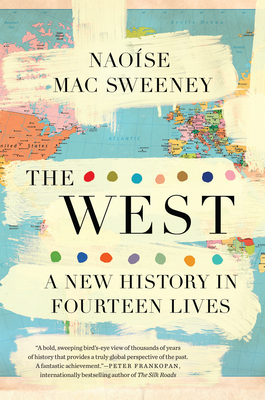
The West, by Naoise Mac Sweeney****-*****

4.5 stars, rounded up.

Those that have taken a course on Western Civilization—as college freshmen or otherwise—are familiar with its framework, that the modern world can attribute its earliest, most progressive, democratic, and technically superior attributes to the dead White European men that came before us. Archeologist and award-winning historian Naoise Mac Sweeney has taken a sledgehammer to this construct, proving that many of the smartest scientists, inventors, and social, military, and political leaders were not White, not European, and not male.

My thanks go to Net Galley and Random House for the review copy. This book is for sale now.
Mac Sweeney demonstrates her thesis by discussing fourteen key figures from the past that don’t fit into the standard framework. She begins with Herodotus and ends with Carrie Lam. Some chapters read like a college text or lecture, one where I know that this information is important, but my mind keeps wandering, and I check to see how much longer the chapter will be. Others woke me up. In chapter seven, she features Safiye Sultan of the Ottoman Empire. She was not legally able to become sultan following her husband’s death, so she saw her son installed, and then “summarily executed” his nineteen younger brothers to prevent anyone from contesting his right to rule. Another that made me sit up and take notice is Njinga of Angola. I was riveted by this one, to the extent that I actually shouted at one point. (It’s all right; I was at home.)  If we judge her work by whether she has proven her thesis, then unquestionably she has done so. 

There are two aspects that I didn’t care for here. The first is a mannerism. The use of the Victorian “we” is grating. “As we shall see…” “We have discussed…” No. She has already seen, and the only one doing the discussing within the pages of this book is the author.  Also, since the title itself identifies this tome as a history book, Carrie Lam of Hong Kong, whose quotes date from 2021 and 2017, has no business being included here. History is defined as what has occurred fifty years or more prior to publication. Mac Sweeney knows this.

In a fit of pique over these two flaws, in addition to the snoozy parts of the narrative, I initially rated this book with four stars, but this is a groundbreaking body of work, and after reflection, I changed my rating to 4.5 stars, rounded up.

Highly recommended to students and to anyone interested in world history.

Our Man in Tokyo, by Steve Kemper****

My thanks go to Net Galley and Mariner Books for the invitation to read and review; Our Man in Tokyo is for sale now.

For the most part, my curiosity about World War II has been slaked, but this book has a different point of view than any other I’ve seen. American history students know of the miserable experience of the two Japanese ambassadors to the U.S., whose own government did not even give them a clue that Japan was about to bomb Pearl Harbor, right there on American soil. But I had never heard a word about their counterpart, the U.S. ambassador to Japan. Joseph Grew was a skilled and seasoned diplomat, and he tried mightily to find common ground between the two nations. Of course, in the end he was more or less shouting into the wind. But I had never read a single thing about him, and so this biography caught my interest.

Readers should know that the last two thirds are much more interesting than the beginning. I don’t care about Grew’s early life, or his marriage, or his golf game. I’m in this strictly for the historical record regarding the U.S. and Japan during the period leading up to the war; also, of course, I wanted to know what happened to him, stationed over there as he was, once war broke out. All of these things are explained clearly and in a conversational manner that is easy to read or listen to. (Since I had fallen behind, I checked out the audiobook from Seattle Bibliocommons, and it sped things up for me.)

The various politicians with whom Grew dealt are interesting indeed. The divisions within the government itself, and also within the Japanese military, created all manner of problems with communication and decision making. There are some bizarre circumstances, and they’re well described. But also interesting to me are the less historically necessary, yet fascinating tidbits that he picks up along the way, living for a decade or so in Japan. Here’s just one nugget for you: Mt. Fuji was (and is) a popular vacation destination, but just prior to Japan entering the war, a terrible trend developed. Young people in their twenties and even their teens went to Mt. Fuji in order to throw themselves into the volcano! When 500 young lives had been lost, the government acted. There were no mental health clinics, and no counselors. Instead, they simply made it illegal to sell anyone a one way ticket to Mt. Fuji. And the really weird thing is, it worked! I am still shaking my head over this one. Kemper’s biography is full of these odd little bits that I doubt you will find anywhere else. His research and documentation are sterling.

As to the audio book, the reader does a serviceable job, apart from his dreadful pronunciation of Japanese names. Shudder.

I recommend Our Man in Tokyo to anyone interested in reading nonfiction about American diplomacy in Japan just prior to the outbreak of war between that country and the U.S. Don’t be ashamed to skip a couple of chapters at the outset if you wish; there’s not much there that will become important later.

Empire of Ice and Stone, by Buddy Levy****

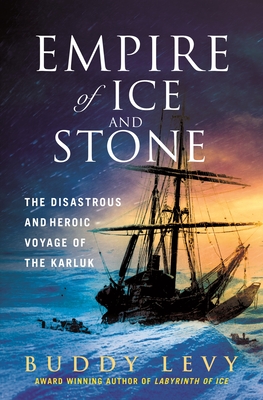
Empire of Ice and Stone tells of the voyage of the Karluk, a brigantine vessel that sailed from Canada to the Arctic in 1913. It was led by Captain Bob Bartlett, the world’s best ice navigator at the time, and Vilhjalmur Stefansson, a “visionary” leader in search of wealth and fame. My thanks go to Net Galley and St. Martin’s Press for the invitation to read and review; this book is for sale now.

This well told narrative details a part of history of which I have read very little. As school children, most of us in the Western developed nations read of the early explorers, but stories of voyages in the twentieth century are few and far between. This is why I take this one on, but I begin to wonder partway into it whether it is more than I have bargained for.

The first half is more than a little confusing, because there are so (so, so, so) many names to remember, and almost all of them are Caucasian men—as is usual for the time and situation. About halfway into it, I abandon my efforts to memorize all of them, and once I am satisfied with memorizing the names of the two leaders plus “Auntie,” (more in a moment) and the ship’s pets, I calm down a bit and it’s easier to follow.  I am fortunate enough to receive the audio galley as well as the digital review copy, and that combination makes it easier to follow.

That said, this is not gentle reading. There is death—in many cases slow and terrible—and betrayal around every corner. I understood that there would be some of that when I took the book, but I’ll tell you right now, if you, dear reader, have any sort of mood disorder or are going through a dark time personally, you may want to stay away from this thing.

As the bodies begin to pile up, I start to feel angry, and I remain so, to some degree, until the book is done. Because this was a dumb thing that these men did. Their ship wasn’t up to the task, they cut too many corners at the outset, and this more or less spelled doom for many of those aboard. I can’t help speaking to these men as though they can hear me, and I’m asking what the fuck got into them to do this at all? If everyone had stayed home, most likely all of them would have lived to a ripe old age. True, they made some scientific discoveries; yet air travel was just around the corner, and the whole thing could have been done much more safely later on.

The story has a definite hero (Bartlett,) and a definite villain (Stefansson,) and the farther into the voyage we go, the more obvious this becomes. However, I would have liked to hear a good deal more about the other hero. Levy tells us that a lot of these men would have been dead before the rescuers arrived had it not been for the Innuit woman that was hired, along with her small children (!) to travel with them, and the narrative bears this out. Time and again, when they are on the razor’s edge of starvation, she comes up with an innovative way to use the environment around them to provide calories. Not always delicious calories, to be sure, but alive is alive. “Auntie” is a total badass, and deserves more ink; possibly not much information is available, given the biases of the time.

The book feels longer than it actually is; however, given the amount of complex information provided, it probably shouldn’t be pared down further. At the same time, I kept thinking that this would be so much more approachable if Jeff Shaara were doing the telling (via historical fiction.)

For those that are very interested in the history of early sea voyages, and to researchers, this immaculately researched book is recommended.

Poverty by America, by Matthew Desmond****

“Hungry people want bread. The rich convene a panel of experts. Complexity is the refuge of the powerful.”

Desmond is the author of Evicted, the Pulitzer winning examination of urban homelessness. Desmond himself grew up poor, and his family was forced out of their home when he was a child. These things give him a different and more authoritative perspective than most urban ethnographers.

 My thanks go to Net Galley and Crown Publishing for the invitation to read and review. This book will be available to the public tomorrow, March 21, 2023.

This book is written for a general readership, and it’s more readable than any other nonfiction work I’ve seen on this subject. His tone is conversational, and his research is impeccable, drawing from a wide variety of sources, well integrated and organized. He addresses the past and present roles of racism, explaining how the overtly discriminatory statutes and policies of the past have morphed into more subtly framed, yet still ubiquitous ones of today. He tells us “why there is so much poverty in America and…how to eliminate it.” He speaks to an audience of middle and upper class readers, warning that we must “…each of us, in our own way, [must become] poverty abolitionists, unwinding ourselves from our neighbors’ deprivation and refusing to live as unwitting enemies of the poor.”

In revealing the roots of American poverty, Desmond is thorough. He discusses the role played by medical costs, and the many workers that still cannot afford health care; the withering of unions, and the way that gig workers and independent contractors have replaced permanent employees; incarceration, and the debilitating effects it has, not only on the person sent away, but on their families for generations to come; the way that government assistance programs have been legally diverted to programs having nothing to do with the poor; the way that poor people are forced to pay more for the same goods and services that the better off pay. He discusses the ways that those living in poverty are cut off from political and economic opportunities. He does these things better than anyone else is doing them right now, and it makes me mad as hell, seeing millions of ruined lives all laid out so starkly.

It is when he approaches solutions that things become a little muddy. There are a few of his suggestions that I genuinely disagree with, but most of them are sound; the problem is that, despite his assurance that all of these changes can be made without much incursion into the lives of the wealthy and powerful, the chances of these people agreeing to implement such changes are somewhere between slim and none. He assures us that he is no Marxist (and that’s the truth, alas,) and that the rich can still have plenty; yet in reality, it’s clear to this reviewer that the kinds of changes that are needed are ones that working people will have to force from the tightly closed fists of the rich. This is where the fifth star falls off of my rating.

Nonetheless, Poverty by America is well worth your time and money, and I recommend it to you.

The White House Plumbers, by Egil “Bud” Krogh and Matthew Krogh

Egil “Bud” Krogh was one of the men known as the “White House Plumbers,” which was a small group of operatives that dressed as tradesmen in order to illegally break into and ransack private offices for the purpose of digging up dirt on political opponents. Krogh’s job, together with E. Howard Hunt, was to lead a small team of men to burglarize the office of Dr. Fielding, the psychiatrist that treated journalist Daniel Ellsberg, in search of a way to discredit Ellsberg, whom President Richard Nixon regarded as an opponent.

My thanks go to Net Galley, St. Martin’s Press, and Macmillan Audio for the review copy and audio book. This book is for sale now.

Few people shy of the Boomer generation will have personal recollection of the Watergate scandal that brought down a sitting U.S. president for the first time, and the burglary of Fielding’s office was the first illegal event that set it all in motion. Nixon was furious that the Pentagon Papers had been released and that the U.S. Supreme Court had come down on the side of the First Amendment and the free press. Consequently, the president decided that the executive branch must go it alone, and sought a way to discredit the journalists behind it. That was how all of this came about. He howled about national security, and may or may not have believed it; or, he may have sought to cover up lies he had told to the American people about the war in Indochina, and  since he couldn’t force the publication out of circulation, the next best thing would be to persuade the public that its authors—or annotators, at any rate—were crazy and not to be believed. This background information comes from me, not from the book.

At any rate, this political memoir comes to us courtesy of Bud Krogh, and also his son Matthew, who completed it after Bud’s death. For the purpose of this review, I will use the name Krogh to refer to Bud, unless otherwise noted.

Krogh was brought into this mess by John Ehrlichman, one of the two advisors that were nearly as close as a second skin to Nixon during his time in office. Other accounts refer to both as cold-blooded thugs, and my earlier reading leads me to agree with them, but to Bud, Ehrlichman was a noble soul dedicated to his country and his president, a fine, devout individual that was like a second father to him growing up. It didn’t occur to him, initially at least, that anything he was being asked to do was corrupt or scandalous; here, I find myself shifting in my seat. Surely he must have wondered why this secret little group of men, not even government employees, were being tasked with this job, rather than the agencies that ordinarily do the cloak-and-dagger jobs? He claims that Nixon couldn’t trust FBI director J. Edgar Hoover, who was a slimy character, and that makes at least a little sense to anyone familiar with him. Yikes.

The writing as well as the accountability are uneven throughout this book. The prologue sounds sketchy to me. Those of us that have spent any time at all watching criminal trials take place is familiar with the vaguely nebulous language I see and hear at the beginning of this thing. Instead of saying that he has done something very wrong and is sorry, he says he has made bad choices, and he is sorry about “what happened.” This is the language that guilty people use when their attorney has told them to show remorse. Someone not listening carefully might think that the speaker has apologized, but they’ve actually distanced themselves from wrongdoing. During this portion of the memoir, I glanced at the text and also the device playing the audio, half expecting to see a little slime leaching from its margins.

And yet, at the end, the prose is more eloquent, and the accountability rock solid. Krogh goes to the psychiatrist in order to apologize in person, once he is out of prison. He visits Nixon to apologize to him (which baffles me, but okay.) He claims to have declined a presidential pardon. He never loses an opportunity to put on a hair shirt prior to his many speaking engagements. And so it goes.

One could surmise that the early portion was written by Krogh, and the end written by his son, but even if that is true, those speaking engagements were taken by Bud, not by Matthew, and likewise the specific apologies rendered. So who knows?

The narrator for the audiobook is Peter Krogh, who does a fine job.

If you are interested in studying the Watergate scandal and haven’t read any other books about it, this is not the one. Krogh’s involvement ended with the break-in to Fielding’s office, and he helped cover it up, lying under oath as he was told to do, but he had nothing to do with the Watergate Hotel burglary of the Democratic National Committee’s offices. In short, though famous enough to be remembered for his actions, he was not a central player. For those interested in reading just one book about this scandal, I’d go with All the President’s Men, by Woodward and Bernstein; The Nixon Defense, by John Dean; or Nixon: The Life, by John A Farrell. These are all fairly lengthy; if you are looking for something less lengthy, try One Man Against the World, by Tim Weiner.

As a general read for the uninitiated, I’d give this book 2.5 stars. For Nixon and Watergate buffs, I rate it 3.5 stars.

The Last Hill, by Tom Clavin and Bob Drury***-****

In 2021, Clavin and Drury published Blood and Treasure, an outstanding biography of Daniel Boone, several American Indian tribes, and their relationship to the American Revolution. When I saw a chance to hear their new audiobook titled The Last Hill, I jumped on it. And the early portion of it convinced me that I was missing too much by listening but not seeing, so then I went back and requested the digital version as well. My thanks go to St. Martin’s Press, Macmillan Audio, and Net Galley for the review copies. This book is for sale now.

This meaty yet readable book details the fight for Castle Hill, a strategically essential location that leads into the core of Nazi Germany. Several entire American divisions had tried and failed to take it, and so General Eisenhower ordered the Rangers to go in. Rudder’s were the most elite, battle-hardened unit of the already elite group known as the Rangers. Led by Lieutenant Colonel James Rudder, they were ordered to fight to the last man, if necessary, and they very nearly did; 130 special operatives, as they were known, ascended the hill, and only 16 were left standing when it was over. Nobody there knew that Hitler’s Wehrmacht had been given nearly identical instructions, as it was through here that a massive number of German troops were slated to descend through the gateway and conclude the Battle of the Bulge for the Axis powers.

The most interesting and enjoyable part of this book, for me, was in the first chapters, where we see the contrast between the misleadership early on, when the Rangers were being trained in rural Tennessee, and that which Rudder provided. The troops were sent on marathon marches without canteens, and their superior officer would be driven alongside them, where they could see him relaxing in his seat and drinking as much water (or whatever?) as he chose. Some men quit; others died.  There were also war games, including “…the pit fighting competitions” that took place in a three foot deep, forty foot square hole in which “…entire platoons jumped in to attack each other like ancient Spear-Danes, screaming lusty war cries that echoed throughout the camp…by the ordeal’s conclusion, the sawdust looked as if it had been coated with red paint and the pit itself smelled like the inside of a leper. Afterward, the medical team—whose members were not spared the crucible—found themselves treating gashes, sprains, dislocations, and a no-inconsiderable number of broken bones, sometimes their own. At the end of these long days the Rangers returned to their tent city too exhausted to make the two-mile, round-trip walk to the barracks showers.” Angry servicemen, when they finally scored passes to the nearest town named Tullahoma, brawled with the locals and left the bars and taverns with splintered wood and broken glass. Lieutenant Colonel Saffarans had to go.

When “Big Jim” Rudder came in, the pit fights vanished and he marched alongside his own men, not for just a portion of the hike, but for the whole thing. When his feet became blistered, he waved away the medics and took care of himself. Soon morale improved, and so did the quality of the troops.

As we move from training to the European theater, I see less information that I didn’t already know. It’s not badly done, but I was so inspired by the earlier portion that I felt a little let down. I am also chagrined—though this is not the authors’ faults—at the casual way that the US Army threw its soldiers into the line of fire. Why could they not soften the area up before sending these poor men to the slaughterhouse? There were 260,000 grave markers in the hold of their transport ship. Whereas I have never been a proponent of nuclear war, it does seem to me that if someone was going to be hit with the bomb, Hitler’s minions were likely very strong candidates; the Japanese that were nuked at Nagasaki and Hiroshima were nearly beaten already, and the bomb was nearly superfluous. And I’ve said it in earlier reviews but I’ll say it again: it’s too bad that the U.S. Military treated white enemies gently, and its nonwhite ones ruthlessly.

Do I recommend this book to you?  If you are looking for just one book about American forces in World War II, this is probably not the one you’re looking for. It’s specific to just one part of Germany and just one hill, so it’s better suited to those that already have the basics mastered.

I might not recommend it at all, as I personally was offended by some of the remarks intended as humorous in reference to local women, as well as women in the service. Whereas I have no doubt that the misogynistic jokes told here are legitimately jokes that were told back then, there are some things that don’t bear repeating, and surely not in detail. I also wasn’t crazy about the clipped bro-speech of the narrator in the audio version.

For this reason, I recommend the printed version over the audio, for those that are interested.

The Black Cabinet, by Jill Watts***-****

3.5 stars, rounded upward.

The premise sounds exciting: a cabinet consisting of African-American luminaries that advised Franklin D. Roosevelt, widely regarded as the best president the U.S. has ever had; well, as far as white folks went, anyway. Wouldn’t it be cool if he had Black advisors, even if it was kept away from the public eye?

It would have been cool, except mostly, he didn’t. Not really.

My thanks go to Net Galley and Grove Atlantic for the review copy. This book is for sale now; in fact, it’s been for sale for a long time. I’m very late with this review, because I was very late finishing the book, because it depressed me so deeply that I couldn’t face it.

Watts is a fine writer and has done the research. The issue for me is that this cabinet, which consisted of outstanding academics and other highly respected Black professionals, had incredibly little clout. They were kept secret. They were unofficial. And it sounds as though FDR tolerated them more than he appreciated them. Despite all of their labor and their eloquence, the New Deal left people of color standing in the rain without an umbrella.

The 1930s were a dreadful time for African-Americans, to be sure. The Jim Crow stranglehold on the South, along with less formal, mostly uncodified discrimination in the North, made it more or less impossible for most bright young Black men to make any headway in their chosen professions, apart from within the Black community (and for Black women? Fuhgeddaboudit.) So, it made my heart sing to learn that there was this exceptional group that advised FDR; but actually, they got crumbs off the president’s table. It makes me a little bit ill to see that this huge study turned up so very little.

For those still interested: there it is.

Scorpions Dance, by Jefferson Morley****

The Watergate burglary’s fiftieth anniversary has passed, and Jefferson Morley, a longtime journalist and political biographer, has written a history of that event; the focus is Richard Helms, the man that ran the CIA and had to walk a tightrope between the demands of President Richard Nixon, and what best served the CIA. This book is for sale now.

If you are searching for just one book to read about the Watergate debacle and/or Nixon, this isn’t it. However, if you are a hardcore Nixon buff, as I am, or if you are a researcher, looking for specific information for academic study, you can hardly do better.

My thanks go to Net Galley and St. Martin’s Press for the invitation to read and review.

Helms was a slick operator, walking a tightrope as he sought to protect the reputation of the agency while maintaining cordial relations with Nixon and those around him. For some of this, there’s a heavy irony involved here; how can anybody ever make the CIA look less than sleazy? But of course, leftists like me are not the ones Helms wanted to impress in the first place.

As the administration sought to damage political enemies that might prevent Nixon’s reelection for a second term, its shady dealings—hiring thugs to ransack a psychiatrist’s office in search for dirt on an opponent, and planting bugs in the office of the Democratic Party in the Watergate Hotel—proved to be the president’s undoing.

Two of the ugly characters in service to Nixon were in charge, for example, of interviewing candidates for a “riot squad” of counterdemonstrators to oppose the anticipated throngs of antiwar demonstrators that were anticipated in Washington. “One of them was Frank Sturgis, whose reputation for violence preceded him. ‘The men were exactly what I was looking for,’ Liddy rumbled in Will, his best-selling memoir. ‘Tough, experienced and loyal. Hunt and I interviewed about a dozen men. Afterward Howard told me that between them they had killed twenty-two men, including two hanged from a beam in the garage.’”

The burglaries had too many moving parts to be kept completely under wraps, and consequently, the president and his top advisors were soon looking for scapegoats below themselves, men that could be packed off to prison while the country regained confidence in the administration that had supposedly brought them to justice. At one point, they had Helms in their sights as a possible fall guy, and the former CIA director, McCord, who was retired, caught wind of this and was having none of it. In a letter, he said, “If Helms goes and the Watergate operation is laid at the feet of the CIA where it does not belong, every tree in the forest will fall. It will be a scorched desert. The whole matter is at the precipice now.”

There are moments when I wonder if the ghost of Richard Nixon haunts the White House, cackling with glee to see a former president in far more trouble today than he himself experienced when he was there. Who knows what the old dog would have thought about the political machinations unfurling today?

Morley has a conversational narrative tone that works wonders. Because I had fallen behind, I checked out the audio version from Seattle Bibliocommons, and narrator John Pruden does a fine job bringing it to life. But the most impressive aspect of this book is the research behind it, with treasure troves of primary documents and brilliant integration of data from multitudinous places. The endnotes are impeccable, enabling other researchers to trace back the facts to their original sources if they need or desire it.

For a niche readership of researchers, this is a five star work, but I suspect most interested parties will be of a more widespread readership; for them, this is still a fine read at four stars. Most satisfying.

Damn Lucky, by Kevin Maurer****

John “Lucky” Luckadoo was a bomber pilot in World War II in the most dangerous period of the European theater, and he survived twenty-five bombing runs, which was unusual. This is his story, told to us by the skilled wordsmith Kevin Maurer, and narrated by Holter Graham and Luckadoo himself. My thanks go to Net Galley, St. Martin’s Press, and Macmillan audio for the invitation to read and review.

The first portion of the narrative tells about Lucky’s early years, as well as his yearning to learn to fly. I feel a bit impatient as I read this segment, because I’m dying, like Lucky, to go to war. However, some of what I think is extraneous material proves to be important later on, so I’m glad not to have skipped anything.

A quarter of the way into the story, and we’re off. I am impressed by the descriptions, which are brief and unmistakably clear, written for general audiences of today. An example is when he tells us that a Quonset hut looks like a tin can that has been split lengthwise, then put on the ground, cut side down. Everything, from the planes, to the target, to the flying conditions is easily understood without talking down to the reader. The chapters are a good length, and the dialogue crackles. But now, we have to talk about that.

When anyone writes military history, whether it’s a biography, a memoir, a reference book, or any other nonfiction work, there must be citations for the facts and especially for quotations and dialogue. (I am proud of myself for not using twelve exclamation marks here; if there were an audio version of this review, I would be shrieking, so it’s just as well that we’ve stuck to print.) The author provides a bibliography at the end, and it. Is. Not. Enough. No, no, no! This is why so many writers in this field use historical fiction as a vehicle; the very best historical fiction communicates the same material, but is not bound to document facts. A bibliography alone would be just dandy for a work of historical fiction…which this is not. In fact, (said the American history and government teacher,) the four star rating is evidence of my appreciation for the clarity, organization, and pacing of this story; ordinarily I would go no higher than three stars for anyone in violation of this clear requirement. (Where was the editor?)

Moving on. The pace in the middle segment is brisk, but I have no problem putting it down and walking away when I am interrupted in my reading. That all changes at the sixty-sixth percentile, when the B-17 pilots and crews are sent on a mission to bomb Bremen. This is a huge mission, and a very dangerous one, as they are trying to bomb the canal where German U-boats are housed in broad daylight. At the same time, Goering is done watching his pilots get pounded, and he orders them to fight to the last man, and those that will not will be transferred to the infantry (note here that the German infantry is starving and freezing; pilots are much better fed.) Consequently, their aggression in the air is unprecedented, with kamikaze-like maneuvers that none of the Allies have seen from Germany up till now. During the portion of the book, I would not have left this story unless my house was on fire.

The callous decisions by higher-ups as to what an acceptable attrition level looks like, with about sixteen percent of active American airmen making it home alive after their service is done, is horrifying.

I have read a number of biographies and other historical works regarding this topic, but nevertheless, I learned some new information. I recommend this book to readers that are interested, but not to researchers or students.

Although the narrators do a perfectly fine job, I realize early that I cannot keep up with this level of detail without seeing the words, so I jettison the audio version and stick to the digital review copy. I recommend the audio version for those quirky souls that understand and retain spoken information better than print.

In On the Joke, by Shawn Levy****

Shawn Levy has taken on an ambitious project, researching and writing about the pioneers of women’s stand-up comedy. In his author’s note, Levy says that while it may seem counterintuitive for a man to write about women comedians in this era of #MeToo, nobody else has done it, and because they are heroes, forging the way forward, performing for audiences that were frequently hostile. The result is in On the Joke, a well-researched book that tells the stories of the women that emerged from the vaudeville era to make history, roughly between the World War II era and Watergate.

My thanks go to Net Galley and Doubleday for the review copy. This book is for sale now.

There are eight chapters in this book, each dedicated to a particular type of comic. He starts with Moms Mabley, whom I had never heard of, and continues down the line with Totie Fields, Phyllis Diller, and several others, and ends with “The Scrapper,” Joan Rivers. I confess it was Rivers’ face on the cover that drew me to this historical work.

Levy has cut no corners, and the documentation is flawless; his style of reporting is conversational and written for a general readership. All told, he’s done a fine job here.

My only sorrow—and one that isn’t the author’s fault—is seeing what horrible things these women had to do to themselves in order to meet with success. One after another, women comics have mounted the stage, day after day, night after night, to make self-deprecating jokes, many of them downright vicious. They tell about how ugly they were as children, and how ugly they are now; they tear themselves apart like Christians diving voluntarily into the colosseum pit where the lions await. I expected to laugh my way through this thing, but most of the time I wanted to sit down and sob for these artists.

As I expected, my favorite among them is Rivers. Eventually she eased up somewhat on the self-attacks and began roasting other public figures. I saw some of her work when she was still alive, and at the time, I thought some of her jokes were too mean to be funny, but as Rivers pointed out to her critics, she always “punched up.” Using her well known catch phrase, “Can we tawk,” she eviscerated the most successful celebrities, politicians, and other newsworthy public figures, and a lot of her material was absolutely hilarious. In fact, I’d have finished reading and reviewing this book much sooner had I not kept setting it aside to watch old footage of her routines, as well as some of the others Levy covers.

If you are looking for a book to make you laugh your butt off, this isn’t that book, but it’s an excellent history of the women that paved the way for the likes of Gilda Radner, Tina Fey, Hannah Gadsby, and many others.

Recommended to feminists, and those interested in entertainment history.