
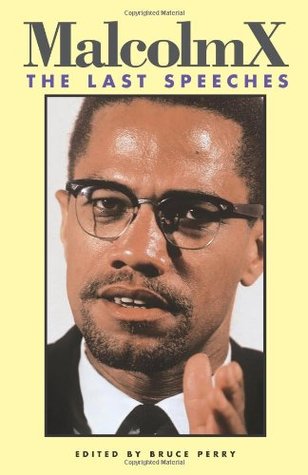
 If you read The Autobiography of Malcolm X, the most widely-read of the books about Malcolm, you will get an idea of the general development of his self-education in prison, and of his attraction to, and eventual prominence in, the Nation of Islam. This volume, in contrast, shows the speeches he made when he broke with the Nation of Islam and decided that the struggle for racial equality was tied to class struggles, and that this meant that people who were not Black could still be part of the fight that he believed was necessary. It shows his attraction to socialist ideas, and these are speeches that were not published until recently, when his widow found them buried amongst a lot of other things in storage, and called the publisher she wanted to distribute these ideas. If you read The Autobiography of Malcolm X, the most widely-read of the books about Malcolm, you will get an idea of the general development of his self-education in prison, and of his attraction to, and eventual prominence in, the Nation of Islam. This volume, in contrast, shows the speeches he made when he broke with the Nation of Islam and decided that the struggle for racial equality was tied to class struggles, and that this meant that people who were not Black could still be part of the fight that he believed was necessary. It shows his attraction to socialist ideas, and these are speeches that were not published until recently, when his widow found them buried amongst a lot of other things in storage, and called the publisher she wanted to distribute these ideas.
For example, for awhile there were posters and tee shirts available for sale showing Malcolm X and Dr. King standing together. The implication inherent in overemphasizing this photograph is that the two were comrades and brothers in struggle. I can’t believe the number of young people I taught believed that Malcolm “wanted peace”. Whereas this is true in the long run, it isn’t what he talked about. When middle class Caucasians were interviewed on TV and they pontificated that it was important for those Black demonstrators walking across the South, being confronted with tear gas, firehoses, police dogs, and arrest, to remain nonviolent, Malcolm responded, “I will be nonviolent when the White man is nonviolent.” In contrast to the ideas of Dr. King, Malcolm was ready to fight for his rights. It was in the last year of his life that he realized that the material interests of the entire working class dovetailed, and he targeted the ruling rich as his oppressors, (correctly so in my view), rather than blaming all members of any ethnicity or race. This was an enormous change from the belief system he had espoused while he was with the Nation of Islam. These speeches serve as the clearest documentation of this change. These speeches are important, though their context was quite different from today’s, because they break up the myth that mainstream media and US government sources have built up surrounding Malcolm X. If you can’t stamp out someone’s speeches and memory, what do you do instead? You co-opt them, sanitize them, find a way to make more in tune with what you wish they’d been. And that’s what has been done to Malcolm X’s legacy, by and large. For those who are seeing a big difference between his earlier speeches and the ones published here, it is not hypocrisy, it is development. It takes a lot of integrity for someone who is famous and controversial to admit he has been in error, and explain what his new viewpoint is, and why he has changed his way of thinking. If you don’t read this book, you will not know the whole evolution of the ideas and political program embraced by Malcolm X over the span of his life. All of this has more relevance than ever now that we are in the midst of a second, perhaps even more vital civil rights movement. Malcolm’s philosophy and political perspective should be widely read. He’s been gone for a long time, but nothing can kill his ideas, and we need them now. |
Tag Archives: history
King Leopold’s Ghost: A Story of Greed, Terror and Heroism in Colonial Africa, by Adam Hochchild *****
Just as Europeans once looked upon the Americas as land that was unclaimed and waiting to be discovered, explored, and claimed by Caucasian Christian civilizations, so too was Africa, referred to as “The Dark Continent”, ripe for exploitation when the Europeans arrived.
Initially, through their own caste system, tribal chiefs were absolutely delighted to trade away the Africans they themselves kept in bondage for the wonderful new munitions, cloth, and other goods that were offered. But their satisfaction turned to horror when they learned that where Black folks are concerned, Europeans just don’t play by the rules. King Affonso of the Congo sat down and wrote a letter to the ruler of Portugal, explaining that he had sent his son to Europe to attend school, and he was never heard from again. Now he has learned that his own family members were being rounded up by slave traders! There must surely be some sort of mistake.
African missionary, explorer, and British emissary Dr. David Livingstone traveled to Africa and was the first known (at the time) European to cross Africa from coast to coast. He returned to England to be feted and celebrated, and then plunged back into Africa…and stayed there. He was happy. Why go home?
Henry Morton Stanley was a journalist of uncertain origins (see the book) who went in search of Livingstone and found him, uttering the famous quote, “Dr. Livingstone, I presume?”
Meanwhile, a royal in Belgium grew restless. Leopold had delusions of grandeur, and why not? If France, England, and Spain could enjoy colonialism, why not Belgium as well? Leopold thirsted for power. He wanted to become a king. As African territory was snapped up piecemeal, he leapt in and grabbed a slice through the middle, in what would for a time be known as the “Belgian Congo”.
By now, slavery had been declared illegal in Britain, and so Leopold strode in to civilize and Christianize dark-skinned people whom he was certain could not do so for themselves. A great road was built there…and it went straight in from the ocean, and straight back out again. Leopold had learned of the ivory to be obtained through the wholesale slaughter of elephants. He offered prizes to locals who brought these forward, and assured them they would be protected from the aggression of any other European powers. What a deal. Leopold sponsored Stanley and gave him the royal seal of approval when he went in to further explore the area. In the end, Leopold claimed all of the Congo, an area, says the author, the size of the United States east of the Mississippi River. Many different tribes and cultures, some peaceful, some not, were brought under his ruthless leadership.
Leopold himself was almost a perfect villain, obsessed with power and obnoxious even to other Europeans of his time and station. When Prince Albert visited the new palace Leopold was having built, he believed he was complimenting the man when he said it would be like “a little Versailles”. Leopold took offense instead. “Little?”
But as amusing as anecdotes like this one are, the brutal fact is that tens of millions of Africans were killed under European colonialism. When Belgium was more or less forced to grant sovereignty to the people of the Congo, he sabotaged the new government of Patrice Lumumba, a popularly elected leader, by refusing to let go of the mines where the remaining mineral riches of the nation were located. The United States helped him crucify this man and was party to the manipulation of tribal rivals. Wholesale slaughter of unimaginable cruelty ensued. Multinational corporations were “also in on the take”.
Though this is a painstakingly written and riveting account, and the research undeniably fastidious, well documented, and scholarly, I would differ with the lame conclusions drawn at the end, namely that the United Nations should have sent in a peacekeeping force during the transition. Who is in the United Nations? Britain and the US, for starters? What a pitiful conclusion to an otherwise brilliant book. I know that if Malcolm X were here, he’d say this was “like leaving the fox to guard the hen house.” For this reason, I considered giving four stars. It’s just too well done otherwise to deny it all five, with this caveat: those final two pages of conclusions should cause any reader who makes it this far down in my review to understand I really mean, four and a half stars.
I say the only way the Congo or any other African nation can rule itself is for colonial powers to get out. Go home. There is nothing there that they own anymore; it’s over. Africans can rule Africa, as long as colonialists let go of the entire pie.
All Standing: The Remarkable Story of the Jeanie Johnson, the Legendary Irish Famine Ship, by Kathryn Miles *****
The Irish potato famine is at its worst. Blight kills all of the potatoes–my god, even the ones that had been harvested and stored away in root cellars where the families thought they could access them!–and the potato was nearly the only crop that the Irish had. Millions depended on charity (nearly nonexistent) or the government, and unspeakable numbers died, while the grain that had grown was shipped abroad as an export for sale. Local farmers who had a surviving patch of turnips or even a single cabbage had to post a guard overnight, or someone else would steal it. Unfathomable.
I was sent a free copy of All Standing as part of the Goodreads First Reads program. My gratitude goes to Goodreads and the publisher for the book, and to Miles for ferreting out the facts to tell this story properly. Research is such tedious work, and here she has done so much to tell an important story.
The first seventy pages of this story are bleak, miserable, horrible, terrible. Miles does not let us go gently. The documentation is well done, and the statistics and examples lend a special sort of dread to that which was macabre to start with. There is no way to Disney-fy a story like the famine and still have it be real history. And those who buy a place on the “coffin ships” for the small chance that they may survive the trip to the new world die in droves, primarily of typhus, though a small number are fortunate and survive.
An innovative ship builder, an experienced and humane captain, and a doctor who was ahead of his time combined to make the Jeanie Johnston exceptional. It is for this part of the story, as well as the righteous anger that serves as the transition from utter misery to success, that those who love Ireland, history, or better still, both should read this book. It is a beacon that is welcome in times such as ours, one that reminds us that one person, or two, or three who have the courage of their convictions really can make a difference to others.
The Counter-Revolution of 1776: Slave Resistance and the Origins of the United States of America, by Gerald Horne *****
| Generally I don’t review a book till I have read every last word. I make an exception only when I find work so excellent that I am convinced that if the book ended right where I am, right now (about 75 percent through, and of course I checked the sources), it would still be worth the full cover price. I will read the rest, but you need to know about this book RIGHT NOW.
Reading this galley, courtesy of the publisher, New York University, via Net Galley, made me feel as if the American history I studied as an undergraduate and then taught for twenty years in the public school system was so incomplete as to be incorrect. If you care about American history; if you have ever wondered why Black anger still runs so deep, especially in certain parts of the USA; if you scratched your head over parts of American history as it has been presented and the ways it did not make sense, then you must read this book. The fact is that America’s early Black population, as well as that of Blacks in the Caribbean, behaved with much more courage and savvy than they are given credit for in standard history texts. The role of Spain that Horne explains here, as well as that of the Catholic Church, and of the Cherokee people, is startling news. And the fact is, what I read here makes me ask questions about all sorts of other events, such as the Louisiana Purchase (the significance of having included Florida in the deal is a monster once this new information is merged with what we knew before), to the Trail of Tears and banishment of the Cherokee Nation from Georgia, to the question I was never able to adequately answer for my own bright students: “Where did the free Blacks come from?” It’s here. It’s all here. America’s students have been robbed, up to this point. If you are a teacher, you have to get this book, even if it means buying it out of your own pocket. You can’t tell the truth without this book! In reading this outstanding work, knowledge of basic place-name geography is critical. A lot of people these days have no idea, for example, where the Bahamas stand in relationship to North America, which US states are where, or even which European nations are closest to the Caribbean and the USA, and if you are fuzzy in this regard, you may need to pull out a map or grab a globe so that you can see how much that proximity matters. Those miles are important miles, and this information is massively different from what I was taught, and it is well enough documented that I am convinced it is true. And it makes so much sense. I can’t hold this review until I have finished the book. I want all scholars who have been stuck in the dark through wrongful and errant selection of information in their own educations to know this book is available, and that what it imparts is huge. Black students deserve to know the truth; their history in the US is not one of pure terror and subjugation; their ancestors fought, and they thought, and they behaved politically. This knowledge is a basic right, not only for them, but for anyone who cares about the truth! |
Tara Revisited: Women, War, and the Plantation Legend by Catherine Clinton *****
 |
First of all, if you are planning to visit Georgia with your family, don’t ask the tourist bureau to help you find Tara! It isn’t there. Neither is Scarlett or Mammy. They’re all fictional.
Thank you; I feel much better having cleared the air. But nobody can make it clearer than author Catherine Clinton, who bursts the myth of the antebellum belle and her loyal house-slaves better with greater heat and light than I have ever seen done by any one historian before. In a time of increasing apology and revisionism that makes the American Civil War seem to have been merely a dreadful misunderstanding, and that decreases the social and material weight of the slaves it freed, Clinton’s historical smack back to reality makes me want to stand up and cheer! And also to thank Net Galley and Abbeville Press for the ARC. Clinton focuses primarily on Southern women, but she takes just about all of the myths of the “Lost Cause” and puts them through the shredder, introducing them and their origins, and in a manner meticulous but never, ever dull, demonstrates why each of them is incorrect. She doesn’t pussyfoot or hesitate to call bigotry by its name, but the tone is of the compelling storyteller rather than that of the lecturer. In a day when Caucasian Americans sometimes carelessly discard the complaints of people of color as “playing the race card” without first examining to see whether it has in fact been called out righteously, this succinct yet thorough narrative is refreshing, as if someone has opened the windows and let some of the cobwebs sweep away. Clinton uses the voices of Southern women, both Caucasian and Black, and recognizes that there is a dearth of the latter, but she has turned over every possible rock and ferreted out every last resource in the back stacks of government libraries dating clear back to the WPA to access what is available. She also quotes Mary Chesnut, a Caucasian Southerner whose diary is a mainstay of Civil War historians, enough and in enough interesting ways to make me want to go dig up my own copy, which bored me to tears the first two times I tried to slog through it. Filtered through Clinton’s prose, it is a lively and interesting vantage point. And she quotes WEB DuBois, one of my greatest heroes. There is one area where most US historians dislike to tread (or are perhaps unaware), and I read on with interest (this being the field in which I taught for many years) to see whether she would go there. She did. Not many American historians can bring themselves to discuss the deepest Southern shame (and by extension, America’s for having accommodated it so long) of slave breeding, a practice done in no other part of the world. In a time in which slavery was dying out across Europe, US border states, which had difficulty growing crops year ‘round to sustain the (minimal but still existent) expenses incurred by slaves, had turned to trafficking in human flesh, going so far as to select who should sleep with whom out in the quarters so that they would have the best possible product to sell once the progeny was born and weaned. Clinton does not use the word “breeding”, but she does describe it accurately. She also points out that actually, most white Southern women did not lead the lives of idle privilege that the cinema would have us believe; though their lives were many times better than that of slaves, they had a large household to manage without the labor saving devices technology would bring. And of course, most white households were not those of planters. She discusses the various social crumbs that were dropped for less affluent whites by the aristocracy in order to keep them from crossing the color line in solidarity with other toilers. I usually must abbreviate my reviews for fear I will give away all the meaty parts of a book and leave the reader no real purpose in checking it out personally. There is no danger of that here. This narrative is so deftly and expertly crafted that I found myself bookmarking more than half of its pages, because so many had a salient fact, interesting quote, or well-turned interpretation. I constantly found myself thinking, “Yes!” When Clinton mentioned the Southern fear of “miscegenation”, or racial intermarriage, this reviewer could not help a small intake of breath, given that in other times, I would be deemed guilty and my husband would likely be dead. If you have any interest whatsoever in the American Civil War, you need this book. If women’s history is of interest to you, get this book. If you care about issues of race in the United States, there are two recently published books that should adorn your shelves and be next-read if you have not done so: this book is one, and Isabel Wilkerson’s The Warmth of Other Suns. In a sense, Wilkerson picks up where (chronologically) Clinton leaves off. And if you have already read Wilkerson, you still need to read Clinton. What are you waiting for? Get out your credit card and order the book. You won’t be sorry. |
|---|
 Seattle Book Mama