
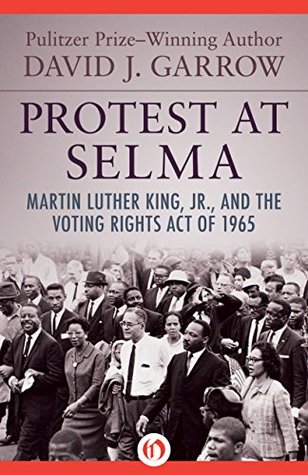
 This newly released digital version of Garrow’s outstanding, comprehensive recounting and analysis of the famous Selma demonstrations carried out by Martin Luther King Junior, other civil rights leaders, along with masses of African-American civil rights activists could not be more timely. In 2013, the Voting Rights Act passed in 1965 after a lot of effort and sacrifice was gutted. The US criminal “justice” system has drawn the eyes of the world, and they aren’t friendly eyes. Thank you, and thank you once more to Net Galley and Open Road Media for making the DRC available for me to read, and for publishing this excellent book digitally for you to access also.
Please be aware that this is not a popular biography of the struggle, but a scholarly one, and will be most appreciated by those who, like your reviewer, have a strong interest in the topic, or who are doing research. In that spirit, I encourage those who also read it to access the endnotes. Garrow has some really interesting remarks, and his references and cross-references will make any researcher bow in awe.
Many people don’t know that Dr. King entered the struggle as a civil rights novice, newly out of graduate school and just 26 years old. (Open Road has also just released the digital version of Garrow’s Pulitzer-winning biography, which I have also reviewed.) Initially his hope was to shame segregationists into integrating schools and providing equal services to Black Southerners. The failure of the movement to make any in-roads in Albany, Georgia convinced King and other leaders that this method would not work. Instead, the eyes of the nation must be made to witness the injustices being meted out in Dixie. For the media, both print and television, a relatively recent mass media source, to pick up events there, they needed to demonstrate in a nonviolent fashion, not back down, and do so in a place where a nasty, violent response on the part of Caucasian cops could be counted upon. In other words, no change could take place without confronting Black America’s worst nightmares head on and intentionally.
Birmingham was the first place this was attempted. Bull Connor was known for gratuitous violence, and the footage of some really ugly aggression, especially the widely-circulated photo of the cop holding an unarmed demonstrator in place while siccing a huge German Shepherd on him, prodded the consciences of Caucasian viewers in the North. (Many Northerners of color were already funding the movement; musician Harry Mancini was one important fundraiser.)
But the attempt of Birmingham demonstrators to effect change was limited. Although it drew international attention, the Kennedy administration seemed more intent on finding ways to shut King and the Southern Christian Leadership Conference down than they were on creating adherence to Federal laws that gave Black folks equality.
Garrow reminds us (or informs us, depending on the reader’s age) that in the late 1960’s, one in three white Americans polled said they would not want to sit next to a Black person on a train or bus, and similar figures also showed that they didn’t want African-Americans living near them, at their kids’ schools, or even trying on the same outfits in department stores that they themselves might later try on.
Young people that are tired of hearing the Dream speech and watching Eyes on the Prize footage (for which Garrow also receives a portion of the credit) don’t seem to understand exactly how brave these people were. My own father told me, when I asked about the footage on television, that the policemen on the evening news were just doing their jobs. He shook with rage as he pointed at the screen and told me, “These people are breaking the law!” I was six years old at the time.
So some people up North needed to either change their minds, or be so repelled by the violence being done to innocent people who obviously wanted something reasonable that they would insist that the right thing be done. And although the movement never did change my father, it changed the thinking of a lot of people.
Birmingham failed to do the job for two reasons, says Garrow . First, they were not able to maintain a completely nonviolent atmosphere on the part of the Black participants. While demonstrators were nonviolent, thousands of African-Americans, some of whom dared not demonstrate actively lest they lose their jobs, became enraged at the maltreatment of the demonstrators; some threw pieces of bricks, concrete, and bottles at the cops from the sidelines.
When I think about this, it doesn’t seem like an even contest to me. Swarms of cops in riot gear; huge attack dogs; fire hoses; lethal weaponry of just about everything except tanks and missiles were accessed by the cops. And a few locals pitched a few bottles. Big damn deal.
But media loves to try to portray both sides of an issue, however uneven they may be. My own years spent participating in, organizing, and sometimes leading demonstrations taught me that if one demonstrator or supposed supporter shows aggression and can gain the media’s attention, the demonstration will magically turn into a “riot” on the news the next day. Or a “conflict”. We can find synonyms all day long, but you get the picture. When there are ten thousand peaceful demonstrators and ten people that break windows, the evening news will give as much time, or more, to the window breakers as the ten thousand. If a member of the lunatic fringe shows up with a forty-foot bloody cross, they’ll goddamn interview the nut and the demonstration’s goals may not get any time at all.
But the people that trained me in struggle were largely educated by their own participation in the Civil Rights movement. The methods of the Civil Rights movement would become valuable lessons for those that led the movement against the Vietnam War. The SCLC, SNCC, CORE, and other organizations that led this movement had to invent most of it, or at least Americanize it; many of the basic tenets were borrowed from Gandhi when he led the movement to kick Britain out of India.
So, there were a few folks that were not strictly nonviolent in Birmingham; the other problem, says Garrow, is that there was no one, clear goal in Birmingham. So much was so wrong that they went in with a laundry list. When it got into the news, it seemed muddy. Those who loved justice could see what was wrong; but every struggle needs a single, clear demand in order to start those waters of justice rolling. In Birmingham, it wasn’t plain what they were there to do.
Selma was the tipping point. All those lessons came into play. The single goal, one that the Democratic administration had pledged (privately of course) to support, was for Black folks to be able to walk into the courthouse and register to vote. No literacy tests; no poll fees; no goddamn alley entrance for people of color. Just walk through the front door; register; and vote.
This time discipline was perfect; the marchers were absolutely, completely nonviolent. Sheriff Clark, the mad dog that the movement sought to bring out of his ugly hole snarling and swinging, did not disappoint. People were sent to the hospital, and a Caucasian clergyman who answered Dr. King’s call to come support the Civil Rights of Southern Blacks was killed by the cops. This time it was clear what the goal was, clear who was wrong and who was right. And the telegrams (an ancient technology since replaced by e-mail) rolled into the Capitol.
Black intelligentsia and working class, I; crazy Southern Bubbas, 0.
President Lyndon Johnson was a crafty old bastard, a politician who knew what side his bread was buttered on. At first he too sought to shut the whole thing down, get people out of the streets and home to their own hearths. But when events unfolded and it became clear that a sea change was occurring, he got on television and gave the best damn speech possibly since the days of Lincoln. Garrow reprints the entire masterpiece. It was viewed by seventy million Americans.
If you are still with me—and my five star reviews are almost never brief—then you may also have sufficient interest to read Garrow’s history of the movement and particularly of Selma, Alabama and the crossing of the Edmund Pettus Bridge. His research is impeccable, his organization easy to follow (or to access a portion of, for those doing research of their own), and his narrative is really compelling.
Once you are done, I hope you will give some time and attention to the new Civil Rights Movement unfolding before us right now. It’s everyone’s job to be sure everyone can vote. And until African-American men and teenagers can drive, walk, and work without harassment or violence from cops and vigilantes, #ICAN’TBREATHE.
Tag Archives: history
The Oregon Trail: An American Journey, by Rinker Buck *****
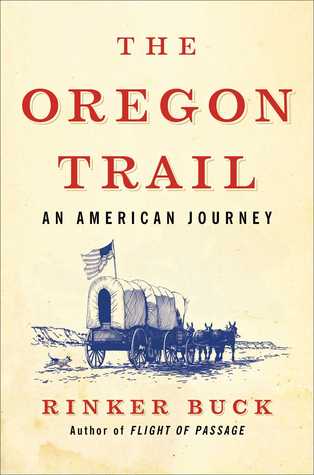 Buck is a journalist and author who replicated (to the extent possible in modern times) the covered wagon crossing of the old Oregon Trail, much of which still contains the original wagon ruts. A creature of the Pacific Northwest myself, I thought I had the whole Oregon Trail story down cold, but I learned a lot from Buck’s wonderful memoir, which threads his own experience with the historical information he gleaned from a variety of sources into a fluent, fascinating, accessible yet hyper-literate narrative. My great thanks go to Simon and Schuster and Net Galley for the ARC. The book will be available to the public in August of this year.
Buck discusses his experience, and the book, here:
The germ of Buck’s idea to travel the old Oregon Trail in a covered wagon came from a favorite childhood experience. Buck’s father took his large family on a covered wagon vacation during the late 1950’s. They traveled in New Jersey and Pennsylvania, and it is one of the author’s fondest memories. His brother Nick, who sounds like a real character, decided to join him on this adventure, and their skills complemented each other wonderfully in most instances, with Rinker having done a great deal of research and put up the considerable sum it took to buy the wagon, the mules, and so forth, and Nick having a wealth of eclectic knowledge about covered wagons and mules as well as tremendous mechanical aptitude in general.
Our author is one hell of a writer. His down to earth metaphors made his story accessible for modern people. For example, he says that the Conestoga wagon was the semi truck of the mid-1800s while the prairie wagon used by most families, which was made by Sears Roebuck, Studebaker, and John Deere, were more like the station wagon. The whole narrative is peppered with this sort of figurative language, and it’s both amusing and helpful. And I loved seeing the ways in which the problems of the early pioneers often became his problems also, sometimes in ways that would have halted an ordinary traveler right then and there. But Rinker and his brother are serious badasses, and they kept on going.
Think for a moment how high up the driver’s seat on a covered wagon is, for example, and how immensely soporific the repetitive clopping of hooves are on a very warm spring day. There is no safety belt; there is nothing whatsoever to keep a man from falling off and being crushed beneath the wagon.
Narcissa Whitman, one of the early settlers who together with her husband, founded the Whitman mission in Eastern Washington (part then of the Oregon Territory) made the trip on horseback. But she had no safety belt either.
The Mormons, or Latter Day Saints, did a whole lot of it on foot and pushing carts; those that lived through the experience populated Utah. But I agree with Buck that Devil’s Gate was not solely part of the Mormon experience, and President Bush had no business turning federal park lands over to the LDS Church. Frankly, it steams my clams all over again just writing about it…moving on.
I also have one small bone to pick with Buck’s research, though it isn’t enough to lop a star off my rating: he says that the 400,000 pioneers that crossed the Oregon Trail was the greatest overland migration in history. To be fair, when he wrote this, it was widely accepted as truth. But in 2010, Isabel Wilkerson documented an overland migration of 6 million African-Americans from the South to Northern Industrial cities and also to California between 1915 and 1970. The Oregon Trail, then, may be the second largest, but not the largest.
I also might have liked to see a citation accompany controversial facts tossed in, such as the claim that it was covered wagon makers, not Henry Ford, who started the mass assembly line. Generally I liked the flow of the text made possible by avoiding footnotes, but if one is going to butcher a sacred cow, one should back the assertion with a source.
But all these things are minor compared to the value, both in education and entertainment provided by the story of the Rinker brothers’ modern day reenactment, which is nothing short of spellbinding. I had just begun it when I came down with a case of flu, and I can’t tell you how comforting it was to curl up under my covers with my glass of orange juice and this book and immerse myself in their journey, which commenced in Missouri and like the original pioneers, continued across six states. And although I have never done the trail itself (and if I were to do so, I’d be one of the Winnebago set that made him half-crazy with their giant rigs that spooked the mules and their never-ending cameras winking at him and blocking his way), I have driven through all of the states he crossed through except Kansas.
It was useful to have traveled through most of the region that Buck described, yet his descriptions were so palpable that I think even if you have never been there and never plan to, you will see much of it in your mind’s eye.
I’m not sure what is the most remarkable part of this wonderful memoir: the novel aspect of the covered wagon trip during the 21st century, or Rinker’s voice, which switches seamlessly from that of historian, to that of family member with family issues, to that of the humorist who can appreciate life’s ironies even in adverse circumstances. All I know is that you don’t want to miss out on this one. What a terrific story!
Lucy Stone: An Unapologetic Life, by Sally McMillen ****
 This well-documented, balanced yet sympathetic biography serves to advocate for the inclusion of Lucy Stone among the statues of great Americans at the Capitol rotunda in Washington DC. Currently there is a suffragist statue that includes Stanton, Cady, and Mott. McMillen makes a strong case that Stone should be there as well. This well-documented, balanced yet sympathetic biography serves to advocate for the inclusion of Lucy Stone among the statues of great Americans at the Capitol rotunda in Washington DC. Currently there is a suffragist statue that includes Stanton, Cady, and Mott. McMillen makes a strong case that Stone should be there as well.
Thank you to Oxford and Net Galley for the ARC. The book will be available at the end of January. The history of the American feminist movement is a cause near and dear to this reviewer’s heart. I have studied it, taught it, and lived it. I have marched on that Capitol numerous times in defense of the right of women’s reproductive freedom, despite the fact that most of my life has been on the West Coast of the USA, and that is one long ride. And so, having recently veered out of my historical comfort zone, here I found myself right back in it. And most of the information in this book, while useful, is not new to me. The reader should know that although there is extraneous material that ought to be edited out, it is all at the beginning of the book. If you are interested in the history of the suffrage movement and/or American feminist history in general, get a copy of this book, and don’t be discouraged by the initial ten percent. It does get better. It probably won’t change the statues in DC., but regardless, what McMillen imparts here is (for the last 90%)thorough, well documented, scholarly, and unflinching when less attractive issues arrive (such as the race-baiting, anti-immigrant speech-making, and the squabbling after the split in the organization occurred). Stone was a remarkable woman, strong, charismatic, and imbued with many ideas that were well ahead of her time. Unlike most of the women who participated in and lead the women’s movement of the nineteenth century, her own origins were not petit bourgeois, or middle class. She was born into a farm family that struggled financially, and still she attended Oberlin College, the first in the nation to accept women and permit them to attend college with men. Her education was not a gift doled out from parental largesse; she taught school in order to pay her way. (Her father relented when she was a senior and paid for the last year).There were a number of restrictions on women there that seem ridiculous now and that Stone fought against and sometimes won. Her steely determination, keen intelligence, and personal magnetism led her to be the first woman to enter the then-popular public speaking circuit. In these days before the American Civil War and after the Industrial Revolution, there was of course no media beyond the printed word. Many people were hungry for new information and ideas, but books were very expensive and newspapers, though plentiful, were often incorrect and for many, insufficient. (This paragraph is not in the book; this is me speaking.) So it isn’t really surprising that those who had the time and the means would turn up to hear speakers on important issues of the day. Many were shocked, McMillen tells us, to hear that a woman, a single, unescorted woman, had taken this path. Stone was considered a radical, but her musical, sweet-sounding voice and her petite countenance, which she deliberately dressed in black silk and lace to take off the edge, took many off guard, and newspaper reviews were often quite favorable. Over the course of time she became famous. She proposed things suggested by no one else, such as the advantage of a woman’s remaining single so that she could keep her own money and property rather than to turn it all over to her husband, as the law required should she wed. Further, she suggested, the law ought to be changed so that such a choice need not be necessary. Later she met Susan B Anthony, and the two were, for a time, close friends, addressing one another by their first names at a time when only the most intimate of acquaintances did so. And just as their political agreement formed the basis for what appeared to be an unshakeable friendship, so it would later cause a rift, not only personally, but in the movement itself. For those interested in women’s history, American history, contemporary history, or Stone herself, consider this a must-read. Skim through the extraneous bits at the beginning and once the narrative truly takes wing, it will keep your attention. |
Napoleon: A Life, by Robert Andrews *****
 Robert Andrews has created an historical masterpiece in this massive tome, a biography of Napoleon. Thank you and thank you again to Net Galley and Viking Adult Publishers for the ARC.
Andrews is well known among historians; his scholarship and experience firmly establish him as an expert in the field of European history, especially military history and biography. The recent availability of a vast treasure-trove of primary documents made this biography possible, together with a tremendous amount of work and travel. He visited libraries all over the world and battle sites where Napoleon had been before him, before all of us. (And he set off the alarm in Napoleon’s throne three times!)
How long did this take, I wonder? By the time it was published, Andrews must have felt an overwhelming sense both of loss and of satisfaction.
As for your humble reviewer, I came to read about Napoleon, whose military career, rule, and downfall I had studied only at the shallowest level during my undergraduate years a whole long time ago, through the back door. My field is the American Civil War, but I was intrigued by the number of Civil War heroes (and others) who had studied Napoleon’s methods in detail, and referred to them when creating their own battle plans. What was it about Napoleon?
Generally, my advice to those contemplating reading a lengthy biography is to get the basics down first, but I didn’t follow my own advice here. I had the opportunity to get the ARC at the end of November, and it was now or never. I decided to plunge in, poorly prepared though I might be. When I was finished, I found I had bookmarked or made notes in over 700 places in this 926 page work. So whereas I won’t use all of my references, I can truthfully say that there is no filler, no fat. If you haven’t the patience for almost a thousand pages of Napoleon, then don’t go there, but for heaven’s sake don’t pretend that more is included here than is necessary for a thorough, scholarly, yet interesting treatment.
Having said that much, I also have to confess that I struggled somewhat with the ARC. My knowledge of European geography is pretty basic. I know where most of the countries are, what their climates are like, and for the most part, where the borders are located. When we morph into the Napoleonic era, I really, really needed maps, and that’s the price one sometimes pays for an ARC: your “map” is [map insert] noted. There will be a map; I don’t get to see it. So I gamely brought myself to my desktop for the first four Coalition Wars, and was lucky enough to find an interactive map that gave me part of what I needed to know. In some places, Andrews explained what took place so well that I could see most of the battle inside my head. But as of the fifth coalition forward, I quit trying to find my own maps when I couldn’t follow the action, and just read what was in the book.
All told, Andrews corrected some misperceptions I had developed regarding Napoleon. My own view had been that there was a heroic French Revolution, followed by what are usually termed “excesses” by the Jacobins who began the Revolution. (Today these en masse trips to the guillotine would be called atrocities.) But could the whole thing be salvaged? It seemed such a terrible waste to have a popular revolution, throw out not only a monarchy but one unusually lacking in decency toward the peasants and urban poor of France, and then have it all come tumbling down. And it also seems like a waste to have an autocrat take over. This was my perspective before reading Andrews’s biography.
Though his approach is both scholarly and balanced, Andrews offers a positive portrait of Napoleon, whom he treats with a fond, almost affectionate narrative. He points out that Napoleon kept the Bourbons off the throne for over twenty years, and it’s true that they returned in 1815 after Napoleon’s first abdication. Things got really ugly then. And he also points out that Napoleon’s career was unusually complicated. The point is well taken.
For example, who invades neighboring nations, overthrows their leaders, presumes to rewrite their constitution without consulting anyone that lives there…yet bestows upon them more civil rights than they have ever had before? And who else would insist in his terms for peace not only remuneration so that he can pay his troops and the annual benefits of military widows, but also demands that great works of art, privately owned, be turned over to him…whereupon he places them in a gallery where all visitors can enjoy them?
Mind you, the man is no Robin Hood. Far from it! He makes it clear from the beginning that he has no use for the ‘hoi polloi’, and whenever he ceases privately held property, he also sees to it that the previous owner is compensated.
The word “hubris” is often applied to Napoleon, and if not him, then who? Andrews argues that he might have been successful…if only. And there’s the rub, right? Because initially, he and his troops travel fast and hard. In the beginning, he asks nothing of them that he would not do himself. His opponents, on the other hand, are spoiled and effete. They travel with vast amounts of personal baggage and servants. They can’t move until they personally have this, that, the other. And in the end, that is the guy that Napoleon becomes.
The text is made more lively throughout with quotations of Napoleon himself, a prolific writer and a brilliant, articulate speaker.
The chapters are organized according to place, generally speaking, and this is very useful when the reader needs to go back and fact-check.
Andrews argues that Napoleon’s autocracy-as-meritocracy might have been successful if he had applied the standard to all of the dynasties he created after toppling their rulers that he applied to France. Nepotism created endless problems, and though Napoleon somehow thought that he personally might make up for the failings of his relatives, there is only so much one man can do. The many, many worthless siblings and other relatives he installed as instant royalty drained his resources and made problems that didn’t have to happen. His first wife, Josephine, was such an obsessive spender that one hates to think of the number of children under age six who might have lived had the wealth been more widely distributed.
Napoleon’s most loyal base of support was within the military, but he fought so aggressively that too many soldiers died, and the backlash was bound to come sooner or later. Yet the military base he so depended upon wanted him back again after just ten months of Bourbon reign.
Could Napoleon have been successful if he had left the Iberian peninsula alone? If he had avoided attacking Russia? Napoleon himself, upon looking back while in exile during his last years, recognizes that trying to best Britain, with its unstoppable navy, was folly; yet he certainly kept them busy for a good long while.
At one point, he reflects that if he had known he would end up defeated, he could have made different choices. He would like to be allowed to emigrate to the United States; who knows, he could have founded a state there! And here, my jaw drops as I imagine that instead of selling the Louisiana Purchase (which doubled the size of the USA) to the USA via President Thomas Jefferson, he had decided to settle it. But being Napoleon, would it have even stopped there, I wonder? He hated Britain and had nothing against US rulers; maybe he would have been able to kick the British out of Canada instead of fruitlessly attempting to rout them from their homeland.
Suddenly I can see how Andrews has become spellbound by what might have been. He has spent a lot more time with this material than I have, and it’s starting to affect me, too!
I know that some of those who read my reviews are teachers. I don’t see this as high school material; a small portion of it could be selected for honors level seniors or community college students perhaps, but then you have huge books to buy in order to use just a portion. I don’t see even the most gifted teenager sticking it out from start to finish. Though the narrative is engaging, the definitive biography is epic .It requires patience and dedication on the part of its readers. Developmentally, most young folks in their late teens and early twenties just won’t be there yet.
But if you are in doubt, buy one copy and read it yourself, then pass it around a little bit and see how it goes. Likewise, if you are homeschooling a truly extraordinary teenager that you think would gobble this up, buy it, read it (because you can’t home school anyone using a text you have not personally read), and then if you still think it may work and your student is game, give it a try.
All told, the price you will pay for this remarkable single volume biography is nothing compared to its worth in your own library, even if only used as a reference source.
Victorian Murderesses, by Mary S. Hartman ****
 It took me awhile to decide to include this title on my blog. The problem as I saw it was that it was marketed in October as a fun-but-naughty romp through history. The reality is less interesting, and to my eye, unbelievably dry. My daughter, a high school student, saw it differently. The four stars are our compromise between my three stars and her five.
“True crime” is a big house with a whole lot of rooms. Some true crime books are deliciously prurient; others are as dusty as the top of a ten foot tall bookcase. In this case, the title (“unspeakable”) and the jacket artist lead the reader to believe we are really going to get down and dish the dirt, and what is more…it’s all true!
Instead, what we have here is a very well-written, well-documented, extremely scholarly if surprisingly dull bit of research, maybe the author’s advanced degree work. The collision between the teaser and the product are somewhat jarring. This was a First Read sent me free through the Goodreads program and the publisher. I would have abandoned it more readily had I not felt a duty to get through it.
What would have fit the bill without ruining the author’s hard work is a good piece of juicy narrative nonfiction. Put in the documentation, but pick up the pace! As is, the book is sometimes a feminist treatise that all but blames Victorian society’s social contract for slut-shaming as an understandable excuse for murder in the case of unsuitable, unmarriageable mates of the lower classes (sorry, no sympathy here), or a self-defensive maneuver against constant verbal abuse, without the loss of a high standard of living that came with the ornery groom. A baby born out of wedlock gets snuffed when an abortion can’t be obtained. The author is inexplicably sympathetic to the not-for-long-I’m-not young mother. Don’t get me wrong; I am pro-choice and an ardent feminist, which you already know if you’ve been reading my blog long. But we’re talking about an infant carried to term, birthed, then suffocated. It turns my stomach to think of it.
At other times, the pace quickens a bit, as if the author is about to get excited and take us along with her, but then her dispassionate researcher’s mind grabs hold of her–stop it right now, you’re getting worked up!–and we go back to the librarian’s hushed monotone.
The font, while suitably Victorian, is really tiny and hard on the eyes.
It may be that I am being unfair to Hartman; she has done a good deal of work here, and the fault may lie with Dover or whoever is publishing and promoting her work. All I know is that I expected this to be a fun read, and it wasn’t. I kept pushing it away in favor of other reading, as if postponing the book might make me like it better once I returned to it.
My daughter, on the other hand, took it to a corner and became disconcertingly fascinated by it, not unlike a cat who’s just found an aquarium full of fish. Hmmm! Her explanation: “It’s even better than I expected!” Well…okay. And now, it’s HER galley.
A strong, scholarly effort that should have been marketed as such. Not a Halloween read.
History of the Battle of Gettysburg, by Craig Symonds *****
 |
Ordinarily I have little patience for anyone who picks up a book on US military history and just wants to look at the pictures.
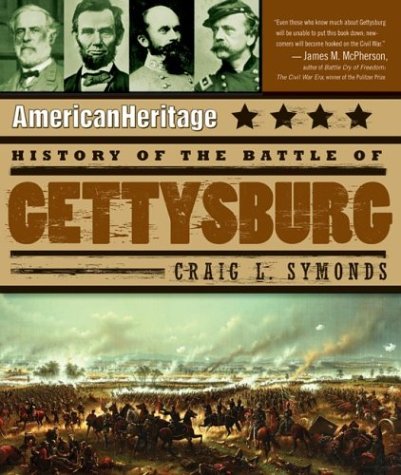
But I read the text. In most places it’s fine, but once you start reading McPherson and Sears on Gettysburg, there isn’t much that Symond’s text will tell you that’s new. Symonds sticks to the basics, and he gives you the brass tacks, if you want to cut to the chase. He is the retired chair of the US Naval Academy. His background speaks for itself, and he is highly lauded as a Civil War scholar. And look at the pictures! The American Civil War was the first US war that had photography available. No, they couldn’t take action shots yet; the subject had to remain stationary for too long at a time for that to work. But there are a lot of primary documents here, photographs of leaders, of letters and memos as they were originally written (with the text beneath them if illegible; spelling was pretty much a discretionary practice back then). There are photos of battlefields with men still lying on them. (It is now considered a breach of national security for the press to go to Afghanistan and shoot photographs of US troops, whether in action or in closed coffins, for the American public to see.) There are photographs of the weapons available at the time, and of landscapes you can visit today that look nothing like they did then. Look at the pictures! My favorite is a full page photograph of Lincoln. His bow tie is dusty, faded, and crooked. His hair cut is terrible. His face is creased, and it bears the hardship of many sleepless nights, and perhaps also of the death of his son and the illness of his wife. It is a picture of a real person, long before the era when presidents became packaged goods to be marketed to the American public. I have sometimes felt bad about the fact that I will likely never visit the Smithsonian. It is the dream of all serious students of American history. But my legs won’t let me get far now, and an airport is accessible only if I use the wheelchair service, which makes me feel quite conspicuous. It’s far easier to stay home and read. This book, which I purchased some time ago in hard cover, will hold a place of pride on my bookshelves for many years to come. Primary sources aren’t that easily come by. Along with Sherman’s and Grant’s memoirs, this is an important addition to my Civil War library. |
|---|
Soldier Girls: the Battles of Three Women at Home and at War, by Helen Thorpe*****
Now that this title has created some buzz, I thought I’d reblog this!

I was able to read this before its publication date, courtesy of NetGalley.com. Thanks, guys!
I am usually good for half a dozen books at a time, but I have to admit that this one story has dominated my reading hours for the past week or so. I had so many preconceptions (and yes, stereotypes) that I didn’t even realize I’d developed until I read about these brave souls who have gone to Afghanistan and in some cases, Iraq.
What kind of woman leaves the home she knows and signs up for the National Guard? Sometimes (often!) it is someone who needs money quick. Sometimes it’s a woman who is desperate to get out of her current living situation. And once in awhile, it is something done, at first, when one is dead drunk and out of control; the Guard will fix that quickly!
I’ve been a Marxist my whole…
View original post 115 more words
Landscape Turned Red: The Battle of Antietam, by Stephen Sears*****
 How familiar are you with the American Civil War? Can you tell McClernand from McClellan from McPherson? Did you know there was a General Ewell of importance for both the Union and Confederacy? One more miniquiz question: in what states would one find Shiloh, Corinth, and Fredericksburg?
What I am trying to say is that this tome, which is either the definitive work on the battle at Antietam or a strong contender, is written for those of us who are pretty well versed in the basics. It won’t explain the essentials as it moves along; there is an assumption inherent in about 400 pages regarding the approach to this battle (about the first 100 pp), the battle itself, and the consequences regarding same. Sears writes with precision and authority, but he does not write for beginners.
As you can see from the rating, I loved it.
Sears isn’t on a mission to merely recount, blow by blow, what happened when. If he were set on hundreds of pages of injury and carnage, I don’t know that anyone but a masochist would care for that many pages of horrifying detail.
Instead, he sets out to prove that General McClellan, who essentially held the Union Army hostage for the duration of his tenure as commanding general, systematically and deliberately prevented the Army of the Potomac from crushing the Confederate forces. He proves the point. Beyond any question, McClellan chose not to send his soldiers to fight because he was sympathetic toward the slaveocracy and wanted the Confederacy to achieve its goal.
He contemplated participating in a coup d’etat,unseating Lincoln and tossing out the Constitution, but the vast groundswell of demand for such a thing,which he believed existed and might carry him to power, never unfolded. Though he had carved out a base of support for himself and his views within the Army of the Potomac sufficient to cripple its use for the duration of the war, there were also soldiers in this army who were sick of not fighting for their country, and who were pleased to see him leave.
I have read other histories of the Battle of Antietam, and they served the purpose of explaining who fought where, and how much blood was shed. What no one else has done is to lay the blame where it rightfully belongs. This battle should have been an open-and-shut deal, and the Confederate forces should have been disabled and the war brought close to a conclusion. Instead, through his reluctance to fight at all and then only because it was clear that to do otherwise would cost him his job, McClellan managed to make the whole thing a bloodbath that was almost a stalemate.
Technically, it was a Union victory, and that was what Lincoln had to have to declare Emancipation and prevent Europe from recognizing the Confederacy. McClellan opposed (of course) the Emancipation, but he was already about to be fired. The question was a political one; no one wanted him to leave before the elections, lest he make a mess of them. Once Congress was once more filled with majority Republican forces on both sides, it was safe to cut the connection and send him packing.
The manner in which he was fired was done with careful attention to military procedure so that he could not contest it without clearly committing a crime.
I had long felt that too much was going unsaid about General McClellan, but I couldn’t tell what it was. I had a hunch it would not do him credit. It was a little bit like childhood, when the grown-ups around you use coded phrases designed to protect you from the terrible truth, and the longer you are aware that you can’t be told something, the worse that something appears to be. And so it was with McClellan. I don’t know whether he has a bunch of really proud ancestors that other writers feared to offend or why he hasn’t been held suitably accountable before this. Perhaps the evidence was buried too deep.
One thing is certain: Sears has built his case as solid as the Rock of Gibraltar. Once the book is done, there can be no doubt whatsoever. For the serious American Civil War scholar, this outstanding volume provides information that is generally not in circulation, and that is key to understanding Antietam, as well as much of what took place before it.
Goebbels, by Peter Longerich ****
 Longerich has established himself as a scholar who specializes in writing about the Nazi thugs who surrounded and supported Hitler’s regime in the 1930’s and 40’s. Thank you to Net Galley and Random House for the ARC.
The fact is, despite my strong preference for meaty, well-documented, detailed historical works including biographies, I really struggled with this one. At first I thought it was my own fault for asking for 992 pages (about a third of which is documentation) about such a rotten guy, but that isn’t the reason I kept setting it aside. I devoured John Dean’s recent tome on Nixon, who while not actually a fascist was a really dirty guy, and that was really interesting reading. This colossal volume on Goebbels, on the other hand, is dry, dry, dry.
Longerich’s thesis, if such a large work can be boiled down to its essence, is that while Goebbels was a villain and a sociopath, he wasn’t nearly as important a player in Hitler’s regime as he considered himself to be. He was emotionally dependent on Hitler and the reverse was also true, but his scope and authority were not as great as many people may believe. Longerich makes his case thoroughly and carefully, using Goebbels’s own journal entries and other primary documents, often citing works in the German language to back his assertions. And maybe that is where part of my ambivalence lies, because what he sets out to prove, isn’t what I wanted to know. I wanted to know—just as we always do when something really calamitous occurs or a really monstrous person draws the public eye—what the hell happened to make someone participate in, and even initiate, the things that Goebbels did. I don’t care about his love life, and would just as soon see a good portion of the first 200 pages edited, since the interesting part of his story is later in his life, once the fascists assume power. However, Longerich has written about at least one other top Nazi, and he followed the same basic format, relying on the man’s early life to demonstrate the formation of his character, and he’s had success and acclaim by doing so, and perhaps that isn’t entirely the reason I found this work to be so unexpectedly dull.
For those who are pursuing research projects that involve Nazi top officers, Goebbels is bound to be a valuable resource. For general audiences it might have been more interesting to see him from multiple perspectives. We see Goebbels through his own eyes, and we see what Longerich has discovered to be fact in terms of the authority he was given and the positions he held. I wonder, what about what others who worked with him thought about him? What about how the German public perceived him? I think it might have livened up the text to include more vantage points.
I have no doubt whatsoever that this is the most thorough biography of Goebbels that is widely available and written in English. For scholars seeking information for purposes of research, I highly recommend it. For the audience that seeks an accessible and interesting history and biography that relates to the Holocaust and Nazi officers, I recommend Six Million Accusers: Catching Adolph Eichmann, by D. Lawrence-Young.
In short, Goebbels is more appropriate for a niche audience than as a general read.
Chancellorsville, by Stephen Sears ****
 Sears won the Fletcher-Pratt award for his retelling of the battle of Chancellorsville, which is meticulously researched. In fact, about 100 of the 600 pages of this mighty tome are footnotes and Index.
If you are waiting for the excitement to start, don’t hold your breath. For one thing, if you are sufficiently interested in the American Civil War to read 500 pages about just one battle, you already know how this one ended, so there is no magic in terms of waiting for the end. The value here is for the die-hard researcher or military theorist, who either wants to examine why the battle turned one way or another, what could have prevented it, etc. Picking apart the miniscule parts of each battle and seeing how they are different in the eyes of one historian from another (usually in small ways) is interesting, for those of us sufficiently obsessed.
In a nutshell, if you are interested in the most minute details of this particular battle, having had your fill of books on Gettysburg and Antietam, this man has done a good job of putting it all together. Sometimes it is compelling, even amusing, and other times dry, but there was no time when I did not feel he had carefully laid the groundwork for what he was describing.
 Seattle Book Mama