
 |
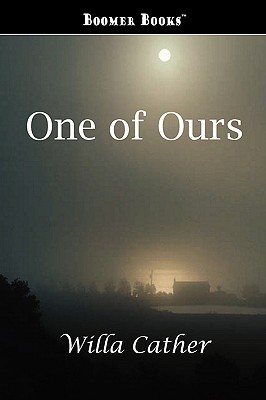
I always seem to love Willa Cather’s writing. Just imagining the country as it was a hundred years ago or more is time-travel of the imagination, and Cather can help a person get started, with her meticulous research and careful, thought-provoking shaping of the protagonist and other characters as well. I feel that the cover description provided on this site is a spoiler, since it takes the reader at least halfway through the book; if you haven’t read it yet and like strong historical fiction, save the goodies as a surprise. Claude is a wonderful protagonist; he is flawed, and I find myself wanting to go up to him, as if he were before me, and tell him he needs to stand up for himself. And I want to yell, “Don’t DO it! Don’t marry her!” But he is at Cather’s mercy, and she shows us what love and beauty look like, but poor Claude also sees some real heart break. As a mother of grown sons, I identified somewhat with his mother, even though she is not a main character. |
|---|
Tag Archives: historical fiction
The Jungle, by Upton Sinclair *****
 It’s not your best beach read, but it’s an important bookmark in the history of American literature.
The second wave of immigrants who came to the USA around the turn of the century (our setting is 1905) came mostly from Eastern Europe. Political turmoil and poverty were the push factors for myriad Italians, Greeks, Slavs, Turks and others who needed to get away, and the still vivid hope of the American dream, the possibility of social mobility unthinkable in Europe, was the pull factor. The Statue of Liberty still meant something back then.
It wasn’t as simple as it seemed, though. One of the primary large cities to which immigrants flocked was Chicago, and one of the chief industries that would offer them work–as usual, work that those born here would not do–was meatpacking. It looked like good money, even after meeting coworkers who had fewer body parts at the end of their tenure at the packing plant than they’d had going in. It was bloody, nasty, inhuman, and heartless, both toward the workers and the animals. And the stuff that landed on the conveyor belt went into the product to be sold at the supermarket, whether it belonged there or not.
I’ll let that sink in a moment.
Sinclair’s novel was intended to be a workingman’s call to arms. Cast off the bonds of wage slavery. Let the people who do the work own the means of production, set the time tables, and divide the spoils. He’d been reading Karl Marx and Frederick Engels, and believed his book would be a revolutionary vehicle. After all, working people read back then, and their attention spans had not been reduccd by the instant gratification that television and video games would later provide. He hoped it would be effective.
It was, but not the way he planned. When Americans read about all of the disgusting stuff that was landing in what they intended to serve for dinner, they revolted, and the Food and Drug Administration was born.
Today, meat packing workers are still among the most injured and the lowest paid, and they are still largely manned by immigrant workers.
The bottom line: read this for its historical importance and its place in American literature, but don’t expect to enjoy the experience. It’s pretty grisly material, but rightly so.
We Are Not Ourselves, by Matthew Thomas *****
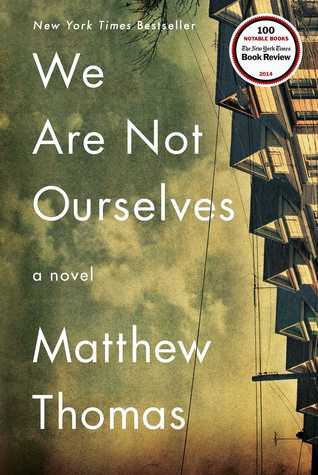 A haunting, epic story that stays with the reader long after the final page has been turned; Thomas has created a masterpiece. Thank you once and once again to Net Galley and Simon and Schuster for the ARC.
When I saw that some goodreads reviewers had marked this book at three stars, at first I wanted to grab those people, shake them by the shoulders and ask, “What is wrong with you?”
But eventually, I came to understand, or at least I believe I do, what it was that bothered them. Our protagonist is not always a lovable one. She’s deeply flawed and hard to bond with. Those who equate a lovable character with a well written book may indeed be disappointed, not only by this story, but by many of the Great Books.
As for me, I am impressed. My measure of extraordinary literature is that I am still thinking of, or even wishing I could have a conversation with the main characters after I have finished reading. I’ve moved on to other books, and yet this one remains with me. Aw, geez; poor Ed. We didn’t know. And what’s up with Connell, anyway? It speaks to me on a deeply personal level as I find myself comparing my own family and relationships with the Leary family. Given that I am a reader who absorbs a dozen books a month and sometimes more, this says a great deal.
Our protagonist is Eileen, who grows up in an Irish immigrant family that cuts across the typical large, boisterous, poor-yet-loving stereotype of the New York Irish. Instead she is the only child in a chilly, quiet apartment. Relationships are often strange and distant despite the fact that her parents love each other and her. The second bedroom is taken, for most of her childhood, by a tenant. Her father is a genial man, well loved among the Irish workingmen’s community, a union man and a hard drinker. Her mother is lonely, hardworking, and bitter until she also takes to drink; yet her parents don’t drink together, but apart. The only fun time is when relatives from Ireland come across the ocean and spill over into her family’s wee apartment as their final pit stop before finding a place of their own.
Eileen grows up knowing that she wants more.
As her hormones work their alchemy and her body grows and changes, she becomes disarmingly beautiful, and she understands that marriage may be her ticket to better things. Once she finishes college and becomes a nurse, she wants to marry a man of great capability and ambition. She believes she has found him when she meets Ed, a brilliant young scientist with a promising career ahead of him. Between the two of them, they ought to be able to bring in the money needed to live the good life. By the time children come, he should have climbed far and high enough that she can stop working and be happily domestic in a magnificent home. It is the dream of the 1950’s, though she wants something a bit finer than a suburban house with a picket fence.
Eileen’s grasping nature and her harsh behavior, at times, toward Ed and their son are off-putting. When their only child brings home a test marked 95%, her husband exudes praise while she asks what happened to the other five percent. I cringe. At times she seems to understand that she is showing no more warmth than her own mother did, yet the habits are ingrained. She does not reach out for the hug, does not easily part with praise. And as it becomes clear that her goals and Ed’s are not really the same, the marriage begins to founder.
The harder she pushes, the more irritated I grow with her. It’s like watching a relative who is bent on self ruin; I want to talk her out of this. I want to hit the “escape” key for her. I want her to be more empathetic, more flexible. But the one thing I absolutely don’t want to do is put the book down.
Then the unthinkable happens, not at all what I expected though, and everything that has gone before takes on new meaning. As events unfold, Eileen must change also.
To say more would be to spoil the read, and you should read it. Happily, this is one book that works just fine on a digital device, and I am grateful to the publisher and Net Galley for letting me read it that way. But if you are a reader who needs the tangible object in your hands, I will tell you that this is worth investing in. All you need is an attachment to excellent literature.
Absolutely brilliant. I look forward to seeing more of Matthew Thomas’s work in the future!
I Been in Sorrow’s Kitchen and Licked Out All the Pots, by Susan Straight *****
 Who knew that there is a completely separate people living on the Sea Islands off the coast of South Carolina? They are descendants of escaped slaves, and the language they speak, known as “Gullah” or “Geechee”, is a dialect similar to Creole English, but it also uses sentence structure that is borrowed from African languages and what Wikipedia calls African “loan words”. I was introduced to this culture by this wonderful novel, written by the talented Susan Straight. It was written some time ago, but remains a personal favorite; your best bet is to order it used.
The story’s protagonist is Marietta, who grows up in this isolated environment in the 1950’s, She’s written several good novels, but this one may be the most memorable so far. Her protagonist lives in an almost unreachable island off the Carolina coasts. Deep back in a nearly impenetrable area that is technologically about 100 years behind, a flushing toilet and an electrical outlet are unseen. Yet tourists somehow get there (god, aren’t they everywhere?) and so she and her family eke out a living by cutting the reeds that grow in the swamps and weaving them into intricate baskets.
She learns early that if a girl (teenage life is unknown in this culture) is six feet tall and very dark, the pale tourists will be frightened and they’ll leave. This gave me pause. I’m not generally into the whole ‘white guilt’ thing; I prefer action to introspection. But I did wonder: if a very dark woman who was seated near me suddenly stood up and she was six feet tall (to my just over five feet), would I take a step back? I don’t think I would now, but there was a time when I would have. The startled reaction comes from isolation and unfamiliarity. I grew up in a very Caucasian neighborhood; there were hundreds of students in my graduating class, and except for the foreign exchange students, there was only one African-American student. The first thing I did, upon gaining independence, was to move straight to the inner city. Isolation wasn’t for me.
But let’s get back to Marietta. When her mother dies, she is forced to move to the mainland, and experiences culture shock. She has to learn to speak standard English; everything is extremely different. Seeing the world through Marietta’s eyes made me view things very differently. What comes of it is a really off-beat civil rights lesson.
| How many white authors have the nerve to write as if they can see into the very soul of an African-American protagonist? I only know of one, and I think she carries it off really well. It’s a gutsy thing to do. There’s good reason for it: Straight grew up as virtually the only Caucasian in a Black neighborhood in Riverside, California. Culturally, she considers herself Black. If this sounds interesting to you, give it a try. See what you think, and let me know. I hope to add a discussion page to this site, which is nearing its one-week anniversary. What could be a better topic for conversation than a really good book? |
I
And Ladies of the Club, by Helen Hooven Santmeyer *****
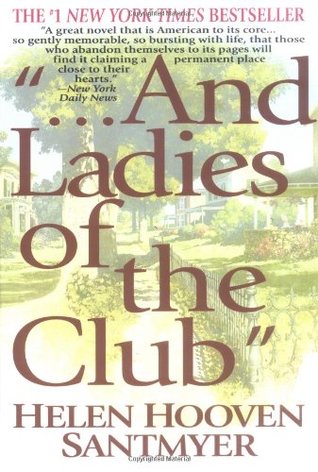 This tome was touted, at the time of its first publication, as the book written by “a little old lady in a nursing home”. May we be forever ashamed to pigeon-hole the elderly in such a manner again. What they MIGHT have said, is that this woman was a college dean of students and a professor of English. She was too busy to finish her book until her retirement. How lovely it was that she lived long enough to see it published!
In sumptuousness and richness, it is like Gone With the Wind without the racism. Most wonderfully of all, it is written in the manner in which time seems to go by, as we follow the life of a woman graduating from a women’s college in the late 1800’s. When she is young, a single year takes up many chapters, but when she is very elderly, one chapter spans years and years. As we age, time goes by so quickly.
Her use of the language is so brilliant that I now count hers as one of my favorite novels. It is thicker than some dictionaries, but infinitely more absorbing, and so I read it twice, once when I was a young mother with my first tiny babes at home; we were poor enough that I saved box tops and waited for double coupon day to buy groceries, but the Book of the Month Club was our one luxury, and they sent this. I read it again later when I was teaching. I gave my mother a copy for Christmas one year, and she loved it too.
I just may go back and read it again..
If you have grown up in the era of instant gratification and sound bites, this is not your book. This is a book to curl up with on a chilly afternoon and let the world fade away. Patience and a fairly high vocabulary level and awareness of the past will help, but give it a try if you aren’t sure. It will be worth it.
Fried Green Tomatoes at the Whistle Stop Cafe, by Fannie Flagg *****
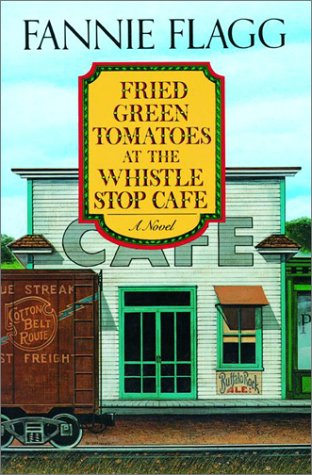 If I had to whittle several decades of reading down to thirty favorite books, this one would make the cut. It is wonderful on so many levels. Flagg has published a number of glorious, whimsical yet not shallow novels, always set in the deep South. This one is the jewel in her literary crown.
| Have you seen the movie? If you have, this book may be easier for you to read. I read it, and absolutely (as you can see) loved it. The issue for other readers I’ve talked to is that the book hops back and forth in terms of setting, including time period, and it doesn’t provide an obvious heads-up that this is what is happening.
There are two stories being told, one that of a contemporary woman who is unhappy with her life, menopausal and fearful that she is losing her husband’s attention, bored and feeling worthless. She is spending part of her weekend at a nursing home where her husband’s wife resides, but the woman hates her and won’t let her in the room. It is in the lobby where she is faithfully stationed, downing the candy stash from her purse for comfort, that she meets one of the home’s residents, who tells her pieces of her life story, a little more each visit. But in the book, we are taken back in time in other ways. Suddenly we are reading a small town newspaper, and if you are a person who skips chapter headings, you’re likely to find yourself entirely confused. I won’t give away more of the plot, but for the time in which it was written, this novel bravely took up one progressive (IMHO) cause about which not much was being written. It’s very subtle. Other parts of the story will leave you laughing so hard that you either can’t catch your breath, or if you are old enough, you may not hang onto…something else. Highly recommended. |
One of Ours, by Willa Cather *****
 I always seem to love Willa Cather’s writing. Just imagining the country as it was a hundred years ago or more is time-travel of the imagination, and Cather can help a person get started, with her meticulous research and careful, thought-provoking shaping of the protagonist and other characters as well. I feel that the cover description provided on this site is a spoiler, since it takes the reader at least halfway through the book; if you haven’t read it yet and like strong historical fiction, save the goodies as a surprise. I always seem to love Willa Cather’s writing. Just imagining the country as it was a hundred years ago or more is time-travel of the imagination, and Cather can help a person get started, with her meticulous research and careful, thought-provoking shaping of the protagonist and other characters as well. I feel that the cover description provided on this site is a spoiler, since it takes the reader at least halfway through the book; if you haven’t read it yet and like strong historical fiction, save the goodies as a surprise.
I don’t have any publishers to thank here. I bought this novel on my annual pilgrimage to Powell’s City of Books in Portland, Oregon, where I grew up. Once I’d read the first chapter, I wondered why I hadn’t read it before. It’s not as if I’ve ever been too busy for books. Claude is a wonderful protagonist; he is flawed, and I find myself wanting to go up to him, as if he were before me, and tell him he needs to stand up for himself. And I want to yell, “Don’t DO it! Don’t marry her!” But he is at Cather’s mercy, and she shows us what love and beauty look like, but poor Claude also sees some real heartbreak. As a mother of grown sons, I identified somewhat with his mother, even though she is not a main character. |
Tipperary, by Frank Delaney *****
Aside
| review | “The most eloquent man in the world”? It’s entirely possible.
This hyper-literate narrative inside a narrative inside a narrative unfolds as a simple tale at first, then becomes more complex as this deft tale-spinner pulls the scope out one notch at a time. In addition, we are provided with a passionate re-telling of the atrocities visited on the Irish by the Anglo and Irish-Anglo ruling class. Delaney puts such genuine feeling into the narrative of the republican movement as it progressed in the early 20th century that I am surprised the writer doesn’t find himself on the do-not-fly list. His honesty and appreciation of the struggle is refreshing, at times surprisingly witty, and disarming. At the story’s beginning, I really do not care much for Charles O’Brien and his stalker-like behavior toward April Burke. No means no. What’s WITH this guy? But then later, the narrator (who is a character within the story) says more or less the same thing, and in due time, I find myself warming toward this awkward but well-meaning fellow. And as the narrator’s camera zooms out and encompasses so much more, I read more closely. Occasionally I made the error of trying to read it AFTER I took the sleeping pills, and found I had to go back the next time and reread. It is not a story for the short attention span or one who wishes to multitask; it is absorbing, and requires one’s entire focus. But I found it rewarding enough to devote the necessary time and attention, and even found myself doing web-crawls to see how much of one or another historical detail was true, and how much was fictional or unknown. In the end, my book was jammed full of sticky notes, and I felt as if I had traveled over oceans and centuries. An eloquent story, indeed! |
|---|
All Quiet on the Western Front, by Erich Maria Marque *****
This has been labeled the best anti-war novel ever written. I agree. We see the first world war (“The Big One”) through the eyes of a young German soldier.
Some have held “Johnny Got His Gun” to be the best anti-war novel; I disagree, because that novel holds out no hope. When all is lost at the beginning and never gets better, it fails to draw the reader’s emotion. Marque is singularly skilled at reaching right down into the reader’s chest and wrapping his scholarly fingers right around our heartstrings. (Don’t look for this term in a physiology text.)
AQWF, on the other hand, develops character and setting sufficient to take us there, to nearly climb inside the skin of someone going through the experience.
Is there such a thing as a war worth fighting and dying in? I think so…but very rarely so, and this novel helps us understand the need for restraint and caution.
Note to teachers: though this is outstanding literature and many students enjoy it, it requires a very strong reader in terms of ability and vocabulary.
Billy Bathgate, by EL Doctorow *****
I have to admit, E.L. Doctorow is one of those writers whose work is a sure fire hit for me. I love historical fiction, and I admire great word-smithery. Doctorow is skilled with both.
This one is a period piece, a look at a hard time and the ugly risks that some folks took from desperation and perhaps a misplaced idea of what greatness might look like. To be sure, the government wasn’t exactly setting a good example; those who searched for less-than-conventional means were, in my view, right to reject the American Dream as a lot of smoke and mist. But organized crime is another form of corruption. Doctorow shows that pretty well too.
All told, it isn’t the moral I seek in a book like this, so much as a good story. Doctorow is a master storyteller, and the reader will always get his or her money’s worth.
I buy a lot of books used, but for this man, I pay full cover price and am glad it’s available. A treasure.
 Seattle Book Mama