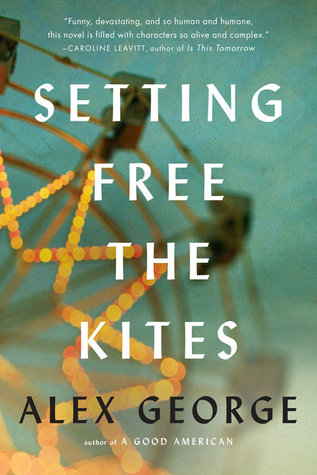
Setting Free the Kites, by Alex George*****

settingfreethekites“Hope is a curious thing. It emerges in the most unexpected places.”

Robert Carter is an introverted boy with few friends and loving but preoccupied parents. His life changes forever when he is befriended by a new kid at school. Nathan stands up for him when he is being assaulted by a bully, and a friendship is forged that will last for life. Thank you Net Galley and Penguin Putnam for the DRC, which I received in exchange for this honest review.

Our story is set in a small Maine town in 1976. Nathan’s parents are creative people, sculpting, writing, building one-of-a-kind kites, but tragedy strikes early in the story and Nathan’s mother retreats into herself, and is not available to her only child. Robert’s parents are fond of Nathan, who also befriends Robert’s terminally ill brother Liam, and soon Nathan has found a second home.

Most reviewers describe Setting Free the Kites as a tragic tale, and they’re right, but what few people mention is how many really funny scenes lie in between the somber stuff. George’s writing has tremendous voice, one that brings these adolescent boys to life as few others do. I actually laughed out loud more than once, and this not only makes this a more enjoyable read, but also underscores the tragedy, taking the reader through a whole wide range of emotions.

The genre crosses between adult and young adult fiction. If I were still teaching highly capable language arts students, I’d want half a dozen copies of this book to use in a reading circle; that said, the sexual content would also force me to send home permission slips, because conservative parents would otherwise rampage into the district office with torches, hot tar and feathers. However, I consider this an outstanding enough read that I’d jump through some hoops to use it.

In some ways, however, it is more suited to literate adults. George uses a high vocabulary and uses it well. It’s certainly not a story I’d recommend to someone whose mother tongue is not English, because there’s too much cultural nuance and subtlety for that audience, and likewise, most adolescents won’t benefit from such a novel.

There are a couple off odd extraneous reveals toward the end of the story that startled me, and that did nothing to enrich the story or develop its characters. However, the rest of the book is so outstanding that it’s a five star read regardless.

This book is available to the public February 21, 2017. Highly recommended to those that love great literary fiction.

Always, by Sarah Jio****

alwayssarahjioAlways, Sarah Jio’s much anticipated new release, takes on the homelessness epidemic using the powerful medium of fiction. I received my copy in advance in exchange for an honest review; thank you Net Galley and Random House Ballantine for the DRC. This title is available to the public today, and if you have enjoyed Jio’s other novels, I am confident you’ll like this one too.

Kailey Crane is a journalist living in Seattle during the 1990s, and she has the whole package: a great job, a wonderful city, and a wealthy, handsome fiancée. It’s the life other little girls dreamed of but didn’t get.  Then one night as she and Ryan are leaving a restaurant, she literally bumps into a long lost love. Cade McAllister is the man Kailey had been going to marry until he disappeared. He practically vaporized. Stunned and humiliated, she picked herself up and rebuilt her life, and now here he is, a half-crazed homeless man living downtown on the streets.

What the heck happened?

Kailey wants to marry Ryan, but she also wants to help Cade find housing, medical care, and food. Ryan makes it easier by agreeing that she should do the right thing. Quickly she learns that it isn’t as simple as it seems. There’s a whole safety net in place for people like Cade, except that it doesn’t work. In fact, without her own ready access to Ryan’s money, she can do virtually nothing for Cade. But it’s all right, because Ryan is on the side of the angels; he sees that this cause is a just one, and he’s a generous guy. He’s in love, and he’s feeling expansive.

The problems begin when Kailey starts missing key wedding events because she’s off helping Cade, or trying to. She becomes so involved with one thing and another that before she knows it, she’s over an hour late. There are out of town relatives that are present, but where’s the bride? And before we know it, she’s telling lies, and sometimes they don’t even seem necessary. I want to reach through the pages of the book, yank Kailey into the kitchen and talk to her.

What  are you doing, girl?

Fissures in her relationship with Ryan turn into fractures as he senses the level of her obsession, and he doesn’t see things as she does anymore. His material interest is involved, since a project his development corporation is about to undertake conflicts with an already established homeless shelter in Pioneer Square, a historic part of Seattle’s downtown. He questions why so many resources are required for the homeless; aren’t these mostly drug addicts and crazy people? There ought to be a simple way to dispatch the problem.

A strong story overall is somewhat tarnished by what feels like a glib ending. I recall a favorite episode of the Muppets when Miss Piggy is working a jigsaw puzzle, and she hates to be wrong, so she slams a piece into a hole where it doesn’t belong and howls, “I’ll make it fit!” The ending of this story brought the episode back to me, because Jio seems to be doing more or less the same thing.

Recommended to fans of this successful romance writer.

The Weight of this World, by David Joy*****

theweightoftheworldDavid Joy is a writer that keeps it real, and that’s what made me lurch forward in my desk chair and grab my mouse when I saw his second novel was done.  Big thanks go to Net Galley and Putnam Penguin for the DRC, which I received in exchange for this honest review. This title will be available to the public March 7, 2017. Those that cherish strong fiction should buy it and read it.

The setting is Little Canada, North Carolina, a wide place in the road in the middle of nowhere. The family unit, such as it is, consists of April—the most unwilling of mothers—along with her son Thad, and his best friend, Aiden McCall, who shares the trailer at the rear of April’s property with Thad. The plot is centered on the inadvertent death of the local meth dealer, and a small fortune that is unexpectedly left in the custody of Thad and Aiden.

They are not stellar decision makers.  In fact, some of the time they seem as if they are half feral.

Aiden came to live with Thad when he was on the run from the law, young and desperate. Thad offered him shelter, and that was more than anyone else had ever done. In fact,


“Nothing about this place had changed in all of Aiden McCall’s life, and maybe that’s why he’d come to hate it so badly. Everything was exactly as it had always been, the haves having and the have-nots starving to damn death.”


Thad, unfortunately, is the last person in this world anyone should become overly attached to. Between his unloving childhood, his time in Afghanistan and the meth he’s used to self-medicate since then, he’s more than half crazy more than half the time. It’s just him, Aiden and his dog, a crossbreed named Loretta Lynn. But things get out of hand, and the bits of baling wire and rusty screws that were barely holding his poor savaged brain together come undone:


“Something broke inside him then. His mind retreated to a place more familiar. There was a sergeant who told Thad the infantry were the hands of God, and that idea made sense to Thad because it was no different from what he had heard all his life growing up in church. The old-timers said some prayers needed feet. But there was evil in this world that had to be strangled. And so it wasn’t just a matter of giving those prayers legs. Sometimes a prayer needed hands just the same.”


As you can see, it’s gritty prose, and it features hardscrabble characters that are not entirely lovable. And so, reader, if you are one that needs a character you can fall in love with, you may have to look elsewhere. Some reviewers have found the story too harsh for their liking, and so to some degree it’s a matter of taste.

But I can tell you this: the settings here are stark and immediate, and the characters are well drawn and completely believable. I appreciate a story that fits the time in which we live, one in which young people have a rough time becoming independent due to economic woes and  the rampant drug addiction that seems to live in the shadow of every economic downturn. I believe Aiden and Thad, and I believe Thad’s mother April as well, a woman that only became a mother because someone spit on her as she came out of an abortion clinic. This is a story that resonates, and nobody can tell it like David Joy does.

Highly recommended!

Little Heaven, by Nick Cutter***

littleheavenLittle Heaven is pure hellfire and horror, the sort of novel that makes a person check the closet at bedtime and leave a light burning in the hallway. I received my copy in advance from Net Galley and Gallery Books in exchange for an honest review. The title is available for purchase now.

This story is set in the present, alternating with events from the past that help us understand what’s happening now. In this sense the story is a bit like All the Missing Girls by Megan Miranda, in that part of it takes place in the past and moves its way toward the present. The method is a powerful way to build suspense, but it’s not the only tool in Cutter’s tool chest by a long shot.

Our premise is that Petty, child of Micah and Ellen, has been kidnapped by the Long Walker. Micah has foreseen this event and dreaded it, but he’s been unable to prevent it:


“And he’d felt it coming, hadn’t he? Something gathering toward his family—a feeling not unlike the thunder of hooves as a stampede of horses approaches. He might as well have tried to outrun his own skin. You cannot outfox the devil. You may be able to stay his approach if you’re lucky and a little crazy, but in the end, his black eye will ferret you out.”


He calls upon two other gun slingers, Ebenezer and Minerva, both of whom shared the same horrific past event as Micah. Each owes him a favor, and he’s calling it in. He wants his daughter back.

There are a lot of twists and turns in the plotting of this story, and you’ll need to bring your full attention to keep track of it.  Ultimately the three find themselves at a cult in the mountains of New Mexico named Little Heaven.

I have never been so conflicted about a book so far into the narrative. On the plus side we have some outstanding word smithery, interesting characters, and some of the best monsters I’ve read in any horror novel. The narrative is fresh, confident and at times jaunty, dropping moments of drollery into unexpected places to help lighten an otherwise dark, dark, dark story. For these factors, I wanted this to be a five star read.

Unfortunately, there’s no denying that there are problems here. There are plot details that are too obvious, to me at least, to just read past, and when these occur, it’s like Toto pulling the curtain away from the wizard’s booth; the Great and Powerful Oz is just human, and at such moments, this is just another book. Examples that occur fairly early on include a character with a full load of morphine successfully racing out of town on the back of a horse; soon after this, another character who’s bleeding profusely decides to tell her life’s story.

Then there’s what is fast becoming a disturbing issue not limited to this author, but which I find unacceptable wherever I find it, and that’s when a character’s bad nature is demonstrated by the writer using ugly racist, sexist, anti-gay, and xenophobic language. When it happens once or twice in a novel, I grimace and move on, but this author finds such a variety of anti-Black slurs to fling at the Afro-British character named Eb and distributes them through so much of the text that an overall sour taste is left behind, and it’s not the sort that comes of reading good fiction. Cutter is skilled enough to use other methods to demonstrate the presence of evil, and he should do so.

Likewise, we don’t need sexist terms or a rape to show us that a character is sexist or that a woman has a traumatic past. Here I point, as I’ve done before, to director Jodie Foster, who said in an interview that she is dumbfounded by the way that so many male directors, when searching for a female character’s motivation, come over and over to the same conclusion: well, she was raped, and that’s why she behaves this way. It was rape, it was rape; she must have been raped! To Cutter and to others I say, stop it.  It’s trite, it’s ugly, and it’s obnoxious. For the same reason that most horror and suspense writers don’t deliver us into a warehouse full of kiddy snuff films and describe them in fine detail, authors should find other ways than hate speech and sexual assault to develop a character or display his or her malevolence.  Let’s not wear this one out any worse than has been done.

In other regards the story shines. The plot overall is complex and woven in a way that neatly brings us back to the problem at hand at the end.  Teenagers that enjoy horror as a genre may especially like this book, given its plethora of gore and the host of skittering critters. In fact, I found myself wondering whether there could be a Little Heaven video game. I’ve never wondered this about a book before, but the monsters are splendid, and so I could see it.

This book was released January 10 and is for sale now. Recommended with the caveats mentioned above.

Forever is the Worst Long Time, by Camille Pagan****

 “Each story is different. Every story ends with loss.”

foreveristheworstCamille Pagan is the author Life and Other Near Death Experiences. Thank you Net Galley and Lake Union Publishing for the DRC, which I received in exchange for an honest review. This title is for sale February 7, 2017.

The story starts in the second person, with the narrator speaking to us intimately; he is James Hernandez, and soon we realize that he is speaking to a child about her mother and his memories of her. The narrative is therefore intimate in tone, but also carefully measured and paced, beginning in 1998 when James meets Lou and unspooling toward the present.  I have read oh so many novels in which alternating viewpoints are used to keep the reader’s attention from wandering, and this fresh approach had me at hello.

James is Rob’s best friend; James’s own childhood home was dysfunctional and bleak, and so Rob’s family included him on family vacations and other family-only events. They weren’t just close friends growing up; they were almost brothers. And so when James falls head over heels in love and decides to marry, the first thing he does is send for his BFF. They are introduced and James is asked to be best man at the wedding.  But in one of those blind random moments of fate, James himself falls madly in love with Lou the minute he sees her.

What would you do in a similar circumstance? Get over it and do it fast, of course. It’s just not possible. But years later, when the marriage founders and Lou walks, James can’t help himself.

There is foreshadowing in plenitude here, and the voice at the outset and at the end are what keeps those pages turning. Of course, there’s also mystery, because the speaker is telling us some things, but clearly withholding others.

If you have to like a protagonist in order to enjoy a novel, then this may not be your book. James isn’t merely flawed; in the book’s middle, he’s whiny.  I check my notes and find that in one place I wonder if Woody Allen will option the rights, and in another, I curse and request a violin. Seriously, I want to smack James upside the head and say sure, you shouldn’t have, but you did and it’s done, so man up and get over it already. But around the three-quarters mark, the whole thing takes another turn, one entirely consistent with what has gone before, and once again, it is a book I don’t want to put down till the last page is turned.

Those that enjoy fresh new fiction should consider this book even if romance is not generally a favorite genre. Pagan is an interesting writer, and now that I’ve read this, I want to go back and read the other things she’s written.  She’s already gained a lot of buzz—and a movie deal—with her first title, and I suspect she will be someone to watch in the future.

Don’t get left out.

The Prisoner, by Alex Berenson****

theprisoner Berenson has written a whole series of espionage thrillers featuring John Wells, a CIA operative fighting al Qaeda. I was unaware of this when I requested a DRC from Net Galley and Putnam Penguin, but I find it stands up quite nicely as a stand-alone novel. Would I have enjoyed it even more if I’d read the others first? We will never know.  However, if you’d like to read this tightly woven thriller either in sequence or singly, it will be available January 31, 2017.

To enjoy an espionage thriller, one has to buy the premise, namely that the CIA is a heroic organization, or at least has a segment of good guys that are fighting terrorism to keep innocent civilians safe. This is a premise I buy cheerfully for the sake of a good yarn; I do it when I read crime fiction in which the cops are morally righteous, or at least more good than bad, so why not here. In exchange, I got to enjoy an intense, interesting thriller that is different from a lot of the other fiction I read, and novelty is a meaningful selling point when one spends several hours daily with one’s nose in a book.

This is a literate read. In a world of dumbed-down fiction that plays to the lowest common denominator, I have come to value writers that have a strong vocabulary and aren’t afraid to use it. I also learned some things about the Middle East and how the USA operates there, including a few new specialized terms and some information about the cultures featured in that part of the world. Of course, this is fiction and it could also be true that Berenson made it all up, but his past includes work as a war correspondent in Iraq, and so perhaps this is what gives the setting its authenticity.

Our premise is that there is a mole at a high level inside of the CIA. John Wells has been feeling the itch to travel, impatient with his wife’s demand for more family time and suffocated by the dull sameness of everyday life in the States. He volunteers to return to the Mid-East and pose as an al Qaeda recruit so that he can be tossed into a Bulgarian prison and cozy up to the high-up operative that is interned there.

I blanched slightly at this; I have read a couple of former CIA employees’ memoirs, and I had to swallow hard to pretend that this guy would actually do this thing. But when we read thrillers, whether it’s crime, mystery, or a spy story, we don’t really want to read about tedium and paper pushing; we want excitement. Once I bought the premise, I was wedded to the narrative.

The other key characters here are Shafer, the CIA officer Wells reports to and who is also hunting for the mole; and the mole, whose name I can’t tell you without ruining the book.At first I thought I was seeing shallow characterization, but Wells’ character is developed in a way that is so subtle that the reader may not realize it’s occurred. Gradually we come to know who Wells is, how he thinks, how he will respond. On the other hand, our mole is a loser and remains a caricature throughout.

Every significant character here is male, but from what little I know, that’s consistent with the CIA, especially among the highest officers, a glass ceiling that’s hard to crack, so Berenson is merely reflecting US intelligence as it actually is.

The plot’s arc is a little different than one might usually expect.  The hook at the start is arresting, and I expected it to perhaps ratchet up, up, up from there. Instead, the pace flagged once we were about 15 percent of the way in, and then gradually began to ascend again. By the time I was 70 percent of the way in, I understood that the next time I picked it up, I would have to finish it.

When we hit the climax, set in France, I threw off the quilt and sat up. The pulse-pounding denouement was inconsistent with lying supine and I read the last 15 percent of the book sitting up and leaning forward.

This story is guaranteed to spike your adrenaline and chase away the winter blahs. Recommended to those that enjoy espionage thrillers.

The Impossible Fortress, by Jason Rekulak*****

theimpossiblefortressThe Impossible Fortress has been generating a lot of buzz since last summer when the review copies came out, and rightfully so. It’s hard to believe this is a debut novel, because it’s smoothly designed and hugely original. It’s written with a deftly woven plot that never misses a step; engaging characters that are nearly corporeal, they are so well sculpted; and an utterly captivating voice that unspools the narrative. Best of all, it’s hilarious! I thank Net Galley and Simon and Schuster for my DRC, which I received in exchange for an honest review. This title comes out February 7, 2017.

When this reviewer retired from teaching, I buried myself in books I had long wanted to read, and I promised myself that I would never have to read another young adult novel. That promise to myself still holds true, but now and again I see a premise so tantalizing that I know I want to read it anyway; this was one of those times. It’s a book you can read in a weekend, and once you have it, you won’t want to put it down anyway.

First I’d like to reassure readers that are most comfortable in the liberal arts realm that the programming jokes here are very shallow, and you can easily read this without missing anything even if you aren’t a tech type. I wrinkled my brow at the chapter headings and called my spouse, a network engineer, in to see them. He told me it’s just the chapter numbers written in code. So for those of you that hyperventilate around complicated math and science, it’s okay. Breathe.

Moving on to the story itself, here’s the set-up: it’s 1987, and Vanna White, America’s girl next door who’s seen every weeknight on television’s Wheel of Fortune, has posed nude for Playboy, and no one under the age of 18 can buy that magazine. The only place it’s even for sale in our depressed rustbelt neighborhood is in Zelinsky’s shop, and the man is unhinged when it comes to kids in his store. He’s had problems with crime, and on top of that, he’s grieving his wife’s death, and right at this moment, he’s in the anger, anger, anger stage.

Our 15 year old protagonist is Billy, a ninth grader whose mother works long hours and can’t supervise him effectively. His two longtime friends are Alf and Clark. The threesome is determined to get that Playboy from Zelinsky’s store. Since they can’t buy it from him, and since it’s kept behind the counter which the owner watches feverishly during all store hours, they’re going to have to steal a copy when the store is closed. Sort of steal it. They’ll sneak in; leave money on the counter; then leave with their magazines. They’ll want three, of course, so that each can have his personal copy.

When his hormones aren’t in overdrive, Billy loves computers more than anything. He sneaks a programming manual inside his textbook during class time, because it’s what he wants to learn about. His mother is beside herself when she sees his grades—“You’re failing Rocks and Streams!”—but she has no idea what to do about it. The only thing she can take away that Billy really cares about is his computer, and she does it, telling him he can have it back once his grades are up.

As it happens, our store owner has a daughter that’s about the same age as Billy, and she has a computer too. Billy is better with computers than any of his public school classmates, but Mary, a student at St. Agatha, is brilliant. He talks to her initially as part of the scheme to get into the store at night and filch the magazine, but once he sees what she can do online, he is transfixed, and he spends more and more time in the back of Zelinsky’s store watching what Mary can do on her computer. He notes that his own technical finesse next to Mary’s is “like finger painting next to Picasso.” As the friendship between them develops, Billy is torn between Mary and computers, versus Alf, Clark, and the magazine. He tries to back out of the plan they’ve agreed upon because he doesn’t want to hurt Mary’s feelings, but complications emerge.

Although Rekulak does a fine job developing Billy, the best developed character in this story is unquestionably Mr. Zelinsky.  As to setting, I am impressed with how much minutiae is absolutely accurate here. But it’s not the character development, setting, or plot that drives this novel; it’s the voice, which is as authentic in adolescent reasoning , planning, and oh dear heaven, in its impulsiveness as anything I have ever seen.

Whether you are a teen, a parent, a teacher, or a reader that’s just looking for a good laugh, you’ll find it here. Highly recommended.

The Bear and the Nightingale, by Katherine Arden*****

“Blood is one thing. The sight is another. But courage—that is rarest of all, Vasilisa Petrovna.”

 thebearandthenigh

The Bear and the Nightingale is the most brilliant fantasy novel I’ve seen since Tolkien wrote, and I want you to understand how different, how special it is. I received my copy free in exchange for an honest review—and those of you that read my last two reviews know that this privilege has never made me obsequious. Thank you Net Galley and Random House Ballantine for the advance copy. It’s worth its weight in spun golden magic, and it will be available to the public this Tuesday, January 10, 2017.


“The brave live…The cowards die in the snow.”


Our protagonist is Vasilisa, affectionately known as Vasya; she’s an adolescent with many talents, some of which are supernatural. She generally keeps these abilities to herself, lest she be called a witch. Her father, Pyotr, is a minor prince in the frozen Northern hinterlands of Russia during the 14th century.  The setting here is mesmerizing, and from the first page I understood that this particular story is one I would save for late nights when my family is asleep. Let my other reading be interrupted by the minutiae of running a household, but not this one. This is a juicy tale, perfect for a cold winter night burrowed beneath the quilts. I open this magical tale and am lost inside it.

Our setting is ancient Northern Russia, then known as ‘Rus’, since no central government had formed yet. This is a time when women carry about as much social worth as a poker chip or livestock, and yet as the story progresses, I realize that this is a stand-up-tall feminist folk tale of the highest order; in fact, it’s a lot of things. This is the sort of debut that most likely causes writers like Harper Lee to go back in the house and never publish anything else, lest the second novel be considered a let-down after the first.  I hope, however, that we’ll see a lot more of Arden.

Our story commences in the house of Pyotr, a minor prince whose wife has died in childbirth. He loved Marina dearly, but as his daughters grow closer to marriageable age, he knows he must go to Moscow to seek a new bride to run his home, and marry his elder daughter Olga to a man of wealth and power. And though Olga’s match is a good one, it’s in Pyotr’s remarriage that things go badly wrong.

A brief note about the setting and other details involved with time and place. First know that this story does require a relatively high literacy level; for those that struggle with a high vocabulary level, it may prove to be more work than fun. However—for those reading digitally especially—please note that there’s a glossary at the back of the book. And those that are able to read this digitally on a device with a touch screen will be happiest of all, because it’s so easy to touch a word and get a definition immediately. I also ran a few searches due to curiosity, since I was not at all eager for this book to end. I took my time with it, and while I was buried in this magical world, I was nevertheless learning details of history and geography that I hadn’t known before.

Because I taught teenagers how to write for a number of years, it’s my natural inclination, even in an absorbing story such as Arden’s, to go back and look again to see what specifically produced this alchemy.  Undoubtedly, the development of multiple characters in a deft, expert manner is essential. There’s not one character in this story that I don’t believe. Every last one of them is real to me, a feat in and of itself when writing fantasy. It takes confidence and authority to tell the reader that although the story contains all manner of supernatural elements, it’s all true, and so are its characters.

But also, there are real life details true to the time and place that Arden weaves in seamlessly. As I reread some key passages, I note that when the men come indoors from the snowy woods, they aren’t merely cold, dirty and tired; they’re covered in scratches, they’re voracious, and their boots steam and stink up the room once they remove them. In another scene, when Pyotr travels far from home, he can afford fine guest lodging, but although he gets a big, soft, fluffy bed, he also has to put up with vermin, because they were a part of everyone’s life.  Such details contribute to the immediacy of the story.

It’s Arden’s outstanding word smithery that makes this story a standout. When Arden writes, the mists clear and we are transported, quivering in the snowy forest of the 14th century Russia, tearing pell mell across frozen ground on the back of a noble stallion, facing down death as demons scream and shadows dance.

I won’t spoil any of the subsequent plot points for you, but please know that this is a multifaceted story with a lot of secondary threads that contribute to the main story rather than distracting us from it.  To do so in a debut novel is stunning. A particularly interesting side character is Dunya, the nurse that has raised Vasya and has held onto a talisman intended for Vasya at great personal cost.

Messages and possible themes come out of the woodwork once one looks for them. A story such as this one, in which Vasya defends the old pagan deities against the religion of Kostantin, would once upon a time have caused conservative Christian parents to come screaming to the school with their lawyers on their cell phones in one hand and a flaming torch in the other. It could happen still, but what greater honor could Arden ask than to find her way into the ten most frequently banned books?

Meanwhile, in this trying time for independent women, we need strong female characters like Vasya and Dunya to remind girls and women that we are powerful, and that together, we can conquer those that would strip us of our autonomy and march us barefoot back to our kitchens. I have no idea whether any such direct political purpose is intended by Arden, but it certainly serves as a potent message: we will be oppressed only if we let that happen. Those that have even a fraction of Vasya’s independence, confidence and courage can not only prevent the door opportunity from slamming shut;  we can knock that door off its fucking hinges, for ourselves, our daughters, and theirs as well.


’All my life,’ she said, ‘ I have been told ‘go’ and ‘come.’ I am told how I will live, and how I must die. I must be a man’s servant and a mare for his pleasure, or I must hide myself behind walls and surrender my flesh to a cold, silent god. I would walk into the jaws of hell itself, if it were a path of my own choosing. I would rather die tomorrow in the forest than live a hundred years of the life appointed me.’”


Those looking for themes here have a banquet of opportunities. Though I would say the story is one of solidarity among women, or of woman’s independence, there are so many other possibilities. One could make a case that this story is about loyalty; one could claim it’s about family. One could say it’s about the victory of the collective good over the pride, greed, and ambition of the individual.

One thing I can say for certain is that The Bear and the Nightingale is impressive any way you approach it. It holds the potential to become a favorite of the genre, handed down lovingly from one generation to the next.  Buy it for yourself, for your daughter, your mother, or for any woman that you love, or for someone that loves women and good fiction. A book like this doesn’t come along every day.

Don’t even think of missing this book. You can get it Tuesday, or better still, you can pre-order it now.

The Woman Who Walked in Sunshine, by Alexander McCall Smith*****

thewomanwhowalkedThe first week or two after Christmas is a sumptuous period for me as a reader. Nearly every book I read these days, fiction or non-, is a DRC, or Direct Reader’s Copy sent to me digitally by publishers via Net Galley in exchange for an honest review.  However, each year there are invariably half a dozen titles, sometimes more, that I really want to read and haven’t been able to obtain free of charge. Sometimes I discover a book after it’s already been published some time ago, and sometimes it’s a book that I couldn’t get as a DRC. These books land on my wish list, and my family is faithful in purchasing them and placing them, clad in pretty paper and ribbon, beneath our Christmas tree. By Christmas night, I’m snuggled deep beneath a pile of fluffy covers, my spouse and hound dog snoring sonorously while I immerse myself in the books I am just about guaranteed to love, bathed in a soft yellow bedside light. This ritual is as significant to me as the more widespread traditions of feasting, wrapping gifts, and hanging stockings. I can’t recall a Christmas without it.

This year we had our gift exchange on Christmas Eve, and by bedtime I was snuggled up in flannel and reading this paperback book, the 16th in the series. The series, for those unfamiliar, is of the cozy variety rather than the pulse-pounding thrillers that absorb a good portion of my reading life. Precious Romotswe is the owner and founder of the #1 Ladies Detective Agency, and a good portion of those that read this book will already be familiar, as I am, with the main characters and their stories. Mma (Ms.) Ramotswe is married to JLB Matekone, who owns and runs the automobile repair shop adjacent to the detective agency; Mma Makutsi , Mma Ramotswe’s eccentric but capable assistant, believes that it’s time for her mentor to take a vacation. And indeed, Precious has never gone on holiday before; it’s about time, isn’t it?

Mma Ramotswe is reluctant. She hates to leave her business in anyone else’s hands; then too, she’s disconcerted when she learns that her husband, his employees, and her own assistants have discussed her need for time off when she wasn’t present. Is it a conspiracy, or is it loving concern?

The mysteries to be solved include the problem on which the temporary assistant hired on for the duration of Mma Ramotswe’s holiday stumbles; an additional situation involving a child named Samuel, an orphan who’s been trained to shake down drivers for coins in exchange for not damaging their cars; and a new school bearing her signature “#1 Ladies” logo, which appears to be not only misappropriating her trademark, but shady in other ways as well. Yet much of the story is dedicated to character development and the personal lives of the main characters, and it’s this that keeps me coming back.

Ultimately, the story is about trust, kindness, and learning to let go sometimes.

It occurred to me for the first time that I don’t know how the majority of Botswana feels about this series. McCall is a native-born Botswanan with Scottish predecessors. Are these characters true to the way the people of color in Botswana see themselves and their people?

Yet another part of me recalls that we are in the land of fiction. Unless I see some sign that the series is objectionable or offensive to those it represents, it will continue to be a happy retreat for me.

Highly recommended to those that love a cozy mystery and an opportunity to drop their blood pressure; the mesmerizing cadence here is better for us than any bottle of pills, and far cheaper than therapy.

Small Admissions, by Amy Poeppel*****

Happy release day! The holidays are over and your humor may be running dry and a little snarky by now. If so, this book is just what the doctor ordered…and it’s for sale right now.

seattlebookmama's avatarSeattle Book Mama

smalladmissionsI received an advance reader’s copy of this darkly amusing novel from Net Galley and Atria Books. It’s funny as hell, and even more amusing to teachers, school counselors, and others that have dealt with high maintenance parents and the aura of entitlement they carry with them. I rate this title 4.5 stars and round upward.  It comes out December 27, 2016, just in time to chase away your post-holiday depression.

I sat on this book for more than three months, which is a rare thing for me.  I kept starting it, not liking it, and deciding to set it aside and look again with fresh eyes later. Finally November came, and I realized the book was not going to change; I’d given my word to the publisher I’d review it; it was time to suck it up and get the job done. And this is a little ironic all…

View original post 408 more words