The Bitter Past, by Bruce Borgos***

2.5 stars, generously rounded upward.

The Bitter Past is the first in the Porter Beck series by Bruce Borgos, and if I liked it, I’d be thrilled to read more. On balance, though, I don’t. Nevertheless, my thanks go to Net Galley and St. Martin’s Press for the invitation to read and review. This book is for sale now.

The setting is the hinterlands of Nevada; part of the story takes place in the 1950s, and part of it is in the present. I rate the historical threads as 3.5 stars, and the contemporary part as 1. The premise is that Porter Beck is the local sheriff who is called when a grisly murder is discovered; in addition, a sister-wife goes missing. Sana Locke is the woman that the Feds send in, uninvited. The premise for the other thread is that a Russian operative named Georgiy Dudko lands in Nevada, tasked with entering the nuclear test site and stealing a nuclear warhead. Toward the book’s conclusion, we see how the two stories are joined.

Before I am even twenty percent of the way into this story, my hackles are up. I haven’t seen an author write with such brazen disrespect for women in a very long time, and I hope not to see it again. You see, Beck is God’s gift to women, and it’s a good thing, too, because none of them prove smart enough to find their butts with both hands until he sails in and fixes everything. From the instant Agent Sana enters the narrative, introducing herself as FBI, Beck is the guy in charge, and Sana is his li’l buddy, his sidekick. Good thing he is here to educate her. It is Beck that finds a hidden room in a house they’re searching; it is Sana whose eyes “go big.” He has to dive quickly to save her from the bad guy with the gun. He tells her what to do, and she does it. Here are some quotes that set my teeth on edge:

“Before [Sana] can speak, I place a finger over her lips.”

“Sana appears confused.”
“I bring my finger under her chin. ‘Look up.’”

And no collection of sexist bilge is complete without the old saw about how women are unable to get along with other women: “[Sana’s] still miffed about Brinley, [Beck’s sister] and it’s clouding her judgment…I glare at Brin, a warning to her to retract her claws.”

Beck feels completely free to comment on Sana’s physical features, particularly her “exquisite ass,” but of course, Sana likes that in a guy. She’s in the sack with his middle-aged, um, butt in no time flat.

For a long time I hold out hope that things will turn around, and the author will prove to us that actually, Beck is about to get his just desserts, and Sana had been sent to take him down for some reason, but the only comeuppance she deals him at any point is when she pulls a jujitsu move on him, and that’s only once.

What else? Ah yes, the sister-wife. The girl’s husband is a good FLDS neighbor, Beck tells Sana. They don’t force anyone to marry. She’s seventeen years old, so it’s fine.

What the fuck. Seriously? Excuse me while I grab my blood pressure medication.

In addition to all of this, there is the constant use of the word “illegal” to describe a person that is in the U.S. without documentation. They don’t even call them illegal immigrants, or illegal residents. They don’t merit a full grammatical description.

The thread that takes place in the past is more palatable. Georgiy needs into the nuclear test site, and so he befriends a scientist that works there, and is introduced to Kitty, the scientist’s daughter, whom he courts and accidentally falls in love with. Kitty is not developed as a character any more than Sana is, but at the same time, during the 1950s in the U.S., marriage and motherhood were very nearly the only acceptable path for women, so within the context of time and place, this is believable. I like Georgiy much better than Beck, that’s for sure!

There’s a twist of sorts at the end, but it’s not all that impressive, and it mitigates nothing.

I was provided with the digital review copy and the audio as well, and so I listened and read at the same time. Narrator James Babson does a fine job portraying the characters as they are written, and he isn’t to blame for the way I feel as I read.

That’s it in a nutshell. If all of this sounds just fine to you, then go ahead and get this thing, and stay away from me. Does anyone have any matches I can use?

Blind Fear, by Brandon Webb and John David Mann*****

Blind Fear is the third book in the red hot series by former Navy Seal Brandon Webb and concert cellist turned author, John David Mann. When the two of them collaborate, the pages jump. My thanks go to Net Galley and Random House for the invitation to read and review; this thriller is for sale now.

In Cold Fear, the second in the series, our protagonist, Finn, is on the run. He’s a SEAL for the U.S. Navy, an elite combat diver, but corrupt elements have framed him for the slaying of his closest team members, and until he can prove his innocence, Finn needs to be invisible.

He’s good at it.

Now he’s moved on from Iceland to Puerto Rico, and he’s been renting a room from Zacharias, an elderly man that supports himself and his two grandchildren by running a café. He works in the café in exchange for room and board. But now there’s trouble; his two grandchildren haven’t come home. Zacharias would go and look for them, but Zacharias is blind.

There’s nobody better at ferreting out secrets than our man Finn, but doing so puts him at risk. He’s deliberately stayed clear of the city because there are so many military people stationed there. The hinterlands have been safe, and until he can come forward with the proof he needs to save himself, the hinterlands are where he belongs.

But then…what about the children?

Like those before it, this is a taut, tense thriller with multiple massive emergencies weaving in and out of one another. We have Finn’s need to avoid discovery yet, find the missing children; now add a serial killer known as El Rucco who’s left grizzly human remains all over the island and a major hurricane, and friend, this is not your bedtime reading material. Read this one sitting up and with the lights on. Just trust me.

Through all of this, Finn also deals with personal baggage that he tries to ignore, but which comes to him in dreams. He has blocked out a large portion of his early life due to trauma, and he has “questions that had hung over him for thirty years like a kettle of vultures.” This is no soap opera and so we see and hear very little of it, but the snippets that intrude during Finn’s unguarded moments heighten the suspense and the reader’s sense of dread.

There are other praiseworthy attributes I could discuss; as we are introduced to the setting, we have brief but meaty passages that serve to inform us about the injustices that are meted out to this lovely but impoverished nation, and the way that the U.S. government has kept its boot on the necks of the people that live there. But all of this remains secondary to the story itself, and the focus is tightly maintained. The research is meticulous, and the organization is stellar. The development of the protagonist is outstanding; the secondary characters, particularly Zacharias and the older grandchild, Pedro, are visceral and memorable, and I would be delighted to see them again.

Highly recommended to all that enjoy a true thriller.

Murder Off the Books, by Tamara Berry*****

“There came a time in every crime solver’s life when they wanted to stop getting stuffed in the backs of vans and facing down danger at every turn.”

My thanks go to Poisoned Pen Press and Net Galley for the review copy. This book is for sale now.

Tess Harrow lives with her daughter, Gertrude, in a tiny hamlet in Washington State. She’s taken the hardware store she inherited and had it redone, and so now it’s her bookstore. But the locals are a bit leery of Tess; everywhere she turns, somebody drops dead. To reassure them that she is normal and trustworthy, she’s throwing a gala bookstore opening; wine, cheese, books, and…a corpse.

Well, heck.

But the good news is, Tess is a pretty decent sleuth. She’d be a lot better if she knew when to shut up, though:

“His words became a snarled growl. ‘Has anyone ever told you that you talk too much?’ Everyone, all the time—and she wasn’t about to stop now.”

This book, and this series, contains exactly what I like to see in a cozy mystery: colorful characters, an easily followed plot, and a good deal of whimsy.

Because I was running late, I checked out the audio version of this story from Seattle Bibliocommons. I like the reader, and the narrative is easy to follow, even for a text-oriented reviewer like me. I highly recommend this book in whatever format is your favorite.

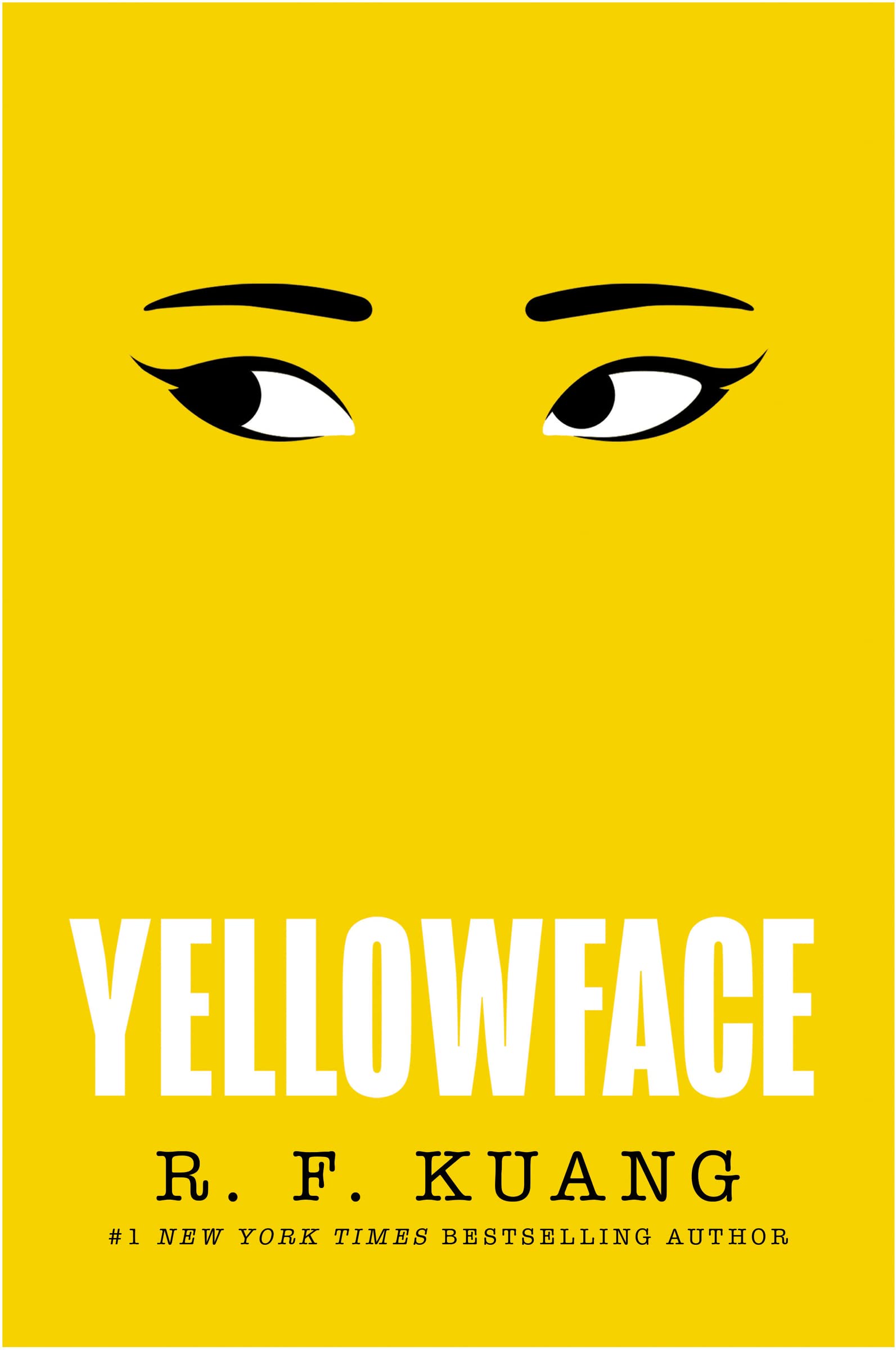
Yellowface, by R.F. Kuang****

Rebecca F. Kuang lights a match, and the literary world explodes! Her new novel, Yellowface, takes on issues of racism, cultural appropriation, cancel culture, and identity politics. My thanks go to Net Galley and William Morrow for the review copy; this book is for sale now.

Our protagonist is Juniper Hayward, a struggling writer. June’s longtime friend, Athena Liu, is spectacularly successful, and though June tries not to be bitter, Athena is a bit oblivious to June’s distress, and so although June likes her, she also kind of hates her. Then one day, as the two of them are discussing Athena’s newly completed masterpiece, which took a decade to create and has been seen by no one yet, Athena chokes to death on a bit of food. June employs the Heimlich maneuver, but it doesn’t work. Now Athena is dead, and June has in her possession the unpublished manuscript.

What comes next makes my jaw drop! June leaves with the manuscript, which still needs cleaning up before it can be published, and using every lame attempt at justification one can imagine, she edits it and publishes it under her own name. She rationalizes:

“The truth is fluid. There is always another way to spin the story, another wrench to throw into the narrative. I have learned this now, if nothing else…My only sin is loving literature too much.”

To make matters worse, her publisher suggests she use her middle name, Song, as a pen name. (Oh, snap! There’s already a mystery series that stars Juniper Song, though this doesn’t make it into the novel.) The book is a brilliant success, but during her book tour, audiences cannot help noticing that June is, well, Caucasian.

Man your battle stations!

Initially, June seems like a decent enough person that has made one self-serving mistake, but as the narrative unfolds, her judgment, behavior, and moral character deteriorate. The suspense is thick and absorbing as I wait to see just what will happen next.

In places, this story is drop dead funny.

I recommend this book to those that love to see good fiction based on current events.

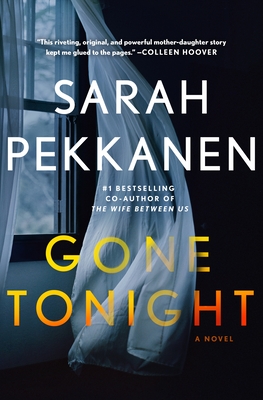
Gone Tonight, by Sarah Pekkanen*****

I’ve been reading and enjoying Sarah Pekkanen’s novels for years now, but Gone Tonight is far and away the best of the bunch. My thanks go to Net Galley, Macmillan Audio and St. Martin’s Press for the invitation to read and review. This book will be available to the public August 1, 2023. If you love psychological fiction or thrillers, you should order it now.

In her previous thrillers—the ones I’ve read, at least—there is similarity. She’s written about women ganging up on one woman, and love triangles, or what appear to be love triangles. This one is different, and it’s better. Here we have just two characters, mother Ruth and her young adult daughter Catherine. The unseen character is James, Catherine’s biological father. Throughout the story, Ruth is vigilant, always watchful. She’s afraid she’s being stalked, or investigated, or otherwise watched. Ruth isn’t merely careful; she keeps a bug-out bag ready for each of them, varies her routine to where she really doesn’t have one. She doesn’t take the same exact route to any of the places she frequents regularly. To see and hear this character, one would think that the CIA, the Mafia, and all of the cartels were out to get her and kill her.

Early in the book, Ruth provides Catherine with some hard news: she has early onset Alzheimer’s. I tell you this in particular, because when I saw it, my eyes glazed over with boredom and I thought that this thriller wasn’t going to thrill me at all. I nearly slid the book onto the bottom of my stack, and that would have been a terrible mistake, because this is *not* an Alzheimer’s story.

Catherine has never met any of her relatives; Ruth lies to keep her from investigating them. But now Catherine is an intelligent adult, and there is the internet. It’s mighty hard to keep a secret these days, and that’s rough for Ruth, because she’s got a lot of them, some bigger than others. As Catherine digs, she is surprised, and this makes her dig even harder. She keeps finding things, and Ruth keeps changing her explanations. It isn’t long before Catherine realizes she’s been lied to, and she stops telling Ruth what she discovers.

The format Pekkanen uses is an effective one, and it’s easy to follow. She changes the point of view in the standard way from one to the other and back with both sides told in the first person, but the tricky part is how to provide Ruth’s narrative. Catherine can give us her first person narrative and we think nothing of it, but Ruth talks to no one except her daughter, and even so, she lies to her daughter all the damn time, so under what circumstances will she spill her guts to us? The solution isn’t all that original, but it’s effective and reasonably believable. Ruth has a secret diary that she’s writing for Catherine to have when Ruth is gone. It requires me to overlook the unlikelihood of someone as obsessively private as Ruth sitting down and documenting the whole shooting match, including names and dates in writing, but this is such a fun book that I set my momentary disbelief aside and keep reading, because I have to know what happens next.

Once we are past the Alzheimer’s passage, my attention is rapt, but friend, the last ten percent of Gone Tonight is one for the ages! I rarely say this, but this creepy little novel would make an amazing movie or miniseries.

Actor Kate Mara reads the audio version, and she does a fine job. Highly recommended!

An Evil Heart, by Linda Castillo****

Four stars for the printed version.

Although An Evil Heart is the fifteenth entry in the Kate Burkholder series, it is my first, and also the first time I have read a book by Linda Castillo. I came to this one on the advice of Goodreads friends, and they weren’t wrong. My thanks go to Net Galley, Macmillan Audio, and St. Martin’s Press for the review copies. This book is available to buy now.

Our story is set in the fictitious town of Painter’s Mill, Ohio, where the Amish make up about a third of the population. Kate Burkholder, the chief of police here, is preparing for her wedding when a call comes in about a bizarre murder. A young Amish man, Aden Karn, has been shot with a crossbow and left to die. This would be unusual anywhere, but for the peaceable Amish, it is a tremendous blow. Who would do such a thing? And then there’s another murder as well. Are they linked, and if so, how?

Of course, things are not what they seem. Eventually, Emily Byler, Aden’s girlfriend, comes in to the station accompanied by both of her parents. Emily has finally confessed the horrible deeds that Aden has visited upon her. As the girl, burdened by “a dark mix of horror, shame, and grief,” buries her face in her mother’s shoulder, her mother says “Let me tell you about Aden Karn. The devil whispered his name and Aden Karn took his hand and went.”

But Emily didn’t kill Aden, so the case is far from being solved; if anything, it’s become more complex. Now Kate wonders whether Aden did such things to other girls as well.

At the outset I listen to the audio version of this book, and friend, it’s dreadful. For awhile I wonder whether it’s read by an A.I., because the sound is choppy, the words cut off in a way that suggests it’s not the fault of any narrator. But as I reach the 20th percentile, I realize that actually, the reader is not doing well, either. When it comes to voicing the male characters, the narrator sounds amateurish, and I have never said this about a narrator before. I begin to dread opening this book again, and that’s when I abandon the audio entirely and settle in with the digital review copy instead. It is the right thing to do. Castillo is a good author with a poor narrator, and I hope the glitches in the sound quality have been dealt with now that it’s publication day.

The ending is somewhat predictable, but not until the last quarter or so of the book. I would cheerfully read further entries into this series, and can tell you from experience that you can jump in right now without concerning yourself over the first 14 books if you choose. I recommend the printed version of this book to all that love the genre.

Zero Days, by Ruth Ware****-*****

What would spring be like without another Ruth Ware mystery?  I hope never to find out. My thanks go to Net Galley and Gallery Books for the review copy.  This book goes up for sale Tuesday, June 20, and those that love a fast-paced, high octane read should order a copy.

One of the finest things about Zero Days is the premise. Our protagonist is Jacintha “Jack” Cross, and she and her husband, Gabe, run a pen testing business. I had never heard of pen testers before; these are people that are hired by corporations to hack into their systems and then report their areas of vulnerability so that they can be corrected before unfriendly hackers find them. Jack is the physical penetrator, and so while Gabe is home worming his way into the client’s network, Jack is on site, physically breaking into the business’s building.

This reviewer has two immediate family members that are fairly high on the IT food chain, so I asked both of them whether this is a real thing; they assured me that it is, although they had never heard the abbreviation. Most penetration testers don’t physically breach the physical building; usually it’s a tech breach only.

On this occasion, Jack meets up with a security guard that doesn’t believe she’s there legitimately, and by the time she straightens things out and gets home, her husband is dead.

When I read my notes, I can find plenty to criticize. At the outset, as Jack is breaking into the site, she has her earbuds in and Gabe is talking to her, and there is some conversation about the sex they’re looking forward to after the job that I find jarring and out of place. Yes, the purpose is to let the reader know that their marriage is strong, but I would have preferred greater subtlety. Then the cops decide Jack is their number one suspect, and when I see that Jack is going to investigate in order to clear her own name and find Gabe’s killer, I actually groan, because this is such a tired, overused trope. And the vast majority of this novel is Jack being chased, Jack running, Jack hiding, Jack running some more.

However, when it’s time to read–and I have several books going at a time, some galleys, some not–I find myself reaching for this one every time. Ware’s pacing never flags, and there’s creativity in the choices Jack makes that are reminiscent of Thomas Perry’s legendary Jane Whitefield series, but with technology added. I love that it’s the woman in this pen business doing all of the physical work, and Jack is a genuine badass, which makes my feminist heart beat harder. She is injured badly in one escape, and I fret over her and even wonder how she’s carrying it off, given the severity, but Ware convinces me that Jack is propelled by adrenaline and a complete indifference to her own safety and health, now that Gabe is gone. There is a small twist thrown in at the end that I find annoyingly predictable, but it’s almost an afterthought, and so it doesn’t impact the main body of the story. And there are occasional brilliant, original bits of figurative language that I love.

In point of fact, I wouldn’t mind seeing Jack Cross again.

For those that love an adrenaline rush, this book is recommended.

When Women Were Dragons, by Kelly Barnhill*****

I read Kelly Barnhill’s The Ogress and the Orphans, and I loved everything about it, so I was pumped when I saw she’d published another book last fall. I was disappointed not to get the galley, but I pulled my socks up and got in line at Seattle Bibliocommons. I was able to get the audio version, and narrators Kimberly Farr and Mark Bramhall do an outstanding job, so perhaps it was for the best. This book is for sale now, and it is a true delight.

The story is set in the American Midwest during the 1950s, a time known for its stifling repression of women. Some women can take it; others turn into dragons. It’s not always by conscious choice; when you’ve had enough, you’ve had enough.

The tale centers on one family, with a mother, father, daughter Alex, and the devoted Aunt Marla, who visits frequently with her adorable baby, Beatrice. Marla is a physically strong and imposing woman, and she raises eyebrows by sometimes showing up in overalls instead of a dress or skirt. The most important person in her life is her sister, a gifted mathematician whose talents are withering away while she focuses on making the perfect pot roast, getting tough stains out of the laundry, and creating endless patterns in her knitting.

Alex is the narrator for most of the story, with the occasional change to the points of view of various bewildered men that live locally. It is the characters here that make this an outstanding story rather than a manifesto. Alex has so many questions as a child, and as she grows up, she struggles to absorb the predominant values of the time, which seem unfair to her. She wants to be a good daughter and play by the rules, but so many of them baffle her, and we feel that struggle with her. For reasons that I won’t share, little Bea comes to live with Alex’s family, and we see Alex try to help raise Bea to be responsible and obey all of the requirements of the time, whether written or unwritten, but Bea struggles with them even more than Alex has, and because of this, Alex is forced to think critically about the things she’s been sweeping under the rug in order to get along. And ultimately, Alex learns the lesson that all parents and older siblings face to some degree, that to help a child grow, we must let go.

Teachers and librarians must especially love this book.

I have read a few unfriendly reviews that insist that this message has already been conveyed by The Stepford Wives. I loved the Stepford Wives, too, but seriously, are we saying that once a novelist drives home a point, that’s it, and nobody else can have a go at it? If it comes down to it, I’d take this novel over the other anyway, for nuance and character development. My favorite grumpy review asks why a dragon needs a purse! I ask you, would you be the one to take that dragon’s purse from her?

I love this book with all my fiery heart, and I highly recommend it to feminists, and to those that love us.

The Making of Another Major Motion Picture Masterpiece, by Tom Hanks*****

Tom Hanks has more than one talent, that’s for sure; or perhaps he is an artist that’s ridiculously talented at telling stories, whether they be on the page or screen. One thing I’ll tell you now: I am completely convinced that he did indeed write this book himself, and it’s damn good, too.

My thanks go to Net Galley and Alfred A. Knopf Publishing for the review copy. This book is for sale now.

The story begins with a child prodigy, an artist living in Lone Butte, California, who as he matures, becomes a comic book illustrator. Fast forward about thirty years, and that comic becomes a movie.

Our story doesn’t have just one protagonist, and it is intentional, or so it appears to this reviewer. We have the big boss, Bill Johnson, his assistant, Candace, and the assistant she recruits in Georgia, Allicia. We learn something of their backgrounds and their personalities, but mostly, we see how important they are to the success of the movie. When the movie is finished with Atlanta, Allicia, who now goes by Al, comes along and is eventually promoted; she then finds someone to take her place. We learn more about other people that are working the production, and I am amazed by the sheer number of people involved, and how much must be done to keep everyone on an even keel. Eventually we meet the two big stars of this action movie; one is hardworking, cooperative, and comes up with a host of useful ideas; the other is an egotist, a Do-You-Know-Who-I-Am type, and everybody walks on eggshells in an effort to make him happy, and to make him want to show up and do his job.

In the hands of a less talented writer, this whole thing might feel list-like, but Hanks sculpts these characters so that I feel I know them, and I care about what happens to them.

There’s more than a little wry humor in this tale, and the copious footnotes at the end of each chapter are a part of that. I read them all, because some of them are hilarious, but readers that lack the patience for it can breeze right on by them without missing anything critically important. And here’s a nugget that cracked me up:

“Of late, Bill had been using military-style call words rather than expletives. Fuck was Foxtrot. Asshole was Alpha Hotel. Cocksucker? Charlie Oscar Charlie Kilo Sierra.”

As a bonus, artist Robert Sikoryak has written the comics themselves, and they are included in the book. Those that love comics should probably get this book in hard cover, because a lot of the detail is hard to see in the digital version that I read. As for me, I don’t give one single poo about comics, and I skipped them.

Movie buffs will be fascinated with the vast amount of movie making minutiae here. I am not a big movie viewer, but I eat it all up, anyway, because I had no idea of the amount of time, personnel, and materials necessary to creating a major movie, masterpiece or otherwise.

Although he doesn’t beat the drum hard enough to distract from the overall story, Hanks’s message is crystal clear: everyone involved in creating a movie is important. If the crew doesn’t have enough restrooms, it affects the movie. If nobody brings lunch to the set, some people will be miserable and perform below par, whereas others will slip away in search of food and not be available when needed. And if just one person is a horse’s ass and drags his feet, or if he blabs things to the press that aren’t supposed to be released yet, he can add millions of dollars to the cost of the production. Here’s a perfect quote:

“What advice can you give us to make it in Hollywood?” She talked about the great divide between solving problems and causing them, and the importance of being on time.”

Through all of this, I keep wondering when we will see the young artist that made the comic again. If we started with him, it makes sense we will see him again at some point, right? Yes. This detail—along with every other—is done beautifully.

There’s not one thing about this book that I don’t love, and the feel-good ending is icing on the cake. Highly recommended to those that love movies as well as excellent fiction.

Mastering the Art of French Cooking, by Colleen Cambridge****

This charming cozy mystery, set in Paris during the postwar years, had me at hello. Tabitha is an American expat, and her best friend, Julia Child, is teaching her how to cook. But one evening, during one of the Childs’s many soirees, a woman is murdered…and the knife in question came from Julia’s kitchen!  To make matters even worse, the victim was carrying a card with Tabitha’s name and address on it when she was found. For some young women, this would be a wakeup call, and the morning would see them on the next available plane to Detroit; but Tabitha is made of sterner and more curious stuff, and so she begins snooping.  

My thanks go to Net Galley and Kensington Books for the review copy; this book is for sale now.

To cope with the horror of the previous night’s events, Julia is roasting a ham.  “I just had to take my mind off everything. Can you even believe it, Tabs? Someone murdered a woman in this building—with my knife! That means they had to have been in my kitchen! This kitchen!”

Like many an amateur sleuth in other mysteries, Tabitha begins poking around. Sometimes she has smart ideas, and at other times she is breathtakingly dense, but there is never a time that I am thinking about the author rather than the protagonist, and that means that I believe the character. There are some familiar tropes and the occasional cliche: “She knew too much!” But it never becomes a problem, possibly because this is a novel that doesn’t take itself too seriously. Now and then the author breaks down the fifth wall, or nearly so. For example, Tabitha tells us that she knows what to do because she has read plenty of Nancy Drew mysteries.

The solution to this whodunit is fairly transparent, and I am able to predict the solution, along with the conclusion of the additional thread of incipient romance early in the book, but the whole thing is so adorable that I never become annoyed. “Just like an Agatha Christie novel—all the questions answered at the end, and the villain is caught, and everyone else is happy.”

Because I had fallen behind, I supplemented my review copy with the audio version, obtained from Seattle Bibliocommons, and narrator Polly Lee does a brilliant imitation of Julia Child! In fact, all of the passages involving Julia are brilliant, and that is my favorite aspect of this story.

Sometimes an author manages to step on multiple pet peeves of mine, and yet I emerge pleasantly entertained anyway, and that’s what has happened here. This is light reading, but it isn’t insipid. I look forward to reading the next in this lovely new series. Recommended to cozy readers.