
Salvation Lake, by G.M. Ford*****

salvationlakeFord is the rightful heir to the late great Donald Westlake, a writer of monstrously amusing mysteries full of quirky sidekicks and kick-ass, zesty dialogue. There’s nobody like him in Seattle or anywhere else. I gobbled up the DRC when it became available via Net Galley and publishers Thomas and Mercer,  so I read this free in exchange for an honest review. But I’ll tell you a secret: if I’d had to, I’d have paid for this one had it been necessary. And so should you. It’s for sale today, and you can get it digitally at a bargain rate.
But back to our story.  We open at a bar called the Eastlake Zoo. The band of misfits to which detective Leo Waterman is tied through bonds of family history and quixotic affection are rocking the house in “well-lubricated amiability”. In fact, there’s a story being told right as we begin, and if it doesn’t hook you, check your pulse, because you’re probably dead. Here:

“Red Lopez was a spitter. When Red told a story, it was best to get yourself alee of

something waterproof, lest you end up looking like you’d been run through the

Elephant Car Wash.

‘So we was comin’ down Yesler,’ Red gushed. “Me and George and Ralphie.’

Everyone had found cover, except the guy they called Frenchie, who was so tanked

he  probably  thought it was raining inside the Eastlake Zoo…”


Right?

As it happens, Waterman, who’s inherited his old man’s ill-gotten wealth, has been lying low and enjoying the good life, but now his late father’s hideously distinctive overcoat has been found on a corpse, and  Timothy Eagen of the Seattle Police Department want to talk to Leo. Now.  There’s bad blood between them:

“…he hated my big ass the way Ahab hated that whale…Eagen was a skinny little turd with a salt-and-pepper comb-over pasted across his pate like a sleeping hamster.”

Since SPD has been under the eye of the Feds lately, Eagen can’t give full rein to his attack-Chihuahua impulses. SPD needs to provide “the kind [of law enforcement] that doesn’t look like Ferguson, Missouri or Staten Island, New York.” So Waterman doesn’t get shaken down or tossed into a cell, but his curiosity is piqued, and since he has no paying job and time on his hands, he finds himself checking into a few things. One thing leads to another.

What relationship does the victim, known as the Preacher, have to Mount Zion Industries, whose pamphlet is found among his effects? Before we know it, Leo is off and running, checking out Salvation Lake, located at the end of Redemption Road. Events tumble one upon the next, and I found that instead of reading in my bed that evening, as is my usual bedtime custom, I was reading on it, bolt upright and clicking the kindle to go a little faster please.

Waterman may have come into money midway through life, but his perspective is a working class perspective. His take on the city’s thousands of homeless denizens and the relationship that cops have to those in need strike a sure clear note that must surely resonate with anyone that’s been paying any attention at all.

Meanwhile, Salvation Lake is written with warp speed pacing, sharp insight, authority, and the kind of wit that can only come from a writer that has tremendous heart.

Don’t miss it. Get it now.

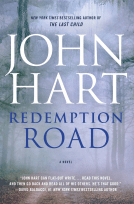
Redemption Road, by John Hart ***-****

redemptionroadJohn Hart has  loyal readers, but until a friend mentioned his name to me I had not read his work. Thanks go to Net Galley and St. Martin’s Press for the DRC, which I received free in return for an honest review. This title is available to the public May 3, 2016. There are some partial spoilers below that give up events midway through the book, but of course the ending is kept secret so that you may find it for yourself. I rate this novel 3.5 stars and round upward.

Our protagonist is Elizabeth Black, a cop burdened by her profound attachment to Adrian Wall, a former cop sent to prison for a murder she is certain he did not commit, and also to Gideon, the child of the murder victim. On the day Wall is released from prison, Gideon, now an adolescent, lies in wait for him, prepared to shoot the man he believes killed his mother.

All hell breaks loose, and once more Liz is immersed in the case. She has served as surrogate mother to Gideon since his mother’s death; his father is not fit to raise a child, and so she has quietly slipped in and out of that family’s home, preparing meals, purchasing the child’s clothes. She can’t step back from this case, even when ordered by her superiors to do so.

Hart is a gorgeous prose stylist, and his pacing is unbeatable. He does use one very old plot device, and it, along with the subscript, which I will discuss in a minute, and the absolutely impossible denouement are the reasons the final star-and-a-half is denied.  In addition, there is a place in the story—I won’t spoil the specifics—in which Liz is stark naked and leaps into a car without a stitch of clothing on, and no one finds this remarkable. It appears that the writer had intended to get her dressed and overlooked this detail, as did editors.Hart’s facility with setting is lush and matchless; the violence in this novel, thoroughly visceral, tipped my “ick” button a couple of times, and for this reason and others, I may not return to his work. But his talent and skill are unquestionable.

A minor character of considerable interest is the attorney Liz hires to defend those close to her, a very elderly local courtroom legend known as Crybaby Jones. Every time Crybaby said or did anything, my mind lit up like Christmas, it was so endearing and entertaining. I wish he had been given a larger role in the story, but for the most part he was relegated to the sidelines.

Another character of interest is the prison warden, who functions as a local kingpin and terrorizes those around him into instant submission. I disliked the way this character was shaped, because it gave the author a handy way to dismiss the over-the-top violence by local cops and prison guards as the product of one terrible man’s dominance, which gives the reader the false but comforting assurance that when cops get bad, it’s an anomaly. Hart may believe this; I don’t. And this is a part of the subscript that grated on my nerves. Early in the story Liz reflects that it is oh so hard to be a cop “since Ferguson”, sounding the message that those of us that hold cops accountable and question the deaths of children and other weaponless civilians is cruelly unfair to those that wield the badge. My e-reader comment: “Oh boo hoo. Poor poor cops.”

Because this writer spins a good thriller, I attempted to overlook this and another troubling aspect of the subscript, but the second message was hammered home again, and again, and again, the message that any woman that terminates a pregnancy is a baby killer. He goes after this one long and loudly, with Liz recalling the day she “killed her baby” in a sleazy trailer park abortion. If we’d just had the trailer and no other abortion reference it could have been interpreted as a message that abortion should be safe and legal in every state in the USA, including North Carolina, but that is clearly not the author’s intent. He has her tearfully remembering what would have been her due date had she delivered the “child”; she marks her embryo’s birthday-that-wasn’t every year, and mawkishly speculates about what he –oh yes, she knows its gender, although this is not even scientifically possible until the fifth month of a pregnancy– might have liked, his possible activities, preferences, and yada yada.

Have you had an abortion, or known someone that has? I can think of half a dozen women without trying hard, and this is just not how it goes, folks. Nor should it be.

Fiction writers often use story to drive home a political message, because story is such a strong device and delivers such powerful feelings. In the hands of friends, it is admirable and welcome. In the hands of those that wish to dictate what a woman may or may not do with her body, and in the hands of those that would restore the status quo of police terror over Black men and other vulnerable members of our society, it is galling.

To sum up, Hart has created a work of stunning prose and imagery and tremendous suspense. If you lean far enough to the right to be unaffected or even galvanized by the subscript, then this is your book.

The Black Glove, by Geoffrey Miller*****

The Black GloveThe place is Hollywood, California; the time is 1980. Terry Traven is a private detective specializing in finding the runaway children of the wealthy. He is offered a job that appears to be more of the same; a local mogul’s son has disappeared, and Dad wants him found. But then the disappearance turns out to be a kidnapping, and the kidnapping turns out to be a murder, at which point all hell breaks loose. This story is fast-paced and though it’s set a generation or two ago, the issues with police brutality—otherwise known as “the black glove”—make it more socially relevant than your average piece of crime fiction. There are other components that will sit well with those with an eye for social justice, too. Thank you Brash Books Priority Reviewer’s Circle for the DRC, which I received in exchange for a fair and honest review. This book is available for sale right now.

The beginning of the book doesn’t appear to be auspicious. A guy walks into Traven’s office and presents him with a dossier that tells him all about himself, at least in the words of intelligence sources. The dossier is too lengthy–we see every word, pages and pages of italicized material– and is clearly a fast, easy way for the author to introduce us to the character. I was prepared to be let down.

Once we get past that sloppy introduction, however, the story is complex and fast paced enough to remind me of James Lee Burke’s detective series. Toss in some quirky names, like Senator Suspenders and a punk rock band called The Dead Cherries, and add a whole lot of action. And yet somehow we find ourselves discussing issues of race, gender, and gay rights without slowing the pace at all. I almost always take off at least a star for the use of the “n” word, but the way it is used here isn’t just some cheap stunt to show us that a bad guy is really rotten or ignorant; instead, the characters manage to embark on an abbreviated discussion of race and white privilege without ever becoming preachy or distracting from the main thread.  Some of it is very indirect, and it took me awhile to get a handle on it. In other places, it’s crystal clear, as when the visiting room at the jail is “gas chamber green…a cruelly subtle reminder to the inmate of his loss of freedom.”

The story’s subscript demonstrates how women and people of color are sometimes so overwhelmed by the racism and sexism that is inherent in US culture—and even more so when this novel was written than now—that we find ourselves internalizing that hatred. Likewise gay men, lesbians, and bisexuals; those from the Boomer generation will recall just how difficult this time period was for anyone that wasn’t straight.  And given that Miller wrote this during that time, I consider this story to be courageously written, a gutsy story by a writer unafraid to take a hard look at a controversial topic.

In fact, Brash Books hasn’t introduced a detective this brainy and complex, yet entertaining since they brought out Barbara Neely’s Blanche White series. What a tremendous find! I wish there was a whole series with this detective.

Meanwhile chances are excellent that you haven’t read this book yet, and if you lean left and enjoy a good detective novel, this is one you should scoop up right away.  It’s strong fiction with a progressive thread running through it. Don’t miss out.

Blind Spot, by Tom Kakonis***-****

BlindspotThis one is 3.5 stars, rounded up. Thanks go to my friends at Brash Books for permitting me access to a DRC. The book is available for sale now.

Kakonis is a kick in the pants, and he builds suspense like nobody’s business. What could be scarier than having one’s youngster snatched by a stranger? The stakes build high, higher, and higher still. Into the bargain we are concerned for the hopeful yet still-grieving mother who believes she has lawfully adopted young Davie (formerly Jeff). Her own child, Sara, died tragically, and her husband has done everything, including the unthinkable, to bring home another child to make the family feel whole again.

Meanwhile, the Quinns search everywhere for their son. After the first 48 hours, the cops have clearly quit looking, so they print flyers to tack on every available public surface, and for good measure, they post an extra large one on their own car window. The “blind spot” occurs when a friend of the new parents passes the Quinns’ car in traffic. The friend’s husband is at the wheel, leaving her free to crane her neck and gawk at the poster, and Marshall Quinn’s pulse quickens as he sees the woman’s mouth form the words, “I know that kid.” Now the search is even more heated as Marshall searches for Della, the woman who knows who has their little boy.

Kakonis’s strength is in his spicy dialogue and strange dialects. In some ways his work is hyper-literate, delving into vocabulary most folks may not see often, but both the dialogue between characters and the internal dialogue as well are so riddled with offensive terms that it’s hard to enjoy. It’s true that Kakonis uses these terms to make plain who is a bad guy and who is not—not that it’s ever unclear, but it’s not the first time I’ve seen an author use the device to make us hate a character even more than we already do. But in such a case, less is more, and the whole first half of the story is studded with really ugly racist expressions, as well as slurs on women, the aged, and the gay. I can see where there would once have been a readership that would have casually flicked through these terms and excused them either because they were untroubled by them at all, or because it is the villain that generally says them. I know this work is seeing fresh publication after a hiatus. But to me, it feels like a lot of work to sift through the epithets to find the mystery under all that sludge.

I considered rating this tale, one with strong pacing and characterization but so many challenges, as 3 stars, but I enjoyed another of this author’s stories quite a lot, and some of the good will has carried over into this review. I’m not ready to give up on this writer’s work yet.

For those that like a fast-paced thriller or mystery and that can overlook the issues I have mentioned, this book is recommended.

Angels Burning, by Tawni O’Dell*****

angelsburningTawni O’Dell is an experienced writer, but she is new to me. I was attracted to her working class setting and protagonist Dove Carnahan, the fifty year old police chief in a tiny Pennsylvanian coal town. I received this galley free for an honest review thanks to Net Galley and Gallery Threshold Pocket Books, and I liked it so much that now the rest of her work, some of which has been featured in the Oprah Book Club, is on my to-read list. Dispensing hilarity and palpable real life truths in equal measure, O’Dell is a keeper.
The strong characterization and the stirring immediacy of this storyline had me at hello. O’Dell’s genius and deft skill are shown by her capacity to develop her small town characters into flesh, bone, and sinew. We know Dove as if she were in front of us; we know her sister Neely; we even know Neely’s dogs.

In her 27 years in law enforcement, Dove has never had to deal with a murder before, and this one is particularly nasty. Camio Truly was just 17 years old when someone smashed her head in, dropped her down a sink hole and set fire to her body. Naturally, this murder isn’t Carnahan’s job; of course not. She has two deputies, one office worker and a busted vending machine. No, the larger and better funded neighboring cop department will deal with this problem. Yet in such a small town, every problem leads into every other problem, so she’s up to her neck in it in no time anyway.

The victim was one of many children in the Truly family. The Trulys are local rednecks whose days run into one another lulled by a steady dose of television viewing. The baby’s bottle has something brown and fizzy in it. Since the narrative is in the first person, Dove tells us herself:

“I marvel as I always do at this very specific kind of American poverty. The Trulys by most people’s standards would be considered poor, yet they were able to buy everything here that has ended up as trash in their front yard. They have a $3,000 TV and the latest phones, and I can’t imagine what they spend monthly on beer and cigarettes, but they couldn’t afford a laptop for their daughter to help her with her schoolwork or a copy of Psychology for Dummies.”

O’Dell gets some good ones in at the expense of this generally ambition-free family, but she also avoids turning them into a caricature. Eldest son Eddie lives away from the family home now, and when she talks to him about his last visit from Camio, she recognizes Eddie’s own traumatic past, which includes the deaths of two brothers and the horrors of Vietnam.

And in her interrogation of Shawna, the perpetually neglectful mother of the Truly brood, she throws us some surprises, establishing dignity and gravitas for this woman stoically enduring disappointment, heartbreak, and perpetual discouragement.

Interwoven into the murder mystery are two subplots that are more important than they appear. One is that her brother Champ, who’s been gone for twenty years, suddenly surfaces with a son; the other is that the man that spent a long stretch in jail for the murder of Dove and Neely’s mother is out of prison and harassing Dove endlessly, claiming that she sent him to prison knowing that he was not guilty.

Put it all together and it’s so much more than the sum of its parts. In fact, it’s pure gold. Janet Evanovich may have to move over and save a stool for a new regular at the Sassy Murder Writers’ Saloon. This title is super smart and the pages turn rapidly, leaving the reader with a sense of loss when it’s over. Whether you buy it for a beach trip or to curl up by the fire, this one’s a must-read, and it comes out January 5, 2016.

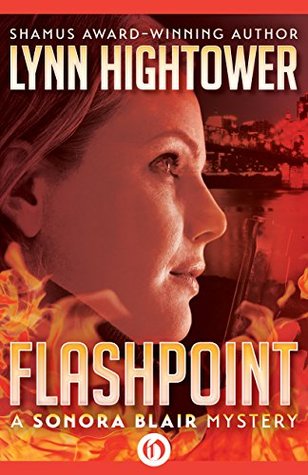
Flashpoint, by Lynn Hightower*****

flashpoint“Anybody talk to a doctor?”
“Guy came out of emergency and talked to the brother.”
“Hear what he said?”
“Just that they were very concerned with Mark’s condition, and were doing all they could.”
“Shit. Mark won’t make it then. They’re already hanging the crepe.”

Sonora Blair is one of the most kick-ass female detectives to hit the shelves in a very long time. Lucky me, I read it free, thanks to Net Galley and Open Road Integrated Media. The original publication date was 1995, and so the initial publishers must have dropped the ball big-time when it came to promotion, because I know this is the kind of story that resonates with large numbers of people, especially women. And I am glad to see it being resold by Open Road, because they know how to do the job right.

So back to Sonora. No wait, let’s go back to Hightower first. What a total bad-ass when it comes to setting! I loved seeing her enter the home where her children were asleep, and the explosion of naked Barbie doll parts in her daughter’s room. I loved the moment when her elderly dog had an accident in the living room, and she was so distracted by the hundred other things, personal and professional, all colliding at once, that it was not even the first thing she took care of once she found it.

So we have two interesting threads here. One is the problem. A killer out there has murdered a man by handcuffing him to the steering wheel of a vehicle and setting fire to it…and him. It’s grisly business, but Hightower doesn’t overwork the detail to where it triggers my “ick” button; in other words, although it’s terrible, it is never so terrible that I just don’t want to read it anymore. And the problem just becomes thornier and trickier the longer she works on it. Clues drop here and there, and the stakes go up.

The other thread is Blair’s personal life, and the problems she faces in dealing with home and work. It sounds like a tired old song when I put it that way, but like any really skillful writing, it sounds brand new when the author rubs her own brand of English on it and sends it spinning.

After having read several hundred mystery, crime fiction, police procedural, and thriller novels—okay, if I had starting keeping track sooner, I know it would be well over a thousand—there are a handful of devices that are so frequently used that my eyes auto-roll when I see them utilized. I was watching for them. But Blair never gets tossed into the trunk of anybody’s car; she never gets the phone call saying the killer has her kids; there is never a moment when we realize she has been framed for the killing herself, and has to solve it to save her own butt. I’m not saying a great writer can’t get away with any of those; there are some Grand Masters out there that have done it and before my eyes could make the full roll, they were glued back to the page. But once someone reaches into that worn, soiled bag of tricks, it becomes a lot harder to engage me, and I was delighted that Blair never went there.

Her facility with setting is consistently brilliant throughout the book.

One tiny odd bit: for the first chapter or two, I was convinced that Blair was African-American. When she turned up blonde later, I had to mentally reinvent her. It didn’t take long though, because I was riveted and had to get back to the story.

For fans of outstanding detective fiction, this is a must-read. Order it now for yourself, or as a gift for someone you know will love it.

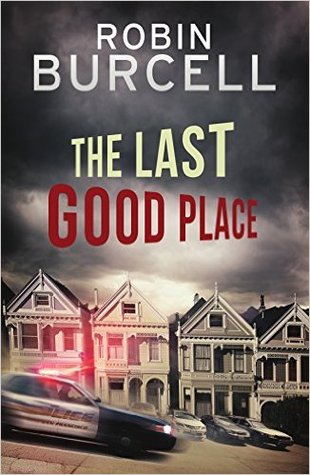
The Last Good Place, by Robin Burcell****

thelastgoodplaceWhat a treat! They say all stories have already been told once, but I’m telling you, this one hasn’t. Oh, trust me! And my thanks go to Net Galley and Brash Books for a wonderful DRC. This one will be up for sale November 3.

Some may recall the TV series “The Streets of San Francisco”; the show was based on a set of police procedurals by Carolyn Weston. Characters Casey Kellog and Al Krug became TV characters Steve Keller and Mike Stone. In bringing the series back to us in the twenty-first century, new co-author Robin Burcell was asked to update it, since some of the over-the-top methods used originally could get a cop fired these days, and the old methods would not resonate with the public. Burcell has a lengthy background in law enforcement, and now I know that she is also a capable novelist. The pages flew by, and I enjoyed her improvement of the old series.

As the story commences, there have been a series of murders at famous landmarks in San Francisco, and it has been inferred by the media that tourists are at risk. While sometimes life may be cheap, the tourist industry is key to the local economy, and there’s heavy political pressure set to find someone and solve this crime, preferably accurately, but if not…just get someone, haul them in, and charge them.

So when Marcie’s neighbor and good friend Trudy turns up dead, there is speculation. Has she been a victim of this killer, or is it a copycat killing?

We find out right at the get go that Marcie knows a thing or two. For example, she knows that Trudy and her husband are getting a divorce; they are no longer in love. And Marcie also knows that her buddy has been spending some private time with Marcie’s husband. And so while Trudy and her soon-to-be-ex are going to sell their house as part of dividing the spoils of a marriage gone bad, Marcie won’t sell her house. Because it is her house, along with the eucalyptus grove out in the backyard. Her grandfather left her the house, and he left her the trees. He used to tell her that this humble, quiet spot out back was “the last good place”, and Marcie won’t part with it. Not ever. Not even to increase the property’s value—for herself and also for friend Trudy—by making their homes bay view property. Her grandfather preferred the trees to the water view, and so does Marcie.

It’s time to go jogging with Trudy, but Marcie hangs back and hides for a bit. We aren’t quite sure why, apart from the fact that she is suspicious that things are not what they seem to be. Trudy’s been a little strange toward her lately. And what do you know…Trudy dies on the morning jog before Marcie catches up to her.

This is a really accessible story, and I thought I ought to be able to solve the mystery. Goodness knows I read enough of them! And yet, I really didn’t get it. The author doesn’t pull the rug from beneath the reader by introducing a lot of new information at the end, or any of the other unfair devices writers occasionally use in order to make their story’s ending a certain surprise; I had a reasonable shot at it, but I didn’t get it. And I loved the ending!

The characters—the experienced, fatherly, crafty interrogator Al Krug, and his ambitious partner, Casey Kellog, are well developed and personable, but their personal lives don’t distract from the problems at hand. There are a couple of red herrings, but the plot is essentially linear and easy to follow.

All told, this one is a humdinger, and you should read it!

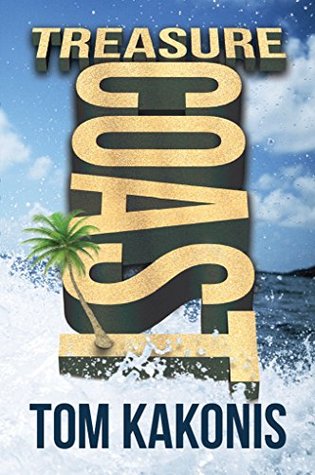
Treasure Coast, by Tom Kakonis*****

TreasureCoastHugely imaginative, terribly funny, and utterly tasteless, Kakonis delivers the chortles with Treasure Coast, a comic caper that juggles numerous entertaining characters with surprising deftness. Thank you twice, first to Brash Books and second to Net Galley, for providing me with the DRC to review. This title will be available September 14, 2015 to the book-buying public.

Our tale begins with Uncle Jim Merriman, a professional gambler who can’t even manage to break even these days, and “his numbnuts nephew”, Leon Cody, “…this kid with the crop of wild hair and Magoo glasses and dippy grin”, who is in debt to loan sharks. Leon’s mother has died and left not only her body, but also her foolish son, to Uncle Jim’s care and keeping. And of course we have the shark’s collection agents, Morris “Junior” Biggs and “your badass Hector Pasadena”.

On the other hand, we have Bryce Bott, hustler of gravestones that once purchased, will never arrive and “séances” delivered with the help of his hillbilly sidekick, Waneta Jean, who feigns nearness to death as a part of the séance scam.

Of course, ultimately, the characters wind up in a messy pile trying out-scam each other. “Circles inside of circles, games within games.”

But oh, that’s not enough! We also have trophy bride Billie Swett, who within my mental movie soon became Bernadette Peters, and her obnoxious, porcine, but almost infinitely wealthy spouse, Big Lonnie Swett. Eventually we add Cheetah, to whom Reverend Bott referred as “that other intrusive fellow”. Their roles in all of this, you will have to find out on your own.

“And how do you count the ways of weird?”

This was a story worthy of patience. There were so many nasty racist comments made about almost everyone you can think of; however, they are used within the context of Junior’s vapor-brained, “Aryan” sensibilities. There are several horribly ugly sexist remarks using the worst possible terms you can imagine, but again, it is only the bad guys that use them…and a reckoning comes down in a manner I found deeply satisfying.

To put it another way: we were halfway through before I was even sure I liked this novel, but once I was on board, I was in it for keeps, flagging one clever passage after another, most of which I can’t share here. I can share this YouTube promotional clip, though:

So although I was ultimately dumbstruck by the creativity with which Kakonis wove all of the complicated strands of this story together without dropping a single one, I also caution the reader. There are some really crass, fairly specific references to corpses in this book. If you have just lost someone and the wound is still raw, this is probably not the title with which you should escape. There are repeated references to the joys of rape. If you or someone near to you has been down that brutal path, maybe this is not your story, either. And one more caveat before I can go back to singing praises: if your mother tongue is not English, you may not want to embrace this challenging novel, which despite its Keystone Cops-like atmosphere requires exceedingly strong vocabulary skills. For those that enjoy word play, it’s a real treat, but any time you have to look up more than 3 words per page, the effort will outweigh the enjoyment you receive.

With the above caveats in mind, this new release comes highly recommended by this reviewer. The only real question is how you will wait until Monday to get your copy!

For the Dignified Dead, by Michael Genelin****

forthedignifieddeadThere’s a murderer on the loose, one that has killed across international boundaries. The weapon of choice? An ice pick. Happily, the case is assigned to total bad-ass Commander Jana Matinova, the best new female detective I’ve seen in emerge in crime fiction in decades. Thank you to Net Galley and Brash Books for the DRC. This title will be available for purchase November 3.

Part of what initially attracted me to this novel was the setting. Though Matinova finds herself crossing into various parts of central Europe, she is based in Slovakia, a country not even on my personal radar. By way of apology, I will point out that for most of my life, a giant swath of Europe and Asia was designated as USSR, and the satellite states lined up like faithful guardians around its perimeter included Yugoslavia and Czechoslovakia, both of which have been carved into different nations since the Stalinist realm crumbled. So I thought I’d learn a little bit about the contemporary contours of central Europe in the most enjoyable way possible—through fiction.

Genelin doesn’t disappoint. Along with Matinova, we have a collection of other cops, some of whom garnered truly fetching descriptions, such as this one: “With his thinning hair and lopsided smile he looked like a harmless, slightly unkempt beagle without its long ears.”

In addition we have the sinister Koba, a master criminal that Matinova considers akin, perhaps, to Holmes’s Moriarty. Koba’s role in Genelin’s story is complex and fascinating.

But most of all, I appreciated the development of Jana Matinova, both for her silver-bullet speed and cleverness, and also for that which is not included. We never hear about her hair, makeup, or her figure; we don’t need to know anything about her love life, and if she experiences any ambivalence about her lack of a domestic life, we don’t hear about it. In fact, Genelin treats his protagonist just as he would a male protagonist.

Now isn’t that a breath of fresh air?

The fifth star, which I would have loved to be able to add to this engaging story, is denied because of problematic passages that popped up often enough to warrant ten different notations in my kindle: “Too wordy! Tighten it up!” It seemed either as if there were two writers, one more capable than the other, co-writing the novel, or as if someone whose mother tongue is not English was struggling to say what needed saying. I noticed this was most frequent during passages of narrative, and less likely to occur during dialogue. Whatever it is, it could benefit greatly from either some rewritten passages or strong editing. But every time I found my eyes jerking through one of these verbose areas in the text, sooner or later we would come out slick as a whistle, and everything would commence to flow again. I don’t think a published text has ever confused me so much in this regard.

That being said, I would cheerfully read other books in this series given the opportunity. Because when push comes to shove, Commander Jana Matinova is a champ!

Blanche Passes Go: A Blanche White Mystery, by Barbara Neely*****

blanchepassesgo“Blanche’s mind rang with remembered slights and taunts, and echoes of that awful, heartbreaking instant of fear that was a part of every trip into the white world—a fear of being refused or given poor service because she was black, stopped by a cop because she was black.”

I finished reading Blanche Passes Go on the second anniversary of the death of Michael Brown, who was shot dead by a cop for jaywalking. Bernie Sanders, the candidate who fancies himself the liberal savior for all progressive-minded Americans, spoke here in Seattle that day. The purpose of his talk, apart from campaigning and fundraising, was to celebrate the birthday of Social Security. The speech was disrupted by a pair of African-American women who took exception to his myopia.

So I guess you could say that everyone, even those that don’t generally enjoy mysteries, ought to be reading this book right about now. In particular, if the reader is still trying to figure out why so many people, particularly people of color, get upset with the clueless slogan “All lives matter”, this book is here, just for you. Neely approaches issues of race, class, and gender in a way that is clear but not unkind. It’s her best work to date, and could not have been published by Brash Books at a more appropriate time. My great thanks go to them and the people at Net Galley for providing me with a DRC, and to Neely for laying it all out so that anybody who has a willing heart can get the picture.

In this fourth Blanche White mystery, Blanche has gone home to Farleigh, North Carolina for a vacation, and to try partnering a catering business with her best friend, Ardell. But Farleigh is a small place, and she can’t avoid running up against David Palmer, a Caucasian man that raped her. She never reported it, of course; were they really going to haul the well-heeled, powerful white man for a sperm sample, given the long history of Caucasian men raping Black women with impunity? Not likely! So when her long-simmering rage is ignited by the sight of him, she vows to not only get mad, but to get even as well.

Blanche White novels always have multiple threads that weave in and out of the plot line, but this is the most complex and impressive yet. Not only does Blanche have to grapple with Farleigh and Palmer, she is back in her home town, and her mama is still here. Like many women, Blanche has hit middle age and menopause with a renewed, powerful yearning to know more about her mama, who never stops talking but never gives away the personal information Blanche is almost begging for, and about her father, about whom virtually nothing has been told her. Blanche decides that once a person has children, their privacy is no longer as sacred as it was before, and a lot of personal information becomes family property. I loved that.

Well into the book, Ardell accuses Blanche of sounding exactly like her mother, and Blanche is dumbfounded to realize it’s true. I threw back my head and laughed out loud. It’s the rare woman that doesn’t hear her own mother coming out of her mouth sooner or later, and the moment was built so deftly and executed so well that it landed hard on my funny-bone.

Other Blanche novels have accentuated the protagonist’s tightly held independence. Here, she meets a fine man named Thelvin on the Amtrak coming into Farleigh, and at some point, she has to decide just how flexible (or inflexible) she is going to be.

Another component is Mumsfield, an acquaintance that has Down’s Syndrome and is about to be married to someone who may be after his money. This aspect of the story, like the others, is skillfully crafted. Mumsfield is not completely helpless, and the fact that he has Down’s does not make him Blanche’s friend, as he claims to be. There is still that division of white privilege. It’s not that Blanche could not have a white friend, but it would have to be someone with ownership of what that means.

Because all of these components are told in the third person omniscient, and because the writer is a complete badass, we are privy to all the intricacies involved here. Add a problem with domestic abuse next door to the Miz Alice where Blanche is staying, and you have an interesting stew indeedy.

Highly recommended.