
Pay Dirt, by Sara Paretsky*****

Sara Paretsky is a badass author with a badass protagonist. Her hero, Vic Warshawski, is a rough and ready private eye, and though based in Chicago, she sometimes—as now—finds herself elsewhere when duty beckons. Author Paretsky is one of the three that pioneered the hardboiled female private eye subgenre; the first in this series, Indemnity Only, came out in 1982, over 40 years ago, and that is how long I have been reading them. And though I was lucky to receive a review copy, thanks to NetGalley and William Morrow, this is one of those rare books that I would have paid full price to read if that was the only way I could get it.
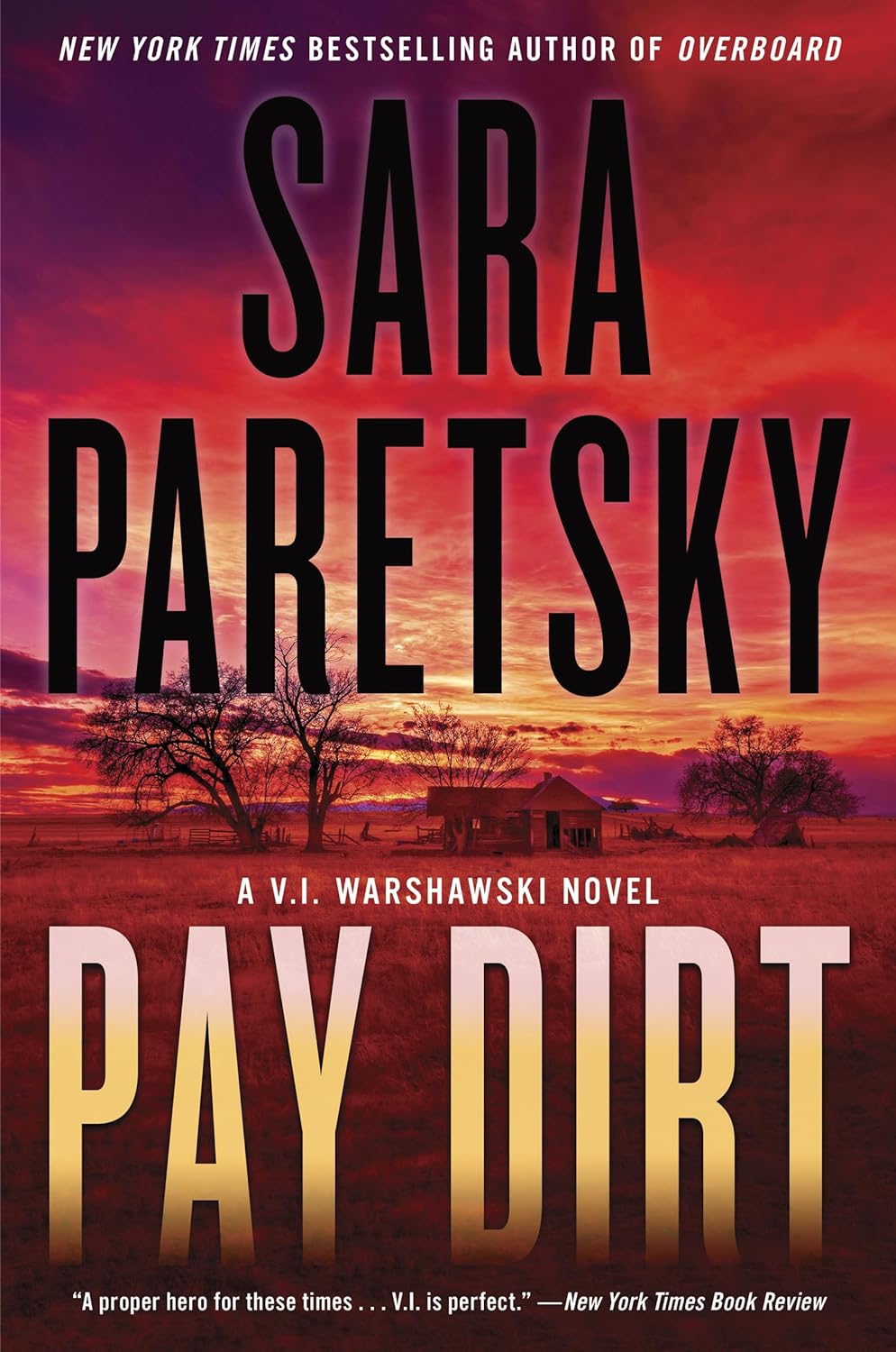
This book is for sale now.

This story finds Vic in bad shape, both mentally and physically. She has attempted to help a student of her boyfriend Peter’s, a trans youth whose father blew out the kid’s brains rather than accept their new identity. The brains stuck to Vic, and the experience sent her reeling emotionally. She’s been forgetting self-care, not eating or exercising. What she needs is rest and quiet.

But that’s not how it goes.

Her godchild Bernie persuades Vic to attend a basketball championship game in Kansas. A group of them will be going down there; it’s just what Vic needs, she says. Reluctantly, Vic agrees, but once they are there and the game is over, one of the parties disappears, and Vic is enlisted to find her. When Vic finds the missing basketball player, she inadvertently finds a dead body. The cops in Lawrence, Kansas as well as the FBI like her for the killing. It’s so convenient to have a mouthy, street smart outsider blunder in; hopefully, they can pin it all on her, and then life will go on as it has been. And so Vic must stay behind because she’s been told not to leave town, but also in order to clear her name.

Now, this is one of the elements that generally irritates me in most mysteries; the whole clearing-my-name trope is desperately overdone. There’s another trope that shows up later in the story, but I won’t share it here because it’s a spoiler. But for every rule, there is an exception, and in the case of both tropes, Paretsky breezes through, and I barely bat an eye; this is because the characters are so real to me, and the situation they’re in is so immediate, that I blow it off so I can find out what happens next.

And as is so often the case, Vic Warshawski finds herself up against the town’s wealthy power brokers, who have a vested interest in not having the real killer caught. As for Vic, she makes friends with a few people that have no wealth and no power, but the small ways they assist her make all the difference.

Once she solves the crime, persuades the local police and others that she is innocent and that the blame lies with the men in the suits, are they hauled off in shackles? Don’t hold your breath. As one of her new pals reflects, “That is justice in America, plain and simple, before you wrap it up in a pretty package of Constitutional rights that only the rich get to have.”

The thing that sets this particular book apart from the other very good mysteries I’ve read recently is the development of the protagonist. She’s vulnerable because of her earlier trauma; her boyfriend left the country on business, and he hasn’t been responding to her texts. She is miserable, and she’s isolated. But as the pressure builds, Warshawski delivers. The last quarter of this novel is impossible to put down, and even before that, I set aside my usual rotation of books, because I wanted to read this, and only this.

This novel is written in such a way that a first time reader can jump into the series, but chances are good that once you do, you’ll reach back for some or all of the others. Highly recommended to those that love gritty, rough and tumble detectives; feminists; and those that lean to the left.

Love and Other Crimes, by Sara Paretsky*****

Sara Paretsky is a venerable author, one who—along with the late, great Sue Grafton—reframed the role of women in detective fiction nearly forty years ago. When I saw this collection available for review on Edelweiss, I jumped on it. It’s for sale now, and you should get it and read it—although there’s a caveat coming up that should be considered first.

Sometimes when a favorite writer releases a book of short stories, I find that I’ve already read a lot of them in one form or another. This time, nearly every story is new to me. One forms the basis of a full length book that I read a long time ago and have forgotten much of. Another is a reworked version of the short story “Wildcat,” which I purchased a short time ago. These are the only duplicate stories I can detect, and I am a voracious reader where this author is concerned.  Some of her work was included in Sisters in Crime anthologies, but I haven’t seen them. Not all of them feature the iconic V.I. Warshawski. The signature elements that include social justice issues such as women’s rights, immigration, racism, and the homeless are here in abundance, as one might hope.

My favorite selection is the second, “Miss Bianca,” a mystery in which a little girl saves a research rat and ultimately uncovers a dangerous conspiracy. Paretsky gets the tone of the child’s voice just right, making her bright within the bounds of what a child that age is capable of, and registering the thought processes and perceptions of her protagonist flawlessly.

There’s an historical mystery that involves a Sherlock Holmes retelling, and like all of that ilk, it bored the snot out of me, a first where this writer is concerned. I abandoned it halfway through. The five star rating is unchanged, because the reader can skip this story and still get her money’s worth and then some; also, I am aware that not everyone is as averse to this type of writing as I am.

Another story is set during the late 1960s, and the Civil Rights Movement is center stage. In order to convey the horror of the backlash by some Caucasian Chicagoans during this tumultuous period, the *N* word is included several times. I used the audio version of this book for some of the stories, including this one, and I feel as if it should have a warning sticker of some sort because hearing that word shouted angrily sent a cold finger right up my spine, and I don’t like to think of other readers, especially Black readers, listening to it within the hearing of their children. I don’t deduct anything from my rating, because the author includes a note about its use and her reasons for it at the end of the story; in fact, there is an author’s note at the end of many of these that makes the story more satisfying. But you should know that this word is there, so be ready for it.

When all is said and done, there are few authors that can deliver the way Paretsky can. With the considerations above included, I highly recommend this collection to you.

Dead Land, by Sara Paretsky*****

Detective Vic Warshawski was born in 1982, a time when a woman advocating for herself, or another woman, or women on the whole were few and far between. Such a woman often spoke softly, hesitantly, and to reassure the listener that she wasn’t stark raving mad, she might begin by saying, “I’m not a feminist or anything, but…” And so for the lonely few of us that were uncloseted, audacious feminists, this bold, brazen, unapologetic character was inspirational. Vic is fictional, but Paretsky is not. It was leading lights such as hers that made me feel less alone. I have loved her from then, to now.

Paretsky is no longer a young woman. I know this because I am a grandmother myself, and she is older than I am. For her readers that wonder if she’s still got it, I have great news. She’s better than ever.

By now I should have thanked William Morrow, Net Galley, and Edelweiss Books for the review copies. You can get this book April 21, 2020.

Victoria’s young goddaughter, Bernie Fouchard appears in an earlier story, and now she returns. Bernie’s youthful passion and impetuous disposition counter Vic’s experience and more measured responses. I liked Bernie when she was introduced, and am glad she is back. Chicago’s shady politicians are about to quietly sell a prime chunk of the city’s park lands to developers; the corrupt nature of the deal makes it essential that the whole thing be done fast and with as little publicity or public input as possible. Bernie and a handful of others learn of it, and they protest at a meeting at which the city fathers had hoped to slide this oily project through. There are arrests, and soon afterward, Bernie’s boyfriend is murdered.  

At the same time, Bernie tries to help a homeless singer named Lydia Zamir. Zamir is brilliant and was once very famous, but everything crumbled around the time that her lover was shot and killed; she’s been living under a bridge, filthy, disoriented, playing her music on a child’s toy piano. Now Lydia is missing. Lydia’s champion has been a man named Coop, and Coop is missing too. Before pulling a bunker, Coop deposits his dog outside Vic’s apartment, earning her the enmity of neighbors that are already up in arms over the barking of Vic’s own dogs when she is gone. Now Vic has every reason to help find Coop, Lydia, and the murderer. At the same time the reader must wonder how the sleazy deal, the murder, and the disappearances are connected. The pacing is urgent and my interest never flags; the haunting mental image of Lydia and her small, battered piano tug at my social conscience, all the more so as the world is hurtled into quarantine.

Long-running characters Lottie and Max, who are like parents to Vic, and newspaperman Murray, a close friend of Vic’s, return here, and I love them all. No doubt this colors my response as well. I have known these characters longer than my husband of thirty years; at one point I realized that somewhere along the line, I had separated the other books I was reading (some of them quite good) from this one. I had my books-to-read category, but I had mentally shifted this story into the same category as my family business. I should check on my sister, who’s been ill; I wanted to set a lunch date with one of my kids; and I should check and see whether Vic is having any luck finding…oh hey. Wait a minute.

Can you read this story as a stand-alone? You sure can. However, this bad-ass, hardboiled Chicago detective is an addictive character; once you’ve read it, you’re going to want to go back and get the other 21 in the series. I swear it. You probably won’t experience the nostalgia that I do, but a damn good read is a damn good read, any way you slice it.

Highly recommended.