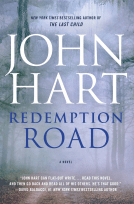
 John Hart has loyal readers, but until a friend mentioned his name to me I had not read his work. Thanks go to Net Galley and St. Martin’s Press for the DRC, which I received free in return for an honest review. This title is available to the public May 3, 2016. There are some partial spoilers below that give up events midway through the book, but of course the ending is kept secret so that you may find it for yourself. I rate this novel 3.5 stars and round upward.
Our protagonist is Elizabeth Black, a cop burdened by her profound attachment to Adrian Wall, a former cop sent to prison for a murder she is certain he did not commit, and also to Gideon, the child of the murder victim. On the day Wall is released from prison, Gideon, now an adolescent, lies in wait for him, prepared to shoot the man he believes killed his mother.
All hell breaks loose, and once more Liz is immersed in the case. She has served as surrogate mother to Gideon since his mother’s death; his father is not fit to raise a child, and so she has quietly slipped in and out of that family’s home, preparing meals, purchasing the child’s clothes. She can’t step back from this case, even when ordered by her superiors to do so.
Hart is a gorgeous prose stylist, and his pacing is unbeatable. He does use one very old plot device, and it, along with the subscript, which I will discuss in a minute, and the absolutely impossible denouement are the reasons the final star-and-a-half is denied. In addition, there is a place in the story—I won’t spoil the specifics—in which Liz is stark naked and leaps into a car without a stitch of clothing on, and no one finds this remarkable. It appears that the writer had intended to get her dressed and overlooked this detail, as did editors.Hart’s facility with setting is lush and matchless; the violence in this novel, thoroughly visceral, tipped my “ick” button a couple of times, and for this reason and others, I may not return to his work. But his talent and skill are unquestionable.
A minor character of considerable interest is the attorney Liz hires to defend those close to her, a very elderly local courtroom legend known as Crybaby Jones. Every time Crybaby said or did anything, my mind lit up like Christmas, it was so endearing and entertaining. I wish he had been given a larger role in the story, but for the most part he was relegated to the sidelines.
Another character of interest is the prison warden, who functions as a local kingpin and terrorizes those around him into instant submission. I disliked the way this character was shaped, because it gave the author a handy way to dismiss the over-the-top violence by local cops and prison guards as the product of one terrible man’s dominance, which gives the reader the false but comforting assurance that when cops get bad, it’s an anomaly. Hart may believe this; I don’t. And this is a part of the subscript that grated on my nerves. Early in the story Liz reflects that it is oh so hard to be a cop “since Ferguson”, sounding the message that those of us that hold cops accountable and question the deaths of children and other weaponless civilians is cruelly unfair to those that wield the badge. My e-reader comment: “Oh boo hoo. Poor poor cops.”
Because this writer spins a good thriller, I attempted to overlook this and another troubling aspect of the subscript, but the second message was hammered home again, and again, and again, the message that any woman that terminates a pregnancy is a baby killer. He goes after this one long and loudly, with Liz recalling the day she “killed her baby” in a sleazy trailer park abortion. If we’d just had the trailer and no other abortion reference it could have been interpreted as a message that abortion should be safe and legal in every state in the USA, including North Carolina, but that is clearly not the author’s intent. He has her tearfully remembering what would have been her due date had she delivered the “child”; she marks her embryo’s birthday-that-wasn’t every year, and mawkishly speculates about what he –oh yes, she knows its gender, although this is not even scientifically possible until the fifth month of a pregnancy– might have liked, his possible activities, preferences, and yada yada.
Have you had an abortion, or known someone that has? I can think of half a dozen women without trying hard, and this is just not how it goes, folks. Nor should it be.
Fiction writers often use story to drive home a political message, because story is such a strong device and delivers such powerful feelings. In the hands of friends, it is admirable and welcome. In the hands of those that wish to dictate what a woman may or may not do with her body, and in the hands of those that would restore the status quo of police terror over Black men and other vulnerable members of our society, it is galling.
To sum up, Hart has created a work of stunning prose and imagery and tremendous suspense. If you lean far enough to the right to be unaffected or even galvanized by the subscript, then this is your book.
 Second Daughter is historical fiction based on the true story of an enslaved woman that went to court and won her freedom in New England around the time of the American Revolution. I received this DRC free from Net Galley and Open Road Integrated Media in exchange for an honest review. And it’s just as well, because if I had paid any money at all for this brief but troubled book, I would be deeply unhappy.
 I loved this memoir. I read it in 2014 through the Goodreads First Reads program when I first began writing reviews, a few months before I began my blog. This is a memoir intended for general audiences, disarmingly funny and engaging. I recommend it to everyone.
 I read this memoir, one of the most important of our era, before I was writing reviews. I bought it in the hard cover edition, because I knew I would want it to last a long time and be available to my children and their children. It was worth every nickel. It’s lengthy and requires strong literacy skills and stamina, but if you care about social justice and are going to pull out all the stops for just one hefty volume in your lifetime, make it this one.
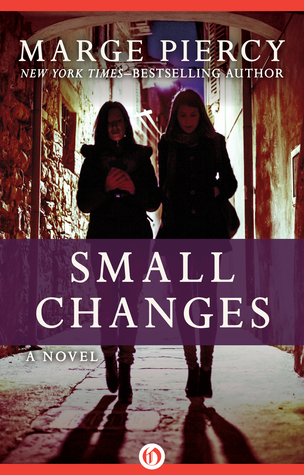 This title was originally published in 1973 during the second wave of feminism that followed the US Civil Rights movement, and then the anti-war movement against the US invasion of Vietnam. Marge Piercy is a prominent veteran writer who spoke to women’s issues during that time and in years to follow. She doesn’t need my review, and neither does Open Road Integrated Media, I suspect, but my thanks go to them and Net Galley for letting me reread this wonderful novel digitally. I received this copy free in exchange for an honest review, but the reader should also know that I came to this galley with a strong, strong affinity for Piercy’s work already, and my bookshelves are lined with paperbacks and hard cover copies of her books. But they are thick and sometimes heavy to the arthritic hand, and it’s a joy to be able to read them on a slender electronic reader. It was released digitally April 12, 2016 and is available for purchase now.
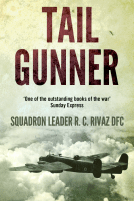 Tail Gunner is the memoir of a member of the Royal Air Force during World War II. I was fortunate to receive a copy free in advance from Net Galley and Endeavor Press in exchange for an honest review. It’s both compelling and informative.
 I like short stories. My Goodreads library tells me I have munched my way through 89 collections and anthologies; yet I can tell you that there is nothing even remotely similar to what Hale offers here. Thanks go to Simon and Schuster and Net Galley for permitting me to view the DRC for the purpose of an honest review. You should get a copy May 17, 2016 when it is released, so that when it is immediately banned by various school boards you will know what they’re screaming about.
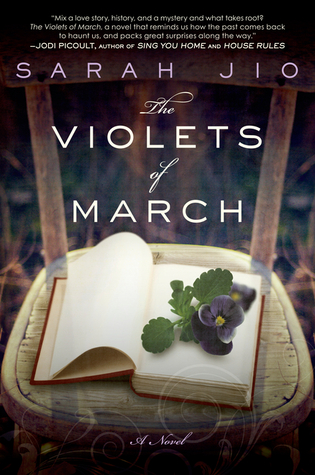 The Violets of March is a crossover title, part cozy mystery, and partly—maybe mostly—romance. I purchased it for myself years ago, back when I was teaching, not advance-reading, and buying all my own reading material. It’s not a bad book, but given that I had paid full jacket price for the trade paperback version after reading some rave reviews, I felt let down. It’s a pleasant read, but it didn’t live up to its hype.
 Lilac Girls is the story of three women during World War II. I received a DRC for this book courtesy of Net Galley and Random House Ballantine in exchange for an honest review. I rate this novel 3.5 stars.
 The Girls is a fictionalized account of the Manson Murders, a terrible killing spree that stunned the USA in the 1960s before any mass shootings had occurred, when Americans were still reeling from the assassinations of President Kennedy, his brother, Senator Robert Kennedy, and Dr. Martin Luther King. Manson, a career criminal with a penchant for violence yet possessed of a strange sort of charisma, attracted a number of young women and girls into a cult of his own founding. Later they would commit a series of grisly murders in the hills outside Berkeley, and it is this cult and these crimes on which Cline’s story is based. Great thanks to Net Galley and Random House for the DRC. This book will be published June 14, 2016.
