The Kaminsky Cure, by Christopher New***

thekaminskycureThe Kaminsky Cure is a satire of Nazi Germany previously published and now offered anew in digital format. Thanks go to Open Road Integrated Media and Net Galley for the invitation to read and review, and for the DRC, which I received free of charge. This title is available to purchase now.

Who would have thought it possible to satirize such a terrible time and have it come out in anything other than terrible taste? But New carries it off, using a pre-school aged child in a mixed family—with one Jewish parent and one Anglo parent—as his narrator. Several times the precocious tot points out aspects of his own narrative that are actually impossible, as for example when the child tells us exactly what is contained in something written and then blandly points out that he cannot read yet. It just makes it funnier.

The appealing thing about this novel is that it brings up the reality which should be obvious to any thinking person that has paid any attention to this particular time and place: most Germans as well as Austrians were entirely in favor of Hitler’s takeover, and although there were Jewish families, many of them in fact, that wanted out of Nazi-occupied Europe as quickly as they could go, there were others that had never embraced their culture and had converted to Christianity in some cases generations earlier; and such is the case with our protagonist’s family, which wants only to pass itself off as Aryan so that it can join in the party. Young Martin, the protagonist’s older brother, longs to become a member of the fearsome SS, Hitler’s storm-troopers. Ah, the uniforms! The ferocity! The authority!

Our toddler-narrator, meanwhile, observes his own family with platonic remove, contemplating which members have violated one edict or another and should therefore be turned in to the authorities. After all, that’s one of the things he has learned in school. Children are the future, and it’s up to them to weed out those older folk that fail to comply with important social changes.

It’s what Hitler would want him to do.

There’s one twist and then another, but overall I found that the story’s momentum lost steam as it progressed, because there was really just one joke here, and it could only be played so many ways before it became repetitious. Nevertheless, it’s wholly original, and when faced with an event as horrific as the Holocaust, one either has to laugh or cry.

And amazingly, New has created a way to help us laugh, at least for a little while.

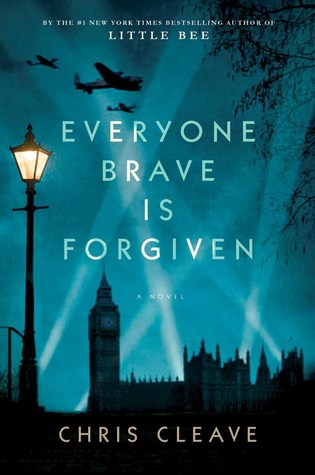
Everyone Brave is Forgiven, by Chris Cleave*****

everyonebraveisforgivenThis is one of those rare novels that I have passed by multiple times despite all the buzz it has generated, because it looked as if it was out of my wheelhouse. A socialite. Pssh. A British officer. Sure. But eventually the enormous buzz among readers and booksellers made me curious. The last time I had this experience, the novel was The Goldfinch, and once I had begun it I gasped almost audibly at what I had almost let slip away from me. And so it is with Cleave’s brilliant novel, historical fiction mixed with more than a dash of romance.  I was lucky enough to get the DRC free of charge in exchange for an honest review; thank you Simon and Schuster and also Net Galley. This luminous novel is available to the public Tuesday, May 3, and you have to read it. It is destined to become a classic.

Our protagonists are Mary North and Alistair Heath; she is dating his best friend, and he is dating hers.  The night before he is to leave to serve in the British armed forces, a moment flashes between them in which they know they want to be together; when he leaves, each grapples with issues of personal loyalty when thinking of the other.

If talent were a mountain, then Cleave would be Everest. If talent were an island, Cleave would not be Malta, but rather all of Britain. And Cleave’s use of word play, first to show how undaunted British youth were by the challenges ahead, and later in a sharper way as the characters learn terrible things and develop a new definition of what courage looks like, is bafflingly brilliant, the rare sort that makes lesser writers hang their heads and understand—this will never be you.

My primary reservation about this novel was that it dealt with the social elite, and my first thought was oh heavens no.  That poor rich girl is going to have to suck it up like everybody else. But I underestimated Cleave and what he was about to take on; Mary, Alistair, and the secondary characters around them begin with a set of assumptions that under his unerring pen seem not only reasonable, but the sort of normal to which their entire lives have accustomed them. Their cavalier approach to the war, from those that serve from those like Tom who at the outset, believe they will “give it a miss”, is the entitlement that has cradled and preserved them from the realities of the greater world all their lives.

And it’s about to change.


Any other city would be chewing its knuckles and digging a hole to hide in.    Alistair    wanted to yell at people: The bullets actually work, you know! What they did not understand was that the city could be extinguished. That every eligible person could die with the same baffled expression that he had seen on the first dead of the war, in those earliest shocking days before the men had learned to expect it. I’m so sorry—I think I’m actually hit.


In turns amusing, poignant, tender, and heartbreaking, this is a novel you will want to reserve hours of your most private moments to read. You may find yourself taking an unexpected sick day so that you can finish it. Based on the overall story of the author’s grandfather with changes, added details, and embellishments, all of which the protagonists would agree are first rate, Everyone Brave is Forgiven is an unforgettable story of love, war, and innocence lost.


Redemption Road, by John Hart ***-****

redemptionroadJohn Hart has  loyal readers, but until a friend mentioned his name to me I had not read his work. Thanks go to Net Galley and St. Martin’s Press for the DRC, which I received free in return for an honest review. This title is available to the public May 3, 2016. There are some partial spoilers below that give up events midway through the book, but of course the ending is kept secret so that you may find it for yourself. I rate this novel 3.5 stars and round upward.

Our protagonist is Elizabeth Black, a cop burdened by her profound attachment to Adrian Wall, a former cop sent to prison for a murder she is certain he did not commit, and also to Gideon, the child of the murder victim. On the day Wall is released from prison, Gideon, now an adolescent, lies in wait for him, prepared to shoot the man he believes killed his mother.

All hell breaks loose, and once more Liz is immersed in the case. She has served as surrogate mother to Gideon since his mother’s death; his father is not fit to raise a child, and so she has quietly slipped in and out of that family’s home, preparing meals, purchasing the child’s clothes. She can’t step back from this case, even when ordered by her superiors to do so.

Hart is a gorgeous prose stylist, and his pacing is unbeatable. He does use one very old plot device, and it, along with the subscript, which I will discuss in a minute, and the absolutely impossible denouement are the reasons the final star-and-a-half is denied.  In addition, there is a place in the story—I won’t spoil the specifics—in which Liz is stark naked and leaps into a car without a stitch of clothing on, and no one finds this remarkable. It appears that the writer had intended to get her dressed and overlooked this detail, as did editors.Hart’s facility with setting is lush and matchless; the violence in this novel, thoroughly visceral, tipped my “ick” button a couple of times, and for this reason and others, I may not return to his work. But his talent and skill are unquestionable.

A minor character of considerable interest is the attorney Liz hires to defend those close to her, a very elderly local courtroom legend known as Crybaby Jones. Every time Crybaby said or did anything, my mind lit up like Christmas, it was so endearing and entertaining. I wish he had been given a larger role in the story, but for the most part he was relegated to the sidelines.

Another character of interest is the prison warden, who functions as a local kingpin and terrorizes those around him into instant submission. I disliked the way this character was shaped, because it gave the author a handy way to dismiss the over-the-top violence by local cops and prison guards as the product of one terrible man’s dominance, which gives the reader the false but comforting assurance that when cops get bad, it’s an anomaly. Hart may believe this; I don’t. And this is a part of the subscript that grated on my nerves. Early in the story Liz reflects that it is oh so hard to be a cop “since Ferguson”, sounding the message that those of us that hold cops accountable and question the deaths of children and other weaponless civilians is cruelly unfair to those that wield the badge. My e-reader comment: “Oh boo hoo. Poor poor cops.”

Because this writer spins a good thriller, I attempted to overlook this and another troubling aspect of the subscript, but the second message was hammered home again, and again, and again, the message that any woman that terminates a pregnancy is a baby killer. He goes after this one long and loudly, with Liz recalling the day she “killed her baby” in a sleazy trailer park abortion. If we’d just had the trailer and no other abortion reference it could have been interpreted as a message that abortion should be safe and legal in every state in the USA, including North Carolina, but that is clearly not the author’s intent. He has her tearfully remembering what would have been her due date had she delivered the “child”; she marks her embryo’s birthday-that-wasn’t every year, and mawkishly speculates about what he –oh yes, she knows its gender, although this is not even scientifically possible until the fifth month of a pregnancy– might have liked, his possible activities, preferences, and yada yada.

Have you had an abortion, or known someone that has? I can think of half a dozen women without trying hard, and this is just not how it goes, folks. Nor should it be.

Fiction writers often use story to drive home a political message, because story is such a strong device and delivers such powerful feelings. In the hands of friends, it is admirable and welcome. In the hands of those that wish to dictate what a woman may or may not do with her body, and in the hands of those that would restore the status quo of police terror over Black men and other vulnerable members of our society, it is galling.

To sum up, Hart has created a work of stunning prose and imagery and tremendous suspense. If you lean far enough to the right to be unaffected or even galvanized by the subscript, then this is your book.

Second Daughter: the Story of a Slave Girl, by Mildred Pitts Walter**

seconddaughterstoryofaslavegirlSecond Daughter is historical fiction based on the true story of an enslaved woman that went to court and won her freedom in New England around the time of the American Revolution. I received this DRC free from Net Galley and Open Road Integrated Media in exchange for an honest review. And it’s just as well, because if I had paid any money at all for this brief but troubled book, I would be deeply unhappy.

First, let’s examine the positive aspects that allowed the second star to happen. Walter has nailed setting, and when Aissa, the girl that serves as our narrator, describes the kitchen of her master’s house, we are there and can see it all. Here she does an excellent job. Other settings are also well told.

Second, the length, just 119 pages, is accessible for young adult readers, many of whom find it difficult, in these technologically advanced times, to focus all the way through a full length novel.

Unfortunately, the problems outweigh the virtues. I have two issues that plant this story on my literary wall of shame. The first is technical, the second philosophical.

Technically I see this as a decent if unmemorable read, and were I to judge this strictly on the writer’s skill, I would call this a three star novel. Overlong passages of narrative, often unbroken by action or dialogue and in lengthy paragraphs, are likely to hit the average adolescent’s snooze button early on. The choice to tell everything in past tense as opposed to the more widely used literary present deadens the pace further. When we finally do get a passage of dialogue, it is so stiff and stilted that not even the most engaging teacher, when reading this out loud to her class, could possibly breathe life into it. One character is depicted as speaking with a Sambo-like dialect, all “dis” and “dat”. If one is going to use a dialect, make it respectful and readable.  This verges on mimicry, and any Black students in the room that haven’t tuned out or gone to sleep yet are going to be pissed, and rightly so.

I can see that Walters meant well in writing from the point of view of a Black slave girl and in depicting a victory gained by Black people on their own behalf, as opposed to the usual torture, death, and despair that represented those kidnapped and forced into slavery. But this is also where I have to step back and ask what the ultimate effect of this book will be on students that read it.

For the average or below average middle school student, reading all the way through even a fairly brief novel such as this one will likely be the only book they make it through during the term in which slavery is covered in the social studies, humanities, or language arts/social studies block. Part of the power of good literature—which this isn’t, and in some ways that may be for the better—is that it drives home a central message. I can envision students that pay attention to this book, perhaps because the teacher is particularly engaging and has driven home its importance, and then walking away from the term’s work convinced that all any slave in any part of the USA ever had to do to get out of his or her predicament was to find a good attorney, take the matter to court, and bang, that’s it, we’re free. Let’s party.

This novel addresses a relatively brief period in the northern states, where slavery had been legal but had not been as widespread as in the Southern states. King Cotton had not become the dominant economic mover it would become by 1850, when its grip on all of US governmental institutions would be absolute. By then, northerners made their money indirectly from the cotton industry in everything from shipping, boat building, rope making, and banking to growing crops for consumption by Southerners and in some cases, for their slaves.

If one is going to teach about slavery, far better to do so as part of an American Civil War unit. It’s a tender, sensitive, painful thing for children of color, but it’s not okay to deceive them, however unintentionally, with the misimpression that all slaves had options that they didn’t.  Better to use portions of Alex Haley’s Roots; teach about the vast but much-ignored free Black middle class in the north that was the primary moving force behind the Underground Railroad; or to show the movie “Glory” in class to emphasize the positive, powerful things that African-American people did during this revolutionary time, than to emphasize something as obscure, limited, and potentially misleading as what Walter provides here.

I am trying to think of instances in which this book might be part of a broader, more extensive curriculum such as the home-schooling of a voracious young reader, yet even then I find myself back at the technical aspect, which results in a book that is dull, dull, dull. Literature should engage a student and cause him or her to reach for more, rather than make students wonder if it will ever end.

In general I have resolved to read fewer YA titles than when I was teaching and treat myself to more advanced work during my retirement. I made an exception for this title because the focus appeared to be right in my wheelhouse, addressing US slavery and the civil rights of Black folk in America. I regret doing so now, but it doesn’t have to happen to you too.

Save yourself while there’s time. Read something else. And for heaven’s sake, don’t foist this book on kids.

Run, Don’t Walk: The Curious and Chaotic Life of a Physical Therapist Inside Walter Reed Army Medical Center, by Adele Levine*****

RundontwalkI loved this memoir. I read it in 2014 through the Goodreads First Reads program when I first began writing reviews, a few months before I began my blog. This is a memoir intended for general audiences, disarmingly funny and engaging. I recommend it to everyone.
I’ve been through physical therapy for things like whiplash from car accidents–yes, some folks really do get whiplash–but nothing like the scale experienced by the veterans and soldiers that Levine treats. And so the first sign of expertise is in the title, where she wisely excluded any reference to amputations.
Ask yourself: is there a tasteful way to laugh about amputations and amputees, as well as the people who work with and visit them?

Amazingly, there is. She’s found it.

And at first I could not accept that this was Levine’s first book, because the amount of synthesis and development of characters is not in any way rookie writing, and I don’t care how brilliant the writer might be. The blurb says “experienced writer”. Everything clicked into place when I noted that she had been writing a weekly humor column for a local news source.

I didn’t set out to learn anything here–it’s not as if I am considering becoming a PT. And as stated, this should not be viewed as a niche book just for medical folk or military types, but for the general book-loving public. It would even make a good beach read.

But I learned some things, nevertheless. I didn’t know that anyone who loses both legs ever has a shot at walking on two prostheses, for example; and indeed, some don’t, but the possibility is strong. I didn’t know some prostheses have computers. And I groaned at the obstacles put in place by the fishbowl environment where she worked: deliberately limited computer access so that anyone, celebrities, congressional staff, or John Q. Public, will see the therapists ONLY working with patients, and then therapists have to stay after work in order to enter notes about progress registered, because people who come to see the circus don’t want to see more than two people using a computer at a time. The banning of coffee for the same reason; nobody wants to see your cup! And I loved reading about the guerilla response to said ban.

Levine uses either real people with changed names, or patients and colleagues that are an amalgamation of more than one person. Characters Cosmo and Major Dumont were favorites of mine. And I loved the Jim-quote and how it is used at a party full of insufferable assholes that think that they are really something because they went to Walter Reed and WATCHED the patients and therapists for awhile. The punch line is awesome, and I won’t ruin it by telling it here.
And I really loved the Miracle reference.

I was on my third day with this book when someone in my family died. It was a total fluke, someone younger than me whose time should not have been up yet, and it hit all of us in the solar plexus. The writer’s chapter on the bone marrow transplant proved really cathartic. It wasn’t written for that purpose; I just had the right book at the right time, and so I sat with the book in my hand and cried awhile. Thanks; I needed that.

Sometimes I recommend getting a book free or cheap, but this one is worth the jacket price. Funny, absorbing, and informative.

Long Walk to Freedom, by Nelson Mandela*****

longwalktofreedomI read this memoir, one of the most important of our era, before I was writing reviews. I bought it in the hard cover edition, because I knew I would want it to last a long time and be available to my children and their children. It was worth every nickel. It’s lengthy and requires strong literacy skills and stamina, but if you care about social justice and are going to pull out all the stops for just one hefty volume in your lifetime, make it this one.

The first two or three chapters flow like molasses on a hot day. Mandela is laying his ground work, but it’s tedious at the start. Fight your way through it, because the story to follow–and we’re talking about the huge majority of the book here–is absolutely riveting, and in many ways is a tremendous lesson in struggle as well.

Mandela is gone, but he is still a luminary figure in world history. In writing his memoir, some of which he did in prison, he was not following any publishing house’s advice about grabbing the reader right at the get-go. He didn’t need to toss in the usual teasers or follow a blueprint, because he was Mandela. An immensely articulate individual, an attorney before he devoted his life purely to the downfall of Apartheid South Africa, he was capable of telling his story brilliantly in many languages, and he did it.

This autobiography chronicles Mandela’s life, first as the son of a tribal chief, then as an educated Black man under apartheid (a dangerous thing to be), then the journey, both outward and inward, from attorney to the leader of a revolution. You will read about his time on Riecher’s Island, the notorious prison, and the various experiences he had in the courtroom and in captivity. He tells of the cunning ways those who were jailed for political reasons created to communicate and to an extent, continue to lead from inside prison. And he breaks up the horror with an occasional vignette of a surprisingly kindly jailor or other authority figure who does small, decent things when no one is looking.

If you are interested in the history of South Africa and the defeat of Apartheid, this is a must-read. If you ever, as I did, had a “Free Nelson Mandela” poster in your living room…read this, and celebrate.

Small Changes, by Marge Piercy*****

SmallChangesPiercyThis title was originally published in 1973 during the second wave of feminism that followed the US Civil Rights movement, and then the anti-war movement against the US invasion of Vietnam. Marge Piercy is a prominent veteran writer who spoke to women’s issues during that time and in years to follow. She doesn’t need my review, and neither does Open Road Integrated Media, I suspect, but my thanks go to them and Net Galley for letting me reread this wonderful novel digitally. I received this copy free in exchange for an honest review, but the reader should also know that I came to this galley with a strong, strong affinity for Piercy’s work already, and my bookshelves are lined with paperbacks and hard cover copies of her books. But they are thick and sometimes heavy to the arthritic hand, and it’s a joy to be able to read them on a slender electronic reader. It was released digitally April 12, 2016 and is available for purchase now.

In 1973, many young adults had cast off the fetters of the impossibly repressive social relations of the 1950’s and early 1960’s. Their parents, on the other hand, were frequently entrenched in the mores that had been with them all of their lives, and felt threatened by the new ideas—some of which were actually pretty stupid—that many Boomer era teens and twenty-somethings embraced. Some notions that were new then are ones most of us now take for granted. Most of western civilization is no longer troubled, for example, by the idea that a woman may want to have a career, and that some women don’t want to have children. Most parents no longer speak of marrying a daughter as a way to transfer the expense of feeding and sustaining her from themselves to a man.

But in 1973, these social mores were still really prevalent. So to readers younger than fifty, or perhaps younger than forty, some of Piercy’s text is going to appear to be over-the-top, a vast exaggeration. It isn’t. And I have to thank Piercy for the gift of her insights, which came to me while I was a young woman still determining what was and was not acceptable in my own relationships.

The sly way Piercy makes her most prominent point is in following the lives of women, two in particular: Beth, who at the story’s outset, is indeed being “married off”, and Miriam, the least-favored child of the family who goes away to school and moves into a series of unconventional relationships. There’s a lot of the cultural flavor of the late 1960’s and early 1970’s here, and Piercy uses her narrative to describe ways in which even the most enlightened women, those seeking to build bonds with other women and support them as they set out to fulfill their dreams, nevertheless find themselves mired in unequal, sometimes physically and emotionally abusive relationships. Women that believe they have liberated themselves by refusing to marry, or by joining a commune and not being monogamous, nevertheless find themselves trapped in destructive situations. Piercy shows us how every woman in her story can see that a good friend is in a bad place; each woman doubts herself first when she starts to reconsider her own entanglements.

It is interesting in hindsight that communal and non-monogamous relationships could be discussed freely, but lesbianism was still so far out on the periphery that not even the most trusted of straight friends were necessarily going to be in on the nature of the coupling. And this is dead accurate given the time period; I was there. And gay sex among men was a mental cobweb to be brushed away. Tran sexuality was still considered a sign of mental illness by nearly everyone, and it isn’t in this book.

Because it deals with relationships and the internal narratives primarily of women, with occasional side-trips into the heads of the men both women encounter, and also of other women Beth and Miriam are close to, this novel is likely to be labeled “Chick Lit”, a genre title I have become increasingly reluctant to use. Think of it this way: how many women have read novels that are entirely about men or one man, and considered what they just read to be relevant and at times, superior literature? And now I have to wonder why, when a book is almost entirely about women or a woman, told from a feminine perspective, it is assumed by so many people that men should not be interested in that literature also?

Note that this tome exceeds 500 pages. The text itself should be accessible to anyone with a high school diploma or equivalency, but not everyone has sufficient stamina to make it through a book of this length. However, if one is on the borderline, and especially if one is a woman interested in evaluating the nature of our most important relationships, this would be a fine place to begin reading longer books.

For those that enjoy reading about this time period, and for those interested in modern feminism as well as the history of American feminist thought, Piercy’s body of work, including this title, should be unmissable.  Her towering feminist presence was a beacon to so many of us, and many of the issues that were so urgent then are still urgent now.

Tail Gunner, by RC Rivas****

tailgunnerTail Gunner is the memoir of a member of the Royal Air Force during World War II. I was fortunate to receive a copy free in advance from Net Galley and Endeavor Press in exchange for an honest review. It’s both compelling and informative.

Those accustomed to modern air travel may find it hard to imagine flight during this time period. There was no source of heat, and of course it’s far colder in the sky than on the ground.  Our author was a turret gunner, and it turns out that the turret and the nose are the two coldest parts of the plane. He stoically assures us there is no reason to be too cold up there if one dresses properly, and then lays out the multitudinous layers that must have made flyers look like old-fashioned versions of the Michelin man, but with head gear and a parachute. He describes the layers of ice that formed on the metal inside the turret, and how his oxygen mask freezes while it is on his face.

None of this is all that important once one is shot down, however.

My interest in military history is recent; I studied and taught history for a long time, but for most of those years, I preferred to study the causes of war, and so my primary interest was more political and theory-based. Maybe this is why it never occurred to me that the pilot is always the boss inside a military plane regardless of the ranks of various officers. Rivas points out that there really can’t be a discussion when the pilot says to jump; the point is well taken!

This novella-length memoir is recommended to those with an interest in World War II, particularly its aeronautic aspects, and also to academics and researchers, given that this is a primary document.  It was released to the public April 8, so you can buy a copy for yourself.

The Fat Artist and Other Stories, by Benjamin Hale*****

thefatartistI like short stories. My Goodreads library tells me I have munched my way through 89 collections and anthologies; yet I can tell you that there is nothing even remotely similar to what Hale offers here. Thanks go to Simon and Schuster and Net Galley for permitting me to view the DRC for the purpose of an honest review. You should get a copy May 17, 2016 when it is released, so that when it is immediately banned by various school boards you will know what they’re screaming about.

The ribbon that binds these brilliant, bizarre tales is that each of them features a social outlier as a protagonist. We start with the airline flight from hell in “Don’t Worry Baby”; you have doubtless flown at least once on a flight with a small child whose mother you long to smack upside the head for her dreadful parenting skills, but this one wins the prize. The second story that deals with Judgment Day didn’t work for me; first there were some hyperliterate science references that zinged right over my head, and then the sick factor got the better of me, and so I skipped that one and moved on to the title story. Having read the rest, I am inclined to chalk that second one up to my own quirks rather than Hale’s skill set.

When I came to “The Fat Artist”, I could only bow in awe. I was overcome with frustration because no one else in my household enjoys literary fiction, and so I couldn’t share. In a nutshell, the protagonist, a performance artist, seeks to eat himself to death while setting a worldwide fatness record. I actually gasped several times while reading this one.

Although the writing within this collection provides outstanding examples of every imaginable literary device, those that teach high school literature would be wise not to place it on classroom shelves unless you work at an alternative school. A very alternative school. A very, very, very…well, hopefully my meaning is clear. There is so much edgy material, from language, to explicit sexual description, to sexual roles and gender ambiguity, that I can see the villagers coming with their torches, their hot tar, their feather pillows. Teachers, don’t do this to yourselves. Get a personal copy; take it home and enjoy it; then pass it on to someone that can be trusted to appreciate it. Seriously.

Four more stories follow, and they’re all strong. “Leftovers” deals with a middle aged man in the midst of an extramarital affair when his problem child unexpectedly appears, ready to ransack the family vacation home for valuables to sell in order to feed his addiction. The way this tale unfolds gives me goose bumps.

The next two tales deal with sexual roles and ambiguity. I came away from “Beautiful Boy”, which made me realize, whether by the author’s intention or not, that men that choose to cross dress only as a diversion are looking at the best of both worlds, never having to confront the glass ceiling because they’ll be at that office meeting clad in their conservative suit and tie like always; it reminds me of white actors that wore black face.

The final story of a troubled brother that lands in the basement of his brother, the MIT researcher, and is provided with a job driving squid from the docks to the laboratory, is as brilliant as all the others, and equally esoteric.

Hale is wholly original, but if I were to compare his writing to any other author, it would be to that of Michael Chabon.

Bring your literary skills to the feast that Hale has laid for you; you will need them.  It’s one hell of a banquet.

The Violets of March, by Sarah Jio

thevioletsofmarchThe Violets of March is a crossover title, part cozy mystery, and partly—maybe mostly—romance.  I purchased it for myself years ago, back when I was teaching, not advance-reading, and buying all my own reading material. It’s not a bad book, but given that I had paid full jacket price for the trade paperback version after reading some rave reviews, I felt let down. It’s a pleasant read, but it didn’t live up to its hype.

Nevertheless, once I had it in my collection, I was glad of it, because at the time, the other books I was reading were the sort that grab the reader by the hair and won’t let go till they’re done. I needed a calmer, more sedately paced novel to read at bedtime, and this was it. It held my attention, but it didn’t keep me awake when it was time to turn out the light.

Our protagonist is Emily Wilson, whose life, up till now, has been lovely. She is a successful author and married to a gorgeous man; what more can she want from life? But then one day he announces he is leaving her for someone else. Boom. Gone. She retreats to the home of her beloved aunt on Bainbridge Island, which is off the coast of Washington State, to lick her wounds. While there she finds herself ferreting out mysteries buried long ago. The plot becomes a story inside a story, and three different narratives are counter posed, two from the past, one from the present.

At the same time, Emily commences dating again. Here I am comfortable, because this isn’t erotica, it is an old fashioned love story, with the protagonist trying to choose between two men, one an old flame from high school, the other a local man she hasn’t known before.

The character development is not what I might hope for, but then this is a debut novel. It’s shallow, but it’s also soothing. It held my attention until I got a little bit sleepy, and then it didn’t anymore, which was exactly what I needed.

In addition, it is the sort of novel one could hand to a bookworm daughter of a fairly young age, if her reading level and interest were there, without worrying about content. Likewise it could grace the shelves of a middle school or high school classroom without a concern that parents would storm the school (as once occurred when I put The Color Purple on my honors shelf).

That said, I won’t pony up full cover price for this author again. But then, I rarely do that anymore anyway.

Those seeking a light romance with some cozy historical mystery elements to read at bedtime or on the beach could do a lot worse for themselves. It’s a matter of taste and priority.