
Beep is squirrel monkey, born and raised in the rain forest of Costa Rica. He’s not a baby anymore, and his old uncles have informed him that all the females are spoken for, and he must travel to a new area to mate and propagate. It’s tricky business, though, because human encroachment has separated the forests from one another, so Beep cannot get to the next forest without going through areas developed by humans. Beep’s odyssey takes him much farther than anyone imagined, and in the end, he finds fame and satisfaction.
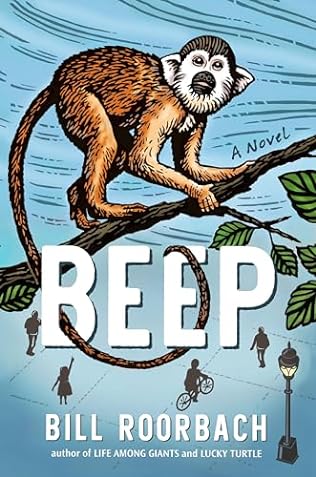
My thanks go to NetGalley and Algonquin for the invitation to read and review. This book is for sale today.
Much of the book is devoted to the relationship that Beep develops with a human child named Inga. While traveling through neighborhoods, a bit lost and unsure where the next forest might be, he spots her eating some delicious fruits in her backyard, so he introduces himself in order to get lunch. Inga’s mother comes out and meets him also, and this passage provides an idea of the story’s character:
“’Squirrel monkey,” the mother said warmly, ‘Ooooh. They aren’t usually solo. Oooh, ooh. Keep your eyes peeled, there will be more.’
“Ugh, eyes peeled? ‘I’d like some fruit,’ I said clearly.
“’Oh, how charming,’ said the mother. ‘Hoo-hoo, monkey.’ She’d wiped most of yesterday’s blood from her lips, but at the edges of the enormous mouth some remained (probably she’d caught and eaten a bird). Also, part of her outer wrappings had come loose and her poor chest looked more distended than ever, wrapped in a bright banner of some kind. Somemonkey once said they look like us, but come on: they do not.”
But this is not Inga’s permanent home; she is on vacation. When her family returns to New York, which Beep calls Nyork, she smuggles him in with her carry-on items and it is in New York City that he meets fame after surviving several harrowing situations.
For the most part, I find this novel charming. There’s no need to concern ourselves about the credibility of the overall story line, because after all, we’ve begun with a monkey providing the narrative, so it’s clear that we just need to roll with it. It is funny in places, a bit dark in others, and then—as with the above quote—sometimes it’s darkly funny. Some of the reviews I’ve read take issue with the ending, but I’m good with it. My sole dissatisfaction, and unfortunately it’s one of my pet peeves, is Roorbach’s failure to develop Inga appropriately in keeping with her age. There’s a scene at the airport when she starts to cry because her stuffed animals are being taken away to be scanned by security, and another soon afterward where she is walking her doll buggy in Central Park, so I’m figuring she’s maybe six years old; but subsequent scenes make her seem much older, and finally we’re told that she’s eleven years old. It doesn’t take years of study to know that an eleven year old girl doesn’t wail about her stuffed animals or take her dolls for a walk in the park. Get real.
Happily, as the story unfolds from there, Inga settles into being a real eleven year old, and my irritability ebbs so that I can enjoy the rest of the book.
All told, this is a delightful read. Because of its dark characteristics, which I will not provide because they’d be spoilers, this is not a book to read to your little ones, but if you have a young Goth in your home who is able to read alternate spellings and dialects, then this book would likely be that kid’s happy place. The overall message is a worthy one, although Roorbach is probably not going to change hearts and minds about the environment, since those in favor of unchecked development in the face of environmental devastation and disaster aren’t going to buy this book. All told though, it’s a fine read for those that are ready for something a bit different and that can handle dark humor.


 Seattle Book Mama