We Are Never Meeting in Real Life, by Samantha Irby*****

wearenevermeetingGet out your plastic and go use the restroom, because this book will leave you holding your sides. Samantha Irby mines what ought to be old material but isn’t, at least not by the time she is done with it, and her edgy, plain-truth humor may leave you breathless by the time the last page is turned. My thanks go to Net Galley and Knopf Doubleday for the DRC, which I received free and early in exchange for this honest review. This book has just been released and is available for purchase.

Much of the base level subject matter is eternal and well worn: needing to use the bathroom while stuck in traffic; dating; racism; attempting to lose weight. But Irby has a fresh take on everything. She refers to herself as “old”, and since at 36 she is the age of this blogger’s eldest child, I suspect that I am not her target audience. But so much of what she says is eternal, and her take on current social concerns such as cop violence and the horror of stumbling upon a bunch of white people in the hinterland performing a Civil War reenactment complete with Confederate flags is welcome and resonant. The thread in which she voices the horror of being away from a major urban center is one I share. I have not laughed at potty humor since I was twelve, but the essay containing the traffic jam bathroom emergency on the way home from the dorm made me laugh hard enough to shake the bed, and my husband—a silver-haired Japanese gentleman old enough for Social Security—laughed hard enough that he was doubled over. The passage where she discusses having squandered money on things she doesn’t need just to prove she can do it is just one instance where I laugh because I am surprised. What writer ever admits this? Irby does.

Other aspects of this wonderful collection of essays were more educational than resonant, but also good to read. Can Black women admit they have mental health issues and still be Black?

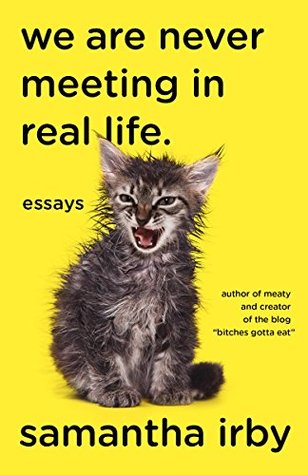
Her cover model represents the cat from hell, Helen Keller:

“’I know where they keep the euthanasia solution,’ I whispered into the downy fur on top of her head.”

Every book blogger knows the pressured feeling that comes with scooping up a galley right before publication. When I begin the book, all I want is to read it fast so I can review it in a timely manner; yet by the time I turn the final page, I am disappointed that we are done here.

Highly recommended to strong women with an offbeat sense of humor, and those that love them.

Ultimatum, by Anders de la Motte***

UltimatumFans of Swedish crime fiction rejoice; Ultimatum is available to the public today. Thanks go to Net Galley and Atria Books for the DRC, which I read free in exchange for this honest review. Although it is the second in a series, I was able to follow along fine without having read the first in the series.

The story weaves together a cast of complex characters within the Swedish police intelligence network and organized crime. Frequent changes of point of view heighten the suspense, which grows to a screamingly tense climax.

Those that are even a little squeamish may want to pass on this one. My threshold for explicit gore is at the level of The Girl with the Dragon Tattoo (not related to this book, but likely those considering this story will have read that one.) This one went past that, and over the top of my personal limit. I found myself skimming every time some graphically sadistic detail rose to the fore; I had hoped that once we were past the beginning and the discovery of the first murder, it would ease up, but I stuck it out all the way through and it didn’t. Another precaution goes out to those—most likely not a lot of people, but if this is you, you need to know—that have lost a loved one to drowning. Again, the description of the recovered body is very graphic and jarring enough that I had to disengage from the story until I was past it.

I would have liked to see less body shaming (“fat bastard” and so on), and more than one female in this large cast of characters who is in the story for some reason other than to nurture or assist the male characters.

That said, the male characters are well drawn, and the settings are well rendered. Those that aren’t upset by the level of detail to corpses, torture, injuries and personal bodily functions will likely enjoy this white-knuckle thriller.

I found one part of the denouement trite, but then I have read so many of these things that I am pickier than most.


If you want this book, you can buy it now.

Watching the Detectives, by Julie Mulhern*****

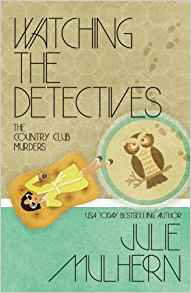
“’There’s been an incident…Mrs. White in the study with a revolver.”

watchingthedetectives
Mulhern is on a roll. This is the fifth book in the Country Club Murders series, but I plunged in without having seen the first four, and it was still a treat. Thank you, thank you to Net Galley and Henery Press for the DRC, which I snagged free and in advance in exchange for this honest review. It is now available to everyone.

The story is set among the Caucasian upper middle class of the 1970s, and Mulhern renders the period—when this reviewer was a mere, blushing wisp of a girl—so well that I checked twice to see whether it was an older title being re-released.

Ellison Russell is our protagonist, and people keep dying at her domicile. It’s become a nuisance, and there’s a cop that thinks it’s too great a coincidence. Ellison’s in a jam, and her thirteen-year-old daughter Grace isn’t helping. She sulks when they are told they must leave the house for a few days because it’s a crime scene, exclaiming that people have died at their house before and they didn’t have to leave. It’s just not fair!

Ellison is a widow, and a merry one at that; she has a flirtation going with a local cop whose name is Anarchy—a guy who believes in rules– but her main man is Mr. Coffee. He’s always there for her.

I moan when Ellison’s mother is introduced—yet one more overbearing mother, I thought, and authors always blame everything on mothers, just like everyone else does—but then I am surprised by where she takes it. I won’t say more lest I ruin it for you. But I will say this: every overused or overworked plot element is here for a reason, either to take it apart, or to make fun of it. Mulhern considers every word in this dandy novel carefully, and the result is splendid.

As the story unfolds there are other witty tidbits tucked in here and there, such as a character named Margaret Hamilton who is such a witch. But the frippery and snarky humor aren’t the whole package; while the mystery is a romp, serving up the snobbery of the petit bourgeoisie with a sharp skewer, this excellent novel is also a nicely turned feminist manifesto. While the mystery is a fine 4-star beach read, the author’s purpose is a strong one that’s delivered well. It is for this aspect that the fifth star is given.
Highly recommended for strong women and those that love them.

The Half-Life of Remorse, by Grant Jarrett*****

TheHalfLifeofRemorseHere is a story for our time. It’s fresh, moving, fall-down-laughing funny in places, and has the best character development I’ve seen lately. I was growing cranky from having to pan other people’s bad books, and I requested this DRC from Net Galley and Sparkpress almost as an afterthought; then it nearly knocked me off my feet with its voice and sheer creative power. It was published last week, and you should get it, read it, and then make other people do the same thing. It’s that strong.

The format is a simple one, and because there’s not a lot of plot or setting, everything boils down to the inner monologues of the three characters here. We start and conclude with a brief narrative in the third person omniscient, and in between we have the staggered monologues of two homeless men and a professional single woman confined to a wheelchair. Sam has blocked out a traumatic past, likely suffering from PTSD and who knows what else. His monologue is a literary sounding one, and indeed, he was once an academic. Now he calls himself a wizard, and at times, we nearly believe him.

The other homeless man calls himself Chick. He is not a young man either, and is running from his own misdeeds, and Sam tells us that Chick “…is a testament to life’s unrelenting desperation to continue.” Chick is not literate, but he manages to communicate brilliantly in his own tumbledown, roughshod, clumsy manner. Every now and then he tries to use a slightly larger vocabulary than he possesses, and ends up referring to “the persecuting attorney” and not wanting to “cast inspersions” upon the characters of others. Though he is thoroughly profane and limited grammatically, in his own way Chick is as eloquent as Sam.

The third character, a less developed but still important one, is Claire. Claire lost the use of her legs when her family was invaded by criminals during her childhood. Both Sam and Chick were there, but at the time, they did not know each other.

Jarrett writes in a way that is wholly original, and the juxtaposition of Sam’s monologue with Chick’s is startling and very funny. Somehow this author manages to slam tragedy and humor right up against one another without diminishing either. Most importantly, he is able to portray both Sam and Chick as men that still have purpose and a personal code of honor despite the horrors they have experienced and the bad choices they have made. Jarrett’s prose is the sort that grabs me by the hair and doesn’t release me until the story is finished. At one point, I found myself lightheaded because I had forgotten to breathe.

This novel is highly recommended to everyone that loves strong fiction.

The Frozen Hours, by Jeff Shaara****

thefrozenhours“’All right. They’re on our left. They’re on our right. They’re in front of us, they’re behind us. They can’t get away this time’.”


Fans of Jeff Shaara’s military historical fiction won’t have to wait much longer; with the ambitious rendering of the Chosin Reservoir battle during the Korean War, he’s taken a great leap forward. I received a DRC from Net Galley and Random House Ballantine in exchange for this honest review. The book will be available to the public tomorrow, May 23, 2017.

Shaara makes military history accessible by breaking it down into small bites, and by choosing a reasonably representative group of historical figures to feature. One thing that has made him controversial, but which I admire and appreciate, is his decision to add at least one completely fictional character to each book in order to have the humble foot soldier, the ordinary joe that never gained fame or glory, represented. If Shaara chose to use the more traditional method, including only those actual servicemen that left a trail of records behind them, he would be telling us about the war solely from the point of view of officers. I am glad he has stuck to his guns—so to speak—because the rank and file make an enormous impact on the outcome of every battle in every war.

Approaching this story, it is key not to skip the preface or the afterword. This reviewer taught American history and government, and yet I learn something new every time I read one of Shaara’s books. One of the things I appreciate most is that it’s reasonably clear what is fact and what is fiction.

The war is basically a struggle over who will rule the Korean peninsula. Over the centuries, Japan, China, and various Western powers have had their eye on it; it is located in a way that gives its would-be colonizer wonderful access to a great many other places. Who wouldn’t want a military base there? And so as we commence, the Chinese, accompanied, at the outset, by the Soviet Union (now Russia), are determined to repel American incursion into the region. Shaara shows Koreans themselves as merely wishing everyone else would just leave, and although others would differ, this point of view serves well enough for the purpose of telling about this battle.

The US military troops here are commanded from afar; General MacArthur provides unreachable deadlines for the capture of hotly contested areas. At the outset of our story, he orders Marines and US Army shipped to North Korea and selects a inland line of march that he tells the press is a “pincer movement” but which in fact leaves vast amounts of unguarded areas between isolated groups of soldiers. They are high in treacherously cold mountains, where many men on both sides of the conflict will freeze to death or lose body parts to frostbite. They are surrounded and forced to fight their way out, then fight again to rescue their comrades.

There are two things I would change here if I could. The first is the maps. I blew them up on my tablet and still wasn’t able to read most of the print. They were better than nothing, but just barely. There isn’t even a compass provided to show where north is located.

The second is actually a pretty sore spot, and that is the constant use of nasty racist terms for every Asian mentioned ever. The Japanese, the Koreans, the Chinese all get called more ugly names than I ever want to see again in my life! I understand that part of his point in doing so is to show how badly the American command underrated Mao’s forces. I also understand that Caucasian US troops did use racist language casually, and that dehumanizing the enemy is one more way to unify one’s own force and go out and kill people.

However, an author gets to choose his points of emphasis. In his many excellent Civil War novels, Shaara goes lightly around the N word, because he understands that it is painful and divisive, and that for many people, it will destroy the joy they might otherwise experience reading his work. It’s a tender place in our national consciousness. Yet the perception doesn’t hold when the people of color are Asian. It’s hard to take. Why add more nastiness than one must? Occasionally there is a lull where Chinese are called Chinese and Koreans are called Koreans, and I sink into the narrative as one does with strong fiction, only to have another epithet tossed in my face like cold water.

Perhaps it is because Asians are quieter, most times, about racism and stereotyping, that writers—Shaara is by no means alone in this, which is why only one star comes off—seem to think nothing of repeatedly slamming these horrifying terms at us again and again from within their pages. The references to the Japanese are obviously only there as—what do I call this, ambience? The Japanese are now allies of the US, but the J word gets sprinkled in anyway, and it’s a rotten thing to do.

There are nearly 7 million Asians of either Japanese, Korean, or Chinese ancestry living in the USA, and I have news: they read. And whereas I am undoubtedly more sensitive than some readers, given that we’re talking about my husband and my youngest child, I am not actually Asian myself. And there were moments here when I really felt that if I hadn’t committed to reading for the purpose of a review, I would prefer to leave the book unfinished, to slide it in the back somewhere and not really look at it anymore.

Shaara is an excellent writer, and his characters are almost tangible at times. With a little more sensitivity toward people of color, his work could be even better. This book is recommended to those that love historical military fiction, with the caveat just mentioned.

Before the Rain Falls, by Camille Di Maio***

beforetherainfallsThose looking for a sweet, light romance will find it here and come away happy. It was just published, and you can get it now. Thanks go to Net Galley and Lake Union Publishing for the DRC, which I received free of charge in exchange for an honest review.

The story is divided between three protagonists, and the narrative alternates to include each of their points of view. Two of the characters are Della Lee, a very elderly woman recently paroled from a life term in prison for the murder of her sister, and Paloma Vega, a young doctor that’s returned to her hometown on the Texas border to take care of family business.

One thing that drew me to the title is that the most important characters are both women, and it is they that prove to be the most dynamic. Our third character, Mick Anders, is a journalist seeking Della’s story. He is changed by it, and yet really his character exists as a foil for the two women. So far, so good.

Because the premise starts with the woman who’s spent her entire adult life in prison, I was expecting something grittier. Women in prison haven’t really made it into a lot of fiction, and so my interest was piqued. I was also hoping for a social justice angle, and to be fair, the teaser promises no such thing, and so to an extent, this disappointment is one I brought on myself. Though Della’s reminiscences as she unspools her memories for Anders recount some of what she went through, it really isn’t a prison story, but the story of Della’s own life and the sacrifice she has made.
The parallels between Della’s life and Paloma’s intrigued me and I was hoping the novel would veer in the direction of literary fiction, some allegory perhaps; something subtle and open to the reader’s interpretation. This isn’t that either. Soon the parallels feed into a tidy package, and the coincidences are just too many. I had reconciled myself to the likelihood that this really would, in fact, be a straight up historical romance, and if the end had been crafted in a more nuanced way I could have given it four stars, but instead it is predictable, and when that happens there can’t be magic, because the Great-And-Powerful-Wizard’s curtain has been pulled away by the unlikeliness of the story. Toto has the curtain in his mouth, and instead of looking at Della, at Paloma, and Nick I am looking Di Maio and saying, Oh come on. Seriously?

Some of the better moments in the story are the side elements, the interaction between Paloma and her sister Mercedes, an adolescent smarting from Paloma’s abandonment when she moved away. Paloma is wooing her back into a sisterly relationship, and her clumsy missteps and the ways in which she corrects herself are resonant and absolutely believable.

Although Della’s back story feels over-the-top to me, her present, the return to her home after seven decades away, the changes in the home and the strangeness of being back in the world and at liberty are also well done. The author does a nice job in crafting Della’s present-day setting and wedding it to her story.

Those looking for a traditional romance, something to pack for a vacation that will leave a warm, fuzzy afterglow will enjoy this novel, and to them I recommend it.

Sting Like a Bee, by Leigh Montville**

stinglikeabee“’It takes a lot of nerve for somebody, mainly a white, to ask me do I hate. I haven’t lynched nobody and hid in the bushes.’”

I received an advance copy free from Net Galley and Doubleday in exchange for this honest review. The book is now available for purchase.

Muhammad Ali died of Parkinson’s disease one year ago. By the time of his passing, he had earned the respect and recognition he craved. In this popular biography, Montville gives an overview of his rise to fame, but focuses primarily on Ali’s legal challenge to the US government, which strove to draft him to fight in Vietnam despite his professed status as a conscientious objector.

During the 1960s and 1970s, almost all of Caucasian America and a goodly number of African-Americans regarded Ali’s public statements either with derision or fear. Born Cassius Clay, he joined the Nation of Islam as a young adult and changed his name in the same way Malcolm X had before him. He did it in order to shuck the slave name given him at birth and adopt a new religion that taught him that Black men were not only equal to white folks, but better. Malcolm X had advocated Black pride and scared a lot of people, but he had done it from the point of view of a political activist. Ali was the first Black athlete to stand up tall and tell all of America that he was the greatest. The descendants of slave owners that willingly or not bore the guilt of the oppressors were absolutely terrified. This was the fear they seldom made themselves face, the notion that the descendants of those so grievously wronged might rise up belatedly and give back some of what their ancestors had been dealt. I was there; I remember.

Ali personified the white man’s fear of the jungle. Dude, here he comes; he’s strong, he’s angry, and he’s free!

Montville recognizes up front that when Ali died, he was an icon, both as an athlete and as a civil rights advocate. But the tone of his prose shifts from a more or less neutral journalistic tone, to a wry one—because Ali did say some outrageous things by anyone’s standard—and then, again and again, to a derisive one. The first time I saw it, I told myself I was tired and grumpy, and that I was probably being overly sensitive. My own family is racially mixed; I have raised a Black son. Sometimes I get touchy when I read things written by white authors about Black people. I should put the book down and examine it tomorrow with fresh eyes.

When I picked it up the next time I was immediately taken with the writer’s skill. His pacing is impeccable. Some of the quotes he chose are really delicious ones, although with Ali, it’s also kind of hard to go wrong. And at this point I considered that since we were on a roll, I should take the next step and examine the end notes and documentation.

Huh. Apart from a list of sources, most of which are biographies written by other people, there’s nothing. There are the in-text references a popular biographer uses, telling us, for example, that a direct quote comes from the magazine Sports Illustrated, without telling us what issue or who wrote it. And to be fair, that’s how a popular biography is written. It’s there for the masses that love boxing and aren’t going to check your footnotes. Everything within my academic heart recoils at this kind of biography, but it sells. I may not like it much, but people will buy it and they’ll read it.

But to write about a legal challenge of this magnitude and not provide specific documentation?
I could mention this within a review—as I have—and say that given this particular caveat, the biography is a four star read, and I thought that I might do that. But when I continued reading, there it was again. The author makes fun of the guy. And so just before the halfway mark, I started making careful notes of my own, because I wanted to see for myself how it is possible for a writer to appear to be neutral much of the time and yet also mock his subject. What I came away with is that the more straight-forward, respectful material is buried in the middle of each section, but the briefer sneering, snide material is usually right at the end of the section in one sentence, set apart from everything that came before it.

Writers do this for emphasis.

Fans of Ali will have to swallow hard to make it through this biography. Fans of boxing will find that it’s mostly about the legal challenge, and although Ali’s boxing matches are included, you’ll find a lot more about those in any one of the numerous other Ali biographies published earlier. And those interested in his legal fight may want to hold out for a more scholarly treatment.

When all is said and done, Ali was the greatest, but this biography is not.

Coming Up

Celebrations here in the family domicile have momentarily distracted me, but that all ends tomorrow. Before I commence partying with family tonight, I thought I’d show you the books you can expect to see reviewed here over the weekend. Some are memorable and others not-so-much, but I am surprised by which are which. Wait for it:

Grief Cottage, by Gail Godwin*****

griefcottage“We know so very little about the people we are closest to. We know so little about ourselves.”
Gail Godwin has been lauded and honored many times over, and has five New York Times Bestsellers to her credit. I read Grief Cottage free and early, thanks to Net Galley and Bloomsbury USA. Now I have to find her earlier work and read it, because her extraordinary prose is worth seeking out. Those that love achingly brilliant literary fiction will want to read this book, which will be available to the public June 6, 2017.

Marcus and his mother live alone and are very close; when she dies, it is as if the bottom has fallen out of his world. He is taken in by a relative he has never met; his Great-Aunt Charlotte lives on a tiny island off the coast of South Carolina. Haunted by his grief, Marcus is drawn to a cottage said to be haunted by a boy that died in a hurricane many years before.

The story begins with a lengthy internal monologue that made me fear I’d regret requesting the review copy. There’s a saying that only those that know the rules of written convention well are entitled to break them upon occasion, and Godwin is one that does, and she does it for a reason. I can promise the reader that if you push through the first twenty percent of the story, complete with very frequently used parenthesis, you’ll be in it for keeps.

Marcus is one of the most resonant characters I’ve read in a long time. He is orphaned, unmoored, and friendless; his one good friend insulted Marcus’s mother, and the friendship was broken. Now his great fear is that Great-Aunt Charlotte, a reclusive painter that values her privacy and has a very small home, may grow weary of the inconvenience of having him with her and send him away. The reader can clearly see this brusque but thoughtful woman grow attached to her young relative, but Marcus is too overwhelmed and depressed to catch a clue. He tries to make himself scarce to reduce his impact on her, and in doing so spends an inordinate amount of time nurturing and watching the nests of leatherback turtle eggs laid on Charlotte’s beach, and walking or biking back and forth to the far end of the island, where the legendary Grief Cottage, Charlotte’s most lucrative painting subject, sits desolate and friendless, not unlike Marcus himself.

A measure of a well written a novel is the way our affection for it lingers after we have finished reading it and look back after we’ve read other things. Because I received a very early galley for this one, I have read and reviewed 24 other books since this one, and yet when I see the cover for this title, I heave a deeply satisfied sigh. Oh yes. Grief Cottage. That one was wonderful!

Those that only enjoy action-packed thrillers will have no joy here; rather, Godwin’s prose is the sort one sinks into, like a deep feather bed or a favorite chair by the fire. For those that love strong literature, I cannot think of a better way to spend quiet spring evenings.

Highly recommended.

Hillbilly Elegy, by J.D. Vance*****

HillbillyElegyI confess I was miffed when I wasn’t granted a DRC for this title, and after reading a couple of reviews, I decided I could live without it. I began to wonder about my choice when I saw it hover on the best seller lists where it remains as of this writing nearly a year after its publication, But the clincher came when my younger daughter came to me and said that she had read it digitally and believed I would enjoy it. She said it had to do with the culture of mining families, and that the dedication was to the writer’s “Mamaw and Papaw”.

It hit me like a bolt of lightning.

A personal note of explanation: I am a grandmother myself now, and my own Mamaw and Papaw were both dead and gone by the time I learned that this was not a set of names that belonged to my family alone. I was the youngest among my cousins and siblings, and had somehow assumed that these grandparents’ names were the result of something said by one of the older kids when they were small. By the time I came along, they had left the mines of the rural Rust Belt and purchased a small working farm in central California. No one else I knew had grandparents with those names or had heard of them. Later my grandparents, aunt and uncle (who—I am not making this up—were an Aunt Sister and Uncle Brother) would relocate to the mountains of Southern Oregon, to the farthest outreaches, secret places up barely-there dirt roads that would make a survivalist happy. Neither California or Oregon is mentioned at all in Vance’s memoir, and so it makes me wonder just how far this culture has permeated across the USA.

Vance tells us that his memoir is particular to the culture of working class Scots-Irish people, primarily in the Appalachian Mountains. But of course, when one mine closes, miners follow the work, and so the culture has spread quite a long way. He himself didn’t grow up in Appalachia, because his grandparents had made a point of moving away from there when a factory opened in a small Southern Ohio town, and so that was where he spent most of his childhood. But the roots ran deep, and they often returned to the West Virginia area where most of the family remained.

The memoir itself is fascinating. His grandparents were enormously tough and tremendously loving. He recounts one experience in which a drug-addicted visitor appeared to be dying of a PCP overdose in the front room, and Mamaw ordered that the person be dragged to a nearby park, because “I don’t want him to die in my fucking house!”

Another time, the author’s immensely unstable mother had beaten JD, and Mamaw persuaded him to lie to the cops, who could never be a part of any solution to their family. Instead, once in the car, “We drove home in silence after Mamaw explained that if Mom lost her temper again, Mamaw would shoot her in the face.”

I am amazed at the similarities that exist between Vance’s culture and that of my father’s family. Over the years succeeding generations have become more educated and moved, for the most part, out of the tulles and to suburbs and cities. But many of the values and cultural nuances remain. And if this is true for me, a Seattle resident of nearly 30 years, how many others across the nation will recognize it as well? Perhaps this is part of the book’s tremendous success.

In closing I want to give a shout-out to Powell’s City of Books in Portland, Oregon, the city where I grew up. Powell’s has a daily drawing for its reviewers, and each day someone wins a $100 gift certificate. My prize is what made it possible for me to purchase this glorious brand new, hard cover edition.

Highly recommended to those interested in the culture of Scots Irish mining families and their descendants, and to those that love excellent memoirs.