The Dog Lived (and So Will I) by Teresa J. Rhyne****


  Thanks! I needed that. (My fifth star is generally reserved for works of greatness or the extraordinary; as light reads go, this one is as good as it gets).

In late April of 2013, my teenager went out walking with our beagle, as is her custom, after school. We live in a major urban US city, and our home is on a secondary arterial. It was Friday at rush hour, and she was deep inside her head. When the two of them crossed the street without looking, the driver who hit them hadn’t the time to even brake or sound the horn. It was so fast, and so sickening.

Two months later, my daughter has recovered from her concussion and broken leg, but when I found this wonderful e-book, the dog was still in the cone-o-doom, and he had worn my patience right down to the nub. At first we were, naturally, just delighted he was alive and did not lose his leg, but doing nurse duty for an injured beagle 24/7 will take it out of a person. I was looking for a not-too-pricey book for my e-reader, and this one looked just like what the doctor ordered. And it was.

In The Dog Lived (and So Will I), Seamus (for you non-Gaelic-proficient folks, that’s SHAY-muss) the beagle gets cancer, and like me, the writer has a cone-headed beagle that needs constant attention. I laughed my butt off at the typically beagle-like incidents involving garbage, stolen food, and the time he got his cone-headed self stuck in the doggie door. Yes, yes, yes.

Rhyne is dumbfounded, just as the dog is pronounced clear and clean, to find that the lump in her right breast is what she feared it was. Though I have never had cancer, I have nursed a spouse through a particularly sinister type of the disease, so again, this struck home. She takes an appropriately serious tone, but also includes enough of the kind deeds of others and the coping mechanisms she used to lighten it up to readable level. There is no funereal air to it; it won’t bring you down. And just as the title suggests, she gets through it, comes back clean, and we can all go to sleep at the end of the book feeling oh, so much better.

My only sorrow is that I went through it so quickly! I need another book now. Aroooo!

Fierce Patriot: The Tangled Lives of William Tecumseh Sherman, by Robert L. O’Connell*****

 fiercepatriot I was able to read this in advance of its publication, thanks to Net Galley. If you can’t find it, I am sure you can pre-order it. And you should!

This is a brilliant analysis of American history’s most controversial, complicated, and I would add, heroic general. In writing it now, rather than waiting till I am finished reading the book, I break one of my own rules; I am an academic, and I pour over prose; sticky note pages (or mark them electronically); make little notes; and only then, when I have thoroughly analyzed every single page, do I set down my review. To do so when I am only 25 percent finished, as I am doing now, means that the book is worth having if you pay the full cover price and read only a quarter of it (though I plan to finish at my happy leisure, and hope you will too); and that I want to promote it badly enough to leap into an early review.

I spent a decade of my life teaching about the American Civil War, and my fascination with it is still not sated. However, because I have read the trilogy by Catton, along with Battle Cry of Freedom, Sears’ tomes on various individual battles, Liddell’s biography of Sherman, Sherman’s own memoirs, and Grant’s as well, I sat down to read O’Connell’s book thinking that perhaps I would find nothing new, but only a rehashing of the information I already have. I could not have been more wrong.

O’Connell takes a fresh new viewpoint, and he looks at Sherman in a more dynamic way than any other writer I have seen to date. He takes him from his beginning career, which was lackluster, he points out, due more to being in the wrong places at the wrong times, consigned to a bureaucratic position during the war with Mexico, and he takes him forward. He starts with the Seminole War, through the Mexican War; and into and through the US Civil War, where he would earn his place in history.

O’Connell manages to synthesize Sherman as a man who hailed from a powerful family, along with the Sherman who suffered from periodic depression (which O’Connell believes to have been similar to that from which Lincoln himself suffered); and does not drop a stitch or miss a beat in threading these important factors and nuances into his role as a key general at a critical time in history. He finds ways to inject Sherman’s character and personality into the narrative without letting it become the story. And most importantly, he notes key instances in which Sherman develops and morphs into the leader he becomes by the end of his career. It is a rare gift to be able to craft a nonfiction narrative into as compelling a story as a well-written novel might be, but O’Connell does it well.

More than anything, the author notes that Sherman was ambitious, but only as a “wing man”. Sherman’s depression took over any time he was placed at the very top of the ladder of authority, and Sherman knew this, and positively begged, again and again, NOT to be given the top job. He had no interest whatsoever in politics; he was a strategist, and though charming enough to run for office (apart from his somewhat understandable hatred of the press, which was quite different then from now), he had no interest in holding office or crafting policy. He was a military man, from the top of his spiky red hair to the soles of his well-worn boots, and he knew it. All he asked was to have one man above him, and at Fort Donelson, he found his perfect match in US Grant.

I began to skip through the book so that I could tell you exactly how O’Connell approaches Sherman’s march through Georgia and to the sea and a dozen other things, but I can’t stand to skim anything this strong. I am going to take my time with it, savor it, and I suggest you do the same. The one other piece of advice I offer the reader is that you spring for a hard copy of this marvelous volume. The maps are important, and utterly unreadable on an e-reader.

There are many books that I recommend to readers only if they can get them cheaply or free. Not so here. This is a real treasure. Buy a good, solid copy that will endure for years. It’s worth it!

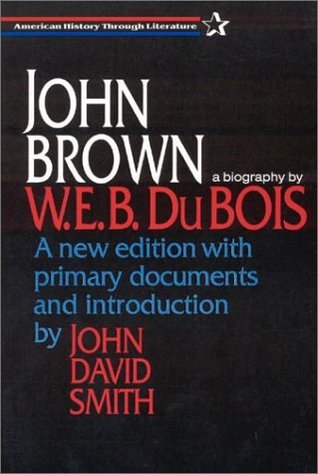
John Brown, by WEB DuBois *****

johnbrownThe class I took in college that featured John Brown as a small figure in American contemporary history dismissed him fairly quickly. He meant well, but was not stable, they said; in the end, he took extreme, hopeless measures that were destined for doom. He remained a hero to Black families (they admitted), South and North alike, as the first Caucasian man who was willing to die for the rights of Black people. Whereas many White folks (those with enough money for a fireplace and a portrait to go over it) featured a family ancestor or a painting of George Washington, Black homes often had a picture of John Brown.

The problem with that education is that no African-American scholars were included in this very central, pivotal part of the prelude to the American Civil War. I doubt anyone would doubt the credentials of this writer, whose urgent and compelling defense of Brown as a selfless but sane man with a perfectly good plan that went wrong due to a couple of the people in key positions of responsibility for the taking of Harper’s Ferry held my face close to the book (it is not the edition pictured; mine is so old, we’ve had it for so long, that the plastic lamination on the paperback has half peeled off, and it is not featured here!). The writer’s words forced me to read it, though I am no longer a student, with a pen in hand to underline and star key passages.

It’s tempting to leave it here, but I think I need to give you a couple of instances that may draw you, if you like history, care about the rights of Black people in the USA–because the oppression that started here is still not over (that’s me speaking; DuBois died in Ghana in 1963), if you are interested in the Civil War or Brown in particular, you have to read this book.

Tidbits that do not spoil, then: Harriet Tubman planned to be there with him. She became seriously ill and was confined to bed; otherwise, she meant to fight alongside him.

White writers have all assumed that his escape route was impossible. They have the WRONG escape route; DuBois explains the actual plan.

The Underground Railroad was run almost entirely by Black people, some of them wealthy, in the Northern US. DuBois points out that free Blacks owned over a million dollars worth of property, free and clear.
It was this same large body of free Blacks who provided the funding for Brown. He would have had more, if he had not become ill, and the loss of momentum removed most of his Canadian backers. Indeed, DuBois states that Brown most likely went to Harper’s Ferry physically ill and “racked with pain”, that he was very gaunt due to illness and poverty, but felt that to wait longer would be to lose his support and those he had gathered (a small group) for the initial attack.

To say might make you feel as if you have little reason to read this book. It is eloquently laid out as only a wordsmith such as DuBois is capable of doing. I am deeply sorry I waited so long to find time for it.

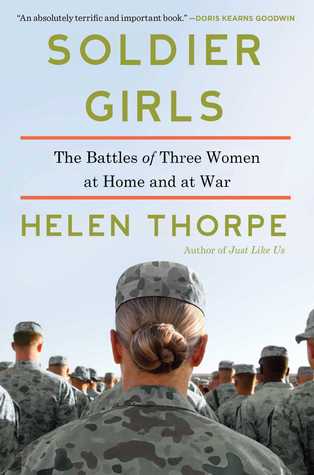
Soldier Girls: the Battles of Three Women at Home and at War, by Helen Thorpe*****

soldiergirlsI was able to read this before its publication date, courtesy of NetGalley.com. Thanks, guys!

I am usually good for half a dozen books at a time, but I have to admit that this one story has dominated my reading hours for the past week or so. I had so many preconceptions (and yes, stereotypes) that I didn’t even realize I’d developed until I read about these brave souls who have gone to Afghanistan and in some cases, Iraq.

What kind of woman leaves the home she knows and signs up for the National Guard? Sometimes (often!) it is someone who needs money quick. Sometimes it’s a woman who is desperate to get out of her current living situation. And once in awhile, it is something done, at first, when one is dead drunk and out of control; the Guard will fix that quickly!

I’ve been a Marxist my whole adult life, and I have no athletic talent or inclination whatsoever. If I loved this story–and I did–then almost everyone will. My past stupefaction with people who signed up for the military and then were somehow surprised when they were sent to go to war is gone. I get it now. And I understand completely what alienation and culture shock awaits someone who has lived under a completely regimented structure in a Third World nation for a year or more, and then comes home to blaring advertisements for things nobody needs and the petty-sounding complaints of those who have always had it soft.

I get it, because I read this book. You should, too.(less)