Ring in the Dead, by JA Jance ****

ringinthedeadJance is a matriarch in the world of detective novels, or in this case, the novella. She has four different series that she prodigiously juggles and maintains. The others take place in Arizona and don’t interest me as much as this series, her first, whose protagonist is a Seattle cop named JP Beaumont.

It takes a good writer to make me buy the premise here, namely that the SPD are mostly hard-working, good-hearted citizens who joined the police department out of a sense of civic duty. The reality is very different; Seattle’s cop force was recently named the most violent in the entire USA. Cops here are legendary for their gratuitous use of brute force. They develop vendettas against individual citizens. My own middle-class neighborhood recently met with the chief of police to let him know that we are comfortable policing ourselves, and he can take those cops he says are too few to do the job, and assign them somewhere else. Anywhere else. Please. Just get them out of here!

So while the FBI knocks its collective head against the brick wall of SPD intransigence, trying to find some way to rein in these mad dogs before the city goes completely nuts and becomes another Ferguson, I read this engaging little novella, and for the brief time it lasted—a single evening—I could forget reality and buy Jance’s premise of brother officers doing good things. That isn’t easy to do.

The fifth star is denied simply because of the brevity of the work. There must surely be a definition that separates the short story from the novella, but I am darned if I know what it is. When reading a digital work it’s not a bad idea to skip to the ending first, so you’ll know when it’s coming. I was glad I did that, because this one ended 67% of the way through its brief length. A full third of its space was devoted to plugging another novel. (I was too annoyed by this to remember the title of the work-to-come, so I guess the teaser didn’t work for me.)

The novella focuses on a long-ago case when Beau was a newly-promoted detective. His partner, known as Pickles, died of a heart attack, and his daughter found some papers when she was cleaning out the family home. She comes to talk to Beau and to give him the papers, which relate to a case he had worked. In a nut shell, the story reminds us that time is short, and that we should spend ours on things that count.

I look forward to Jance’s next Beaumont novel. I just hope it’s full length. I obtained this novella from our public library, but if I had paid for it, I would have felt robbed. Get it free or cheap, or keep your plastic put away.
The Trouble with the Truth, by Edna Robinson ****

thetroublewiththetruthThree and a half stars, rounded up. My thanks go to Betsy Robinson, the late author’s daughter, who invited me to preview an ARC and review it. It’s been a fun read.

Lucresse and her brother Ben have an unusual life. On the one hand, they aren’t starving, as many people around the world were during the Great Depression. But on the other hand, their circumstances require a constantly changing back-story in order for them to be accepted by polite society, which was much harsher and more judgmental than it is today.

For one thing, their mother is dead, and their father, a much older man than their classmates’ fathers, has not remarried. Not unless you count Fred, their chauffeur, butler, and otherwise highly respectable servant whose devotion to their family is not fully understood until a crisis strikes. Fred does not sleep with Father, of course. He has separate quarters, but no separate life. They’re pretty much his whole story.

Lucresse has the trouble with the truth that gives our novel its title. Her whole life is predicated upon a series of courteous lies; every time they pack everything and move to a new town, which occurs as often as four times annually, she and Ben are thrown birthday parties. There’s a good reason to do that, but it’s not true that it’s their birthday, and they both know it. And when Father cultivates the acquaintance of a well-known actress and she moves into their guest room, a visiting aunt is told she is the book keeper. It’s another lie, for the sake of appearances.

This highly accessible, charming novel is set out in brief chapters, and in most cases the chapter represents a new story within the overall story, so it is almost like reading a series of consecutive short stories featuring the same characters. With quirky good humor and also a certain amount of ambiguity regarding our head of household, I found myself smiling and nodding at the fib-to-cover-another-fib.

Though the family’s life is bizarre, the children are loved and well cared for; this is no Glass Castle. Rather, it is a portrait of a fictional family that never quite meets the conventional standard society seems to expect.

Recommended for those who like a little whimsy now and then.

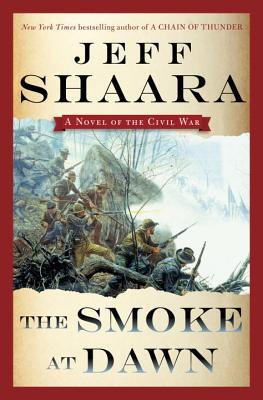
The Smoke at Dawn, by Jeff Shaara *****

thesmokeatdawnI hungered for this book! I am a great fan of Shaara’s work. I didn’t get the ARC, but Seattle Public Library came through. Had it not done so, this is one of the very few books for which I would have paid full jacket price.

Shaara writes historical fiction about American wars, sometimes in the form of trilogies, and here he wraps up a trilogy on the Western campaign of the American Civil War. The scenario: Rosecrans, the Union officer who heads the Army of the Cumberland, has had a strong victory followed by a stunning defeat. First he used brilliant gamesmanship and planning to attack and take Chattanooga; this went largely unnoticed by the press, which was beside itself, understandably, over the twin victories of Vicksburg and Gettsburg. But then, unfortunately, Rosecrans pushed his luck too far, getting his ass kicked and a lot of good men dead at Chickamauga. The result was that he ran like hell, dug himself in, and refused to go forth again. Unfortunately, the Confederate troops led by Braxton Bragg cornered him and he was besieged. When Grant was given overall command of armies in the west, he was asked to choose whether to keep Rosecrans in place, or send him packing and promote George Thomas. He chose the latter.

Shaara is generally brilliant at crafting character based upon the historical record. I found Bragg to be almost a caricature—and hell, for all I know, maybe he didn’t have many good characteristics from which to draw; I haven’t studied him much. Grant is portrayed with warmth in a way that sits right with me; the same holds true for Sherman. Thomas has always been something of an enigma, and he clearly is for Shaara also. Sherman and Grant both said in their memoirs that he was slow. (My own memory of Sherman’s is a letter to Grant in which he says, “We both know Thomas is a little slow,” and I sensed irony and understatement in his tone). Yet other historians swear that he was in fact misunderstood. Shaara gives him the benefit of the doubt while allowing for some ambiguity.

I read my copy digitally, and I was pleased at the way I was able to zoom important maps that made it much more possible to see what troops were moving where.

The most controversial aspect, judging from what other reviewers have said about this trilogy, is the creation of Bauer. When I have wanted to confer 4.5 stars on one of his novels in this series, I round up, and it is for Bauer that I do so. Bauer is the only character that is entirely fictional, but Shaara chose to create him to represent that nameless, faceless soldier who represented the vast number of those who bore the greatest burden. They didn’t become famous or have their belongings shown in museums. It’s rare to find a foot soldier’s whole story. Some kept journals, but these were often lost during a battle, scuttled during a hard march when everything non-essential got tossed on the road, or drenched in rain or during a river crossing. No journalist ever followed a humble private around to record his experiences and opinions. For his effort to include the every-man in spite of the flack he would endure from the purists among his readership, I give Shaara high marks.

Next up: Shaara will tackle Sherman’s march through Georgia, through the flames of Atlanta, to the sea. This is my favorite part of the whole thing, and I am excited as I look forward to reading it.

If you enjoy historical fiction based on the American Civil War, and especially if you do not harbor any cherished sentiments toward the dead lost “Cause”, you can’t go wrong with this one. Historical fiction at its best, from a master of the genre.

Where the Heart Is, by Billie Lett ****

wheretheheartis  I recently read and enjoyed another title by this author. A quick internet search brought me to this title, which the same search told me had made Oprah’s book club. I rarely watch daytime television and have never seen that show, but I know that books she recommends are often titles I like as well. Such was the case here.

Just imagine it: seventeen years old, basketball-belly pregnant, and riding in a car so beat-up that when you nod off, your shoes fall off your feet and through the rusted-out spot in the floor of the car. There they go! And what could be worse than that?

Then the man of your dreams, who to be fair doesn’t seem all that engaged in your relationship, drops you off at Walmart to get some house shoes, and floors it as soon as you enter the store. There he goes, too.

This story is fascinating because it forces us to examine the difference between innocence and ignorance, between the trusting nature that being a trustworthy person sometimes engenders, versus straight-up stupidity.

Novalee Nation is innocent and maybe a little bit ignorant, but when given the chance to improve her own knowledge base, she does it with enthusiasm. She isn’t stupid; she suddenly realizes, as she enters the Walmart, that Roger would not have given her a ten dollar bill when she only asked for five, if he hadn’t planned to dump her there. She runs back out to the parking lot, but she’s too late. All she has now is Walmart.

Once in awhile the fringe characters in this affable tale are a tad overdrawn (all those bandaids; really?), but most of them–Sister Husband, Forney, Moses Whitecotton, and others, not to mention our protagonist– are so palpable that I found myself inventing other scenarios for them as if they were actual people. That’s always a good sign.

So get your copy–I got mine at the Seattle Public Library–and hunker down in your favorite reading spot. This is engaging fiction from a writer I’ll be following in years to come.

The Christmas Train, by Rexanne Becnel****

I read and reviewed this wonderful holiday book in October. Now that the season is here, let’s shoot it down the pipe one more time.

seattlebookmama's avatarSeattle Book Mama

thechristmastrainRexanne Becnel has written a brief, sweet, sentimental story that can only play at Christmas time. Were I to read this story in February, I would roll my eyes. In April, I would stick two fingers down my throat and make little retching noises.

Note that although the publisher bills this as a romance, it is really a love story between many family members, and the protagonist is a child. A great big thank you goes to Net Galley and Simon & Schuster for the ARC.

In October, in November, in December, I sigh contentedly. It really is about the season. Maybe those of us who celebrate this season find permission in it to drop our guards and bury our noses in sentimental stories. It did me a world of good!

Anna is ten years old, and her beloved Nana Rose, the grandmother with whom she has lived most of…

View original post 269 more words

Nora Bonesteel’s Christmas Past: A Ballad Novella *****

norabonesteelI’m a long-time fan of Sharyn McCrumb’s ballad novels (and now a novella); they are sure fire hits. Thank you to Net Galley and Abdingdon Press for the ARC.
I feel compelled to mention that the kindle galley was so full of formatting issues as to render it unreadable. I hope the publishers will correct this issue before it is released. I was able to read it with no trouble at all once I moved it to my desk top.

But back to our story.

We have parallel stories, and the setting is Christmas, of course. The story lines, one of Christmas present, which features Sheriff Arrowroot being ordered to drag an elderly man to jail on Christmas Eve, appears to have a dead-sure predictable ending, except that it doesn’t. That’s all I’m giving away in this case.

The more flavorful thread is Nora Bonesteel’s. The Bonesteel women have “the sight”. Those who have followed McCrumb’s novels already know that, but a reminder doesn’t hurt. Nora is asked out to solve a haunted manse issue for some new-comers. I found this part vastly amusing.

The setting, for those unfamiliar with McCrumb’s work, is in the Appalachian Mountains. It was one of her novels that taught me how to pronounce the word correctly (all soft “a”s, as in apple). Her love of place comes through on the page, and as much as I love the Pacific Northwest where I have lived for most of my life, while I read this, a part of me positively yearn for the Smoky Mountains, which I only visited once as a (oh the shame) tourist. It’s a rare kind of engagement. You can say she casts a spell over the reader, if you wish.

Ah. But that leads us to the descriptor I read in Net Galley. It is described there as a “Christian” novella. I confess it gave me pause. There are Christian novels, and there are Christian novels. Some are so heavy handed that they make terrible literature, from a critical viewpoint: we’re racing along, plot-wise, when someone announces that they should go to the Lord with their problem. A page and a half of long-winded prayer follows. Lather, rinse, repeat. I didn’t want to find myself stuck with a book like that, but a strong writer builds a bond of trust with her readers, and my sense was that McCrumb was unlikely to trash her own work in such a manner. I was correct, and the story is great. The single religious reference is central to the plot and is entirely consistent with the setting. Also, sometimes “Christian” is a sort of code to let the reader know there will be no profanity or sweaty sex scenes, and frankly, I was just as glad to be spared those.

To sum up, McCrumb is a master writer, a mystery champ, and a brilliant novelist whose work with Appalachian setting and tradition stands alone in an otherwise crowded field. Pick up a copy now. You can enjoy it and then pass it around for family and friends to enjoy. The quirky humor and redolent, traditional setting are sure to please anyone who loves Christmas and a good read.

The Big Book of Christmas Mysteries, by Otto Penzler *****

TheBigBookofXmas

I received this wonderful collection last year as an ARC from the “first read” program via the Goodreads.com giveaways. At the time, I didn’t have a blog; I reviewed it on Goodreads and because I liked it so well, I also reviewed it on amazon. Then, while I was on the site, I bought two copies to give as gifts. I have never done that with an ARC before or since (so far), but it is so wonderful that I wanted others to have it, and I wasn’t willing to share mine.

Now the season is upon us. This blog will be punctuated by worthwhile Christmas books of a secular variety. I guess it is a typical retired-teacher behavior to decorate my home with brightly jacketed Christmas books when others are getting out their craft supplies and hot glue guns. At any rate, if you buy just one Christmas book for yourself or someone else, and if the reader enjoys mysteries, this is the best you will find.

The stories are organized according to category in a format and layout that is congenial all by itself. There are ten sections, starting with “A Traditional Christmas”, with the first entry being one by Agatha Christie; it is a story that has aged well, and I don’t remember having read it even though I thought I’d read everything by that writer. There are a few more, and range from just a few pages, double columns on each page, to 25 or 30 pp. Then we move on to “A Funny Little Christmas”. The first there is a story by the late great Donald Westlake, and I gobbled it up and then felt bad that I hadn’t saved that story for last, because I adore his work and he’s gone and can’t write anything more. But I perked up when I noted that yet another section, “A Modern Little Christmas”, has an unread (by me) story by Ed McBain. There are many others. The final section, “A Classic Little Christmas”, bookends the anthology neatly by finishing with Dame Agatha. All told there must be about sixty stories, maybe more.

The anthology, edited by the brilliant and acclaimed Otto Penzler, is billed as having a number of rare or never-published short stories, and I think it’s a true claim. There are many mystery writers I’ve read and enjoyed here, and others I had never even heard of, but found immensely entertaining. I haven’t skipped any yet, but even if I find something I don’t care to read, the book is worth owning. I know that already. It is also billed as an anthology to warm the heart of any grinch, and indeed, there has been at least one story with a satisfyingly creepy ending.

One of the charming things about anthologies is that one can read a single story in a sitting and not feel too bad when it’s time to put the bookmark in and go get something done. Then it waits there to greet us as we return from executing less pleasurable tasks, a reward that invites us to sit down, curl up with good cup of coffee or the dog or both and have a cozy read. It also makes the book a lovely thing to keep where guests can access it, because they can enjoy it even if they haven’t time to read more than a story or two in between other activities.

…but I’m keeping you. You could be reaching for your car keys, your bus pass, or even better, going to another window to find this book online and order it. Once you see it, you will most likely feel as I do…unwilling to part with your own copy, yet yearning to get at least one more for somebody else! Get the plastic out and do it right away.

Soldier Girls: the Battles of Three Women at Home and at War, by Helen Thorpe*****

soldiergirlsNow that this title has created some buzz, I thought I’d reblog this!
seattlebookmama's avatarSeattle Book Mama

I was able to read this before its publication date, courtesy of NetGalley.com. Thanks, guys!

I am usually good for half a dozen books at a time, but I have to admit that this one story has dominated my reading hours for the past week or so. I had so many preconceptions (and yes, stereotypes) that I didn’t even realize I’d developed until I read about these brave souls who have gone to Afghanistan and in some cases, Iraq.

What kind of woman leaves the home she knows and signs up for the National Guard? Sometimes (often!) it is someone who needs money quick. Sometimes it’s a woman who is desperate to get out of her current living situation. And once in awhile, it is something done, at first, when one is dead drunk and out of control; the Guard will fix that quickly!

I’ve been a Marxist my whole…

View original post 115 more words

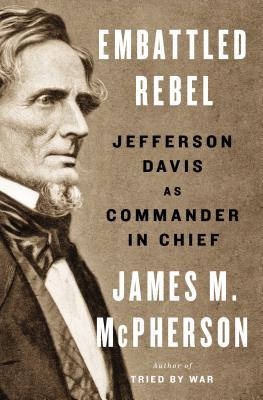
Embattled Rebel: Jefferson Davis as Commander in Chief, by James M. McPherson *****

embattledrebelThis was my first biography of Jefferson Davis. I have studied and taught about the American Civil War for decades, and read biographies and memoirs of and by some of the other principals in this conflict; I have avoided biographies and memoirs of Southern generals and politicians that smacked of nostalgic yearning for that Lost Cause. I would swear some of their authors would cheerfully go back to the enslavement of people of color given half a chance, the way they carry on. In any case, when I found this gem recently released by one of my favorite historians who has proven his scholarship trustworthy, I knew I had to read it. Sadly, I didn’t get the ARC when I requested it; hey, it happens! But my spouse popped through the door with a copy of it and I was in business at last. It was well worth his time and effort. James M. McPherson won the Pulitzer for Battle Cry of Freedom, the best single volume treatment of the Civil War I have read. He didn’t disappoint this time either.

If you read this biography, don’t skip the introduction. All of the details that follow are succinctly outlined in interesting and readable form; in fact, I read it before I read the book, and then I read it again afterward.

The book is punctuated by photographs of commanding generals in excellent resolution when read on an e-reader. I was also pleased to see that the maps could be zoomed to where I could generally tell what was on them when I held the e-reader near the light. This is a huge improvement over earlier history texts produced digitally. I used to suggest to those reading military history that they spring for a paper copy so that they could read these, which are often key to understanding what is being said. This time if you buy the book digitally, it will serve just fine.

The thing I was most curious about was whether it was true that Davis was insane by the time the war ended, and that the proceedings were mostly left to Robert E. Lee. Whereas Lee made his own decision to surrender to Grant, Davis, though undoubtedly in denial and out of touch with the reality of Northern conquest, was not insane nor near death, as the terrible textbook I was assigned to use with my teenagers had it. Happily, I noted that the sections on the Civil War had a number of other incorrect entries, and so I greatly limited my use of that book. Now I am really glad I did. Davis didn’t want the presidential nod, but he got it and took it; in fact, when he died many years later, he was entirely unrepentant. McPherson believes he was a strong politician who did a creditable job with a damnable task; Lincoln was a better president, but the Confederacy did not lose the war because of Davis’s failures. It was almost surely going to lose anyway.

Prior to reading this biography, I had believed that the south held on for as long as it did because its military leaders were stronger than those of the Union. This actually isn’t saying much about Confederate leadership.Union General McClellan cost both sides a lot of years and bloodshed that didn’t have to happen. It isn’t so much that the South had amazing generals; it was more that the Union had nobody who was both dedicated and proven. In fact, says McPherson, the Confederate military was practically tearing itself apart through gossip, infighting, and rivalry. Jefferson probably was guilty of promoting his friends beyond their level of competency; yet the cabals and gamesmanship practiced by those assigned to answer to General Bragg were at best a morale-draining waste of time, and at worst may have cost the Confederacy some battles. And the now-venerated Robert E. Lee was castigated in the Southern press for the number of Confederate soldiers who didn’t walk away from his battles. He was dubbed “the king of spades” for the graves that had been dug.

One Confederate general I had wondered about was John Bell Hood. My impression of him, I admit, was that he was a bad-ass general. He never seemed afraid to attack, even with one leg and one arm gone. Who does that? Still up there on his horse; “Charge!”  But this was one more hole in my scholarship that McPherson quickly filled. Hood would fight unwinnable battles. He destroyed an army during the last-ditch effort to save the Confederacy, losing a full fifty percent of the tens of thousands of men he led into just one fight, and most of the rest of them soon thereafter. The “reserves” consisted of old men; children too young to sign up initially; and those proud wealthy souls who had originally paid someone else to fight on their behalf. (I can imagine how well the latter took orders!)

I was familiar with a lot of the primary information provided here and was therefore free to focus on, and enjoy, the details. One new bit of amusing minutiae was that Southern women saved “the contents of chamber pots to be leached for nitrate to produce gunpowder”. Those of you more familiar with chemistry will know whether the women were lined up with their number one or number two. For me, it was a stitch to envision all those fine ladies dressed up in their hoops and bonnets standing in the potty-donation line!

I was particularly interested in what McPherson had to say about guerilla warfare. Lincoln was intent upon making it as easy as possible for the Confederate states to rejoin the Union. Some of us, had we been present, would have made a strong case for executing Davis and some other leaders—particularly those in South Carolina who started the whole mess—for treason. And some who were in Washington DC at the time made that case, too; but the decision was for quick, peaceful reunion. One reason for this was the concern that rebels made bitter by the price of losing the war might take to the hills and wreck endless havoc upon the offices of government and the economy long after the war had officially ended. But guerilla actions during the period when the Confederate government was in place and holding out for official recognition would have been unwise. Says McPherson:

Guerrilla actions as the main strategy are most appropriate for a rebel force trying to
capture the institutions of government, not defend them. And a slave society that
practices guerrilla warfare is playing with fire, for it opens up opportunities for the
slaves to carry out their own guerrilla actions against the regime.

But what of Beauregard? What about General Johnston and General Johnston? (Of course, there were two.) Bedford Forrest? What was the deal with Kentucky? Ah, there’s so much more to discuss.

I write really long reviews. If you are still with me by the end of this one, your interest is sufficient to go out and get this wonderful book. I don’t recommend it for those unfamiliar with the Civil War; for that, you ought to read Battle Cry of Freedom first. But once the basics are in your tool kit, you will find this biography accessible, interesting, and rewarding. Go for it!

All the Time in the World: New and Selected Stories, by E.L. Doctorow *****

allthetimeinWhen I was a kid, I often bore the distinction of being the second-smartest kid in the class. You’d think it would be an honor, but then, how often do we watch silver medalists at the Olympics stand ashamed, tears streaming, because they were not the very, very best? And so as I read these gob-smackingly brilliant short stories by Doctorow, I know exactly who he would have been in my life. He would have been that smartest kid, that gold medalist. I could never even touch his writing ability with anything I produced.

Back when I was that second-smartest student, I would have burned with envy at Doctorow’s brilliance, but now I can only bow in awe. What talent—and what a work ethic! He has produced prodigious prose over his lifetime, and I don’t think he has ever published anything that wasn’t top drawer work.

Here’s his author blurb, lifted from Goodreads.com:

“Among his honors are the National Book Award, three National Book Critics Circle Awards, two PEN Faulkner Awards, The Edith Wharton Citation for Fiction, and the presidentially conferred National Humanities Medal. In 2009 he was short listed for the Man Booker International Prize honoring a writer’s lifetime achievement in fiction, and in 2012 he won the PEN Saul Bellow Award given to an author whose “scale of achievement over a sustained career places him in the highest rank of American Literature.” In 2013 the American Academy of Arts and Letters awarded him the Gold Medal for Fiction.”

I rest my case, at least in terms of the author’s overall prowess. And no friends, I did not read this as an ARC; I don’t think Doctorow even needs people like me reviewing him, but I do so because it brings me joy. I ferreted this hardcover treasure from among the stacks at my favorite Seattle used book store, Magus Books, in the University of Washington neighborhood. I considered the used-book price a steal, and have enjoyed all of the stories included here.

One section is devoted to “Liner Notes”, and this one is from the liner notes to Billy Bathgate (also highly recommended). He describes a fugue state in which he is walking, yet dreaming:

“…it walks me through the underworld of the dreaming masses, where this pudgy demon of truth, W.C. Fields, with his dirty top hat, his run-down elegance of manners, his drunken scrollwork of a personality, presides over the technology of our souls…the clown won’t go away, you see…leading him through the window over the great landscape of the underworld that looks so beautiful from the window of this safe house and showing him what it really is. And he sees the bubbling sulfur pits of intentions, and the slake mountain of ideals, and great gray ash as far as he can see, the ashes of innocence creased by rivers of blood.”

Not everything he writes is in this flowery style, lest it exhaust us; instead, he intersperses it with other brilliantly funny work. “A House on the Plains” is dry wit at its best. Earle and his mother roam from one town to another, and gradually we come to understand why they have to keep moving. In one location, Earle is to call his mother “Aunt Dora”, and his mother has really outdone herself. Earle is used to a certain level of weirdness, but he can’t help inquiring, in the wake of her many troubling preparations for what is to come, “Aunt Dora, I said, what are we up to here?” (The author uses no quotation marks in this story, but it won’t muddy the meaning at all…and he makes up for it with his grammar police references in the final story, for which the book is titled.)

“Walter John Harmon” was one of my favorites; it features a religious cult, and is so wry and cutting that it made me laugh out loud in places.

The final piece, in which the writer makes better use of repetition as figurative language than anyone I have ever read before, is the coup de grace, and one can see why it is placed last; it leaves one holding the book with the sure and certain knowledge that it cannot be given away to a friend or relative, but must be nested softly back on the shelf. In my case, it will go in a small section of novels written by this remarkable word smith.

Has it just been published? Oh no no no. You will have to work to find it as I did. Well, of course you could check with various online retailers, and likely you would find a copy more easily than my breathless treasure hunt in the back stacks at Magus.

But if you love and respect good writing, you will do yourself a favor if you get a hold of it, one way or another, and dive in as soon as you can offer your complete attention.