
Blanche On the Lam, by Barbara Neely*****

BlancheontheLamI was already a Barbara Neely fan when I received this DRC, courtesy of the Brash Priority Reviewers Circle, in exchange for an honest review. I’ve been reviewing books for Brash Books and others for the past couple of years, and had read three other Blanche White mysteries out of order, so when I saw that the first in the series—which I think was the only one I hadn’t read yet—was up for grabs, I nailed it right away. It’s available for purchase now.

The amazing thing to me is that although these novels were originally published in the ‘90s, they are extremely relevant right now. For those new to this Anthony, Macavity, and Agatha Award winning book and series, Blanche White is author Barbara Neely’s foil for a number of social issues that are best approached with humor, yet also with absolute, stark clarity. Those that have supported the #BlackLivesMatter movement should order this fantastic book right away. It’s a double win, treating those of us that favor social justice and also enjoy strong fiction. On the other hand, those that don’t understand the current of Black anger that pumps through the small towns, fields and cities of the United States may want to read this book and catch a clue.

She makes everything crystal clear.

Here’s the premise: Blanche, who does domestic work and also has custody of her late sister’s children, is in trouble with the law. She has written some checks she can’t cover, and the fact that they’ve all been paid in full by the time she stands before the court doesn’t make much difference to the judge. She is given two months in the slammer, but a much greater disturbance distracts the officer who’s supposed to lock her up, and without a moment’s hesitation, Blanche slips out a side door to freedom. She knows she has to get gone and figures on leaving the state as soon as she has the money for travel, but in the meantime she escapes by using the greatest camouflage possible…because nobody looks a domestic worker in the face.

The family that has hired her has problems of its own, and Blanche can’t leave once the shit hits the fan, because if a domestic worker suddenly disappears when a crime has been committed, the thing will automatically be blamed on them. Instead, she is pinned like a butterfly, stuck in the kitchen of a horribly dysfunctional—and criminal—family. But Blanche is a born survivor, and the cynical things she does in order to keep herself from harm’s way, and ultimately to avenge the death of a nice man that didn’t deserve his fate are both amusing and riveting.

It is here that we meet Mumsfield, an engaging character who will turn up later in the series.

Blanche’s attitude toward the sheriff and the situations that feature him made me want to stand up and cheer!

I took the opportunity to read Blanche White mysteries as they became available, and I am glad I did. Reader, you have the chance, if you haven’t begun the series yet, to read them in order. Neely’s writing is both politically on-point and also seriously funny. What more could you ask for? Once you read this one, you’ll want to continue the series.

Highly recommended!

My Life on the Road, by Gloria Steinem*****


mylifeontheroadI’ve been thinking a lot about Steinem since the recent unfortunate episode on a TV talk show. I was heartsick. What woman gets past 80 without a single regrettable senior moment? But most of us will be fortunate enough to have a spouse, partner, adult child, or other companion who will take us aside and suggest we rethink what we’re doing or saying. “Mom, I’m getting a little worried. Can we check your meds? What do you think?”
But Steinem doesn’t have that sort of support system. The women that were closest to her for a long, long time are already dead.

So I republish this blog post asking you to think, not about the single magic moment, for which she later apologized, but instead, for all the amazing accomplishments and selfless deeds she has done on behalf of women, and for her willingness in a time when most of white America kept to itself, to learn at the feet of women of color.

Because this is her legacy; her real one.

Feminist heroes are everywhere, but if I had to name half a dozen women that were at the core of the feminist movement that followed closely on the heels of the Civil Rights movement and the movement to end the US war in Vietnam, Steinem’s name would be among them. In fact, hers might be the first name out of my mouth. It was she who coined the salutation “Ms”, and who founded Ms. Magazine. When I saw she had written a memoir, I knew I had to have it, and when Net Galley and Random House gave me the DRC, I was delighted. But this is one of the few books that if I’d had to, I’d have been willing to pay full jacket price in order to read. Heroes are thin on the ground these days, and we treasure those that still walk among us.

My reading records reflect over 300 biographies, autobiographies, and memoirs I’ve read, and I didn’t even start listing them until about 3 years ago, so who knows how many? The one thing I know to expect, when someone really famous sits down to tell us about her life, is that the ego will be there. It might be veiled, especially if the person is famous for writing as opposed to something else, or it might be big and bold. Once in awhile it’s been so bald-faced that I came away wishing I hadn’t read the book so I could go on liking the author. So for one of the most famous of living feminists, I was braced and ready.

And this icon’s ego isn’t there. I don’t mean she hides it well; I just don’t find it. And it appears as if large amounts of time spent among Native sisters in struggle—Wilma Mankiller foremost among them—taught her so much about focusing on the circle, rather than a table that has someone at its head, a big-boss type, that she let go of whatever ego she might have been thinking about building. For example, when she works as an organizer, she dreads public speaking, but looks forward to the place at which one part of the auditorium begins to answer the questions from another part, and she knows a circle has formed, one in which she becomes just another person present. I was blown away!

Steinem began her career in journalism, and she is one of the finest writers whose work I have read. For a brief time in years gone by, I dismissed her because of her sometimes-attachment to Democratic party candidates, but the sum of her contributions has been so much more that I missed the forest for the trees during that time of my life. Now I want to read everything she ever wrote.

Travel is a great metaphor, but it’s also a material fact for Steinem. She grew up with a father who was a traveling salesman, and unlike most such men, he took his family with him. For most of her childhood, there was no home, merely a series of stop-overs. This rootless existence would leave some children traumatized. Kids thrive on routine, and not all would be able to translate constant travel into a sense of the usual. But Steinem mostly remembers it as a positive attribute, and credits her parents for their capacity to question social norms during a time most Americans were madly conforming. The fact that she continued to live out of a suitcase once she was grown and on her own is the greatest testament of all to her upbringing, and to her response to it.

There are oh, so many stories, some of which made me laugh out loud, and others that made me think. You can go winnow those out for yourself. And of course, my favorites may not be yours.

But the one thing I can promise you is a really great read, one with depth, yet not difficult to access. It’s friendly and feels as if we are having coffee with an old, dear friend, right at the table with one another. A circular table.

You have to read this book. It will be for sale October 27.

Blanche Passes Go: A Blanche White Mystery, by Barbara Neely*****

blanchepassesgo“Blanche’s mind rang with remembered slights and taunts, and echoes of that awful, heartbreaking instant of fear that was a part of every trip into the white world—a fear of being refused or given poor service because she was black, stopped by a cop because she was black.”

I finished reading Blanche Passes Go on the second anniversary of the death of Michael Brown, who was shot dead by a cop for jaywalking. Bernie Sanders, the candidate who fancies himself the liberal savior for all progressive-minded Americans, spoke here in Seattle that day. The purpose of his talk, apart from campaigning and fundraising, was to celebrate the birthday of Social Security. The speech was disrupted by a pair of African-American women who took exception to his myopia.

So I guess you could say that everyone, even those that don’t generally enjoy mysteries, ought to be reading this book right about now. In particular, if the reader is still trying to figure out why so many people, particularly people of color, get upset with the clueless slogan “All lives matter”, this book is here, just for you. Neely approaches issues of race, class, and gender in a way that is clear but not unkind. It’s her best work to date, and could not have been published by Brash Books at a more appropriate time. My great thanks go to them and the people at Net Galley for providing me with a DRC, and to Neely for laying it all out so that anybody who has a willing heart can get the picture.

In this fourth Blanche White mystery, Blanche has gone home to Farleigh, North Carolina for a vacation, and to try partnering a catering business with her best friend, Ardell. But Farleigh is a small place, and she can’t avoid running up against David Palmer, a Caucasian man that raped her. She never reported it, of course; were they really going to haul the well-heeled, powerful white man for a sperm sample, given the long history of Caucasian men raping Black women with impunity? Not likely! So when her long-simmering rage is ignited by the sight of him, she vows to not only get mad, but to get even as well.

Blanche White novels always have multiple threads that weave in and out of the plot line, but this is the most complex and impressive yet. Not only does Blanche have to grapple with Farleigh and Palmer, she is back in her home town, and her mama is still here. Like many women, Blanche has hit middle age and menopause with a renewed, powerful yearning to know more about her mama, who never stops talking but never gives away the personal information Blanche is almost begging for, and about her father, about whom virtually nothing has been told her. Blanche decides that once a person has children, their privacy is no longer as sacred as it was before, and a lot of personal information becomes family property. I loved that.

Well into the book, Ardell accuses Blanche of sounding exactly like her mother, and Blanche is dumbfounded to realize it’s true. I threw back my head and laughed out loud. It’s the rare woman that doesn’t hear her own mother coming out of her mouth sooner or later, and the moment was built so deftly and executed so well that it landed hard on my funny-bone.

Other Blanche novels have accentuated the protagonist’s tightly held independence. Here, she meets a fine man named Thelvin on the Amtrak coming into Farleigh, and at some point, she has to decide just how flexible (or inflexible) she is going to be.

Another component is Mumsfield, an acquaintance that has Down’s Syndrome and is about to be married to someone who may be after his money. This aspect of the story, like the others, is skillfully crafted. Mumsfield is not completely helpless, and the fact that he has Down’s does not make him Blanche’s friend, as he claims to be. There is still that division of white privilege. It’s not that Blanche could not have a white friend, but it would have to be someone with ownership of what that means.

Because all of these components are told in the third person omniscient, and because the writer is a complete badass, we are privy to all the intricacies involved here. Add a problem with domestic abuse next door to the Miz Alice where Blanche is staying, and you have an interesting stew indeedy.

Highly recommended.

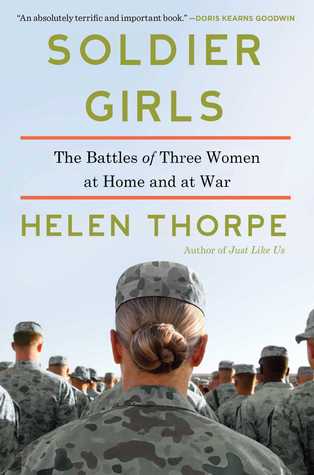
Soldier Girls: the Battles of Three Women at Home and at War, by Helen Thorpe*****

soldiergirlsNow that this title has created some buzz, I thought I’d reblog this!

seattlebookmama's avatarSeattle Book Mama

I was able to read this before its publication date, courtesy of NetGalley.com. Thanks, guys!

I am usually good for half a dozen books at a time, but I have to admit that this one story has dominated my reading hours for the past week or so. I had so many preconceptions (and yes, stereotypes) that I didn’t even realize I’d developed until I read about these brave souls who have gone to Afghanistan and in some cases, Iraq.

What kind of woman leaves the home she knows and signs up for the National Guard? Sometimes (often!) it is someone who needs money quick. Sometimes it’s a woman who is desperate to get out of her current living situation. And once in awhile, it is something done, at first, when one is dead drunk and out of control; the Guard will fix that quickly!

I’ve been a Marxist my whole…

View original post 115 more words