Somewhere Toward Freedom, by Bennett Parten*****

Bennett Parten is a fine historical writer, and here he examines General William Sherman’s renowned march through Georgia during the American Civil War through the lens of the formerly enslaved people that followed him. It’s a job that needed doing, and I’m glad that Parten was the one to do it. My thanks go to Simon and Schuster and NetGalley for the review copy. This book is for sale now.

The Union’s approach to formerly enslaved people evolved considerably over the course of the war. (This is your reviewer talking, not Parten.) In the beginning, when both North and South thought the conflict would be a brief one—ending, of course, in their own victories—anyone that left a plantation without permission to follow the Union army was promptly returned to their owner. But this was problematic from the start, if only logistically, as such practices slowed the army’s pace and drained resources from it, all in service to the enemy. For a while, then, everything was unofficial, as gradually, the formerly enslaved were sometimes folded into the army as support staff, helping cook, set up camps, pave roads, and whatever other noncombat roles needed to be filled. Eventually the practice was codified, not because slaves were declared free—not yet—but as “contrabands” of war. The idea was that by taking the enemy’s property that one runs across, be it livestock, crops, or (wince!) human beings, one’s own forces were strengthened, the enemy’s weakened. And after the Emancipation Proclamation, the formerly enslaved could theoretically go wherever they chose, but since guns and dogs can render such a proclamation from a far away and often unrecognized authority, it seemed like a wise plan for the formerly enslaved to follow the Union army.

Prior to reading this book, I was unaware of the relative size of the crowd of followers as opposed to the army itself. As Sherman’s forces made their way through Georgia waging total war, razing fields and burning cities, the crowd behind it grew from hundreds, to thousands, to tens of thousands!

Sherman’s first obligation, as he saw it, was to win this war. The army had to be his focus. Yet, as enthusiastic followers swarmed, they needed food, shelter, and sometimes other assistance. Initially, the troops were instructed not to give food to anyone other than those followers tapped to serve the army, but it proved difficult to enforce. There were children there, and they might well starve if not fed. The army had, as an intentional strategy, denuded the farms and villages of food and other necessary resources, so telling the followers to go find their own food was disingenuous. The army had nearly all the food there was; unfortunately, it wasn’t enough for thousands of extra mouths. And at times, Sherman and his generals made an effort to prevent, or to at least not help, the followers from remaining with them.

The greatest scandal was the one at Ebenezer Creek. (Sherman himself was not physically present for this, but what happened was consistent with his policies.) Georgia was full of rivers, swamps, creeks, and bogs, and in order to cross them, sometimes the engineers constructed bridges, and then either burned them behind themselves to prevent the enemy from following, or retrieved them for later use. In this instance, the enemy was close at the rear, and the order was given to pull up the bridges just as soon as the last soldier was across. The result was horrifying: with the hounds baying behind them, the desperate followers used every possible means to try to stay with the army. Some drowned; others were captured and either returned to slavery or killed. Women and children perished in those muddy waters, and later, the Federals launched an investigation.

There were other less dramatic, yet still tragic, incidents of the same sort.

In order to solve this conundrum, Sherman ordered a series of abandoned plantations in Port Royal, an island in South Carolina, to be turned over for the use of the freedmen and women. The book goes into a fair amount of detail about how these were run, with a fierce competition between two sides for control. Despite an overly colonial administration, formerly enslaved people were able to farm for themselves, and in some cases were able to buy land with the money they earned. It was a sound, if flawed program that was ultimately destroyed when Lincoln was murdered and Andrew Johnson, a sympathizer of the South, became president and gave the plantations back to their original owners, making no provision whatsoever for the farmers that now worked them.

It is this aspect of which I knew nearly nothing. Part of this is because I am a coward; I have a dozen or more books about Reconstruction that I say I will read, but then I don’t, and that is because I know the ending will be heartbreaking. But there’s also this: conventional histories of the Civil War tend to follow one or another army, general, and so forth, and very few tell the story of what happens after the army marches onward. And so I learned a good deal from this portion of the book; and yes, my heart broke, but not as much as those of the people that were first assisted, and then abandoned by the U.S. government.

Finally, I want to comment on the notes and sources used here. They are beyond reproach, with many primary sources used, multiple sources per endnote in most cases, and well-integrated. I particularly appreciated the quotations of the followers themselves.

I highly recommend this book to all that are interested in the American Civil War, Reconstruction, and the many social and racial problems that have continued to weigh on American society ever since.

Good Dirt, by Charmaine Wilkerson*****

Charmaine Wilkerson is the author of the massively successful Black Cake. Her sophomore effort, Good Dirt, carries some of the same components—an impending marriage, a family heirloom, secrets and betrayals—but is nevertheless a very different story, and it’s an even better one. My thanks go to Random House Ballantine and NetGalley for the invitation to read and review. This book will be available to the public on January 28, 2025.

Our protagonist is Ebby Freeman, which is short for Ebony. She lives with her parents in an affluent neighborhood in New England, but there was a fourth family member, her brother Baz, who was murdered during a home invasion; Ebby witnessed all of it, and has long carried the guilt of survivors. Could her ten year old self have done something to save Baz?

Now Ebby is grown, and plans to be married, but things don’t go as anticipated.

As in her previous novel, Wilkerson packs so many points of view into the story that I eventually stop counting, and although I am skeptical about this choice through much of the book, by the end I have to admit that she has carried it off nicely. Some points of view are urgently necessary to carry the plot forward; others, like that of the intended groom, Henry, are straight-up hilarious in places. Once again, we move not only between points of view, but time periods as well, reaching back into an earlier century, when some of her ancestors were enslaved. These passages aren’t entertaining, but they are necessary to provide clarity and urgency.

Ordinarily, I don’t read stories with wealthy protagonists, and make no mistake, Ebby’s family has a great deal of money; but having the family be African-American, and self-made rather than heirs to massive, often ill gained fortunes helped a great deal. Ultimately it was easy to bond with Ebby. When she experienced pain and rejection, I felt it, too. I carried her around in my head in a way that I usually don’t; over 1,000 reviews are in my rearview mirror, and only the truly special ones take hold of me as this one has.

Highly recommended.

You’ll Never Believe Me, by Kari Ferrell**-***

My thanks go to NetGalley and St. Martin’s Press for the invitation to read and review. This book will be available to the public January 7, 2025.

The blurb for this book had me at hello. Korean baby girl adopted by Caucasian Americans, who then become Mormons; a childhood and adolescence rife with alienation, discrimination, and ultimately a life of crime; prison time, followed by social crusades, among them prison reform, which is hugely necessary. I was all in, but that was before I read this thing. My own daughter is half Japanese and has to listen to “Where you from?” a fair amount, so this is a sensitive area for me, too. Racial teachings within the LDS (Mormon) church are a veritable minefield, and indeed, I can see how Ferrell’s upbringing would have been fraught.

And yet, the memoir that I read was not what I expected. The memoir, the blurb said, would be laugh out loud funny; I chucked a few times at the outset, and then was mostly just horrified. I received both the digital and audio galleys, and halfway through I abandoned the audio, because Ferrell, who provides her own narration, sounds so ebullient, so proud of herself, that I couldn’t take it. Reverting to the digital made it doable, but I found myself finishing it from a sense of obligation rather than a desire to read more.

Ferrell’s friends during her adolescence are what most adults would consider to be the wrong crowd. Truancy, petty theft, lying, drinking, and drugs are hallmarks. But Ferrell neither stays there as an adult, nor reforms herself once she reaches adulthood, though her parents, even though they divorce, likely can provide her with psychiatric treatment or counseling. Instead, she escalates, and commences stealing and defrauding her friends, pretending to need an abortion, pretending to have cancer, receiving so-called loans and gifts from those that don’t have a lot of money but love her dearly, and then disappearing. Steal in Utah, move to New York City. Steal in New York, go home to the folks in Arizona. And it continues until, at long last, she is arrested, tried, and convicted.

I tried to put my finger on what it is that makes me edgy here. Why do I not believe she’s all that sorry? Partly, it’s that other people appear only briefly and vaguely here. Of course it’s Ferrell’s life that’s the focus, but I would have expected some passages that flesh out the people that have loved her and tried to help her, even if it is necessary to conceal their identities as a matter of their own preferences. What happens to them later? What hardships, if any, do they suffer because of her actions? Instead, all of them come across as shadows, and as if they don’t really matter. I would have expected some emotion around reconnecting with some of these people, trying to make amends and financial restitution, even if they don’t want to see or hear from her. She talks a fair amount about the realization that her behavior is a form of self-sabotage, cutting herself off from positive relationships, but she doesn’t talk much about how she has sabotaged, or even completely blown up, the lives of others.

Lastly, I’m disturbed by some of her assumptions. The one that comes immediately to mind is when she reminds us—as if this is well known—that lying is fun. What??

In order for a memoir to be successful, the reader must be able to bond with the author. I have been unable to do that, either because Ferrell enjoys talking about her crimes and betrayals a little too much, or because she is unable to convey remorse in her writing; either way, I cannot recommend it to you.  

Crook Manifesto, by Colson Whitehead*****

The Ray Carney mystery series is among the most exciting new series to emerge during the past decade, and that is hardly surprising, given that it’s written by Colson Whitehead, who has two Pulitzers and a host of other prestigious awards to his credit. The first in the series is Harlem Shuffle, which came out in 2021. Crook Manifesto is his second. I was unable to get the galley this time, but happily, my son bought it for me for Mother’s Day. I mention this because it’s rare that I pursue a book once I’ve been denied the galley. In this case, it was worth it!

Ray Carney, when we met him first, was a man who’d sometimes been known to bend the law in the past, but as a family man, it was important to him to lead a straight, steady life now. Carney owns a furniture store, financed by money his father had socked away before he died. Ray politely refused to deal with the sort of merchandise that, you know, fell off a truck. That had been a big part of his father’s life, but it wasn’t his.

The place is, of course, Harlem, in New York City; the time is the 1970s.

Ray’s dad had lived on the wrong side of the law. Decent, above board jobs were hard for a Black man to come by in Harlem, so when something needed to exchange owners, or a decrepit building needed to be set ablaze, Mike Carney was your guy.

But not Ray.

I seldom read a book printed on paper anymore, so when I do, I put it in the bathroom. No novel that remains in the bathroom from start to finish can have five stars. In the case of Crook Manifesto, it emerged immediately, but after a few chapters, it went back in, and it managed to stay there until an electrifying moment at the 78% mark, when I sat bolt upright and dragged the book over to the bed.

It all starts out with a corrupt white cop who forces Carney to accompany him on a shakedown. There’s the carrot, and there’s the stick. On the one hand, he can give Carney tickets to see the Jackson 5 live in concert; Carney’s daughter has a birthday coming up, and would give a great deal to see that concert. Tickets are impossible to get, but the cop has some. And then there’s the stick; the cop can make Carney’s life very, very difficult. And so Carney has no real choice.

But among all of the wrongdoings occurring in Harlem, there’s an arson that nearly kills a boy, puts him in the hospital. Carney is obsessed with this. It’s over the line, and he wants to find out who did it and make them pay. And in the process, which involves side business and some interesting new characters, he is forced to reckon with exactly how his own father managed to support his family.

And so that whole middle section of the story, which is atmospheric but relatively low key, is the calm before the storm, but oh honey, that storm is coming. Believe it!

I cannot wait for the third book in the Ray Carney series to come out. When it does, I’ll be ready. If you love this genre, you should start with Harlem Shuffle, then advance to Crook Manifesto directly. Highly recommended.

The Message, by Ta-Nehisi Coates****

Ta-Nehisi Coates is an eloquent writer, and I look forward to reading whatever he publishes. My thanks go to NetGalley and Random House for the invitation to read and review. This book is for sale now.

This book is brief, and it consists of four essays. The first and briefest is about returning to Howard University to teach writing. The second details his first trip to Africa, specifically Senegal; it’s surprising that it took him this long, he says, what with being raised in an Afrocentric home, the child of a Panther. But it’s expensive, it’s time consuming, and now, he can finally do it. As I read both of these, I admire the way he crafts an essay, but at the same time, I also feel as if I am not his intended audience; at times I feel almost as if I am listening in on someone else’s conversation. But I remind myself that I am reading this thing at the publisher’s invitation, so I push on, and it’s outstanding material.

The third essay is the one I enjoy the most, particularly because I had just finished reading a harrowing memoir about book banning. Coates attends a South Carolina school board meeting in which his own book, Between the World and Me, is being challenged. He’s invited by a teacher there that wants to continue using his book in her classroom, and he’s amazed at the assertions being made by some of the speakers in attendance, right in the shadow of George Floyd’s murder. And speaking of this, he says

“I understand the impulse to dismiss the import of the summer of 2020, to dismiss the ‘national conversations,’ the raft of TV specials and documentaries, even the protests themselves. Some of us see the lack of policy change and wonder if the movement itself was futile. But policy change is an end point, not an origin…and whereas white supremacy, like any other status quo, can default to the cliched claims and excuses for the world as it is—bad cops are rotten apples, American is guardian of the free world—we have the burden of crafting new language and stories that allow people to imagine that new policies are possible. And now, here in Chapin, some people, not most (it is hardly ever most), had, through the work of Black writers, begun that work of imagining.”

The final essay, which is also the lengthiest, is about his trip to the Middle East. At the outset he mentions his trip to the World Holocaust Remembrance Center, and seeing the vast Book of Names, which catalogs all of the nearly 5 million Jews killed in the Holocaust. But a few pages later he gets to the meat of the matter and decries the way that Israel is treating Hamas. No wait, that’s not the way he words it. He dislikes the treatment of the Palestinians that chose to be ruled by Hamas. Whatever. All I know is that when he states flatly that he isn’t interested in hearing the other side of this conflict, completely ignoring the pogrom that set this entire conflict in motion, he loses me. I skim the rest of the essay in case there’s a surprise for me somewhere in there, but of course, there isn’t. Bandwagons are easily joined, but I would have expected a writer of his caliber to think and write more critically.

So, should you read this book? There’s no denying that Coates is a skillful writer, and the essay regarding censorship is worth reading all by itself. And in that spirit, I won’t say that you shouldn’t read this because I happen to disagree with the last nearly fifty percent of the book; but when you do so, keep your brain engaged and don’t take everything he says at face value.

Let Us Descend, by Jesmyn Ward*****

Reading Jesmyn Ward always hurts so good. In Let Us Descend, she conveys the heartbreak and sense of betrayal a young girl, Annis, faces when she and her mother are sold separately by their owner—who is also her father–and the ways that she copes, and also the ways she is helped by the spirits of her ancestors.

My thanks go to Scribner and Net Galley for the invitation to read and review. I’m sorry to be so late here, and am grateful that the literary world has recognized this book for the masterpiece that it is.

You may have seen other reviews in which I complain and gnash my teeth over historical inaccuracies; sometimes I rant over an author’s failure to portray a child in a way that is developmentally inaccurate. There will be none of that here. Ward has taken the time and done the research, and so her well crafted characters aren’t compromised by sloppy background details. I had to take this story in small bites because it is excruciatingly sorrowful.  For part of it I listened to the audio version; this is a treat in itself, as Ward reads her own novel.

Some reviewers have taken issue with the amount of magical realism Ward employs. I disagree with them. How can any novelist portray such a story and such a character as Annis with any glimmer of hope, unless they employ these literary devices? Does anyone really want to read a book that is miserable at the outset, miserable in the middle, and miserable even at its bitter, wretched conclusion? Without hope, there’s not much incentive to keep reading, nor would it have been satisfying to write; but Ward will not and does not revise history simply to make her readers more comfortable. There was only one way to tell this story and be true to history and her characters, and Ward found it.

Yes, it’s a rough read, but it’s so well written that many readers must have smiled through their tears. Know that, of necessity, this story is absolutely loaded with triggers; assuming that you can navigate them without coming undone, I highly recommend this story to you.

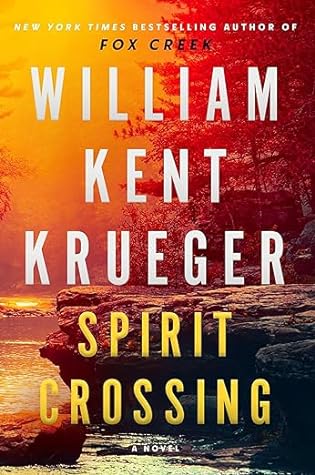
Spirit Crossing, by William Kent Krueger

Spirit Crossing is the spellbinding new novel in the Cork O’Connor series by William Kent Krueger. The book starts with two missing women, and an accidental discovery of a fresh grave. Readers faithful to the series will recognize the characters; there are enough of them, mostly related to one another, to provide depth and interest, without confusing the reader or making the plot too complex.

Lucky me, I read it free and early. My thanks go to NetGalley and Atria books for the invitation to read and review. This book is for sale now.

The story begins innocently enough, with the series protagonist, Cork, out berry picking with his son, son-in-law, and grandson, who is known by the Ojibwe nickname Waaboo. While searching for blueberries, they come across a fresh grave. Waaboo sees the victim standing before him, as if she is still alive, and he’s distraught because she is so unhappy. Waaboo is not the first one in his family to have this ability; nobody doubts that he sees what he says he sees. And so the men immediately wonder whether this is the grave of Olivia Hamilton, daughter of a wealthy Anglo, who’s been reported missing with massive headlines everywhere; or that of Crystal Two Knives, a missing Native girl whose name barely elicits more than a yawn from law enforcement.

And so right away, we are looking at not only the characters, but the longtime issue of missing Native girls and women, and the way that law enforcement neglects their cases for those whose families have money and connections.

One of the things I admire most about Krueger’s writing is the way that he incorporates urgent issues that especially impact the place where he lives—northern Minnesota—into the plot, blending them in so seamlessly that the reader isn’t distracted, because the issues are part and parcel of the mystery to be solved. He does the same thing with pipeline protests similar to the Dakota pipeline that lit up the headlines in recent years. Other aspects of the story include Ojibwe (Chippewa) culture and history, which is part of every book in the series, since most of the family is Ojibwe, and in this case, a character with a brain tumor. When significant events occur and the woman with cancer is the only one to witness them, did they really happen, or is it the brain tumor talking? This adds a layer of psychological tension not present in most of Krueger’s book; I’m not a fan of that subgenre, and am pleased to see that this doesn’t take over the plotline. It’s dealt with tastefully and without sensationalism.

Those that read my reviews know that I have an interest in seeing how authors develop child characters, particularly in a story such as this one, in which the child plays a major role. It makes me crazy when an otherwise competent author searches for shortcuts, such as a child that’s precocious or gifted, to explain away their own failure to craft the child’s character in a way that is honest developmentally. This is one more reason I enjoy this series. Yes, Waaboo has unusual powers, but he is still a small boy. The notion of going home without blueberries is a major blow. Tears threaten. I love the way Krueger develops this kid, and I can’t wait to see more of him in the future.

My one criticism involves a specific passage between the 88th and 90th percentiles, just as we rise toward the climax. Without going into spoilerish details, I will say that one character does something that everyone in the family agrees they must not do, and without any explanation, everyone in the family is fine with them doing it this time. This, of course, puts the character in danger, which anyone that’s paying attention can predict the very moment the action commences. It’s clumsy in a way that is atypical of this author, and I have no idea why he makes the choice he does, but it affects my enjoyment of the book, because suddenly I am not thinking as much about the characters as I am about the author. Having this occur a split second before the climax is especially grating.

On the other hand, I am picky. Very picky. I suspect that this passage will annoy only a small percentage of readers.

I do recommend this book, and this series, to those that love a good mystery. Although it can be read as a stand-alone, those with the time and inclination might enjoy going back a few titles, or even to the beginning of the series.

Trouble in Queenstown, by Delia Pitt***-****

Delia Pitts has been writing mysteries for quite some time, but she is new to me. In Trouble in Queenstown, she introduces hardboiled sleuth Evander Myrick. Myrick’s friends call her Vandy, and that helps to distinguish her from her elderly father for whom she is named; he’s in a memory care unit.

My thanks go to NetGalley, Macmillan Audio, and St. Martin’s Press for the review copies. This book is for sale now.

At first glance, I thought that this detective fiction was set in New Zealand. Queenstown, right? But in this case, the locale is Queenstown, New Jersey. The story opens with Vandy cleaning up a mess in her office just as Leo Hannah storms in and wants to see Evander Myrick. He assumes Myrick will be a Caucasian male, and that Myrick herself is a member of the cleaning staff.

Oops.

Hannah comes to hire Vandy in the wake of his wife’s murder. He knows exactly who did it, he tells her, and he wants her to prove it, starting with some surveillance. Vandy isn’t sure she should take this job, but she has to pay top dollar to keep her daddy in the best facility, so she reluctantly signs on. As the story progresses, there are numerous twists and turns, and the violence escalates. By the story’s end, three different people have tried to hire her for exactly the same case!

The thing I appreciate here is the way Pitts addresses cop racism. So many detective novels require the reader to suspend belief, to assume that every cop is fearlessly dedicated to finding out the unvarnished truth and arresting the perpetrator of the crime, regardless of race, ethnicity, or sexual orientation. But as Vandy conducts her investigation, Pitts keeps it real. At one point the detective speaks with a salon stylist that worked on Ivy’s hair, and he tells her that Ivy was afraid of someone at home. Vandy asks if he contacted the police.

“’The police?’ He jerked his neck, pursing his lips as if I’d farted. ‘Girl, you think the cops came here?’ He sniffed. ‘You don’t look like a fool. Maybe I read you wrong.’”

Sadly, the second half of the book doesn’t impress me as much as the first half does. I have a short list of tropes that I never want to see again in a mystery novel, and she trips a few, including my most hated one. I won’t go into details because it’s too far into the story, and I don’t want to spoil anything, but when it appears, I sit back, disengage from the text, and roll my eyes. Ohhh buh-ruther. As I continue reading, I can see who the murderer is well in advance, and the climax itself is a bit over the top, though without the tropes, I mightn’t have noticed this last issue.

In addition to the digital review copy, I have the audio. The reader does a fine job.

The more mysteries a person reads, the staler tropes become. I am perhaps more sensitive than most readers, having logged over a thousand novels in this genre. Readers that have not read many mysteries are less likely to be aware of, and therefore bothered by overused elements, and so this book may please you much more than it did me. But for hardened, crochety old readers such as myself, I recommend getting this book free or cheap, if you choose to read it. Newer readers may enjoy it enough to justify the sticker price.

The Chinese Question, by Mae M. Ngai****-*****

Mae Ngai is an award-winning author and a professor at Columbia University. In her third book, The Chinese Question, she examines the race relations and to some degree, the economic underpinnings of the Chinese diaspora.

My thanks go to NetGalley and W.W. Norton and Company for the review copy. I am disgracefully late, but when I began reading this book I realized that if I were to absorb and retain anything here, I would need to take it in small bites. That said, this is an unusually well researched work, and it’s well worth the time and attention of anyone interested in the topic.

Usually when I see research having to do with Chinese immigration, it is within the context of immigration to the United States, or an examination of the push factors of emigration, examining why Chinese chose to leave their native land and embark upon an expensive, dangerous, and uncertain journey to a place they’d never visited—in most cases—and where they usually did not speak the language. Instead, Ngai examines it as a global diaspora that includes English speaking nations, namely South Africa, the United Kingdom, Canada, Australia, and the United States. In doing so she is able to highlight the similarities of treatment, to put it politely, and also to dismantle some of the stereotypes that have rooted themselves in English speakers’ knowledge of history.

For starters, she wants us to know that Chinese immigrants were not necessarily “coolies” or indentured workers, and they didn’t always face conflicts with Caucasian powerbrokers. But there certainly were a great many blood chilling abuses, sometimes brought about by White fear of the “other,” but oftener from greed and the desire to exploit the Chinese working class and eliminate competition from the businesses of better off Chinese.

This study is adjacent to my own graduate study topic of many years ago, when I examined the “Model Minority,” and the attempt to counter the demands of U.S. Civil Rights activists of the 1950s and 1960s with the suggestion that Black people quietly accept abuse and quietly climb the economic ladder, or not, as Asians of Chinese and Japanese descent had supposedly done. Ngai demonstrates that Chinese immigrants weren’t all that quiet, and they weren’t all that accepting of maltreatment at the hands of employers and local officials. This is interesting material indeed, and I wish I had known these things sooner.

As a general read for a wide audience, this may be a four star book because it is dense and has an academic approach that not all pleasure readers will appreciate; however, for those with a strong interest in the topic, whether for academic research or personal knowledge and growth, it is hands down the best work I’ve seen in decades.

Highly recommended to those passionate about the issue.

It’s a Privilege Just to Be Here, by Emma Sasaki****

Emma Sasaki makes her fictional debut with the darkly amusing story of a mother and daughter caught up in a scandal at a prestigious private school. My thanks go to NetGalley and Dreamscape Media for the audio galley. This book is for sale now.

Wesley Friends School is the prep school to which presidents and other high placed politicos send their teens, a place where they are nurtured as completely as any hot house flower, and then sent onward, hopefully to an ivy league college. Aki Hiyashi-Brown abandons her PhD and accepts a teaching job there in order for her daughter, Meg, to be able to attend; otherwise the tuition would be impossibly expensive. The school is overwhelmingly Caucasian, and so perhaps it’s unsurprising that Aki finds her face prominently displayed on all of the promotional materials the school disseminates, along with those of the few other teachers of color.

That’s all fine and good until the day when the fence outside is vandalized by spray paint reading, “Make Wesley white again.” Aki is ready to do what she’s been taught from the cradle: keep her head down, do her job, and not say anything. But Meg and her classmates have no intention of remaining silent. Before she knows it, Aki finds she has been assigned to be the head of the Racial Equity Task Force, a token job on a token committee that has more to do with appearances than with any actual desire for change.

She is given a script to follow and told not to offer up any of her own observations or opinions.

Soon, things spiral beyond the control of Wesley’s administration, and Aki is caught between doing what her bosses want her to do, and supporting her daughter and students in their quest for genuine change.

This book, which the author notes is based on her own experience, has me at hello. Though I am not a wealthy or connected individual, I did send my child to a private school for a few years, one which was very white, and which used my half-Japanese daughter’s face on its pamphlets a lot. I can’t not read this book, and whenever I have earbuds in, this is what I listen to. I find it well paced and engaging, setting just the right tone without over-moralizing or becoming strident. There are some great side characters as well; I like Aki’s husband and mother particularly, and appreciate the bond between Aki’s half-Japanese daughter and her Issei (first generation) grandmother.

However, my own husband is also Issei, and I asked him to listen to the reader during one of the many passages in which the grandma speaks to Aki in Japanese. “Is this reader’s Japanese as good as I suspect?” I asked, somewhat proud of my first year Japanese skills. He listened to two lines, laughed, and shook his head.

For this, I really do have to knock one star off my original five star rating. Perhaps if I had a digital review copy I could have rated that version higher, but I have what I have, and it’s problematic. Nevertheless, I appreciate this novel and the message it delivers, and I greatly look forward to reading whatever Sasaki publishes next.