Marked for Life, by Isaac Wright, Jr. *****

Marked for Life is the legal memoir of Isaac Wright, Junior, and it is a compelling story. At age 28, Wright was framed as a “drug kingpin,” though he had never used or sold drugs, and when he rejected the plea deal offered him, he was convicted and sentenced to life plus seventy years. Through his own efforts, he was able to prove his own innocence and regain his freedom. This book is for sale now, and you should get it and read it.

My thanks go to Net Galley and Macmillan Audio for the review copy. Listening to the recorded version is all the more powerful, because the author reads it himself. Readers should know that this book starts out painfully harsh, with the blow-by-blow events of the day he is arrested, and his subsequent treatment. There’s not a tremendous amount of physical violence, but the emotional toll could just about bring me to my knees; imagine how it must have been for Wright, who lived through it! I begin to fear that I will dread listening to it, and so I promise myself that this will be my car book; I will listen to it while I am driving around, and when I get home, I will turn it off. However, only the beginning is harsh, and once I am twenty percent of the way into it, it becomes so interesting that I quickly change my mind, and it joins me in the kitchen. So reader, don’t be afraid of this book. The rough part is all in the first few chapters.

Wright is targeted by corrupt local officials, who are under the misapprehension that he has a small fortune socked away in the safe in his bedroom. In fact, Wright is a successful businessman; he starts as a music producer, then moves into management, touring with Run DMC, and indeed, he and his family live well. Although he doesn’t say as much, part of me wonders if that is his crime, in the eyes of the local cops and courts: he’s a Black man with money. As soon as he is arrested, the shakedown begins. Give us the money, Wright, and we’ll make it all go away.

He doesn’t, and they don’t.

The most fascinating part of this is learning how a prisoner is able to study the law and represent himself. Obviously, not everyone is as literate and intelligent as Wright is; he makes himself indispensable to other prisoners by assisting them with their own cases also. His ability to juggle a lot of moving parts—his own appeal, his fellow inmates’ cases, and the rigors and restrictions of the prison system, along with the endless pressure on him from those that framed him—is impressive. A lot of his success lies in his perception of what other people want. What does the warden want? What do his fellow prisoners want and need? If this had been me, I don’t think it would have gone well. I’d have been good with the research and the paperwork, but I doubt I could have read the wishes and intentions of those around me as successfully as Wright has done. Ultimately, it is an inspirational story, and I highly recommend it to you.

The Black Cabinet, by Jill Watts***-****

3.5 stars, rounded upward.

The premise sounds exciting: a cabinet consisting of African-American luminaries that advised Franklin D. Roosevelt, widely regarded as the best president the U.S. has ever had; well, as far as white folks went, anyway. Wouldn’t it be cool if he had Black advisors, even if it was kept away from the public eye?

It would have been cool, except mostly, he didn’t. Not really.

My thanks go to Net Galley and Grove Atlantic for the review copy. This book is for sale now; in fact, it’s been for sale for a long time. I’m very late with this review, because I was very late finishing the book, because it depressed me so deeply that I couldn’t face it.

Watts is a fine writer and has done the research. The issue for me is that this cabinet, which consisted of outstanding academics and other highly respected Black professionals, had incredibly little clout. They were kept secret. They were unofficial. And it sounds as though FDR tolerated them more than he appreciated them. Despite all of their labor and their eloquence, the New Deal left people of color standing in the rain without an umbrella.

The 1930s were a dreadful time for African-Americans, to be sure. The Jim Crow stranglehold on the South, along with less formal, mostly uncodified discrimination in the North, made it more or less impossible for most bright young Black men to make any headway in their chosen professions, apart from within the Black community (and for Black women? Fuhgeddaboudit.) So, it made my heart sing to learn that there was this exceptional group that advised FDR; but actually, they got crumbs off the president’s table. It makes me a little bit ill to see that this huge study turned up so very little.

For those still interested: there it is.

The Battle Cry of the Siamese Kitten, by Philipp Schott*****

Philipp Schott is a Canadian veterinarian, and he’s very funny. This meaty compendium of essays runs the gamut, and the overall effect is a calming one, like the fish tank in your doctor’s waiting room, but more entertaining. My thanks go to Net Galley and ECW Press for the review copy. This book is for sale now.

I came to Dr. Schott’s work through the back door, so to speak. A friend on social media recommended a mystery he wrote, Fifty-Four Pigs. While I was requesting the galley for that one, I saw that this was also available, so I put in for it as well. I am glad I did, because while the mystery is pretty good, this little gem is even better.

I have never said this before without intending it as an insult, but I do so now: this book is great for insomnia. Here’s what I mean. I’m tossing and turning and after half an hour of that, studies suggest that one must give the battle up and go do something for a bit in order to reboot the brain. When we cannot sleep, it eventually upsets us, and when we are upset, it’s even harder to get to sleep.

When I am sleepless, I am too groggy to do much. I’ve had a sleeping pill, and my motor skills make me unfit to clean house or do anything else that is useful. Once my eyes are able to focus on text, reading is the obvious activity to breach the difficult night hours, but I cannot be certain I’ll remember what I’ve read the next day, and I’m not with it enough to take in complex literature or nonfiction. Thrillers are completely out; they’ll wake me up further, once I’m coherent enough to understand what I am reading.

When all is said and done, short stories or collections of essays, are the best, and Dr. Schott’s are particularly congenial. Each is engaging; a few are tear-jerkers, and while some are persuasive or informational, most are humorous. Although Dr. Schott’s practice is almost entirely there for house pets that are mammals—so, cats and dogs—he has a handful of essays describing cases where he has gone far afield. The zoo wants an ultrasound of that pregnant snow leopard? He’s on it! Beluga whales? YES!

There’s one in which he waxes eloquent about the healing bond that occurs between the very elderly, particularly those in assisted living facilities, and elderly cats and dogs, and he decries the way most such facilities exclude pets; he advocates for a large scale effort to remedy this, including volunteer corps to assist with the extra labor that including these beloved beasties creates. He makes a strong case.

Funniest of all, however, is the title piece, in which he and his wife attempt to take their own cat to the office for shots and whatnot:

I don’t think we veterinarians appreciate how difficult it is to bring some cats to the clinic. Dogs are more easily fooled, only catching on once they get to the clinic door, but it is the rare cat who cheerfully saunters into their carrier, purring in euphoric anticipation of the double joy of a car ride AND a veterinary visit…

“Lucy, look! Extra treats today! And that special catnip mouse! Don’t you want to go in?                                                                                                      Her facial expression was clear: ‘How dumb do you think I am?’                         Play our cards wrong, and she could bolt for the cat sanctuary above the basement ceiling tiles.  The cats think of it as their secret rebel base; we know where it is, but we still can’t get them out of there.

 The pandemic has inspired countless previously petless households to seek out four-pawed companionship, and so, during the period when many businesses have suffered from a lack of customers, Dr. Schott has been even busier than usual. It’s lucky for us that he’s found the time to sit down and write these agreeable essays. In addition to aiding the sleepless, it’s a fine addition to a guest room or yes, the bathroom, because each entry is fairly brief, and the reader can be assured that they’ll have time to finish what they’ve started. Regarding the book, I mean.

Highly recommended.

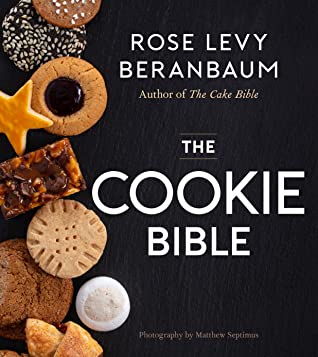
The Cookie Bible, by Rose Levy Biranbaum***

Biranbaum is the author of The Cake Bible, a book that I used to own, never used, and finally handed off to my daughter. Had I realized this at the outset—and I should have, as it was included in the promotional blurb—I probably would have stepped away from this cookbook. However, cookies are generally an approachable baking project, and it didn’t occur to me that this author might provide recipes that are not.

My thanks go to Mariner Books and Net Galley for the review copy. This book will be available to the public on Tuesday, October 18.

My rating is a compromise, because recipes such as these will elicit a variety of responses, none more valid than another, and so I can see this collection as two stars for unpretentious and somewhat lazy souls such as me, and four stars for those looking for a tremendous challenge, or an opportunity to impress.

I was on a weight loss regimen during the warm months, looking forward to fall and the chance to get back in the kitchen and bake. I held onto this galley as a reward for all the weight lost, and I planned to test a couple of recipes before writing a review. That hasn’t happened, nor will it. I confess I didn’t understand what I was in for. These recipes are the sort one uses for a grand occasion if at all. If there’s a dessert auction on the horizon, or if you are simply looking to flex your baking muscles, or even intimidate other bakers, this book is your book. Be prepared to buy a LOT of ingredients that aren’t standard. Super fine sugar; candied lemon peel; brandy or freshly squeezed orange juice, strained; unbalanced hazelnuts! I believe I’d have to be unbalanced to attempt any of this. Fine sea salt; hulled sesame seeds; Muscovedo light brown sugar; sour cherry preserves. Mine are ordinary cherry preserves. Fail. Crystalized ginger. Oh, and once you procure your super fine sugar, you’ll need to grind it in your spice grinder. You have one of those somewhere, of course.

I found one recipe that I thought I could manage. There were 2.5 pages of densely printed instructions.  I could see that I was supposed to have 60-62% cacao dark chocolate, but after reading the recipe four times, I couldn’t find the place where I was supposed to have added it. I did find the place where I should have added something else on top of it, but as far as I am concerned, if the recipe isn’t clear after four readings, then it’s not clearly written.

Next!

Once again, if you have occasions when you are ready to pull out all the stops, you may like this thing, but do make sure you read your recipe well in advance, as I suspect you will have to special order tools and ingredients.

Not for me.

Elvis and Me, by Priscilla Presley****

Priscilla Presley is the ex-wife of the king of Rock and Roll. I was a teenager when he died, and neither I nor most of my peers were fans; in the event his name did come up, we’d invariably ask, “Wait. Do you mean young hot Elvis, or old pudgy Elvis?” But I do love a good memoir, and those written by or about musicians are high on my list. My thanks go to Net Galley and Macmillan Audio for the review copy. This audio version of the author’s 1985 memoir is for sale now.

The relationship between Priscilla and Elvis took place in a completely different time, with completely different sexual mores and assumptions. That said, this was still a truly messed up pairing. Today, Elvis would probably be considered a predator, but within the context of the American South in the 1950s and early 1960s, he was regarded as a romantic, and women threw themselves at his feet. A quick online peek at old film and television clippings says it all.

Priscilla grew up in a strict but loving household. Her stepfather, the only father she knew, since her own died when she was an infant, was a military man, and so the family moved often. It was while they were stationed in Germany that one of Elvis’s employees saw Priscilla and invited her to meet with Elvis, who was doing his own tour of duty.

I have to feel for the bind her parents were in. On the one hand, she was just fourteen years old, and Presley was twenty-four, a grown man. On the other hand, if they refused to let her go, she would never have forgiven them; this was an invitation that literally millions of girls yearned for. Seeking a happy medium, her stepdad set boundaries: they were to be chaperoned, never alone together, and he wanted her home at a certain time. He groused about the fact that someone other than Elvis would be transporting her, but the reason was a legitimate one: Elvis could not drive himself anywhere without the car being mobbed. It was genuinely unsafe.

Rather than being the single event that the family anticipated, Elvis made their visits regular ones; when her parents balked, Elvis spoke to them personally, turning all of his charismatic charm on them, and telling them everything they wanted to hear. Most of it was untrue, of course, but the one thing he adhered to was not having sexual intercourse. During this time period, the Madonna-Whore dichotomy was alive and well, and any girl or woman known to have sex outside of marriage was likely to be ostracized by former friends and in some cases, family. It’s hard to imagine now, but at that time, no birth control pill had been invented, and a pregnancy outside of marriage was likely to ruin a young woman’s entire life.

Priscilla reads this memoir to us herself, and that makes it much more fun to hear. As we age our faces and our bodies change a lot, but our speaking voices change very little. Remembering some of the silly moments from that time, the author lets out a brief, girlish giggle, and it’s almost impossible to believe that she is now a grandmother.

Priscilla acknowledges that this was a monstrously unequal relationship. Elvis dictated whom she could talk to, what she wore, and sometimes even what room in the house she was supposed to be in. At one point, when he is going to be touring for months on end and she will be left at home with his grandmother, she goes out and gets a job. She’s so proud of herself. He makes her quit immediately. When he phones from the road, she had by God better be there. Priscilla compares this to Pygmalion. He has all the power, and she is in his thrall before she has even had a chance to grow up.

I have read two other Elvis biographies, and as dreadful as all of this sounds, the other authors were less gentle. In fact, this is part of Priscilla’s stated reason for deciding to tell her own story.

There are advantages to reading this particular biography. The official version of events is often what is published, but Priscilla is positioned to know the real story, more often than not. For example: when Elvis is drafted, the official story is that, although stars of his caliber are often offered soft assignments that involve singing to the troops, or making inspirational training films, Elvis insisted on doing the same job as every other American man.  On the other hand, Priscilla states that this is all his manager’s doing, because it will make Elvis appear noble. Enough new songs were taped in advance for there to be regular new releases on the radio throughout his tour of duty; toward the end, Elvis feigns illness because he’d prefer to be in the hospital being swarmed by nurses than marching around and getting dirty.

Her memory of Elvis, despite everything he put her through, is mostly a tender one. The spiral that led to his death, his issues with mental health, back before much was known, coupled with the immense number of strong prescription drugs he used to wake up in the morning and go to sleep at night—or to NOT go to sleep at all, and just stay up, night after night—set him up for relationships with unscrupulous characters, and nobody could rein him in, because he was the King.

Recommended to those that like vintage rock music or well-written memoirs of famous musicians.

Liberating Lomie, by Saloma Miller Furlong*****

Saloma Miller Furlong is the author of two memoirs that focus on her decision to leave the Amish faith and community; this is her third. I received a copy for review purposes from the author; this book is for sale now.

Furlong hasn’t had the typical Amish childhood. In her earlier works, she explains that her father was unable to function normally; given to sudden, inexplicable rages, he was a frightening man when he was angry, and he was angry often. Sometimes his rages occurred at predictable times; other times, they came from nowhere. He was unable to do the necessary work to support the family, as is usual in Amish households, and Saloma’s mother, siblings, and Saloma herself had to scramble to pick up the slack. These things are described in Why I Left the Amish and Bonnet Strings. Her experience is also featured in two PBS Experience films, “The Amish,” and “The Amish Shunned.” These documentaries are available free of cost online.

None of Saloma’s books provides light reading; her experience is a brutal one, her childhood traumatic. She is assaulted numerous times, and some of these involve sexual assaults. She tells her mother, who does nothing to protect her. And so, if you are looking for a book that details the typical Amish life, its cultural and religious practices, what technology is acceptable and what is forbidden, and so forth, this is probably not the book you’re looking for, although the two documentaries mentioned above will provide a good overview. Instead, her books demonstrate what happens when an Amish household or some of its members are in crisis.

The extremity of her trauma is glaringly obvious by the fact that her first two memoirs completely overlook her mother’s own brutality towards Saloma, as well as her complicity in assaults by Saloma’s father and older brother. For more than fifty years, this author buried this part of her own trauma, the betrayal she experienced by the person most responsible for her protection as a child. Only recently has she permitted herself to acknowledge it within her own mind, let alone write about it. In the email she sent me requesting that I read and review this new memoir, she told me that she wishes there were a way to recall every single copy of that first memoir, because it omits so much. But I believe one can also read it, and for that matter, all three of these books, with the understanding that we learn as much by what is not said, as by what is.

Saloma’s decision to leave home, to abandon the culture that is all she’s ever known, is driven by two factors. The first and greatest, of course, is self-preservation, the need to find physical safety. But another strong motivator is intellectual inquiry. Amish girls do not attend school after grade 8. This isn’t a general rule; it’s an absolute one. In rare cases an exception may be made for a young man, if his course of study will ultimately benefit the community, but at the end of eighth grade, girls are done. Informal study and reading are also nearly impossible. Amish homes contain the Bible and essential Amish teachings; novels, art books, even resource materials have no place there. An Amish family member that is curled up with a book or newspaper is a slacker at best, using time that could instead be used to benefit the family. At worst, it is a sign of moral corruption, reading worldly content that is not necessary and may even be regarded as evil. No, Saloma couldn’t get away with such things; she once purchased a magazine subscription of the tamest variety, and that was allowed, though it was seen as strange.

Sometimes we know a book is good because of the thinking it inspires after we finish the final page. So it is for me here. I find myself wondering why there aren’t more Amish youngsters that are unable to turn away from the written word. Surely there are other bright, intellectually curious boys and girls that chafe at being forcibly wrenched from their education? Initially I assumed, as many non-Amish do, that most Amish youth might slip through the open door represented by Rumspringa, hit the road, and never look back, but I learned that this isn’t true. The overwhelming majority of Amish teens remain Amish all of their lives, and the majority that do leave, return home later and stay put. And so I wonder; have they simply bred for passivity? It’s a conundrum.

I am initially surprised by Furlong’s decision to use the same book cover here that she used on her first, but I believe it may have been done with an eye toward replacing the old memoir with this new one.

As for the writing quality here, I like the quality of her analysis, and so for those that enjoy a memoir with depth, I recommend this book to you.

Dirtbag, Massachusetts: A Confessional, by Isaac Fitzgerald***-****

I enjoy a good memoir, and so I was all in when I saw this singular work; my thanks go to Bloomsbury and Net Galley for the review copy. It’s by “the beloved founding editor of Buzzfeed Books,” but somehow, I either missed that part or forgot about it, so I read it and assessed it as if he were just some random guy, and ultimately, that’s probably the fairest way to do so anyway. This book is for sale now.

Fitzgerald has seen and done just about everything. His family life growing up is dreadful, and he is delighted to bail out of the screaming, wretched mess called home in order to attend boarding school. He is the scholarship kid, but he benefits plenty from the largesse of his classmates. Post education, he takes himself to San Francisco, with an entire continent stretching between himself and his family. Upon arrival, he continues his favorite pastime, drinking, which he began doing with his older brother when he was just twelve. His parents didn’t do it, so he figured it might be a good choice.

The promotional blurb says that this is the story of the author’s “search for a more expansive vision of masculinity.” Perhaps this is why I find it so hard to relate to. There are moments, though. A huge chunk of the first half in particular describes his affinity for bars, which he identifies as his safe spaces. My notes from the start of this segment say “Oh boy, I always wanted to read yet another alcoholic memoir.” Soon afterward, though, he says, as if reading my mind, that if we expect him to discuss the way he quit drinking, we’ll be in for a long wait, because he still drinks, though not nearly as much. That much was good for a chuckle. Then there’s another segment about his period with the porn industry. I confess I straight-up skimmed some of that, although again, there’s a moment, when he talks about the importance of consent, and how the porn industry, in his experience, is more careful and respectful of this boundary than anyone else he’s encountered.

The book is billed as being humorous, but this is a massive overstatement. Most of the content is dead serious. But then again—yes, you guessed it. There are moments.

What takes me by surprise, and happily so, is the message that he’s spent the whole book building toward, and I never see it coming until we’re there. I highlighted it in case I wanted to use it as a quote here, but that would be an epic spoiler. You didn’t know that memoirs can have spoilers? Oh yes. They can. And when I see this one, my disgruntlement fades and I am once again a perfectly gruntled reader and reviewer.

One aspect that I appreciate, and particularly appreciated during the rougher patches, is that the brief essays that, strung together, make up the memoir, make very short chapters, and they’re clearly marked. This is a terrific bedtime book, because I am able to find a reasonable stopping place when I need to turn out the light (or, as it happens, turn off my Kindle.)

If you’ve read this review and are interested, then I recommend it to you. I anticipate that men will enjoy it more than women.

Scorpions Dance, by Jefferson Morley****

The Watergate burglary’s fiftieth anniversary has passed, and Jefferson Morley, a longtime journalist and political biographer, has written a history of that event; the focus is Richard Helms, the man that ran the CIA and had to walk a tightrope between the demands of President Richard Nixon, and what best served the CIA. This book is for sale now.

If you are searching for just one book to read about the Watergate debacle and/or Nixon, this isn’t it. However, if you are a hardcore Nixon buff, as I am, or if you are a researcher, looking for specific information for academic study, you can hardly do better.

My thanks go to Net Galley and St. Martin’s Press for the invitation to read and review.

Helms was a slick operator, walking a tightrope as he sought to protect the reputation of the agency while maintaining cordial relations with Nixon and those around him. For some of this, there’s a heavy irony involved here; how can anybody ever make the CIA look less than sleazy? But of course, leftists like me are not the ones Helms wanted to impress in the first place.

As the administration sought to damage political enemies that might prevent Nixon’s reelection for a second term, its shady dealings—hiring thugs to ransack a psychiatrist’s office in search for dirt on an opponent, and planting bugs in the office of the Democratic Party in the Watergate Hotel—proved to be the president’s undoing.

Two of the ugly characters in service to Nixon were in charge, for example, of interviewing candidates for a “riot squad” of counterdemonstrators to oppose the anticipated throngs of antiwar demonstrators that were anticipated in Washington. “One of them was Frank Sturgis, whose reputation for violence preceded him. ‘The men were exactly what I was looking for,’ Liddy rumbled in Will, his best-selling memoir. ‘Tough, experienced and loyal. Hunt and I interviewed about a dozen men. Afterward Howard told me that between them they had killed twenty-two men, including two hanged from a beam in the garage.’”

The burglaries had too many moving parts to be kept completely under wraps, and consequently, the president and his top advisors were soon looking for scapegoats below themselves, men that could be packed off to prison while the country regained confidence in the administration that had supposedly brought them to justice. At one point, they had Helms in their sights as a possible fall guy, and the former CIA director, McCord, who was retired, caught wind of this and was having none of it. In a letter, he said, “If Helms goes and the Watergate operation is laid at the feet of the CIA where it does not belong, every tree in the forest will fall. It will be a scorched desert. The whole matter is at the precipice now.”

There are moments when I wonder if the ghost of Richard Nixon haunts the White House, cackling with glee to see a former president in far more trouble today than he himself experienced when he was there. Who knows what the old dog would have thought about the political machinations unfurling today?

Morley has a conversational narrative tone that works wonders. Because I had fallen behind, I checked out the audio version from Seattle Bibliocommons, and narrator John Pruden does a fine job bringing it to life. But the most impressive aspect of this book is the research behind it, with treasure troves of primary documents and brilliant integration of data from multitudinous places. The endnotes are impeccable, enabling other researchers to trace back the facts to their original sources if they need or desire it.

For a niche readership of researchers, this is a five star work, but I suspect most interested parties will be of a more widespread readership; for them, this is still a fine read at four stars. Most satisfying.

Rogues, by Patrick Radden Keefe****

Patrick Radden Keefe is a much celebrated journalist with a list of honors and awards as long as your arm. He first drew my notice in 2019 with Say Nothing, his searing, meticulously researched book on The Troubles, that period of guerilla warfare in the North of Ireland, as its people tried (yet again) to break free of British imperial rule. That book rattled me to my core, and when I received a review copy for this book, I understood that there couldn’t possibly be another book as deeply affecting as his last. And I was right; it isn’t. It is, however, interesting in most places, and Keefe can write like nobody’s business. This book is for sale now; my thanks go to Net Galley and Doubleday for the galley.

Each chapter of this book is on a different topic; ostensibly, each is about a different rogue, or group of rogues, or—in one case—a whole family of rogues! However, there are a couple of chapters where that isn’t really true, and that is my strongest quibble with anything presented there. Most, however, are unquestionably about scoundrels. The first, about an obscenely wealthy wine snob who finds himself with some counterfeit wine, makes my blood boil. A private plane, burning enough fuel to melt the polar caps, or to transport a good many people to work for an entire year, is dispatched to fetch some wine. This one makes me cranky enough, and is lengthy enough, that I abandon it halfway in. The next, “Crime Family,” is a riveting expose of a notorious, yet strangely beloved Scandinavian kidnapper whose sister turns him in when she senses that he’s spiraling out of control. She owns five armored cars, because she knows her brother will never rest until one of them is dead. Chilling, indeed! Other favorites are about El Chapo, and about Mark Burnett, the promoter that turned Trump into The Apprentice, splicing and editing sufficiently to make the man sound coherent and businesslike. There is one about the Lockerbie bombing, and another about insider trading, that I tried to care about but couldn’t, so I skipped those. And there’s one about Jeffrey Epstein, too.

All told, this book is a meal. Even if you do as I did, and skip those that don’t spark your interest, this is a well written, worthwhile collection.

Recommended to those that enjoy well crafted journalism.

Did Ye Hear Mammy Died, by Seamas O’Reilly*****

Seamas O’Reilly is an Irish journalist; as far as I can tell, this is his first book. He was just five years old, one of the youngest of eleven children, when cancer claimed his mother, leaving his father—an extraordinary man, if even half of Seamas tells us is accurate—to raise them all. This is their story. My thanks go to Net Galley; Little, Brown and Company; and Fleet Audio for the review copies. This memoir is for sale now.

Of all the ways in which one can write about the death of a parent, this is one that I never considered. O’Reilly describes his family, his mother’s demise and the impact it has on his family and the community; and the subsequent years of his own and his family members’ lives, and he is hysterically funny. How he manages to achieve this without breaching the boundaries of good taste and respect is nothing short of pure alchemy. Somehow he finds just the right combination of irreverent humor, poignant remembrance, and affection, and it’s pitch perfect.

His finest bits are assigned to his father. I’m giving you just one example, because I want you to experience everything else in context. This isn’t his most amusing anecdote, but it’s a worthy sample of his voice. After heaping praise on him for other things, he tells us:

“He is alarmingly cocky when it comes to his skill at killing mice, a species he hates with a malevolent, blackhearted glee. It’s an odd facet of his character; a man regarded by his friends as one of the kindest, gentlest humans on earth, and by mice as Josef Stalin. He takes particular joy in improvising weapons for the purpose, and has killed rodents with a shoe, a book, and at least one bottle of holy water shaped like the Virgin Mary. He famously dispatched one with a single throw of a portable phone, without even getting out of bed. I know this because he woke us so we could inspect the furry smudge on his bedroom wall…”

I have both the audiobook and the DRC, and rather than alternate between the two, or listening to the audio and then skimming the DRC for quotations and to answer any of my own questions, which is my usual method, I chose to read them both separately, because this story is good enough to read twice, a thing I seldom do these days. Whereas I usually think that having the author read his own audio is ideal, since the author himself knows exactly where to place emphasis and deliver the piece the way it is intended, this time I am ambivalent. O’Reilly speaks faster than any audio reader I’ve yet heard, and he doesn’t vary his pitch much, and as a result, there are some funny bits that I miss the first time through; I am doubly glad to have it in print also. As the audio version progresses, I grow more accustomed to his speaking style, and I miss less than I did at the outset. Nevertheless, if the reader has a choice and doesn’t greatly prefer audiobooks, I recommend print over audio. Ideally, I suggest doing as I did and acquiring both versions.

There’s no doubt in my mind that this will be among the most memorable and enjoyable books published in 2022. Highly recommended.