Emperor of the Seas, by Jack Weatherford*****

How much do you know about the Mongol empires? If you grew up in the U.S., chances are you answered, “Absolutely nothing.” The world is a big place, and world history has never been much of a priority in American schools; we study various phases of U.S. history, state history, and in a wild flurry of internationalism, some districts now teach a semester of Canadian history. The single year of world history in high school is usually devoted to World War II, which is impossible to teach without including information about Europe, and a smidgen about Japan along with, yes, more American history. There you go. Here’s your diploma.

In my retirement years, I have reveled in the freedom to learn about the history that wasn’t on the syllabus for what I studied, and later, what I was hired to teach. Having marched my way through various other times and places, I realized that I knew nothing about the Mongol khans. I read one novel about Genghis, and I was hooked.

My thanks go to NetGalley and Bloomsbury for the review copy. You can buy this book now.

If you’re going to read a single nonfiction book about the Mongols, this would be a fine choice. Jack Weatherford’s research is outstanding, including works in several non-English languages that most of us couldn’t hope to read on our own. His scholarship is so meticulous that he has been awarded both of Mongolia’s top national awards. Not half bad, for a boy from South Carolina. And while this book is not written as narrative nonfiction, the tone is conversational, the language accessible. I read it daily at lunch time, and it wasn’t long before I was shouting out random, amazing facts to family members that dared venture into the kitchen.

It began with Genghis, a young man whose family was left homeless, left to freeze or starve when his father and protector died. With desperation, talent, and ruthlessness that he learned well, he turned it around, and as he grew up he vanquished his enemies, brought the most talented and trustworthy elements to himself, and let the devil take the rest. His instinct for military strategy was a thing of pure genius. But this book is mostly not about him; it’s about his grandson, Kublai Khan, who expanded the empire Genghis began until his domain stretched from Baghdad to the far shores of China.

Until Kublai arrived, Mongols were an inland people, but it was Kublai who realized that in order to expand and become a world power, he had to have ocean-going vessels and people that knew how to use them. The peoples of Southern China were tough to defeat, but once it was done, he was able to use their technologies in ways that were of immeasurable value.

The progression looked like this (in a very simplified version): Genghis conquered, and took no prisoners, with a few rare exceptions. Kublai conquered, but also used diplomacy, highlighting the potential benefits of becoming a Mongol subject; he didn’t routinely kill everyone he defeated. And under Kublai’s son Temur, the Mongols segued from physical battle to economic dominance, making China’s ports the ideal destination of merchants from all over the world.

One of the most interesting things I learned had to do with the authority that was vested in the women of the highest placed families. When the men rode off to conquer, it was women that looked after the business interests and saw to local governance. It worked out nicely; Europeans should have taken note.

I can’t compare this book to others because I haven’t read any others on this topic cover to cover, but I wouldn’t let that stop you. If the Mongols are persuaded that Weatherford has done the work and done it well, who can argue? I learned a great deal and enjoyed it, and so I highly recommend it to you.

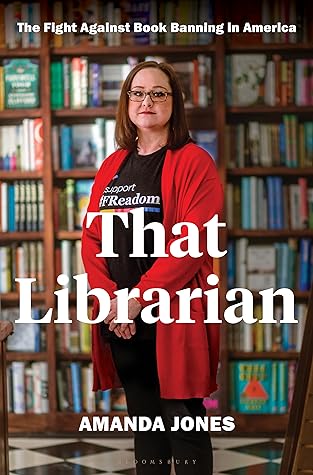
That Librarian, by Amanda Jones****

If ever a clarion call were needed in defense of the First Amendment in general and libraries in particular, that time would be now. Amanda Jones is an educator in a small Louisiana town, where she has lived all of her life. When a censorship battle presented itself, primarily at the behest of organized outsiders with an agenda, she turned up and spoke in a public meeting; in doing so, she unwittingly entered the most chilling chamber of horrors one might imagine.

My thanks go to Bloomsbury and Net Galley for the review copy. This book is for sale now.

Amanda describes herself as a committed Christian and a political moderate; she blushingly confesses to have voted for Trump in 2016. How could a Southern Baptist teacher and librarian suddenly find herself at the heart of a maelstrom, being referred to online as a pedophile, a groomer, and a member of the “woke” left? In a place in which outsiders hold less credibility than those with longstanding roots, how could so many native residents be convinced that pornography is being peddled to children by one of their own? Of course, the only way to create such an atmosphere is through fear and convincing lies.

“Book censors will often say there are books containing pornographic, or sexually explicit, material in children’s sections of the library to rile up public fear. They decry the need to protect children from the evil smut they say is next to Dr. Seuss books. As if a kid could be looking for The Very Hungry Caterpillar and whoops, there’s The Joy of Sex or The Kama Sutra right next to it. That’s never the case. Libraries have collection development policies for ordering books, and appropriate books are placed in the appropriate section. Public libraries do not purchase pornography. Adult books are not in the library’s children section, and to suggest otherwise is ridiculous.”

The American Library Association has guidelines for challenging books. This is essentially what Amanda tells those in attendance at the meeting called by book burners that evening. She is one of more than twenty other locals that show up for the same purpose.

What occurs at this meeting turns out to be a formula frequently used by the extreme right. A page of alarming material is blown up on a big screen for attendees to see. The presenter explains that this very book was found in an area easily accessed by children, right here in the public library in Livingston Parish. It’s a lie. The book isn’t there at all. But most people are decent and tell the truth most of the time; it doesn’t occur to audience members that this is a complete fabrication.

Why Amanda was chosen by these sinister visitors to be the sacrificial lamb is anyone’s guess. Perhaps she is more persuasive than others, or better organized in her remarks. Who knows? By the following day, social media has blown up with vile, horrifying accusations against her. Worst of all, there are people that she has known all of her life and considered friends, that add approving reactions to these poisonous lies. People she always believed would stand up for her, disappear instead, or join the opposition. Her family, her closest friends, and her fellow librarians across the country are the core of her defense, which eventually finds its way into the courtroom. Fellow educators at work? Not so much.

Although this takes place in the deep South, Amanda points out that these challenges are taking place across the country, with the ultimate goal of defunding public libraries. She mentioned a challenge in my hometown, Seattle, Washington, and I gasped. And so, this is an issue that must be monitored, and libraries and free speech defended, by all liberty loving readers everywhere.

The first half of the book is beautifully organized and compelling. I believe my jaw dropped when she wrote of sleeping with a shotgun under her bed, and checking for bombs or tracking devices on the undercarriage of her car. Death threats? Oh honey. Yes. The second half is also good, but could probably use a bit of tightening up. However, were I in her shoes, I would no doubt ramble endlessly.

This would make a terrific movie, and if well done, would certainly deliver the message to still more people.

I wholeheartedly recommend this memoir to all readers that support libraries and the First Amendment.

The Chinese Question, by Mae M. Ngai****-*****

Mae Ngai is an award-winning author and a professor at Columbia University. In her third book, The Chinese Question, she examines the race relations and to some degree, the economic underpinnings of the Chinese diaspora.

My thanks go to NetGalley and W.W. Norton and Company for the review copy. I am disgracefully late, but when I began reading this book I realized that if I were to absorb and retain anything here, I would need to take it in small bites. That said, this is an unusually well researched work, and it’s well worth the time and attention of anyone interested in the topic.

Usually when I see research having to do with Chinese immigration, it is within the context of immigration to the United States, or an examination of the push factors of emigration, examining why Chinese chose to leave their native land and embark upon an expensive, dangerous, and uncertain journey to a place they’d never visited—in most cases—and where they usually did not speak the language. Instead, Ngai examines it as a global diaspora that includes English speaking nations, namely South Africa, the United Kingdom, Canada, Australia, and the United States. In doing so she is able to highlight the similarities of treatment, to put it politely, and also to dismantle some of the stereotypes that have rooted themselves in English speakers’ knowledge of history.

For starters, she wants us to know that Chinese immigrants were not necessarily “coolies” or indentured workers, and they didn’t always face conflicts with Caucasian powerbrokers. But there certainly were a great many blood chilling abuses, sometimes brought about by White fear of the “other,” but oftener from greed and the desire to exploit the Chinese working class and eliminate competition from the businesses of better off Chinese.

This study is adjacent to my own graduate study topic of many years ago, when I examined the “Model Minority,” and the attempt to counter the demands of U.S. Civil Rights activists of the 1950s and 1960s with the suggestion that Black people quietly accept abuse and quietly climb the economic ladder, or not, as Asians of Chinese and Japanese descent had supposedly done. Ngai demonstrates that Chinese immigrants weren’t all that quiet, and they weren’t all that accepting of maltreatment at the hands of employers and local officials. This is interesting material indeed, and I wish I had known these things sooner.

As a general read for a wide audience, this may be a four star book because it is dense and has an academic approach that not all pleasure readers will appreciate; however, for those with a strong interest in the topic, whether for academic research or personal knowledge and growth, it is hands down the best work I’ve seen in decades.

Highly recommended to those passionate about the issue.

Guilty Creatures, by Mikita Brottman*****

Tallahassee, Florida is a city with more than its share of horrifying murders, which Brottman tells us has earned it the nickname, “Tallanasty.” Is it something in the water? No, wait. That’s the gators. One thing that we know is true: in the far right, conservative Christian enclave there, two upstanding young people decided to forego the disgrace and humiliation of divorce by committing the perfect murder. One of their spouses would have an accident while out duck hunting, and he would never be heard from again.

My thanks go to NetGalley and Atria Books for the review copy. This book is for sale now.

The four of them met when they were just kids, and while attending a private Christian high school, they developed a tight bond. Mike and Denise, Brian and Kathy were constantly in one another’s company, and they stayed tight after graduation. The two couples married, and then they cut loose, the four of them partying and engaging in edgy sexual practices that could make an old lady school teacher like me blush. Mike, a hardworking young man from the working class, and Kathy, who wanted to start a family, were ready to settle down and behave themselves; Mike’s wife, Denise, and Kathy’s husband, Brian, were not. In a heartbeat they began carrying out an affair, making elaborate arrangements to avoid shame within their families, church, and community. Ultimately, they decided that Mike, who was a stickler for a structured life and extreme attention to even the smallest financial expenditures, simply had to go. They devised a plan to disappear him, and although suspicions were raised, they got away with the crime for nearly twenty years, when they turned on each other and all hell broke loose.

I had never heard of the case before reading this book, though the author tells us that it has received extensive media coverage. Brottman does a fine job of relaying the story, with perfect pacing and just enough attention to detail. There’s extensive documentation in the end notes, and she relies primarily on primary sources. It reads almost like narrative nonfiction, with suspense building to where I couldn’t look away during the last 25% of the story. This is especially impressive given that I can usually walk away from murder mysteries and thrillers at any time.

I seldom read true crime, and when I finished reading this book, I recalled why that’s so. While I was reading it, it was a fine, trashy wallow, steeping myself in the misdeeds of people that live lives very different from my own. It’s riveting stuff. But once I was done, I felt as though I should take a shower and perhaps gargle.

A little of this type of story goes a long way, but for those that love true crime, it’s a hard one to beat. Highly recommended for those that enjoy the genre.

The Demon of Unrest, by Erik Larson*****

When it comes to history, it’s hard to conjure a more capable author than Erik Larson. I’ve thought this for some time, but his Churchill biography, The Splendid and the Vile (2020) cemented this impression.  I am therefore gushingly grateful to NetGalley and Crown Books for the review copy. I would have paid full cover price for this book if that was the only way that I could get it—or the only way that I could get it soon.

This book focuses on Fort Sumter, the Federal fort off the coast of South Carolina that became the catalyst for the opening guns of the American Civil War. The Southern states that seceded from the US, or that attempted to do so, believed themselves entitled to seize the forts, munitions, and indeed, every single ounce of American property located within the borders of their states—and although Fort Sumter and the lesser, partially constructed forts around it were on islands rather than inside the state’s boundaries, they expected to annex those, too.

Meanwhile, as most know, Major Robert Anderson was the fort’s commander, and he desperately wanted orders from Washington. The period following Lincoln’s election, up until he actually took office, was a critical one, but President Buchanan was determined to postpone any official acts until he could hand the responsibility to someone else. He didn’t want his legacy marred by the beginning of a civil war, or indeed, by any sort of noteworthy strife whatsoever, and so he mostly just hid from everyone. Representatives from South Carolina—would-be ambassadors that came to conduct international business—were turned away without official recognition, and that’s about the only worthwhile thing the guy did. And during this fraught period, Anderson and those he commanded waited tensely to learn whether they would be ordered to evacuate, or to defend the fort.

They waited a long damn time; too long.

This is a complex story and an interesting one, and so there are many historical characters discussed, but the primary three that take center stage are Major Anderson; Edmund Ruffin, a South Carolinian firebreather, stoking the fires of secession; and Mary Chesnut, the highly literate wife of a member of the ruling elite. Others of importance are, of course, President Lincoln; Allan Pinkerton, the head of the notorious Pinkerton Agency, which is tasked with keeping Lincoln alive; and a Southern power broker named Hammond, with whom the story begins.

In starting the narrative by discussing Hammond, Ruffin, and Chesnut, Larson gives us a fascinating window into the minds of the South Carolinian ruling elite, known among themselves as “the chivalry.” They style themselves as if they were characters from out of Arthurian legends, placing their own somewhat bizarre code of honor above every other possible principle, and beyond matters of simple practicality. I’ve always been fascinated by the way that leaders of morally bankrupt causes arrange their thoughts and rationales so that they can look at themselves in the mirror every morning and like what they see, and nobody can explain it quite the way Larson can. Everything is crystal clear and meticulously documented. I’m a stickler for documentation, and so although I feel a little silly doing so for someone of his stature, I pull two of his sources, Battle Cry of Freedom, by James McPherson, and Mary Chesnut’s Civil War, which is the diary she wrote leading up to and during the war, from my own shelves, and turn to the pages indicated in a couple of the notes. There they are, just where Larson said they’d be! This may not impress you, but it makes me ridiculously happy.

The story commences with Hammond, a wealthy planter with a highly elastic moral code. There’s a fair amount of trigger worthy material here—though the term had not been coined yet, he was a sexual predator of the highest order, and delighted in writing about the things he did to his nieces. Although this information, drawn from primary sources, does its job by letting us know exactly what kind of person helped shape the rebellion, it’s hard to stomach, and I advise readers that can’t stand it to either skim or skip these passages, because one can easily understand the majority of the text without them.

Once upon a time, this reviewer taught about the American Civil War to teens, and yet I learn a hefty amount of new information. In particular, I find the depiction of Anderson illuminating. I have never seen such a well rendered portrait of him before.

I could discuss this book all day, and very nearly have done so, but the reader will do far better to get the book itself. Highly recommended, this may well be the best nonfiction book of 2024.

Left for Dead, by Eric Jay Dolan***-****

When I saw this book, I was eager to read it. Shipwreck, treachery, and survival? It doesn’t get a lot more exciting than that. I signed myself up for both the digital and audio galleys, and settled in to immerse myself in history.

My thanks go to NetGalley, RB Media, and W.W. Norton and Company for the galleys. This book is available for purchase now.

The book is well paced and well researched, with plenty of quotes from primary sources. The events described take place during the War of 1812, and involves British and American ships and crew members, none of them particularly lovable, but definitely resilient and ingenious at surviving in extremely dangerous conditions. The men on the American ship have been at sea since before war was declared, and are astonished to find themselves prisoners of war when they are rescued by the British at one point. There are a great many twists and turns, and this is one of those stories that would be considered completely unrealistic if written as fiction. What an experience these sailors endured!

Nevertheless, I am not the best audience for this story after all. I came into it thinking of history and survival, but when I applied for the galleys, I didn’t appreciate the word “sealer” in the ship’s description. Sealer, as in clubbing the seals to death. Hundreds! So easy! Filling the hold of the ship and…I will spare you the rest, since I was unable to spare myself. I sternly reminded myself that this was a different time period with different societal expectations. No animal had been declared endangered, and there had been no technologies that would render the need to wear animal skins for warmth obsolete. People need to stay warm and dry; seal skins will do that for them. I vowed to let it slide past and focus on the rest of the book; but it never slid past, because it was mentioned again, and again, and again, not with a tremendous amount of detail, yet far more than I needed or wanted to hear.

Yes, a baby is born on the ship, but that babe gets about three sentences. Yes, there’s a dog on board, and he saves the crew members many times over, but his heroics don’t show up until the last portion of the tale, and although other reviewers have said that the book is worth reading for this alone, I must respectfully disagree.

Clearly there are a number of people that appreciate and enjoy this book, and I agree that it’s important to document historical events, but I finished reading this thing weeks ago, and I still get a sour gut remembering. If you still want to read it, then do so, but it’s important to go in with your eyes wide open.

Codename Nemo, by Charles Lachman****

3.5 stars, rounded upward.

Code Name Nemo is the true story of how U.S. Naval Commander Dan Gallery and his men captured a German U-boat during World War II. My thanks go to NetGalley, Diversion Books, and Dreamscape Media for the review copies. This book will be available to the public June 4, 2024.

German U-boats were brilliantly engineered submarines that were the terror of the seas for Allied forces in the Atlantic theater during World War II. They were extremely difficult to detect, and were responsible for sending not only Allied ships, but also Merchant Marine vessels and other commercial craft to the bottom of the ocean. Until Gallery took the initiative to capture one, the U.S. Navy had been hard pressed just to sink the treacherous subs rather than be sunk by them. To capture one was an intelligence coup of the highest order, providing the Allies with not only the technical details of the U-boats themselves, but also a host of military secrets kept onboard, including the codes that in turn led to the plans and locations of other German subs.

No Naval officer had even attempted such a thing before. Nazis were expected to destroy their subs rather than allow them to be taken; this, even if it meant all or part of the crews had to drown with the vessels. But lately, it was known that there were sailors that were conscripted and who were not Germans, men from conquered European nations. Gallery believed that some of these men would now choose to surrender and live, rather than drown themselves for the Fuhrer. Gallery was right.

Lachman does a presentable job of describing the events leading up to the sub’s capture, and he chooses to tell it from dual perspectives, and so we see it through both American eyes and those of the Germans. I am not a fan of this trend. For starters, I don’t see this as a good time, if such exists, to depict Nazis as warm and fuzzy fellows that just happened to be on the losing side of history. Furthermore—and I’ve said it before, so forgive me if you are my longtime reader and growing sick of my saying this—you never see historical writers take this tack when detailing the events of the Pacific theater. It’s as if there’s an implied requirement, saying, Look here. We are all (Caucasian) human beings, after all.

That aside, I enjoyed this book, particularly the most exciting part when they board the sub and have to prevent its exploding, or sinking fast along with the U.S. sailors that have come on deck. There is a certain amount of information dumping up front that slows things down a bit up front, and that might also confuse a reader or listener trying to remember the many names and personal histories of those involved. I can see the reasoning behind all of it; some of those mentioned in this book will have descendants that swell with pride as they hear of the courage and cleverness of their great-great whatevers, and who may be devastated to see their late relative omitted. However, the narrative would flow better if the details were streamlined.

I primarily use the audio version, with the Kindle version as backup for rechecking facts. Some of the time I used both at once. Qarie Marshall is the reader for the audio, and does an outstanding job of taking me back in time, once the story gets moving.

The research is adequate, but not stellar. Certain sources get the lion’s share of use, primarily Dan Gallery himself, who has written at length about his experience. I found myself wondering, from time to time, if I would have been better served to read his own account rather than this one. But by then I had this one well underway, so I went with it.

Those that enjoy military history might enjoy this story, and for them, I rate this book four stars. As a general read for history buffs, it may be more of a three star read. If you are the latter and considering reading it, you may want to get it free or cheap, rather than investing full cover price.

Longstreet, by Elizabeth Varon*****

Longstreet: The Confederate General Who Defied the South is a biography that focuses on Longstreet’s military service in the American Civil War, and his political life thereafter. It’s meticulously researched, and the documentation is among the best I’ve seen anywhere. Students, Civil War buffs, and other interested readers won’t want to miss it.

My thanks go to NetGalley and Simon and Schuster for the invitation to read and review. This book is for sale now.

James Longstreet was one of the most able and respected generals for the Confederacy, serving as General Robert E. Lee’s right hand officer. Lee called him “my old war horse.” However, a disagreement between them about strategy at Gettysburg has made Longstreet a convenient scapegoat for Lost Cause types that accuse him of treachery, of deliberately sabotaging the deadly three day fight, and thereby causing the rebels to lose a key battle. Varon sets the record straight, and then goes on to explain what he did following Lee’s surrender and the Confederacy’s failure.

When I saw the subscript in the title, I wondered whether Varon might be overstating Longstreet’s postwar behavior in order to draw readers. Having read it, I can say that she has not overstated one single thing. This is a fair and balanced account. In essence, Longstreet recognized that, while the Confederate Army fought long and hard, it had in fact lost, and there was no good to be gained from further destruction at a time when reconciliation was more important. He basically said that having lost the war, the best thing for the South to do is recognize that the war is done, and proceed to obey the laws of the United States and rebuild the ruined Southern states.

I was unaware, before reading this biography, how extensively defeated Caucasian Southerners were inclined to sabotage the U.S. government. Guerilla actions were common, along with the passage of local laws that directly conflicted with Federal ones. Acts of terror against African American former slaves, as well as free Black Southerners, were frequent whenever Federal troops or other peacekeepers were not present to see to their safety and their rights. And though I had not realized it, Longstreet hailed from Louisiana, which seems to have had the ugliest resistance of all, with the White League and the Knights of the White Camelia wreaking havoc against Blacks that occupied governmental posts, became too prosperous for the liking of local Whites, or that in any way displeased any White person of any social standing. Longstreet did his best to shut that down; he failed.

Varon discusses the role played by Longstreet’s personal friendship with U.S. Grant, one which predated the war; he was best man at Grant’s wedding to Julia. She suggests that although the friendship was important, Longstreet was also acting on principle.

Varon doesn’t overstate her case, and is measured and fair in her assessment. She points to the occasions when Longstreet folded and cooperated with the local racists in that well-traveled road of U.S. politicians: I have to do this terrible thing in order to get elected, or I can’t do any good for the former slaves or anything else. This habit, both past and present, sets my teeth on edge, but she doesn’t defend it. She also points out that had the Confederacy won the war, Longstreet would have remained a Dixie racist for the rest of his life, more likely than not.

Those looking at the length of this book—over 500 pages—should be aware that about the last twenty-five percent of it is endnotes, with documentation, bibliography, etc. And while it may be more than a general reader that simply enjoys a good biography might appreciate, those interested in the Civil War should get this book and read it.

The Backyard Bird Chronicles, by Amy Tan****

My thanks go to Net Galley and Alfred A. Knopf for the review copy. This book will be available to the public April 23, 2024.

I probably should have read the promotional blurb more carefully, because here’s a fact: I have very little interest in birds. But I saw the name Amy Tan, and her work is always wonderful; I figured that the birds would sometimes be metaphors for other things, and that there would be a significant nonbird component to her essays. However, this little book is exactly what the description indicates: a book about the birds she’s seen in her backyard, along with her very own illustrations. And so, even though the book is by an iconic author, I soon found my eyes glazing over. I tried changing sections, since sequential reading isn’t important here; no joy.

It’s really just birds.

So, as a general read for fans of Tan’s writing, I have to call this a three star read. However, as a niche read for birding aficionados, particularly in California, this might well be a five star read. I’ll split the difference and call if four stars.

Recommended to those that love birds and bird art.

Between Two Trailers, by J. Dana Trent*****

And you thought your childhood was difficult.

Dana Trent is the child of two drug addicted schizophrenics who met and fell in love on the psych ward. The fact that she lived to adulthood is astonishing. Her story is captivating; my thanks go to NetGalley and Random House for the invitation to read and review. This memoir will be available to the public April 16, 2024.

“’Kids make the best hustlers,’ King told me the week after I was expelled from preschool. He lifted me onto the counter and coated his arms with palmfuls of petroleum jelly from the biggest Vaseline tubs Walmart sold. Then he greased up mine. ‘No one expects a runt in a Looney Tunes T-shirt to shank you,’ he explained. ‘Budgie!’ he said and pointed to my chest, then sealed my street name with a Vaseline cross to my forehead. ‘Budgie,’ I parroted, finger to my own chest…‘Guns are for idiots,’ he added. ‘Here.’ He handed me my first pocketknife, a foldout two-inch blade with a horse and buggy painted on the handle. Knives teach you to accept the inevitable. ‘You’ll get stabbed,’ he said, ‘but you’ll survive. No big deal.’”

The nickname “Budgie” was chosen because she was his lookout on drug deals. She would ride along with him, his trunk stuffed full of drugs, and when he got out, she was stationed on the highest available vantage point. If she saw someone—an ambush, the cops, anyone—she was supposed to sing like a bird. (Even other drug dealers and manufacturers questioned the wisdom of hauling a three year old on such expeditions, but King, as her father was known, was not easily influenced.)

At such moments, one might wonder where her mother was. Usually her mother was either unconscious in bed, or on the way into or out of that state. Because her father was awake and slightly more predictable, Dana considered him the more reliable parent. Before she was old enough for kindergarten, she understood that it was up to her to take care of The Lady.

My initial response to this scenario was to be bitterly angry at whoever decided to expel this child from preschool. Boom, there went that tiny girl’s one tie to the safer, saner world. How could anyone look at her behavior, her clothing, her hair and not call Children’s Services? I’m still fuming.

Miraculously enough, Trent made it to adulthood, and after years and years of therapy, she is able to lead a normal life. She’s achieved a remarkable amount, with a Ph.D. to her credit along with a solid career in academia.

And she can write! There is never a slow moment in this memoir, a hair raising read that I brought out at lunchtime, but never at bedtime. There is very little by way of dialogue, and that makes the swift, steady pacing even more remarkable.

Between Two Trailers is one of the year’s best reads. Highly recommended.