
New Iberia Blues, by James Lee Burke*****

New Iberia Blues is the twenty-second addition to the Dave Robicheaux series, which I will love till the day I die. The Denver Post has called Burke “America’s best novelist,” and the Mystery Writers of America made him a Grand Master. Big thanks go to Net Galley and Simon and Schuster for the review copy. This book will be for sale January 8, 2019. 
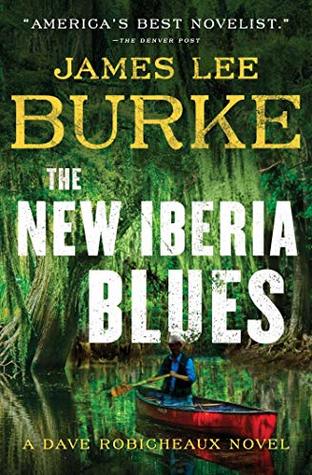
The qualities that have made Burke’s writing famous include his lyrical prose, particularly with regard to setting, and a host of memorable characters, often with quirky names. His bad guys are wealthy and often come from Hollywood to the Gulf Coast of Louisiana, where the series is set, but he often also features a character or two that works for the wrong side, but is complicated and has redeeming qualities. All of these things hold true for this novel, which is one of Burke’s best. 

Dave Robicheaux is a cop in New Iberia, Louisiana, a senior citizen, thrice widowed and lonesome when our novel begins. Then an old acquaintance comes home after making it big:

Desmond Courmier’s success story was an improbable one, even among the many self-congratulatory rags-to-riches tales we tell ourselves in the ongoing saga of our green republic, one that is forever changing yet forever the same, a saga that also includes the grades of Shiloh and cinders from aboriginal villages. That is not meant to be a cynical statement. Desmond’s story was a piece of Americana, assuring us that wealth and a magical kingdom are available to the least of us, provided we do not awaken our own penchant for breaking our heroes on a medieval wheel and revising them later, safely downwind from history.
Desmond was not only born to privation, in the sleeper of a semi in which his mother tied off the umbilical cord and said goodbye forever; he was nurtured by his impoverished grandparents on the Chitimacha Indian Reservation in the back room of a general store that was hardly more than an airless shack. It stood on a dirt road amid treeless farmland where shade and a cold soda pop on the store gallery were considered luxuries, before the casino operators from Jersey arrived and, with the help of the state of Louisiana, convinced large numbers of people that vice is a virtue.

Desmond returns to the bayou in glory after hitting it big in the motion picture industry; he brings with him an unsavory character named Antoine Butterworth. While Dave is welcoming Desmond home, a terrible surprise looms into view: a boat on which a dead woman hangs on a wooden cross. It is plainly visible from Courmier’s deck, and yet he and Butterworth both deny seeing it. And with that, the story commences. 

A complicating factor is that screenwriter Alafair, Dave’s daughter, has begun dating Lou Wexler, a man involved in the film Desmond is making. She is an adult woman, and her father has absolutely no authority in any of her affairs, and yet he feels as if he should. He doesn’t like Wexler, and this creates friction between himself and his daughter.

But at the same time, Dave has plenty of issues of his own. The bottle still calls to him, and sometimes he experiences a ‘dry drunk,’ in which he consumes no alcohol but exhibits many of the same poor impulses as if he had done so. Alafair tells him in exasperation, “Dave, you use a nail gun on the people who love you most.”

One aspect of this book bothers me, and I briefly considered removing a star from the rating but I couldn’t bring myself to do it. Nevertheless, the female characters in this novel, and in this entire series, need to be discussed. The very moment a young, nubile newcomer joins the force and is made Dave’s cop partner, I made a note. “Oh Christ, here we go. There’s no way she can exist and not be a romantic partner. Will she walk on the tops of his feet like his first three wives did? [yes.] Will his ears pop when they have sex? [yes.] And will he marry her and make her wife #4?” (Not telling.)

Burke has difficulty creating a female character who is not Dave’s relative and whose sexuality is not prominent or at least discussed. (His boss, Helen, is allowed to be an exception, but in every book we are told that she is a lesbian, as if business couldn’t proceed without this news.) Can we have an important female character whose sex life isn’t an issue, and can we see her developed in other respects? Of course, Burke is hardly alone in this regard, but the rest of what he writes is so outstanding that this one obvious flaw stands out like a ketchup stain on the Mona Lisa. 

Having said that, I can get back to the novel’s more congenial aspects, one of which is Dave’s closest friend, Clete Purcel. Clete can’t be a cop anymore because he doesn’t honor boundaries; however, this quality, combined with his loyalty to Dave, is what makes him so engaging and entertaining. Moreover, it is he who is most effective at pulling Dave away from the bars and the bottle. I cannot think of any literary sidekick that has been better developed across any series ever than Clete. I have a mental movie that runs when I read this series, and in my mind, Dave looks like a younger version of the author, and Clete—I only just realized the other day—shows up in my head as a sunburned Rodney Dangerfield. 

One other regard in which Burke consistently shines is his ability to create tragicomic side characters, and Smiley Wimple is unforgettable. Smiley is not all there, until he is. In fact, he may surface from beneath your bed. Smiley works as an assassin, but he also has standards. He needs to believe he is taking out a bad guy, or he won’t take the job. Smiley is fond of children, and he likes ice cream. Who knows? He might want to be your friend. And while I am on the subject—there’s some graphic material here, as is true for all of the books in this series; don’t count on this as meal time or bedtime reading. In fact, you may want a few extra lights turned on when you pick this one up. 

Lastly, this book can be read as a stand-alone. I entered the series halfway in when I was given a free paperback copy of The Tin Roof Blowdown; you can enter the series anywhere you prefer. However, if you love a complex, literary mystery and can tolerate a fair amount of violence, you will probably like it well enough to go find the rest and read them too. 

Masterfully written, and highly recommended. 

The Burglar, by Thomas Perry****

Thomas Perry’s tightly plotted suspense novels always keep me on the edge of my chair. Big thanks go to Net Galley and Mysterious Press for the review copy. This book will be available to the public January 8, 2019. 

Our protagonist is Elle, a twenty-four-year-old Californian that is also a professional burglar. She was raised by relatives that ditched her when she was barely grown, and so she makes her living taking jewelry from rich people’s houses. They in turn will file the loss with their insurance companies, so no harm, no foul. She is on one such expedition when she comes across three murdered people that were apparently killed while they were having a three-way on the homeowner’s bed. Worse: there’s at least one camera involved. It might provide the identity of the killer, but then it might provide her identity as well. What’s a girl to do? 

In the real world, the answer would be simple: you were never there. Destroy the camera, go through the wallets for any cash, then get gone fast. Elle has no police record, so even if she wasn’t gloved up, her prints wouldn’t matter, nor would her DNA. Just go. 

But that wouldn’t make for an interesting story, now would it? 

Elle decides to make sure that the cops get the camera, but without her identity on it. This adds a twist, requiring her to break in again in order to return the camera once she’s looked at it and done the other things she needs to do, but in the midst of all this she is being stalked by a mysterious black SUV. In time it becomes clear that someone associated with the house, and likely associated with the murders, wants to kill her. In order to stay alive without going to jail, she must learn the killer’s identity and get the proof to the cops, again without being implicated herself. 

There are a number of places here where I stop, roll my eyes and say, No way. For one thing, Elle owns her own house. How does an orphaned 24-year-old afford a Los Angeles home? I could easily see her squatting in a house that’s for sale, or even inheriting a house from a dead relative after her other family members scarper out of the area, but to have purchased real estate by age 24? No no no no. How does a young woman like that even have a credit history? It defies common sense. In addition, Elle has a vast amount of knowledge in many different areas despite her lack of formal education. How does a 24-year-old know about the history of architecture in Southern California, just for one example? 

But here’s the interesting thing. Despite all of these inconsistencies, I wanted to keep reading. I usually have somewhere between four and ten books going at a time, in various locations and on various devices, and this was not the only good book I was reading at the time; yet when it was time to kick back and read, this one is the one I most wanted to read. And this has never happened to me before. Usually a book with so many holes in the plot and in the construction of the protagonist either causes me to abandon the title or more frequently, plod through it simmering with resentment because I have committed myself to writing a fair review. But not here. With Perry’s book, while part of my brain is tallying the impossible aspects of the novel, the other part of my brain asks, “So what happens next?”

The simple truth is that despite everything, Thomas Perry is a master of suspense. This is what keeps me coming back to him, every stinking time. There’s nobody that writes taut, fast-paced novels of suspense the way this guy does, and so come what may, I had to finish this novel, not out of obligation but for myself, and for the same reason, I will come back to read him again, again, and again.

Best Mystery of 2018

Image

TheCraftsman

Best Fiction by a Pacific Northwest Author 2018

Seattle Book Mama counts it down. For the genres already named, see the separate link at the top of this page.

Findyouinthedark

Night Moves, by Jonathan Kellerman****

Night MovesI always enjoy the Alex Delaware series. It takes a fun read to make me look forward to my stationary bike–which is generally not my favorite thing–and this did that. My rule for myself is that I am allowed to stop pedaling early, but if I do, the audio book gets turned off, and sure enough, I have been riding it full tilt to sneak in a few more pages.
The best parts are the dialogue, and of course, the adolescent characters that only Kellerman can craft so effectively. That said, I cringe when Milo tells Alex to wear a Kevlar vest when they go in to make the bust; I have bought the premise of the psychiatrist riding around as if he were Milo’s partner, since it makes for a good story and is so well written, but when the bulletproof vests come out, my eyes roll. Noooo, don’t be silly.

John Rubenstein does a fantastic job of reading, and his voices for the many characters are bang on.

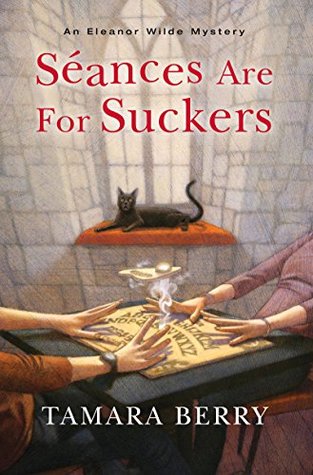
Seances Are For Suckers, by Tamara Berry****-*****

SeancesareforTamara Berry is the queen of snarky humor, and now that I have read the first installment of the Eleanor Wilde series, I am primed and ready for those that follow it. Big thanks go to Net Galley and Kensington Books for the review copy; this book is for sale now.

Ellie narrates her own story in the first person. She explains that she makes her living through fraud, scamming those that want to talk to their dead relatives and solve their Earthly problems via séances. A referral brings her a wealthy Brit that wants a fake medium to vanquish the ghost his mother believes is haunting their mansion. Expenses paid, she flies out to join him and is delighted to find that he lives in an actual castle. His mother, however, hates houseguests and discourages them with miserably small, terrible meals and bad accommodations. As preparations are made for the séance, guests exchange furtively obtained and hoarded snacks in order to avoid starvation.

Nicholas is a hunk; he and Ellie are both drawn toward each other and repelled in classic fashion, and there’s a lot of crackling banter that keeps me snickering. Other well drawn characters include Nicholas’s mother, his sister and her teenage daughter, and a couple of other men, one of whom works for the family. When she comments to the reader, “Bless the sturdy and simple folk of this world,” I nearly fall off my chair. The narrative and dialogue are wonderfully paced and hugely amusing. The solution to the mystery is both partially obvious and wildly contrived, but since this is satire, that makes it even better. In fact, there’s more than one tired old saw that works its way into this story, but it’s with a side-eye wink every time, and I love it.

As the narrative unspools, a corpse is found and then lost, threats and warnings heighten the suspense, and we wonder along with Ellie which of these guests and family members are truly as they seem, and which might be a killer.

The scene leading into the séance is so hilarious that I nearly wake the mister with my cackling.

The only aspect I find unappealing here is the somewhat saccharine story having to do with Ellie’s dying sister. Ellie’s dishonest vocation is, she tells us, necessary so that she can pay for her catatonic sister’s nursing care, and while squeamish cozy readers may find it comforting, I am more than ready to dispatch sis to the great beyond and just let Ellie be Ellie anyway. Happily, this doesn’t hold the story back, particularly since most of the sister’s part of this tale is told at the start and is out of the way by the time we are rolling.

I can’t wait to see where life—and the wakeful dead—will take Ellie next. Highly recommended for mystery lovers ready to be entertained.

A Shot In The Dark, by Lynne Truss****

AShotintheThe world is a serious place right now, and everyone needs to step away from it now and then in order to stay sane. Here it is, your very own mental health break. In fact, if you look at the hourly rate of a good therapist versus the number of hours you’ll read this mystery, even at the full jacket price, Truss’s book is clearly the more economical choice, and it’s far more fun. Lucky me, I read it free courtesy of Net Galley and Bloomsbury. It’s for sale now.

The story doesn’t start as well as it might. It begins with a note from the author explaining that she has written this book exclusively for the purpose of joining a particular writer’s club. It’s likely intended to be a tongue-in-cheek reference, but it comes across as an in-joke between people other than me. I almost feel as though I have walked into a party to which I am not invited.

Then, to make matters worse, the opening chapters contain some jokes that fall completely flat. At about the quarter mark, I consider skimming and then bailing, but I am reluctant to do this with a galley, so I double check the author and publisher first. That changes everything. Bloomsbury is not some small, desperate press that will take any old thing, so that gives me pause. Then I see that Truss also wrote Eats, Shoots and Leaves as well as Cat Out of Hell. At this point the tumblers click into place. I liked both of those books quite well, but I felt exactly the same at the quarter mark of the latter story as I feel about this one. Truss is a writer that takes her time warming up, but she is worth the wait. Soldier through the start as she sets up her characters and puts the story in motion, because once she is on a tear there is no stopping her, and then she’s funny as hell.

Our story starts in a little tourist town in Britain. Twitten is the eager new guy on the force; Sargent Brunswick is unimaginative but sincere, shackled by the lead cop, a bureaucratic blowhard that avoids doing police work by pretending that Brighton has no crime. Since this is the first in the Constable Twitten series we know he won’t be killed, but everyone else is at risk.

Our story features performers from the Brighton Royal Theatre, a woman that works as a cleaner and occasional secretary for the constabulary, a love triangle, a playwright, and an ambitious journalist. The satire is both thick and at times, subtle. I appreciate a writer that can sneak humor into odd nooks and crannies without hitting me over the head with the fact that she’s made a joke, and Truss does that even as she lays out the larger joke in an unmissable way. Ultimately, even the captain must acknowledge that a crime has taken place:

“’May I offer you a sherry before you go?’ And then she opened the door to her front living room, and let out a scream of horror. Furniture was in disarray; ornaments shattered, curtains torn, blood dripped from the fireplace and was sprayed in arcs across the walls. There was no doubt that a life-and-death struggle had taken place inside this room–the biggest giveaway being the lifeless remains on the best Persian rug, of the magnetic young playwright Jack Braithwaite, whose own personal Gas Man had arrived unexpectedly to read his meter and collect his dues.”

The glory of satire is that instead of needing to dream up a variety of innovative twists and turns to liven up the plot, Truss instead can take the oldest and tritest murder mystery elements and make us choke with laughter as we read them.

An added perk is that this is the first in a series, and so the reader can get in on the ground floor. Just don’t trip over the corpse.

Once Truss warms up, her humor is hilarious. Cancel that expensive therapy appointment and order this book instead.

The Craftsman, by Sharon Bolton****-*****

TheCraftsman“One night…what’s the worst that can happen?”

4.5 rounded up. I am late to the party where this author is concerned; a literature chat session directed me toward this galley, and now I am sure to read Bolton’s work again. My thanks go St. Martin’s Press and Net Galley for the review copy. This book will be available to the public tomorrow, October 16, 2018.

Is it a thriller, or is it a horror story? Bolton successfully rides the center here, and there’s a good case to be made in either direction. Our protagonist, Florence Lovelady, is a high ranking cop in the UK. Her career was made when she identified a serial killer and was instrumental in his arrest; now he is dead, and she returns to the small town where he nearly made her one of his victims 30 years ago. The plan is to attend the service with her 15-year-old son in tow, and then spend the night or two in a hotel, where her spouse will join them.

Things don’t go according to plan.

The plot is cunningly constructed, beginning with one of the creepiest fictional funerals in literature. The foreshadowing will give even the most cynical reader a serious case of the heebie-jeebies. As for me, I know my limitations, and as soon as I saw how things are in this one, I decided it could not be the last thing I read before falling asleep at night. Ever.

The interesting thing here—and what keeps this story from actually becoming too horrible to be any fun—is that we know, at the outset, how this case, which takes place in 1969, comes out. We are told in a smooth first person narrative what the broad contours of the case are. We know what the crime was; what happened to Florence while she investigated it; who did it; and that he was caught and convicted. There now.

So as we look back to the teenager that was kidnapped, then buried alive, I confess my eyes skipped over some of the explicit horror, but really the description isn’t a lengthy one, and after all, we know that the guy was apprehended. We see the numerous humiliations to which Detective Lovelady is subjected, in the day when female cops are scarce on the ground and expected to run along and make the tea for their colleagues and to comfort the crying women; I love the scene in which she is told she’s being (punitively) put on a desk to type up reports, and it turns out that she doesn’t know how to type. Ha. But then again, we also know that her career is a successful one, that she has weathered these miseries and now outranks most of the men that treated her badly.
But there are surprises in store too, as new developments surface while she’s there in town. One thing after another unravels till we are on the edge of our seats—and this time we don’t know how it will all shake out.

At about the eighty percent mark, a plot element that I won’t identify comes into play that makes me stop cold for a moment and roll my eyes. Oh please. Not this thing. Every steadfast reader of the genre has a mental list of overused devices they hope never to read again, and after doing so well at avoiding them all, Bolton lets a big, beefy one loose, and just as things are on a roll, too. I don’t want to spoil the story for you, but it took the wind out of my sails for a moment. However, after a brief visit to the literary corn-and-cheese factory, she comes out on top again, and the ending is deeply satisfying.

The story features witches—yes, real ones! As well as shadowy, mostly unnamed stonemasons, and Dwane, who is by far the best-written sexton in a thriller or mystery anywhere.

Highly recommended to all that enjoy a creepy murder story with supernatural elements.

The Clockmaker’s Daughter, by Kate Morton***

TheClockmakersDaughterKate Morton is queen of the British historical mystery, and so I leapt at the chance to read and review The Clockmaker’s Daughter. My thanks go to Net Galley and Atria Books. This book will be available October 9, 2018.
This story starts strong with a spellbinding first person narrative told by the woman whose spirit resides eternally at Birchwood Manor. She came here with Edward, a wellborn cad that “could make the very devil pray”, one that called her his muse. Edward seduced her, yes, but he would never have married her.

Elodie Winslow is an archivist in present-day London.  In the course of her duties, she runs across two pictures in a leather satchel. One is a photograph, quite old, and the other is a sketch of a house that seems familiar to her somehow. And so of course, faithful readers are cued right away to watch for a connection between Elodie, and the people, setting, and events that are introduced at the book’s beginning.

Find me a writer that can create more resonant settings in a British historical mystery; I dare you. For the first quarter of this novel, I was in it, steeping in the escapist paradise Morton provides, drinking in the several characters and narratives. But at the thirty percent mark, when yet another new thread, another new character—or is it an old character pretending to be a new character—is introduced, I find myself searching for a nice brick wall to smack my forehead against. It’s hard to get to know any of these characters with so many new ones added.

Usually with Morton’s books, the details and subsections are worth the reader’s careful attention because it all comes together so well at the end. Here, there’s excellent setting and a lot of secrets but not enough plot or character development, and so before the story is even halfway done I find myself eyeing the page numbers. How much longer…?

I also find myself wondering what story elements are classic, and which are simply overused. The old house with the secret doors?  I will never get tired of this element, especially when the writer is as capable as Morton. But bullies at a boarding school—meh. I am ready to be done with that one. And the sack of kittens to be drowned? I gave myself permission to skip a page, because it is. Not. Worth. It.

Many of Morton’s faithful fans will be pleased; her trademark style is unmistakable, and if that’s what you want, here it is. But a story this complex needs more legs to go with it, and less reliance on stale devices.

Am I done reading Morton? Not by a long shot. Every author has a story or two that isn’t magical. But when a story requires this much effort on the part of the reader, the payoff needs to be greater than it is here.

Recommended to diehard Kate Morton fans; even so, get it free or cheap, but don’t pay full jacket price this time.

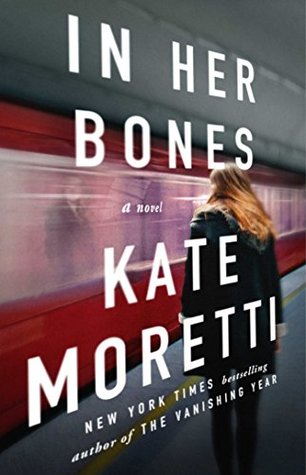
In Her Bones, by Kate Moretti****

InHerBonesMoretti’s mysteries are addictive, and when I found this galley in my email, I jumped it to the front of the queue. Big thanks go to Net Galley and Atria for letting me read it free and early. You can buy it now.

Edie is an outcast, spurned by her friends when her mother Lilith is arrested as a serial killer. Since it is so rare for a serial murderer to be female, the press is everywhere; meanwhile, all Edie has left is her brother Dylan and later, his young family. Otherwise, the people to whom she feels most closely bonded don’t know Edie, don’t realize that she is watching them, obsessing over them in person and in cyberspace; they are the bereaved family members of Lilith’s victims. It gives me chills.

One day Edie takes her voyeuristic tendencies to the next level; when the man she’s been stalking is found dead, police immediately suspect Edie of being his killer. And as we read Edie’s narrative, which tells us some things but not everything, we wonder too: is Edie a lonely, isolated young woman searching for connection to another human being; or is she a chip off the old block, a stone cold killer just like her mama?

The first person narrative alternates with a third person study of Lilith, and so the voice switches from Edie’s very personal story to a clinical, dry report regarding her aberrant mother. (Let me tell you, whatever issues you may have with your own mother—she’s going to seem like the mother of the year once you’ve read this.)

I’ve read a few unhappy reviews by online friends. but I like this book. It helps if you approach it as a mystery rather than a thriller; those in search of a grab-you-by-the-hair page-turner may not get what you’re looking for, but I wanted an interesting story with an original premise and a credible ending, and this is that. In addition, the third person case notes written by social workers and their ilk ring true to me. In fact, I made a wry note to myself, wondering whether Edie or Dylan might have been in one of my classes; I have never taught the children of a serial killer to my knowledge, yet the wanton neglect and lack of nurturance, even a simple effort to provide the basics eludes Lilith in a way that seems familiar. You think I am exaggerating? Not so much. There are terrific parents; there are indifferent parents; and there are, I am sad to say, more than a few Lilith Wades out there in the parent pool.

This is my third galley by this writer. Whereas I liked The Blackbird Season a little more than this one, mostly because of its amazing word smithery, I find this story more original and memorable than The Vanishing Year, which has the sort of denouement that makes me roll my eyes. Here Moretti pulls the ending together in a way that keeps me thinking about the characters rather than the author, and I sigh with appreciation when it’s done.

All told, it’s a solid mystery with a satisfying conclusion. Recommended to all that enjoy the genre.