
Love for Lydia, by H.E. Bates*****

loveforlydiaHE Bates wrote before, during, and after World War II. Many readers came to his work after seeing a televised version of it.  It was different for me. I am fond of excellent fiction, military history, and short stories, and when I cruised Net Galley and found The Flying Officer X and Other Stories, I took a chance and scored a copy. Once I had read those, I knew I would want to read more of his work when I could. So although I came to this outstanding novel in a different way than most readers, I have to tell you that I loved it every bit as much as they did. Thank you Net Galley and Bloomsbury Reader for the complimentary DRC.  I read multiple books at a time, and I feel a bit sorry for others I read at the same time I read this, because almost everything else looks shabby next to Bates’s work. Those that enjoy great literary fiction, romance, and historical fiction—which this technically isn’t, since it was written during that time rather than later, but the feeling it generates is similar—should get a copy. Once the reader opens it, she is destined to be lost to all other purposes until the last page is turned.

This spellbinding story will be released digitally Thursday, May 12, 2016.

The setting is a small town in Britain, a town with a tannery and small farms. One great house surrounded by beautiful gardens stands aloof from the rest; it houses two elderly single women and their alcoholic brother.

Then Lydia, their niece, comes to live with them.

Lydia’s arrival is cloaked in mystery. She doesn’t talk about her mother. The aunts encourage the belief that Lydia is an orphan, but we later learn that isn’t really true. And at first Lydia, who has been cocooned so carefully that she has no social graces nor any real wardrobe, futzing around in clothing that looks suspiciously like that of her elderly aunts, really needs a trustworthy young mentor close to her own age. After having eyed the local population, the aunts send for the protagonist, young Mr. Richards, whose family fortunes have slid to terrible places. Once the proud owners of considerable farmland, the Richards family is now cramped in a noisy flat that shares a wall—and the attendant noises and smells—with the tannery.

Perhaps the thing the aunts like most about young Richards is his great fondness for flowers, an unusual trait in a young man at the party-animal age. He endears himself to the aunt that gives her attention to the landscaping, commenting on the traits of flowers and making suggestions that create an instant bond between young man and old lady, but Richards is unprepared for what awaits him.

The aunts want him to meet Lydia, and they wonder whether he might take her skating on the lake. He agrees to do so. Lydia has never skated and starts out as if she were a colt trying to navigate a frozen surface, all arms and legs floundering, falling. So he is unprepared for the grace and dignity that soon possess her. They fall in love, and young love proves to be the school of hard knocks for our young man, as it is for so many.

None of this brief outline can provide Bates’s magical facility with words. This blog has reviewed hundreds of books—all read and reviewed by me—and this is one that stands out and that has stood the test of time. Bates transports us to a place we have never been and makes us feel we know it, and its inhabitants, intimately. He also lights on issues like social class and the way those with lifelong privilege might treat those without. But this is not a social justice campaign, it’s a brilliant work of fiction that sizzles in places and scorches in others. Character development is spectacularly done; I have had my nose in half a dozen books since I finished reading this one, yet I still think of Blackie, of Tom, of Nancy, of Alex, and oh of course, of Lydia. The ending is bittersweet yet strangely satisfying.

The vocabulary level that makes for such tremendous depth of character and setting also requires a strong facility for the English language on the part of the reader. Although there are no explicit sex scenes, I don’t recommend handing this novel to your love-struck sixteen-year-old as summer reading unless he or she reads at the college level.

I dare you to find a more engaging love story than this one.
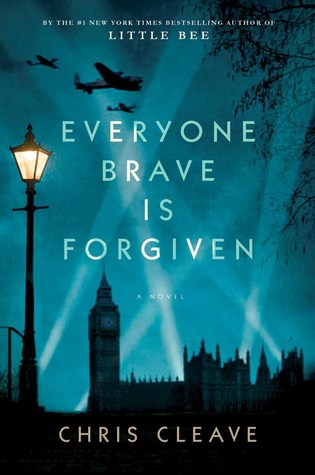
Everyone Brave is Forgiven, by Chris Cleave*****

everyonebraveisforgivenThis is one of those rare novels that I have passed by multiple times despite all the buzz it has generated, because it looked as if it was out of my wheelhouse. A socialite. Pssh. A British officer. Sure. But eventually the enormous buzz among readers and booksellers made me curious. The last time I had this experience, the novel was The Goldfinch, and once I had begun it I gasped almost audibly at what I had almost let slip away from me. And so it is with Cleave’s brilliant novel, historical fiction mixed with more than a dash of romance.  I was lucky enough to get the DRC free of charge in exchange for an honest review; thank you Simon and Schuster and also Net Galley. This luminous novel is available to the public Tuesday, May 3, and you have to read it. It is destined to become a classic.
Our protagonists are Mary North and Alistair Heath; she is dating his best friend, and he is dating hers.  The night before he is to leave to serve in the British armed forces, a moment flashes between them in which they know they want to be together; when he leaves, each grapples with issues of personal loyalty when thinking of the other.

If talent were a mountain, then Cleave would be Everest. If talent were an island, Cleave would not be Malta, but rather all of Britain. And Cleave’s use of word play, first to show how undaunted British youth were by the challenges ahead, and later in a sharper way as the characters learn terrible things and develop a new definition of what courage looks like, is bafflingly brilliant, the rare sort that makes lesser writers hang their heads and understand—this will never be you.

My primary reservation about this novel was that it dealt with the social elite, and my first thought was oh heavens no.  That poor rich girl is going to have to suck it up like everybody else. But I underestimated Cleave and what he was about to take on; Mary, Alistair, and the secondary characters around them begin with a set of assumptions that under his unerring pen seem not only reasonable, but the sort of normal to which their entire lives have accustomed them. Their cavalier approach to the war, from those that serve from those like Tom who at the outset, believe they will “give it a miss”, is the entitlement that has cradled and preserved them from the realities of the greater world all their lives.

And it’s about to change.


Any other city would be chewing its knuckles and digging a hole to hide in.    Alistair    wanted to yell at people: The bullets actually work, you know! What they did not understand was that the city could be extinguished. That every eligible person could die with the same baffled expression that he had seen on the first dead of the war, in those earliest shocking days before the men had learned to expect it. I’m so sorry—I think I’m actually hit.


In turns amusing, poignant, tender, and heartbreaking, this is a novel you will want to reserve hours of your most private moments to read. You may find yourself taking an unexpected sick day so that you can finish it. Based on the overall story of the author’s grandfather with changes, added details, and embellishments, all of which the protagonists would agree are first rate, Everyone Brave is Forgiven is an unforgettable story of love, war, and innocence lost.


Redemption Road, by John Hart ***-****

redemptionroadJohn Hart has  loyal readers, but until a friend mentioned his name to me I had not read his work. Thanks go to Net Galley and St. Martin’s Press for the DRC, which I received free in return for an honest review. This title is available to the public May 3, 2016. There are some partial spoilers below that give up events midway through the book, but of course the ending is kept secret so that you may find it for yourself. I rate this novel 3.5 stars and round upward.
Our protagonist is Elizabeth Black, a cop burdened by her profound attachment to Adrian Wall, a former cop sent to prison for a murder she is certain he did not commit, and also to Gideon, the child of the murder victim. On the day Wall is released from prison, Gideon, now an adolescent, lies in wait for him, prepared to shoot the man he believes killed his mother.

All hell breaks loose, and once more Liz is immersed in the case. She has served as surrogate mother to Gideon since his mother’s death; his father is not fit to raise a child, and so she has quietly slipped in and out of that family’s home, preparing meals, purchasing the child’s clothes. She can’t step back from this case, even when ordered by her superiors to do so.

Hart is a gorgeous prose stylist, and his pacing is unbeatable. He does use one very old plot device, and it, along with the subscript, which I will discuss in a minute, and the absolutely impossible denouement are the reasons the final star-and-a-half is denied.  In addition, there is a place in the story—I won’t spoil the specifics—in which Liz is stark naked and leaps into a car without a stitch of clothing on, and no one finds this remarkable. It appears that the writer had intended to get her dressed and overlooked this detail, as did editors.Hart’s facility with setting is lush and matchless; the violence in this novel, thoroughly visceral, tipped my “ick” button a couple of times, and for this reason and others, I may not return to his work. But his talent and skill are unquestionable.

A minor character of considerable interest is the attorney Liz hires to defend those close to her, a very elderly local courtroom legend known as Crybaby Jones. Every time Crybaby said or did anything, my mind lit up like Christmas, it was so endearing and entertaining. I wish he had been given a larger role in the story, but for the most part he was relegated to the sidelines.

Another character of interest is the prison warden, who functions as a local kingpin and terrorizes those around him into instant submission. I disliked the way this character was shaped, because it gave the author a handy way to dismiss the over-the-top violence by local cops and prison guards as the product of one terrible man’s dominance, which gives the reader the false but comforting assurance that when cops get bad, it’s an anomaly. Hart may believe this; I don’t. And this is a part of the subscript that grated on my nerves. Early in the story Liz reflects that it is oh so hard to be a cop “since Ferguson”, sounding the message that those of us that hold cops accountable and question the deaths of children and other weaponless civilians is cruelly unfair to those that wield the badge. My e-reader comment: “Oh boo hoo. Poor poor cops.”

Because this writer spins a good thriller, I attempted to overlook this and another troubling aspect of the subscript, but the second message was hammered home again, and again, and again, the message that any woman that terminates a pregnancy is a baby killer. He goes after this one long and loudly, with Liz recalling the day she “killed her baby” in a sleazy trailer park abortion. If we’d just had the trailer and no other abortion reference it could have been interpreted as a message that abortion should be safe and legal in every state in the USA, including North Carolina, but that is clearly not the author’s intent. He has her tearfully remembering what would have been her due date had she delivered the “child”; she marks her embryo’s birthday-that-wasn’t every year, and mawkishly speculates about what he –oh yes, she knows its gender, although this is not even scientifically possible until the fifth month of a pregnancy– might have liked, his possible activities, preferences, and yada yada.

Have you had an abortion, or known someone that has? I can think of half a dozen women without trying hard, and this is just not how it goes, folks. Nor should it be.

Fiction writers often use story to drive home a political message, because story is such a strong device and delivers such powerful feelings. In the hands of friends, it is admirable and welcome. In the hands of those that wish to dictate what a woman may or may not do with her body, and in the hands of those that would restore the status quo of police terror over Black men and other vulnerable members of our society, it is galling.

To sum up, Hart has created a work of stunning prose and imagery and tremendous suspense. If you lean far enough to the right to be unaffected or even galvanized by the subscript, then this is your book.

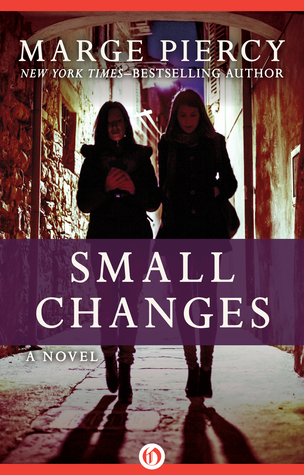
Small Changes, by Marge Piercy*****

SmallChangesPiercyThis title was originally published in 1973 during the second wave of feminism that followed the US Civil Rights movement, and then the anti-war movement against the US invasion of Vietnam. Marge Piercy is a prominent veteran writer who spoke to women’s issues during that time and in years to follow. She doesn’t need my review, and neither does Open Road Integrated Media, I suspect, but my thanks go to them and Net Galley for letting me reread this wonderful novel digitally. I received this copy free in exchange for an honest review, but the reader should also know that I came to this galley with a strong, strong affinity for Piercy’s work already, and my bookshelves are lined with paperbacks and hard cover copies of her books. But they are thick and sometimes heavy to the arthritic hand, and it’s a joy to be able to read them on a slender electronic reader. It was released digitally April 12, 2016 and is available for purchase now.

In 1973, many young adults had cast off the fetters of the impossibly repressive social relations of the 1950’s and early 1960’s. Their parents, on the other hand, were frequently entrenched in the mores that had been with them all of their lives, and felt threatened by the new ideas—some of which were actually pretty stupid—that many Boomer era teens and twenty-somethings embraced. Some notions that were new then are ones most of us now take for granted. Most of western civilization is no longer troubled, for example, by the idea that a woman may want to have a career, and that some women don’t want to have children. Most parents no longer speak of marrying a daughter as a way to transfer the expense of feeding and sustaining her from themselves to a man.

But in 1973, these social mores were still really prevalent. So to readers younger than fifty, or perhaps younger than forty, some of Piercy’s text is going to appear to be over-the-top, a vast exaggeration. It isn’t. And I have to thank Piercy for the gift of her insights, which came to me while I was a young woman still determining what was and was not acceptable in my own relationships.

The sly way Piercy makes her most prominent point is in following the lives of women, two in particular: Beth, who at the story’s outset, is indeed being “married off”, and Miriam, the least-favored child of the family who goes away to school and moves into a series of unconventional relationships. There’s a lot of the cultural flavor of the late 1960’s and early 1970’s here, and Piercy uses her narrative to describe ways in which even the most enlightened women, those seeking to build bonds with other women and support them as they set out to fulfill their dreams, nevertheless find themselves mired in unequal, sometimes physically and emotionally abusive relationships. Women that believe they have liberated themselves by refusing to marry, or by joining a commune and not being monogamous, nevertheless find themselves trapped in destructive situations. Piercy shows us how every woman in her story can see that a good friend is in a bad place; each woman doubts herself first when she starts to reconsider her own entanglements.

It is interesting in hindsight that communal and non-monogamous relationships could be discussed freely, but lesbianism was still so far out on the periphery that not even the most trusted of straight friends were necessarily going to be in on the nature of the coupling. And this is dead accurate given the time period; I was there. And gay sex among men was a mental cobweb to be brushed away. Tran sexuality was still considered a sign of mental illness by nearly everyone, and it isn’t in this book.

Because it deals with relationships and the internal narratives primarily of women, with occasional side-trips into the heads of the men both women encounter, and also of other women Beth and Miriam are close to, this novel is likely to be labeled “Chick Lit”, a genre title I have become increasingly reluctant to use. Think of it this way: how many women have read novels that are entirely about men or one man, and considered what they just read to be relevant and at times, superior literature? And now I have to wonder why, when a book is almost entirely about women or a woman, told from a feminine perspective, it is assumed by so many people that men should not be interested in that literature also?

Note that this tome exceeds 500 pages. The text itself should be accessible to anyone with a high school diploma or equivalency, but not everyone has sufficient stamina to make it through a book of this length. However, if one is on the borderline, and especially if one is a woman interested in evaluating the nature of our most important relationships, this would be a fine place to begin reading longer books.

For those that enjoy reading about this time period, and for those interested in modern feminism as well as the history of American feminist thought, Piercy’s body of work, including this title, should be unmissable.  Her towering feminist presence was a beacon to so many of us, and many of the issues that were so urgent then are still urgent now.

The Fat Artist and Other Stories, by Benjamin Hale*****

thefatartistI like short stories. My Goodreads library tells me I have munched my way through 89 collections and anthologies; yet I can tell you that there is nothing even remotely similar to what Hale offers here. Thanks go to Simon and Schuster and Net Galley for permitting me to view the DRC for the purpose of an honest review. You should get a copy May 17, 2016 when it is released, so that when it is immediately banned by various school boards you will know what they’re screaming about.

The ribbon that binds these brilliant, bizarre tales is that each of them features a social outlier as a protagonist. We start with the airline flight from hell in “Don’t Worry Baby”; you have doubtless flown at least once on a flight with a small child whose mother you long to smack upside the head for her dreadful parenting skills, but this one wins the prize. The second story that deals with Judgment Day didn’t work for me; first there were some hyperliterate science references that zinged right over my head, and then the sick factor got the better of me, and so I skipped that one and moved on to the title story. Having read the rest, I am inclined to chalk that second one up to my own quirks rather than Hale’s skill set.

When I came to “The Fat Artist”, I could only bow in awe. I was overcome with frustration because no one else in my household enjoys literary fiction, and so I couldn’t share. In a nutshell, the protagonist, a performance artist, seeks to eat himself to death while setting a worldwide fatness record. I actually gasped several times while reading this one.

Although the writing within this collection provides outstanding examples of every imaginable literary device, those that teach high school literature would be wise not to place it on classroom shelves unless you work at an alternative school. A very alternative school. A very, very, very…well, hopefully my meaning is clear. There is so much edgy material, from language, to explicit sexual description, to sexual roles and gender ambiguity, that I can see the villagers coming with their torches, their hot tar, their feather pillows. Teachers, don’t do this to yourselves. Get a personal copy; take it home and enjoy it; then pass it on to someone that can be trusted to appreciate it. Seriously.

Four more stories follow, and they’re all strong. “Leftovers” deals with a middle aged man in the midst of an extramarital affair when his problem child unexpectedly appears, ready to ransack the family vacation home for valuables to sell in order to feed his addiction. The way this tale unfolds gives me goose bumps.

The next two tales deal with sexual roles and ambiguity. I came away from “Beautiful Boy”, which made me realize, whether by the author’s intention or not, that men that choose to cross dress only as a diversion are looking at the best of both worlds, never having to confront the glass ceiling because they’ll be at that office meeting clad in their conservative suit and tie like always; it reminds me of white actors that wore black face.

The final story of a troubled brother that lands in the basement of his brother, the MIT researcher, and is provided with a job driving squid from the docks to the laboratory, is as brilliant as all the others, and equally esoteric.

Hale is wholly original, but if I were to compare his writing to any other author, it would be to that of Michael Chabon.

Bring your literary skills to the feast that Hale has laid for you; you will need them.  It’s one hell of a banquet.

The Girls, by Emma Cline*****

thegirlsThe Girls is a fictionalized account of the Manson Murders, a terrible killing spree that stunned the USA in the 1960s before any mass shootings had occurred, when Americans were still reeling from the assassinations of President Kennedy, his brother, Senator Robert Kennedy, and Dr. Martin Luther King. Manson, a career criminal with a penchant for violence yet possessed of a strange sort of charisma, attracted a number of young women and girls into a cult of his own founding. Later they would commit a series of grisly murders in the hills outside Berkeley, and it is this cult and these crimes on which Cline’s story is based. Great thanks to Net Galley and Random House for the DRC. This book will be published June 14, 2016.
Evie is an only child of the middle class; she is well provided for, but her parents have split up and her presence is getting in the way of her mother’s love life. Evie needs her mother’s attention now that she has entered her teens and so she pushes the limits in small ways, then in larger ones. When it becomes clear that her mother just doesn’t want her around, Evie looks elsewhere and finds herself drawn to a feral-looking young woman named Suzanne, who has unsuccessfully tried to shoplift something from a nearby store. Before long, Evie is sleeping on a mattress at the rural commune where Suzanne lives, eating from the communal kitchen and being used sexually by the group’s charismatic leader, and then by a man in the music industry that Russell, the founder, wants to please in the hope of having his music published.  Russell dispenses hallucinogenic drugs freely to make the girls more compliant.

We know immediately that this place, the commune, is not a good place. When we find that the babies  born to young women that live there—in this era before Roe versus Wade gave women the right to choose—are segregated from their young mothers and the pitiful way they regress and attempt to attach themselves to various females in search of a mother or mother figure, that’s a huge tell. But when Evie arrives she doesn’t want to know these things, at least not yet. All Evie wants is to be with Suzanne.

The story’s success isn’t anchored so much in the story line, a story that’s been tapped by previous writers, but in the dead-accuracy of setting, both the details of the time and in every other respect as well, from home furnishings, to slang, to clothing, to the way women were regarded by men. The women’s movement hadn’t taken root yet. This reviewer grew up during this time, and every now and then some small period bit of minutiae sparks a memory. In fact, the whole story seems almost as if a shoebox of snapshots from pre-digital days had been spilled onto the floor, then arranged in order.

The other key aspect that makes this story strong is the character development. Evie doesn’t have to live in poverty among bad people, but she feels both angry at her mother and hemmed in by the conventional expectations of her family and friends. Her boundary-testing costs her the loyalty of her best friend, really her only friend, and so she casts about for a new set of peers. Her mother prefers the fiction that she is still visiting Connie, the friend that has disowned her, and this lie provides Evie with a lot of wiggle room on evenings when her mother is with her boyfriend and finds it convenient for Evie not to be home.

As for Evie, what has started out to be an adventure, a bold experiment in branching out from the middle class suburban life she’s always known, gradually begins to darken. But the worse things get, the more important it is to her to prove her fealty to Suzanne, to not be rejected a second time as she was with Connie. Hints are dropped that probably she ought to just go back where she came from before it’s too late, but she is determined not to hear them.  I want to grab her by the sleeve and get her out of there; Evie won’t budge. Once she is in trouble at home for the things she had done on behalf of the group, her desire to avoid her home and stay with Suzanne grows even stronger, which leads her into more trouble yet. Clues are dropped that something big is going to happen, something that our protagonist maybe should avoid, but she plunges forward anyway with the bullheaded determination peculiar to adolescence.

All told, Evie’s future doesn’t look good.

Readers among the Boomer generation will love this book for its striking accuracy; those that are younger will feel as if they have traveled to a time and place they have never seen before. One way or another, Cline’s masterful storytelling weaves a powerful spell that doesn’t let go until the last page is turned. Riveting, and highly recommended.

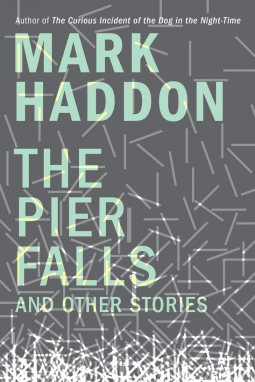
The Pier Falls: and Other Stories, by Mark Haddon*****

thepierfalls.pngMark Haddon has already left his mark on the world with his well known novel and play, The Curious Incident of the Dog in the Night-Time. I haven’t read that book but I will now, because this new collection is impressive. Thanks go to Net Galley and Doubleday for the DRC, which I received in exchange for a fair and honest review.  At times like this, when I get to review stellar writing, it’s a great pleasure to do so.
Note the title first, because it serves to set the tone for all of the stories here. It’s dark out there. On the one hand, a collection filled with cataclysmic tragedies and crimes can make our own troubles look small; yet the reader that tends toward serious clinical depression might be better served to read something lighter. I could imagine how immersing oneself in these stories, which seem quite immediate because they’re so well done, might make a depressive start dwelling on other things, like whether to reach for the rat poison or the razor blades. So if that’s you, get a different book, seriously.

For the rest of us, this is amazing fiction. The title story is the best:

The noise, when it comes, is like the noise of a redwood being felled, wood and metal bending and splitting under pressure. Everyone looks at their feet, feeling the hum and judder of the struts. The noise stops and there is a moment of silence, as if the sea itself were holding its breath. Then with a peal of biblical thunder…a woman and three children standing at the rail drop instantly. Six more people are poured, scrabbling, down the half-crater of shattered wood into the sea.

The story is written so intentionally that not a word is wasted. The result is a tale that is like having a pile of snapshots fall out of your wallet. There it all is in one cruel moment after another, laid bare for all to see. And you have to see it, because once you start, you cannot possibly look away.

Haddon’s capacity to develop a character within a short space is part of his magic, as is his brilliance with setting. The Gun has won an award already, and reminds me somewhat of Peter Straub’s spellbinding facility in combining children with horrible circumstances; the distinction between the protagonist and the new friend that his mother has warned is a bad influence point to class difference and the sometimes-terrible pragmatism that poverty creates. And in two other stories, Bunny  and Breathe, we see a crackling combination of genuine good intentions in a protagonist grappling with great pressure and suppressed rage.

None of it is pretty, but it’s too good not to read!

Another personal favorite is The Woodpecker and the Wolf, which veers into science fiction, starting off gently with the notion of space travel that involves sitting on a sofa, playing Scrabble a lot, and not doing much but observe, but then there are other developments and once again, things grow darker.

There have been times when I have had to speculate about whether it would be worth the purchase price of a book to read one really good short story that’s in the collection, or two really good stories. That’s not an issue here. While I confess that I didn’t finish The Island because it was so horribly dark—and one could perhaps argue that Haddon just did his job a little too well for me there—everything else here is simply admirable.

This outstanding collection is available to the public May 10, 2016, and it’s highly recommended.

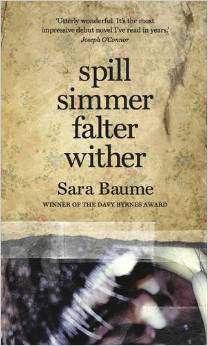
Spill Simmer Falter Wither, by Sara Baume*****

spillsimmerThis novel defies genre, and if you read it, I defy you to ever forget it. Thank you to Net Galley and to Houghton Mifflin Harcourt for the DRC. I received an advance copy free in exchange for a fair review, and I can tell you, this one’s a keeper, and it is for sale to the public today.

Our protagonist, who tells the whole story start to finish without any other significant characters apart from his memory of them, is “…not the kind of person who is able to do things.” He lives independently in a coastal village in England, subsisting on government aid, the rent paid by the tenants in the building his father left him, and the money he has tucked away, bit by bit, over the course of his fifty-seven years. There is black mold in his house, and plenty of grit and grime, but he is left alone and can fend for himself, eating from cans and frying sausages. His greatest fear is of children, because he was bullied as a child and is certain—correctly, perhaps—that if children were to see him now, they’d do the same. His loneliness is so intense that he has purchased picture frames and kept the inset photos of the models used to sell the frames. There they are in his living room, these strangers under glass. Faces to look at.

On one of his quiet trips to the neighborhood thrift store, he sees a sign offering a free dog; it’s to go to a home without small children or other pets. He thinks to himself that a terrier might help with his rat problem. As soon as he arrives, he hears the disparaging way the shelter employee refers to this dog, which would be put to sleep the following day if not adopted; the employee seems to think this might not be a bad plan, since the “little bugger” had nipped him. Our lonely man peeks in at the matted fur, the “maggot nose”, the missing eye, and he realizes he has found a kindred spirit.

The language with which the story is told reminds me of James Joyce in its luminous quality and word play, but is more accessible than Joyce, and friendlier toward its reader. Animal stories, which this partly is, are often overly sentimental, but the violins don’t wail at us here. It’s the story of One Eye, but it is also the story of our lonely man, whose history gradually unfolds as the story is told.

I cannot help but think that were this protagonist real, and were he in the USA instead of the UK, he would likely either be in prison or homeless.

I read a great deal, and the truth is, now that I am the same age as our protagonist, I forget more of the DRC’s I read than I remember. A few months after I’ve read them, most are a bit foggy. A year later, I may have to check my records to be sure I have even read this book or that one. But perhaps a dozen or so each year stand out in bold relief, stories that will make me tell friends and family, “Ohhh, you have to read that one!”

This is one of those.

I would qualify my recommendation to say that because of some of the terrible things that happen in our protagonist’s history, I would not offer this title to your precocious young reader without first reading it yourself. Also, of course, this might not prove a good choice to those that for personal or religious reasons, simply detest dogs.

Apart from these narrow confines, I recommend this book wholeheartedly to one and all. It’s absolutely matchless.

Work Like Any Other, by Virginia Reeves****

worklikeanyotherReeves makes her debut here with a deeply moving, haunting tale of a man that tries to do the right thing and finds his entire life miserably, horribly gone wrong instead. Thank you to Net Galley and Scribner for the DRC; this book is available for purchase March 1, 2016.

Roscoe marries Marie, the woman of his dreams, a woman that speaks little but recognizes every bird call in the state of Alabama. When her father dies, he gives up being an electrician, work that he loves, in order to move to the farm they inherit. Unlike his father-in-law, Roscoe’s own father has always looked down on farming as a poor man’s last resort. Roscoe thinks he has found a compromise by bringing electricity, and with it mechanized farm tools, to Marie’s father’s farm; he won’t have to sweat in the fields, and he has found a way to continue doing the work her prefers. Pirating electricity from the lines out on the highway is against the law, but it’s nothing to make a man do hard time. If he is discovered, he’ll pay a fine and the electric company will install a meter. No harm, no foul.

That’s what he thinks, anyway.

Everything goes to hell in the blink of an eye when someone dies grabbing hold of a live wire located on his improvised set up. He is charged with manslaughter; with a halfway decent attorney, he should be able to get the sentence suspended or reduced, since no harm was intended, but Marie chooses not to hire anyone to represent him. She tells the state to give him a court appointed attorney, and instead she pays for an attorney for the man that has assisted him, knowing that the state of Alabama will come down harder on a Black man, a man that has worked for her family since she was a tiny child.

She can afford two attorneys, as we later learn. It isn’t about the money. It’s about blame. It’s about cold, hard vengeance.

We follow Roscoe as he makes his way through the trial, bewildered not to find Marie in the courtroom. We follow him through his years in prison, a system that tells the public it is there to correct bad habits and teach men skills they can use for the future. It’s a cruel, cold lie. And so although Roscoe’s experience is better in some ways than that of Wilson, who is sent to the end of the prison reserved for men of color, his sentence is much longer, with parole denied again and again as Marie fails to advocate for him.

Reeves is a genius with prose. Were I to rate this book solely on her skill as a writer, this would be a five star review, hands down. The kind of lyrical quality shown here is not a thing that can be taught; at some point, the word smithery put to use here is a matter of talent, and Reeves possesses enough for all Alabama.

My sole concern here is credibility. I don’t want to give too much away because you should read this novel, but I have to say that the way the last portion of the book plays out could never, never occur in the Jim Crow heart of Dixie. One could almost imagine some of it occurring in a different way, one closely guarded and unseen by the community, but to have things set up as they are when Roscoe finally gets out of prison and have the local storekeeper be aware of it, regard it as either normal or as private business that is no concern of his, strains credulity beyond the most magical prose. That house and farm would have been burned to the ground. It could never have happened.

Reeves has developed Roscoe’s character with depth and intimacy, and this is the greatest strength of her story; the first 75% of the plot is also well paced, with tension gently building as a story arc is meant to do. But the spell is broken during the last portion by the problem mentioned above.

Reeves is an author likely to go forward and do great things, and this is a strong debut. Apart from the one distraction mentioned, this book is highly recommended to those that love good fiction.

Interior Darkness, by Peter Straub****

interiordarknessPeter Straub is a legendary writer of horror, and has been publishing novels and short stories for decades. Those that have followed him everywhere and sought every new thing he has written won’t find much joy here. This new collection draws on earlier collections. So for fans of Stephen King looking to add a second horror writer to their favorites list, this book is a winner, and it is for this new generation of horror readers that I mark this collection 4 stars. For die-hard Straub fans like me that are looking for stories that haven’t been published before, it may be a disappointment. I read my copy free courtesy of Net Galley and Doubleday in exchange for an honest review.

The first story, Blue Rose, is one of the most chilling, most terribly great stories Straub has ever written. This is probably why once I was partway into it, I suddenly remembered the middle and ending exactly after all these years, with over a thousand works of fiction read between then and now. I also suspect this story may have been featured in multiple collections, although I don’t know it for a fact. Likewise, the stories featured from his Houses Without Doors collection were all stories I remembered having read more recently.

However, I found three stories that had been published earlier in Magic Terror that had somehow slipped my attention. In particular, “Porkpie Hat” and “Mr. Clubb and Mr. Cuff” are  well done. I became a Straub fan before I finished college, and also before I was a literature teacher. It is great fun to go back and look at all the miraculous ways he uses imagery and other devices in these two stories to build dread in the reader and connect us in a nearly-visceral way to his protagonists. There is only one story in this collection that pushes my ick button—that part of my gut that turns over when something goes from being sick in an entertaining way to being sick in a way that makes me really feel sick and regretful at what I’d read; this is “The Ballad of Ballard and Sandrine”, originally published as a novella.

One sad thing in coming back to Straub’s work with more depth of knowledge than I had when I first read it is that I see a problem I didn’t notice before. Straub cannot develop female characters, and falls prey to every stereotype imaginable. There is one story in the “Noir” section where he deliberately uses stereotypes tongue in cheek, but this apparently hasn’t caused him to notice that he practices many of the same habits in the rest of his prose. It is this failure that denies him the fifth star in my rating.

Horror writers love to use kiddies, and Straub is no exception. If you cannot bear to read stories in which fictional children are subjected to cruelties in order to move the story forward, don’t read this book. In fact, if that’s the case for you, this may not even be your genre. Sometimes Straub rescues the kid at the end of the story, but then again, sometimes he doesn’t. And sometimes, it’s gruesome. I would not have cared to read these tales when I was pregnant or raising young children; I was way too close to his fictional characters at that time in my life. I mention this in case it’s true for you right now.

Conservative Christians won’t like this book.

Most of these stories were written for the book buying public of the late twentieth century, the majority of which was Caucasian and perhaps more clueless than most white folks are today. I could not help but notice that none of his scary characters had blue eyes. However, there’s one nicely done story involving allegory as well as wry humor titled “Little Red’s Tango”. In this story a Japanese book buyer turns up and stays awhile; Straub avoided every stereotype and the character was both believable and respectfully drawn. I appreciated it.

Between what I have said here and the table of contents that you can find online, you should know now whether this collection is in your wheelhouse and whether it’s something you want to pursue. It is available for purchase now.