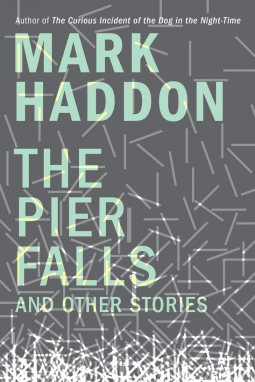
The Pier Falls: and Other Stories, by Mark Haddon*****

thepierfalls.pngMark Haddon has already left his mark on the world with his well known novel and play, The Curious Incident of the Dog in the Night-Time. I haven’t read that book but I will now, because this new collection is impressive. Thanks go to Net Galley and Doubleday for the DRC, which I received in exchange for a fair and honest review.  At times like this, when I get to review stellar writing, it’s a great pleasure to do so.
Note the title first, because it serves to set the tone for all of the stories here. It’s dark out there. On the one hand, a collection filled with cataclysmic tragedies and crimes can make our own troubles look small; yet the reader that tends toward serious clinical depression might be better served to read something lighter. I could imagine how immersing oneself in these stories, which seem quite immediate because they’re so well done, might make a depressive start dwelling on other things, like whether to reach for the rat poison or the razor blades. So if that’s you, get a different book, seriously.

For the rest of us, this is amazing fiction. The title story is the best:

The noise, when it comes, is like the noise of a redwood being felled, wood and metal bending and splitting under pressure. Everyone looks at their feet, feeling the hum and judder of the struts. The noise stops and there is a moment of silence, as if the sea itself were holding its breath. Then with a peal of biblical thunder…a woman and three children standing at the rail drop instantly. Six more people are poured, scrabbling, down the half-crater of shattered wood into the sea.

The story is written so intentionally that not a word is wasted. The result is a tale that is like having a pile of snapshots fall out of your wallet. There it all is in one cruel moment after another, laid bare for all to see. And you have to see it, because once you start, you cannot possibly look away.

Haddon’s capacity to develop a character within a short space is part of his magic, as is his brilliance with setting. The Gun has won an award already, and reminds me somewhat of Peter Straub’s spellbinding facility in combining children with horrible circumstances; the distinction between the protagonist and the new friend that his mother has warned is a bad influence point to class difference and the sometimes-terrible pragmatism that poverty creates. And in two other stories, Bunny  and Breathe, we see a crackling combination of genuine good intentions in a protagonist grappling with great pressure and suppressed rage.

None of it is pretty, but it’s too good not to read!

Another personal favorite is The Woodpecker and the Wolf, which veers into science fiction, starting off gently with the notion of space travel that involves sitting on a sofa, playing Scrabble a lot, and not doing much but observe, but then there are other developments and once again, things grow darker.

There have been times when I have had to speculate about whether it would be worth the purchase price of a book to read one really good short story that’s in the collection, or two really good stories. That’s not an issue here. While I confess that I didn’t finish The Island because it was so horribly dark—and one could perhaps argue that Haddon just did his job a little too well for me there—everything else here is simply admirable.

This outstanding collection is available to the public May 10, 2016, and it’s highly recommended.

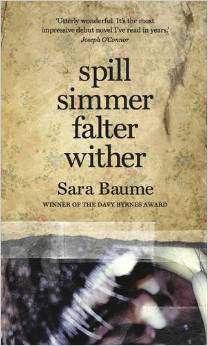
Spill Simmer Falter Wither, by Sara Baume*****

spillsimmerThis novel defies genre, and if you read it, I defy you to ever forget it. Thank you to Net Galley and to Houghton Mifflin Harcourt for the DRC. I received an advance copy free in exchange for a fair review, and I can tell you, this one’s a keeper, and it is for sale to the public today.

Our protagonist, who tells the whole story start to finish without any other significant characters apart from his memory of them, is “…not the kind of person who is able to do things.” He lives independently in a coastal village in England, subsisting on government aid, the rent paid by the tenants in the building his father left him, and the money he has tucked away, bit by bit, over the course of his fifty-seven years. There is black mold in his house, and plenty of grit and grime, but he is left alone and can fend for himself, eating from cans and frying sausages. His greatest fear is of children, because he was bullied as a child and is certain—correctly, perhaps—that if children were to see him now, they’d do the same. His loneliness is so intense that he has purchased picture frames and kept the inset photos of the models used to sell the frames. There they are in his living room, these strangers under glass. Faces to look at.

On one of his quiet trips to the neighborhood thrift store, he sees a sign offering a free dog; it’s to go to a home without small children or other pets. He thinks to himself that a terrier might help with his rat problem. As soon as he arrives, he hears the disparaging way the shelter employee refers to this dog, which would be put to sleep the following day if not adopted; the employee seems to think this might not be a bad plan, since the “little bugger” had nipped him. Our lonely man peeks in at the matted fur, the “maggot nose”, the missing eye, and he realizes he has found a kindred spirit.

The language with which the story is told reminds me of James Joyce in its luminous quality and word play, but is more accessible than Joyce, and friendlier toward its reader. Animal stories, which this partly is, are often overly sentimental, but the violins don’t wail at us here. It’s the story of One Eye, but it is also the story of our lonely man, whose history gradually unfolds as the story is told.

I cannot help but think that were this protagonist real, and were he in the USA instead of the UK, he would likely either be in prison or homeless.

I read a great deal, and the truth is, now that I am the same age as our protagonist, I forget more of the DRC’s I read than I remember. A few months after I’ve read them, most are a bit foggy. A year later, I may have to check my records to be sure I have even read this book or that one. But perhaps a dozen or so each year stand out in bold relief, stories that will make me tell friends and family, “Ohhh, you have to read that one!”

This is one of those.

I would qualify my recommendation to say that because of some of the terrible things that happen in our protagonist’s history, I would not offer this title to your precocious young reader without first reading it yourself. Also, of course, this might not prove a good choice to those that for personal or religious reasons, simply detest dogs.

Apart from these narrow confines, I recommend this book wholeheartedly to one and all. It’s absolutely matchless.

Work Like Any Other, by Virginia Reeves****

worklikeanyotherReeves makes her debut here with a deeply moving, haunting tale of a man that tries to do the right thing and finds his entire life miserably, horribly gone wrong instead. Thank you to Net Galley and Scribner for the DRC; this book is available for purchase March 1, 2016.

Roscoe marries Marie, the woman of his dreams, a woman that speaks little but recognizes every bird call in the state of Alabama. When her father dies, he gives up being an electrician, work that he loves, in order to move to the farm they inherit. Unlike his father-in-law, Roscoe’s own father has always looked down on farming as a poor man’s last resort. Roscoe thinks he has found a compromise by bringing electricity, and with it mechanized farm tools, to Marie’s father’s farm; he won’t have to sweat in the fields, and he has found a way to continue doing the work her prefers. Pirating electricity from the lines out on the highway is against the law, but it’s nothing to make a man do hard time. If he is discovered, he’ll pay a fine and the electric company will install a meter. No harm, no foul.

That’s what he thinks, anyway.

Everything goes to hell in the blink of an eye when someone dies grabbing hold of a live wire located on his improvised set up. He is charged with manslaughter; with a halfway decent attorney, he should be able to get the sentence suspended or reduced, since no harm was intended, but Marie chooses not to hire anyone to represent him. She tells the state to give him a court appointed attorney, and instead she pays for an attorney for the man that has assisted him, knowing that the state of Alabama will come down harder on a Black man, a man that has worked for her family since she was a tiny child.

She can afford two attorneys, as we later learn. It isn’t about the money. It’s about blame. It’s about cold, hard vengeance.

We follow Roscoe as he makes his way through the trial, bewildered not to find Marie in the courtroom. We follow him through his years in prison, a system that tells the public it is there to correct bad habits and teach men skills they can use for the future. It’s a cruel, cold lie. And so although Roscoe’s experience is better in some ways than that of Wilson, who is sent to the end of the prison reserved for men of color, his sentence is much longer, with parole denied again and again as Marie fails to advocate for him.

Reeves is a genius with prose. Were I to rate this book solely on her skill as a writer, this would be a five star review, hands down. The kind of lyrical quality shown here is not a thing that can be taught; at some point, the word smithery put to use here is a matter of talent, and Reeves possesses enough for all Alabama.

My sole concern here is credibility. I don’t want to give too much away because you should read this novel, but I have to say that the way the last portion of the book plays out could never, never occur in the Jim Crow heart of Dixie. One could almost imagine some of it occurring in a different way, one closely guarded and unseen by the community, but to have things set up as they are when Roscoe finally gets out of prison and have the local storekeeper be aware of it, regard it as either normal or as private business that is no concern of his, strains credulity beyond the most magical prose. That house and farm would have been burned to the ground. It could never have happened.

Reeves has developed Roscoe’s character with depth and intimacy, and this is the greatest strength of her story; the first 75% of the plot is also well paced, with tension gently building as a story arc is meant to do. But the spell is broken during the last portion by the problem mentioned above.

Reeves is an author likely to go forward and do great things, and this is a strong debut. Apart from the one distraction mentioned, this book is highly recommended to those that love good fiction.

Interior Darkness, by Peter Straub****

interiordarknessPeter Straub is a legendary writer of horror, and has been publishing novels and short stories for decades. Those that have followed him everywhere and sought every new thing he has written won’t find much joy here. This new collection draws on earlier collections. So for fans of Stephen King looking to add a second horror writer to their favorites list, this book is a winner, and it is for this new generation of horror readers that I mark this collection 4 stars. For die-hard Straub fans like me that are looking for stories that haven’t been published before, it may be a disappointment. I read my copy free courtesy of Net Galley and Doubleday in exchange for an honest review.

The first story, Blue Rose, is one of the most chilling, most terribly great stories Straub has ever written. This is probably why once I was partway into it, I suddenly remembered the middle and ending exactly after all these years, with over a thousand works of fiction read between then and now. I also suspect this story may have been featured in multiple collections, although I don’t know it for a fact. Likewise, the stories featured from his Houses Without Doors collection were all stories I remembered having read more recently.

However, I found three stories that had been published earlier in Magic Terror that had somehow slipped my attention. In particular, “Porkpie Hat” and “Mr. Clubb and Mr. Cuff” are  well done. I became a Straub fan before I finished college, and also before I was a literature teacher. It is great fun to go back and look at all the miraculous ways he uses imagery and other devices in these two stories to build dread in the reader and connect us in a nearly-visceral way to his protagonists. There is only one story in this collection that pushes my ick button—that part of my gut that turns over when something goes from being sick in an entertaining way to being sick in a way that makes me really feel sick and regretful at what I’d read; this is “The Ballad of Ballard and Sandrine”, originally published as a novella.

One sad thing in coming back to Straub’s work with more depth of knowledge than I had when I first read it is that I see a problem I didn’t notice before. Straub cannot develop female characters, and falls prey to every stereotype imaginable. There is one story in the “Noir” section where he deliberately uses stereotypes tongue in cheek, but this apparently hasn’t caused him to notice that he practices many of the same habits in the rest of his prose. It is this failure that denies him the fifth star in my rating.

Horror writers love to use kiddies, and Straub is no exception. If you cannot bear to read stories in which fictional children are subjected to cruelties in order to move the story forward, don’t read this book. In fact, if that’s the case for you, this may not even be your genre. Sometimes Straub rescues the kid at the end of the story, but then again, sometimes he doesn’t. And sometimes, it’s gruesome. I would not have cared to read these tales when I was pregnant or raising young children; I was way too close to his fictional characters at that time in my life. I mention this in case it’s true for you right now.

Conservative Christians won’t like this book.

Most of these stories were written for the book buying public of the late twentieth century, the majority of which was Caucasian and perhaps more clueless than most white folks are today. I could not help but notice that none of his scary characters had blue eyes. However, there’s one nicely done story involving allegory as well as wry humor titled “Little Red’s Tango”. In this story a Japanese book buyer turns up and stays awhile; Straub avoided every stereotype and the character was both believable and respectfully drawn. I appreciated it.

Between what I have said here and the table of contents that you can find online, you should know now whether this collection is in your wheelhouse and whether it’s something you want to pursue. It is available for purchase now.

The Portable Veblen, by Elizabeth Mckenzie*****

theportableveblen“There is a terrible alchemy coming.”

Veblen has led an insular life, focusing her energies on genealogy, a love of nature, and oh dear heaven, her mother. The fact is, her mother is both dominant to an extreme degree, and frankly more than a little bit squirrely. But when Veblen meets Paul, her life changes dramatically; but even more so than most young women, she finds that she needs to be flexible to accommodate Paul, whose needs are different from her own.

A huge thank you goes to Net Galley and Penguin Random House Publishers for permitting me a DRC. I nearly let this title pass unread by me, thinking, because of the cover art, that it was going to be a cutesy animal story, its humor no doubt cloying. I could not have been more mistaken, and so thanks are also due to whatever journalist’s review was posted in my hometown newspaper. Realizing my error, I rushed to the computer to see if it would still be possible, at this late date, to read it free.

It was indeed.

Dr. Paul Vreeland, neurologist and researcher, seeks some normalcy and order in his life. He was raised in a communal environment by parents determined to avoid the rat race and its social conventions as well. All of them. Had he been raised in an urban environment, someone would have probably called the authorities and had him removed from the filth, the drugs, and oh yes, the dreadful embarrassment. When he meets Veblen, he senses that she is fresh and unpretentious, but does not fully grasp just how much she wants to be like his parents—well, minus the drugs.

When Veblen is under stress, she starts anthropomorphizing squirrels. She is certain she can talk to them and that they understand what she’s saying. The stranger her mother behaves, the more Veblen is drawn to squirrels.

And now, a personal note. A good friend of mine took a respite from the grinding, long hours of social work, and for awhile she worked as a wedding planner. It didn’t last long. Having had so much experience dealing with disparate personalities in her initial career, she often felt the urge to hurl herself between the prospective bride and groom, upon whose union tens of thousands of dollars was being lavished. She wanted to cry out, “Just get away from each other, both of you! This marriage will be over before the year is over, so just don’t go there!”

And this is what I wanted to do as of the 33 percent mark. I wanted to haul Veblen back to the rundown cottage she occupied by preference, and haul Paul back to his state-of-the-art medical facility, and have them never see one another again.

Then again, their relationship is hysterically funny, and all of us can use a good laugh, followed by another, and yet another.

The reader can approach this hugely original tale on one of two levels. It can be read as literary fiction, with the squirrel as metaphor. Or one can just read it, and sit back and howl with laughter.

One way or the other, this unbelievably clever, hilarious book is available for purchase now, and it is highly recommended to everyone.

Where All Light Tends to Go, by David Joy*****

WhereAllLightTends“Dead men tell no tales, Jacob. The ones left to living are the ones who write the history.”
I received my DRC courtesy of Net Galley and Putnam Penguin publishers in exchange for an honest review. This title is available for purchase.

Jacob McNeely is a teenager in Cashier, North Carolina, a tiny  town deep in the crags and hollows of the Appalachian Mountains. His mother is a crank user recently released against his father’s wishes from a psychiatric hospital. Jacob has always wished she might turn into a real mother, but it isn’t going to happen.

His father is the local drug czar, with cops on his payroll and a wide variety of other employees as well. He uses McNeely’s Auto Garage to launder his drug money. If any clueless tourist should come by, he gives them a quote so outrageous they take their business elsewhere. Locals foolish enough to cross him or get in his way find themselves and their vehicles in a deep, watery grave yard. That’s if the abused, underfed Walker coonhounds that are tied up at intervals throughout his property don’t kill them first.

Jacob walks a careful tight rope just in order to stay alive. He doesn’t like the life he leads, but he doesn’t see a way out. That is, unless he can run away with Maggie, the girl he has loved since childhood. Maggie is cut out for greater things; Maggie should go to college and escape the danger and poverty of Cashier.

If only Jake could go with her.

Joy is a gifted writer. His stark prose is chilling yet poignant, and so arresting that the reader will be hard pressed to set it down once it’s begun. But you may think twice about reading it at bedtime.

Where does all light tend to go? The allegory is heavy but sophisticated. Perhaps all light goes toward heaven, the candle that reminds us of the existence of God.

Or it’s possible that all light just goes out.

Searing, wrenching, and deeply affecting, this is a book to remember long after you’ve forgotten everything else you’ve read. Highly recommended to adults. Definitely not for children or adolescents.

Simply brilliant!


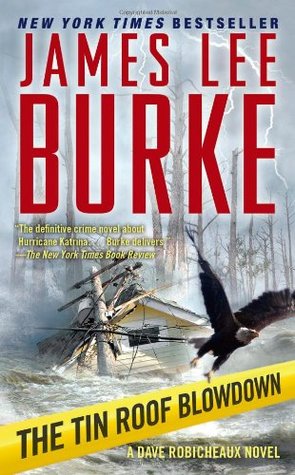
The Tin Roof Blowdown, by James Lee Burke*****

thetinroofblowSometimes people say they “ran across” a book, and that is close to how I came to read James Lee Burke for the first time. I had been tidying up for company, and my daughter had selected this book from the “free” pile at school, then decided she didn’t want it. She is a teenager, so instead of finding our charity box and putting it there, she dropped it on the upstairs banister. I scooped it up in irritation..then looked at it again. Flipped it over…read the blurb about the writer. This man is a rare winner of TWO Edgars. Really? I examined the title again; I hadn’t read any novels based on Hurricane Katrina, so why not give it a shot?

There are about a dozen writers whose novels I will read just because they wrote them. This man is now one of them. I appreciated his ability to develop characters, deal respectfully but realistically with the tragedy and travesty that was Hurricane Katrina (followed by Rita) and recognize it as such; and keep about a million plot threads going without ever dropping anything. In fact, the complexity of the character line-up–somewhere between a dozen and fifteen important people to remember, when I was on the verge of falling asleep for the night–gave me pause, but then this is #6 in a series, so it is possible that if I’d begun with #1, some of them would have been old friends by now, with just a few new ones introduced (and some disposed of before the story was over).

The setting was entirely unfamiliar to me; I have never spent time in the deep southern part of the USA, unless you count a trip with my family to Disney World, and have never set foot in Louisiana. Burke knew it well enough for both of us. His word work was sufficient to lay the canvas before me,and the devastation that was visited upon those who had previously been poor but stable was laid bare:

“They drowned in attics and on the second floors of their houses. They drowned along the edges of Highway 23 when they tried to drive out of Plaquemines Parish. They drowned in retirement homes and in trees and on car tops while they waved frantically at helicopters flying by overhead. They died in hospitals and in nursing homes of dehydration and heat exhaustion, and they died because an attending nurse could not continue to operate a hand ventilator for hours upon hours without rest.”

He gave due credit to those who, in an official capacity or otherwise, worked tirelessly for up to 72 hours on end to save the lives of the vulnerable who had been unable to get out in time, or whose parents had made the wrong choice for them. But he also tells the truth about the condition of the levee that was supposed to protect the residents of New Orleans, and how it had been permitted to deteriorate, when Federal funds were dropped by 50% without a moment’s notice or explanation, and permitted to deteriorate worst in the Black part of town. The narration spills out with disgust the “latent racism…that was already beginning to rear its head.”

Meanwhile, our hero, cop Dave Robicheaux, is trying to find out the whereabouts of a “junkie priest” who perished trying to evacuate his parishioners, but died in the flood waters when criminals stole his boat. He also keeps track of his best friend Clete, a bail bondsman and private detective who will follow him around if he is not included in the search, because some of the people Robicheaux is trying to locate are also bail skippers, and therefore also his bread and butter. Clete is an alcoholic and makes some really bad decisions; Robicheaux tirelessly tries to keep him under his wing and under control, all the while also trying to keep his wife and daughter safe from a local mercenary he’s investigating. The bad guy knows that Robicheaux’s family is his greatest treasure, and threatens them as an attempt to make him back off.

While parts of New Orleans appear untouched by Katrina, others have had their entire infrastructures destroyed, and there are virtually no navigable roads; the waters are treacherous as well, with downed power lines and debris just below the surface. In short, he has his work cut out for him.

Burke’s bad guys are complicated characters. All come from hideous family situations, and childhood has left its unalterable mark on them, but they are layered in the depths to which they will stoop in seeking wealth, power, or simply revenge. One is capable of property crime, violence, even rape, but finds he cannot look an unarmed man in the eye and shoot him; another can do it without a hitch in his heartbeat. The street smart voices I heard within these chapters felt real to me.

But the consistent thread which lies at the core of the story, of the storm, of everything that takes place between its covers, is one which the writer has hold of like a pit bull with a rat. He has his jaws around it and shakes it without ever letting loose of it, whatever other events weave in and out of his pages, the racism that caused the most harm to be brought upon those with the fewest resources, intentionally and maliciously. He will not let go of the racism that rules New Orleans.

“The original sympathy for the evacuees from New Orleans was incurring a strange  transformation. Right wing talk shows abounded with callers viscerally enraged at the fact evacuees were receiving a onetime two-thousand-dollar payment to help them buy food and find lodging. The old southern nemesis was back,naked and raw and dripping–absolute hatred for the poorest of the poor.”

I can see why this guy has a pair of Edgars to bookend his mantel. He spins a compelling, absorbing tale, and the values and priorities that lay at the core of his work are ones I share and appreciate. It was in reading this novel that I became a die-hard James Lee Burke fan. I wrote this review before I had a blog on which to put it, and this book is a must-read for those that love good fiction, good mysteries, or that care about social justice.

The Man Who Cried I Am, by John A. Williams*****

TheManWhoCriedIAmThe Man Who Cried I Am was originally published during the turmoil of the late 1960’s, in the throes of the Civil Rights and antiwar movements, and following the assassinations of President Kennedy, his brother Bobby, Martin Luther King Junior, and Malcolm X. Now we find ourselves in the midst of a long-overdue second civil rights movement, and this title is published again. We can read it digitally thanks to Open Road Integrated Media. I was invited to read it by them and the fine people at Net Galley. I read it free in exchange for an honest review. It is available for purchase now.

The story is a fictionalized account of the life of writer Richard Wright, one of the giants within African-American literature. I am ashamed to say that although I did pick up a copy of both Native Son and Black Boy, his two most famous books, they were still perched on my to-read pile when this invitation rolled in. I found myself perusing this meaty material without knowing anything about Wright himself, apart from his legendary stature and his occupation. I wanted to be able to give my readers a strong critical analysis of this novel, but I have really struggled with it. I found myself having to do a Wiki search in order to figure out whether Max Reddick or Harry Ames was supposed to be Wright. It’s embarrassing. I will read it over again and try to publish something more useful than this review in the future, but I promised to publish my thoughts on the book no later than today—a week following its release—and so I’m going to tell you what I can.

As literary fiction, it’s strong. Ames, who is Wright, as it turns out, and Reddick, who is James Baldwin fictionalized, go on an Odyssey all their own, leaving the USA and its myriad racial issues behind for Europe. A number of other historical luminaries are recognizable in its pages by different names, in addition to those called by their real names, such as Dewy and Truman, and philosopher Camus. The time period spans from post-World War II to the Civil Rights movement.

So many social issues are embraced here that I found myself making far more notes and highlighting more quotes than I can use. The debate unfolds as to how the Communist Party USA treats artists, as opposed to workers, and even touches briefly on the assassination of Trotsky at the hands of a Stalinist agent. Discrimination against African-American (then referred to as Negro) soldiers in the Buffaloes is part of Reddick’s inner narrative. Black Pride had not yet had its day, and Black men often coveted relationships with Caucasian women, partly, as Malcolm X later pointed out, from self-hatred, partly as a social status symbol, and occasionally for the practical material benefits of marrying into, or becoming aligned with, a woman that had access to money. But this was also a double-edged sword, because the women’s movement hadn’t occurred yet either, and women were supposed to stay home and have babies while their men went off to work.

The whole thing is very complicated.

In this time prior to the 1973 Roe vs. Wade decision that made abortion legal for American women, an unwanted pregnancy is dispatched by a doctor who is supposed to be quite good and risk free, but of course, the procedure is not legal, and there are no emergency facilities available. One of the characters loses the woman he loves when she bleeds to death after a back-alley abortion. This is not intended to be the primary focus of the book, but it’s huge to me, and so it stayed with me.

Be aware that there are scores of ugly racist terms, used for the purpose of highlighting racism, as well as sexist terms and references to gay men as the f-word. All references are either there because of the time period in which the story is set or for the purpose of defining the struggle of the Black man in America, but readers have a right to know and to brace themselves. There are descriptions of the atrocities visited upon European Jews during the war, as well as references to their struggle in the USA, primarily New York City; again, there are some ugly terms used.

Should you read this title? Not at the beach. This excellent novel is for the serious student of African-American history and for the history student focused on social justice. It’s more than worth your while, and I will re-read it myself after I have read Wright’s work. Just understand that there are many, many historical references that will make you reach for Google. The story was written during a time when the average reader had most of these things—from clothing styles such as zoot suits and pegged pants, to offhand references to the cigarette jingles that once punctuated our radio and television broadcasts as frequently as Coke and Pepsi do now, to slang terms whose use is either gone or worse, changed to mean something else. For example, if someone is high, they haven’t been using street drugs; they are drunk. None of these things is explained to the reader. We must have them stored in our memories; search for the meanings of unfamiliar references; or attempt to understand the text without knowing them.

I consider this literature to be accessible only to those that read at college level.

Highly recommended for those that take African-American literature and history seriously, and whose reading ability is well above average.

Miller’s Valley, by Anna Quindlen*****

MillersValeyMiller’s Valley is an intimate, poignant story so personal that it is hard to remember that it’s fiction rather than a memoir. Thanks to Net Galley and Random House for the DRC. Though I usually read several DRC’s at a time, this was the one I saved for the end of the day, for that time when the phone stops ringing, the dogs quit barking, the family doesn’t need my attention, and there’s nobody at the front door. During those deep, silent hours I immersed myself into the life of Mimi Miller, hypnotized as if my best friend were perched on the bed spilling out her secrets.

If you love good literary fiction, you have to read this book!

The Millers are a family of working farmers. Day by day, inch by inch, water is claiming their land. Shifty business is going on between a developer, who wants to build and sell a waterfront community in what is now rural land containing farms and woods, and the government, which is interested in increasing the size of the local dam. Visitors come to all land owners in the valley, slick people ready to wheel and deal, threaten and cajole.

The Millers are having none of it.

The reader sees all of this through the eyes of Mary Margaret “Mimi” Miller, who grows up amid the tension, the resistance to the governmental takeover of their land, and the pride…above all, the pride. Her family mucks out the mud when the floods come, and they persevere. They resign themselves to the notion that wall-to-wall carpeting can never happen because water comes into the house so often. You can shovel the muck off of wood or linoleum, but a carpet would be ruined the first time the flood came.

Woven in and out of her story is that of her family members and closest friends, including reclusive Aunt Ruth, her mother’s sister who lives in a separate house on the property. Ruth is agoraphobic, and would not come out of her house if she believed it to be on fire. Ruth says that getting out of the house is “overrated”. We also see her older brother, Eddie, who is “the glory of Miller’s Valley”, the perfect son who goes off to college and makes good; we also follow her other brother Tommy into a host of trouble, trouble, and more trouble.

We view each setting as individual snapshot; she paints it, and we are there. Character development is likewise outstanding. As Mimi grows older, we see the same characters with deeper layers of complexity, just as our understanding of those around us grows fuller and deeper as we age. And as she grows into her adulthood, Mimi becomes so similar to her mother in so many ways that I have to remind myself continually that this is fiction, not memoir.

Quindlen is a veteran writer, and when I started to pass this galley by, I realized it was for a foolish reason: I had been required to read her essays and stories sometimes in teachers’ workshops, and so when I ran across her name, my instinctive response was to associate it with work. But those required-readings were some of the best workshops I ever sat through, and now that I am reading on my own time, I find her novel suits me down to the ground.

And I agree with Mimi’s conclusion that “Maybe everyone stays the same inside.”

Those that love good literary fiction as well as stories of finding ourselves through our heritage will appreciate this beautifully told story as much as I did. It is available for purchase April 5, 2016. Highly recommended.

Pilgrims: A Lake Wobegon Romance*****

PilgrimsOh my stars. Keillor is at his finest here. I’ve never read anything funnier. Every now and then I permit myself to read a title that isn’t a new release but that I’ve been considering reading for a long time. This is one of those.

By now you probably have an idea whether or not you are a Keillor buff. His appeal is largely (but not limited to) the boomer generation. His trademark capacity to satirize people from rural Minnesota, and in particular Lutherans and Norwegians and most of all himself, is legend. He somehow manages to tug the heartstrings occasionally and evoke bittersweet feelings that are experienced by those of us who grew up in the USA during a particular time period, even if we are not from his part of the nation or his culture.

Keillor seemed to me to be sort of a hit-or-miss writer for awhile, but lately, he’s been hitting, at least for me. Liberty, Pontoon, and this one, which parodies Chaucer’s pilgrims in the Canterbury Tales, carries on without slowing or hitching or ceasing to be interesting and at many times (especially the end) a total crack-up.

If you have never read Chaucer and don’t intend to, that won’t wreck it. The basic contours: Chaucer wrote about people going far away, in a limited group, and Keillor uses the same style of poetry Chaucer used to mark the beginning and end of this book. If there are other parallels, then I am not deep enough to find them, but if I found this to be a good bedside read with only that much recollection, then it will likely suffice for you too.

Here are the story’s components. (I actually flagged fifteen hilarious passages, and then realized that if I quoted them here, it would ruin it to you, so I’ll just give you the basics and set you free.) Margie is 53 and very unhappy. Life has sort of ground to a dull halt; the nest is empty, and husband Carl has moved to a different bedroom. She doesn’t know why. She hopes that if they take a romantic trip to Italy, it will rekindle the flame.

Writer Gary Keillor comes to town. No one includes him in anything. They all assume he is being standoffish by not coming, and he is hurt that no one invites him; very Scandinavian. Before he knows it, he has livened up the speech he is giving (and which is obviously boring his audience senseless) by offering to fund the trip to Italy. Holy smokes! What has he done?

On top of all of it, the town hero, Gussie, their fallen Norwegian soldier who fought in World War II, should have his grave decorated. His daughter Margo, born in Italy outside the sanctity of wedlock, has never gotten around to coming to the USA to meet him, and his remaining brother, very elderly and in a nursing home in another part of the USA, has long wanted someone to convey a photo of Gussie to his grave site. A simple request, and nobody would do it. Now, Margie calls to tell him she’ll be happy to help, and joy of joys, he sends her a big pile of money, and on his deathbed, he refers to her as his “daughter, Margie.” She is entirely untroubled about taking his money as the little band from Lake Wobegon sets out on its vacation and its mission to decorate Gussie’s grave.

This should give you enough information to decide if you want to see the rest. I will only tell you this: the story has some surprises in store at the end; it is not as predictable as it appears to be at the 75% mark.

I found my copy during an annual pilgrimage of my own, to Powell’s City of Books in Portland, Oregon. It has been available to the public for some time.

Hilarious, and highly recommended!