Let Us Descend, by Jesmyn Ward*****

Reading Jesmyn Ward always hurts so good. In Let Us Descend, she conveys the heartbreak and sense of betrayal a young girl, Annis, faces when she and her mother are sold separately by their owner—who is also her father–and the ways that she copes, and also the ways she is helped by the spirits of her ancestors.

My thanks go to Scribner and Net Galley for the invitation to read and review. I’m sorry to be so late here, and am grateful that the literary world has recognized this book for the masterpiece that it is.

You may have seen other reviews in which I complain and gnash my teeth over historical inaccuracies; sometimes I rant over an author’s failure to portray a child in a way that is developmentally inaccurate. There will be none of that here. Ward has taken the time and done the research, and so her well crafted characters aren’t compromised by sloppy background details. I had to take this story in small bites because it is excruciatingly sorrowful.  For part of it I listened to the audio version; this is a treat in itself, as Ward reads her own novel.

Some reviewers have taken issue with the amount of magical realism Ward employs. I disagree with them. How can any novelist portray such a story and such a character as Annis with any glimmer of hope, unless they employ these literary devices? Does anyone really want to read a book that is miserable at the outset, miserable in the middle, and miserable even at its bitter, wretched conclusion? Without hope, there’s not much incentive to keep reading, nor would it have been satisfying to write; but Ward will not and does not revise history simply to make her readers more comfortable. There was only one way to tell this story and be true to history and her characters, and Ward found it.

Yes, it’s a rough read, but it’s so well written that many readers must have smiled through their tears. Know that, of necessity, this story is absolutely loaded with triggers; assuming that you can navigate them without coming undone, I highly recommend this story to you.

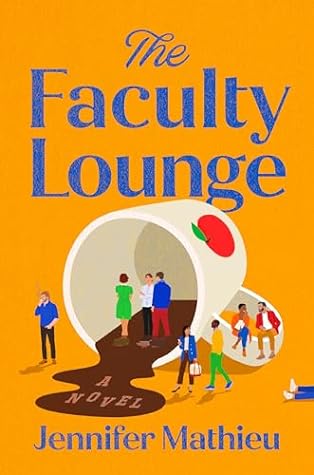
The Faculty Lounge, by Jennifer Mathieu****-*****

“You really had to hand it to Mr. Lehrer. While dying at work is never ideal, he had the decency to do it during his off period. And not only that, but at the start of it, too, giving the clerks in the main office plenty of time to find someone else to cover Ms. DeLaRosa’s Spanish II classes, even as they scrambled to figure out who should be telephoned when an eighty-two-year-old substitute teacher lies down on a ratty couch in a high school faculty lounge and dies. “

Jennifer Mathieu’s new novel, The Faculty Lounge, has been described as love letter to teachers. Though it is darkly funny in a number of places, the description isn’t wrong. By the ten percent mark, I had cackled out loud twice, it was so strangely accurate.

My thanks go to Penguin Group Dutton and NetGalley for the review copy. This book is for sale now.

Our school is Baldwin High, a Texas school with a solid reputation. After the stage is set, with poor Mr. Lehrer breathing his last breaths during his planning period, and another teacher being cranky when the paramedics make her leave before her photocopies are done so that they can work on him, the story is organized with a single chapter per character. Obviously there are a lot more people on Baldwin’s staff, but this method works quite nicely, and since the characters interact, the chapters that come later in the book are richer, because there’s more backstory to help us understand them.

The youngest teachers have grown up with the knowledge that they might be shot to death at school; first they grew aware of this when they were students, and now, as teachers, the danger is still there. While older staff members tend to be rattled by a lockdown, younger ones see it as almost routine. Take attendance, salute the flag, and whoops, there it is. Herd any students outside of your door into the room, then lock it. Everyone on the floor. Pull your window blinds. Wait till it’s over.

I appreciated every character in this book, and I was sorry when it ended.

There are crises at Baldwin, just as there always seem to be fires to put out in real schools; there are high maintenance parents with absurd complaints, as well as idiotic district directives. Bureaucrats! Toward the end, a veteran teacher explains to a newer one that some days, “the best you can do is show up and hang on.” So true! Your reviewer is retired from the profession, and I can recall a wise older teacher saying to me privately during difficult periods, “I’m here. And I’m dressed.”

The whole thing seems so familiar.

How much will this resonate to readers that aren’t educators? I have no idea, but I know that the in-jokes, the sense of the familiar, can’t be as strong. For a general readership, I’d say this is a four star read. Possibly this is true as well for those that have always taught early childhood, because many of the parameters are different. But for those of us that have taught middle and high school, particularly for those that are veterans, this is a solid five star read.

Cheerfully recommended to all, and highly recommended to veteran secondary teachers.

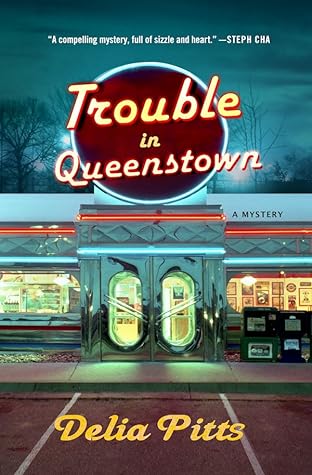
Trouble in Queenstown, by Delia Pitt***-****

Delia Pitts has been writing mysteries for quite some time, but she is new to me. In Trouble in Queenstown, she introduces hardboiled sleuth Evander Myrick. Myrick’s friends call her Vandy, and that helps to distinguish her from her elderly father for whom she is named; he’s in a memory care unit.

My thanks go to NetGalley, Macmillan Audio, and St. Martin’s Press for the review copies. This book is for sale now.

At first glance, I thought that this detective fiction was set in New Zealand. Queenstown, right? But in this case, the locale is Queenstown, New Jersey. The story opens with Vandy cleaning up a mess in her office just as Leo Hannah storms in and wants to see Evander Myrick. He assumes Myrick will be a Caucasian male, and that Myrick herself is a member of the cleaning staff.

Oops.

Hannah comes to hire Vandy in the wake of his wife’s murder. He knows exactly who did it, he tells her, and he wants her to prove it, starting with some surveillance. Vandy isn’t sure she should take this job, but she has to pay top dollar to keep her daddy in the best facility, so she reluctantly signs on. As the story progresses, there are numerous twists and turns, and the violence escalates. By the story’s end, three different people have tried to hire her for exactly the same case!

The thing I appreciate here is the way Pitts addresses cop racism. So many detective novels require the reader to suspend belief, to assume that every cop is fearlessly dedicated to finding out the unvarnished truth and arresting the perpetrator of the crime, regardless of race, ethnicity, or sexual orientation. But as Vandy conducts her investigation, Pitts keeps it real. At one point the detective speaks with a salon stylist that worked on Ivy’s hair, and he tells her that Ivy was afraid of someone at home. Vandy asks if he contacted the police.

“’The police?’ He jerked his neck, pursing his lips as if I’d farted. ‘Girl, you think the cops came here?’ He sniffed. ‘You don’t look like a fool. Maybe I read you wrong.’”

Sadly, the second half of the book doesn’t impress me as much as the first half does. I have a short list of tropes that I never want to see again in a mystery novel, and she trips a few, including my most hated one. I won’t go into details because it’s too far into the story, and I don’t want to spoil anything, but when it appears, I sit back, disengage from the text, and roll my eyes. Ohhh buh-ruther. As I continue reading, I can see who the murderer is well in advance, and the climax itself is a bit over the top, though without the tropes, I mightn’t have noticed this last issue.

In addition to the digital review copy, I have the audio. The reader does a fine job.

The more mysteries a person reads, the staler tropes become. I am perhaps more sensitive than most readers, having logged over a thousand novels in this genre. Readers that have not read many mysteries are less likely to be aware of, and therefore bothered by overused elements, and so this book may please you much more than it did me. But for hardened, crochety old readers such as myself, I recommend getting this book free or cheap, if you choose to read it. Newer readers may enjoy it enough to justify the sticker price.

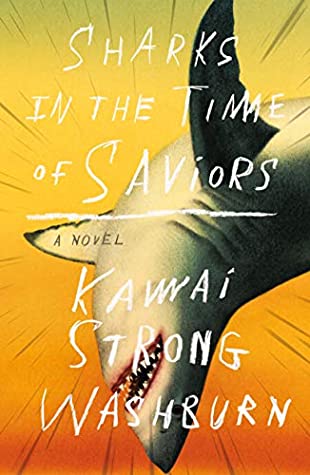
Sharks In the Time of Saviors, by Kawai Strong Washburn*****

A story like this one only comes along once in a rare while, luminous, intimate, and deeply affecting. My great thanks go to NetGalley and also Farrar, Strauss and Giroux for the review copy. This book is available to the public, and you should get it and read it.

Initially I was drawn to this book for several fairly superficial reasons. The cover is certainly arresting; the title is perplexing. But the biggest draw for me was that it was set in Hawaii, and all of the characters are native Hawaiians. In my corner of the world, the Pacific Northwest, there are a lot of Pacific Islanders. Why anyone would leave such an idyllic climate for the dark, soggy winters we see here used to be a mystery to me, but ultimately, people follow the jobs, and so many Seattle residents come from there.

As a history teacher, I’ve always felt that my students deserve to be included in the curriculum, and so in addition to teaching about Caucasians during whatever time period we’re examining, I work in African-Americans, Latinx, Native peoples, and a variety of Asian ethnicities, but time and again I hit a wall when I tried to find something for my Islander students. And when I’ve taught literature, it’s been the same struggle. Islander kids get shut out every time.  And so now I am retired, and here’s my appeal to other educators out there. Put this book in your classroom.

For the rest of you: apologies. Let’s get on with it.

As we open, the setting is Hawaii in 1995, and the protagonists are two parents and three children, all members of the Flores family. They’re on vacation when seven year old Noa falls into the ocean where sharks are circulating. But instead of devouring the boy, one of the sharks delivers him back to his family, carrying him gently in its jaws, “Like you were made of glass, like you were its child.” The first chapter is told in the second person, with Malia, the mother, recalling the event, speaking to Noa. She tells him, “The gods were hungry for change, and you were that change.” It’s obviously a miracle, and others see it happen also. Their lives will never be the same.

As the story continues, we hear from all of the family members. At first, Noa appears to be gifted with a magical healing ability, but he is still a child, and the demands on him are grueling, exhausting. But this is not the only change his magical abilities produce. Noa is the youngest child in the family, but now the siblings’ hierarchy is completely flipped, and the resentment felt by his brother and sister is dreadful. At one point Kaui, who is academically talented, fumes that she is “just his shadow, shaped like a sister.”  And his brother Dean, who is an athlete, explains:

You’re out at breakfast without him, eating cereal and joking with Mom and Dad, Kaui coming in, and you get them all laughing and smiling, just because of you. But then Noa shows up right, and suddenly it’s all questions about what’s happening with his day and did he sleep okay and here’s some thoughts about which extracurricular program he should enroll in…Hard not for get angry at that. I felt it like a fist flexing inside my own chest.

To make matters even more fraught, there’s an economic downturn that makes it impossible for the parents to support the family. They begin charging people that come to be healed by Noa, and so the youngest child is not only the golden favorite because of his miraculous ability; he’s also the family breadwinner. And again: it’s an awful lot to put on the shoulders of one small child.

The dialect combines with the authorial voice to create characters that I swear I would know if I ran into them, and in many ways, they remind me of the adolescents that I taught. Because I was so unconscionably late here, I checked out the audio version at Seattle Bibliocommons, and I have never heard an audiobook I loved more. The voice actors are so convincing that I can hear them now, more than a month and several other audiobooks, after I finished it.

For me, that would be enough. Create visceral enough characters and I don’t even care much about the plot. But the plot is also gobsmackingly brilliant! I believed I could track where it was headed up until perhaps the 60% mark, and then there’s one surprise turn, and another, and another, till at the end I was simply sitting with my mouth open and my eyes on the text as the audio gave way to the afterword and credits. I had to remind myself to breathe.

This is one of those rare galleys that I could see reading again just for the love of it. This review is my 923rd for NetGalley, and I have chosen to reread fewer than 10 of them, so let that indicate the measure of esteem in which I hold this novel.

The Ghost Orchid, by Jonathan Kellerman****-*****

4.5 stars rounded upward. My thanks go to Random House Ballantine and NetGalley for the review copy. This book will be available to the public February 6, 2024.

The Ghost Orchid marks the thirty-ninth entry in the Alex Delaware series, one of the longest series in publication. It’s easy to see why it’s lasted so long. The protagonist and side characters are engaging, and the dialogue never loses its sparkle.  In this one, Alex has been recovering from a savage beating that he took at the hands of the murderer in our last mystery. Milo, his BFF, is a homicide cop who often hires him to assist the LAPD with cases where a psychologist is needed, but now Milo is so mired in guilt that he can hardly look at his friend. Finally, with a nudge from Delaware’s longtime (and slightly boring) girlfriend, Milo includes him in another case, and we find snappy dialogue that never fails to entertain.

This time it’s a double homicide in Bel Air. The man and woman are found by the pool, naked and dead. The investigation reveals that he is the son of a mega rich European shoe magnate; she is the wife of another rich man, a young, socially awkward member of the ruling elite who isn’t pleased to learn what his wife has been doing when he’s away on business. But then we learn that she was using an assumed name, and so the whole thing is even more mysterious. Who is this dead woman, and who killed her?

At the same time, Alex is engaged to interview a child in his early teens whose adoptive parents have decided to bail. They are divorcing; neither of them wants the kid.

The main storyline is a lot of fun. Everyone enjoys seeing the super-rich suffer. With wealth of this magnitude, there’s no chance any of Kellerman’s readers will identify with the male murder victim or the husband of the female victim, either. The way it’s resolved is believable, and it’s done without any of the prurient or kinky sex that Kellerman inexplicably included for a handful of books in this series a few years back. The half star is withheld from my rating because the other storyline, the one about the teenager, sort of fizzles without going anywhere, and it’s hard to see why he included it in the first place. Kellerman’s career, and this series, were originally launched around crimes where kids were involved, often as witnesses, and those initial books are fascinating. I’d love to see the author return to his roots, write some more episodes that incorporate his credentials and experience in child psychology.

You can read it as a stand alone novel if you choose, but you’ll want to read the others afterward.

Nevertheless, if you are looking for a fast, fun whodunit, this book is a hard one to beat. I highly recommend it to those that love the genre.

Martyr! by Kaveh Akbar

“’Do you worry about becoming a cliché? ‘

“’How do you mean?’

“’Another death-obsessed Iranian man?’”

My thanks go to Doubleday and NetGalley for the invitation to read and review this singular debut novel. This book is for sale now.

Our protagonist is Cyrus, an Iranian immigrant who comes to live in the U.S. as an infant. He is raised by his father, Ali; his mother’s plane was shot down shortly after Cyrus was born, an accident on the part of the U.S. military. His father dies suddenly while he is away at college, leaving him rootless. He spends a lot of time anguishing over death, wondering what is worth dying for. He doesn’t want to waste his “one good death.” Later, he points out that “If I died trying to kill a genocidal dictator tomorrow, the news wouldn’t say a leftist American made a measured and principled sacrifice for the good of his species. The news would say an Iranian terrorist attempted a state assassination. “

And you know that he’s right.

The thing that attracted me to this story is its difference from everything else that I have read. Persians almost never show up in American novels, and when they do, the Persian is the other, the bad or weird person, pretty much like the quote above suggests. So I was all in.

However, I have to say that the amount of angsty inner dialogue makes this a slooow read in places. There is also dialogue between Cyrus and friends, but most of it basically the same thing with a different format. I was primed for humor, since that’s how the book is being promoted, but didn’t find much of it.

The story wakes up a bit when Cyrus leaves Indiana for New York, but the writing remains inconsistent, and the transitions are sometimes a bit ragged.

The revelation about his mother, which occurs toward the end of the story, is startling, and I didn’t see it coming, but it also presents a credibility issue; I won’t go into details here, because it would be a spoiler. Still, apart from this one reservation, the ending is nicely rendered.

Akbar is an interesting writer, and I look forward to seeing what he writes next.

Unnatural Death, by Patricia Cornwell*****

Unnatural Death is the twenty-seventh installment in the Kay Scarpetta series by Patricia Cornwell, and it’s as good as they get. My thanks go to NetGalley and Grand Central Publishing for the review copy. You can get it now.

For those not conversant with the series, Scarpetta is a medical examiner for the state of Virginia. She’s moved around over the course of the series, decamped to Boston, and come back. So now she’s in her old stomping grounds, but all is not well. The obnoxious, obstructive secretary she was saddled with in the last book, a miserable woman that blamed her for the ouster of the corrupt man that came before, has been—finally—fired, but somehow, she is back in a different government position in the same building, along with the corrupt guy she likes working with, so it’s tense.

Our other permanent characters are Pete Marino, who’s worked with Kay forever and is now married to her sister, Dorothy, who’s a hot mess; Benton Wesley, Kay’s enigmatic husband, a forensic psychologist that works in extremely high level situations that he can’t tell Kay about, even when they have a bearing on her life; and Lucy, her adult niece whom she has raised as her own, and who is the daughter of Dorothy. Lucy is a wunderkind, a tech wizard employed by the FBI, sometimes on loan to the CIA.

I won’t go into the premise for this installment because you can get that in the promotional blurb, but I will tell you that by the ten percent mark I was riveted, and before the halfway point my notes say, “I hate being away from this thing.” A shocking development occurs that is much more impactful to those of us that have followed the series from the start. I have heard other reviewers say that they used to read the series, then lost the habit, so I will say this: if you have read most of the series but missed a book here or there, you can still get the full measure of this thriller. If you just missed the most recent one, that’s okay. But if you go into this book cold, your very first time reading a Scarpetta book, some of the magic will be missing. Perhaps you will read it and be impressed enough to go back and binge read the whole series. It’s not a bad idea!

Any author that writes a long running, successful series like this has to flesh out the main characters to keep readers’ attention. For the first few books, pure plot-based adrenaline rushes are possible, but at some point, there’s going to be a credibility issue continuing that way. I would have difficulty believing that a forensic coroner had been kidnapped by bad guys and hurled into the back of a vehicle, bound and gagged, even once, but when it happens over and over, I’m done and I’m done. Cornwell does the smart thing instead, developing crises that are sometimes more about others in Kay’s family, but that nevertheless spill over onto her in a big way. In doing this, she forces us to examine questions that have no easy answers. For example, if an extremely dangerous development comes up that could affect you or your family, but it is also a matter of national security, and one family member knows, should they break the vows of their office in order to let you or other family members know? Or should they keep it ambiguous, along the lines of, “Maybe you should stay home today?” What if two know, and you don’t?

One way or the other, this story is a wild ride. The tension is occasionally broken up by Marino’s fixation on Bigfoot. He’s obsessed, and it cracks me up when we’re worried about killer drones and enemies unseen, and then Marino pipes up about the big ole footprint he found in the woods. For quite awhile I have wondered why Cornwell hasn’t been made a Grand Master by the Mystery Writers of America. Hopefully, this outstanding novel will serve as a clarion call. Highly recommended.

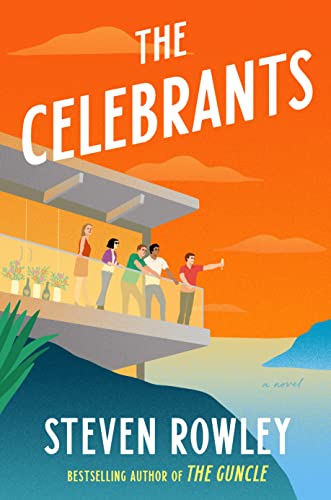
The Celebrants, by Stephen Rowley***

I enjoyed Rowley’s novel, The Guncle, which came out in 2019. When I was invited to read and review The Celebrants, I jumped at the chance. Unfortunately, it didn’t do a thing for me. Nonetheless, my thanks go to Net Galley and Putnam Books for the review copy. This book is for sale now.

As a child, we once had a bird bludgeon itself to death on our sliding glass door, unable to accept that the invisible barrier was really there. Reading this book made me feel just a bit like that bird. I’d liked Rowley’s last book. Other Rowley fans liked this book. So why…(BAM!)…why…(BAM!)…why could I not get into it?

I think it all boils down to privilege.

Had I read the premise more carefully, I might have avoided this trap. A group of seven college friends, grief-stricken after losing the eighth friend, agree to meet every few years and give each other mock funerals to celebrate the lives that still exist among them.

What rarefied conditions must exist to make such a thing possible? Imagine having the resources to be able to drop everything and fly off to wherever the meeting is held. Air fare. Childcare. Housing. But as I read the abundant dialogue in this thing, such trivialities are seldom mentioned. These are people that for the most part came from money, and they have money now, and they assume they will have as much, if not more, in the future.

Of course, the story is not about money and privilege. It’s about taking stock of their current lives and comparing them to their youthful expectations. There are secrets. There is baggage. And now, in their middle aged years, they are older, wiser, and in many ways, sadder.

Oh honey. They think they’re old now? My ass!  My children are middle aged. Get a fucking grip.

So okay, I am probably not the ideal audience; and yet, I will remind you that I didn’t volunteer for this. I was selected. Someone clearly believed that I am within the target audience.

I initially felt some of this when I began reading The Guncle. The protagonist there was a successful actor with a pile of money; and yet, the challenges he faced, first with the death of his partner, and then with the homophobic relative that tried to keep him from taking the children that had been entrusted to him, won out. The presence of well-written children helped a good deal, and the humor was completely on point. I cannot fail to appreciate an author that can make me laugh out loud.

I didn’t laugh out loud this time.  It’s grim, but it’s wealthy-people grim, not working class grim. If you don’t know the difference, then we all know which one you are.  I rolled my eyes a great deal, but it’s even harder to read when you do that, so I borrowed the audio from Seattle Bibliocommons. It didn’t help a bit, apart from making it possible to take in the book and roll my eyes at the same time.

I see that this title has been nominated for the Goodreads Choice awards, so clearly, a lot of people have loved this book. But I am not one of them.

Recommended to rich people that believe their lives to be harder than they actually are.

The Golem of Brooklyn, by Adam Mansbach*****

Len Bronstein is an art teacher. He has a whole lot of clay he’s filched from his employer’s supply closet, and now he’s stoned. He should make something. He should make a Golem. And friend, that’s just what he does.

Traditionally, The Golem is made by a rabbi to help the Jewish people during difficult times. Len isn’t a rabbi, and he doesn’t expect much from his creation:

Five minutes passed, and nothing happened. Len reminded himself that he didn’t actually expect anything to…he didn’t believe in any of this shit. He stood, dusted himself off, and went inside to grab a beer…Len deposited his beer in the sink just as The Golem ripped his back door off the hinges and flung it aside.

My thanks go to Net Galley and Random House Ballantine for the invitation to read and review. This book is for sale now.

Now that The Golem has awakened, he needs to know what his target is. His answer comes to him as he views the news on Len’s television. White Supremacists are railing about a Jewish conspiracy; the Holocaust, they say, was a hoax. The Golem was asleep during the Holocaust, but once it’s explained to him, he’s ready to get busy. But first, he must talk to the rabbi.

Our second main character is a woman named Miriam, Miri to you and me. She works at the bodega down the street, and Len recruits her to be a translator; The Golem, you see, only speaks Yiddish, and Len doesn’t. Miri has been drummed out of the temple because she is a lesbian, but The Golem likes her just fine. Before you know it, Len, Miriam and The Golem are on a road trip beyond all others, first to find a way in to see the Sassov Grand Rebbe, a wealthy and powerful man with a great many gatekeepers, and then to a scheduled White Pride rally down south.

This is, as may be obvious by now, very edgy humor. There’s a great deal of profanity, and whereas most of it is hilarious, at the beginning, the author could have varied his choices more. There are lots of cuss words out there, and not all of them begin with F. But this is a small matter. This novel’s action is interspersed with brief passages of Jewish history that I find very interesting, and they are so brief, and so skillfully woven into the narrative, that you may not notice that you’re learning some things.

My favorite passages involve a bombastic politician, and multiple encounters with cops. (The Golem doesn’t care for them.) As for me, I have read several very funny novels this year, but none made me laugh out loud as often as this one. And in the end–well, you don’t expect me to tell you how this ends, now do you?

Highly recommended to readers that lean left and can tolerate profanity.

Bright Lights, Big Christmas, by Mary Kay Andrews****

I tend to avoid heartwarming holiday stories and romances because so many of them are infused with saccharine and require the reader to put their I.Q. in a box until the book is over. But two years ago, I was happily impressed with Mary Kay Andrews’ The Santa Suit, and so when I was invited to read and review Bright Lights, Big Christmas, I happily agreed. My thanks go to Net Galley, St. Martin’s Press, and Macmillan Audio for the review copies. This book is for sale now.

The Tolliver Christmas tree farm is an institution, not only at home in North Carolina but as far north as New York City. As a child, Kerry sometimes accompanied her family to New York to set up a tree stand and sell the trees, but as an adult, she’s had other priorities. This year, though, she finds herself unexpectedly jobless, while at the same time, her father’s health prevents him from executing the task. Kerry must take his place, traveling to the Big Apple with her brother, Murphy. They set up the stand, and they sleep in the ancient pink trailer nicknamed “Spammy” because of its resemblance to a canned ham. Adventure awaits.

Kerry’s love interest pops up before we’re even ten percent into the story, but it appears that the author planned for us to know that, and it doesn’t hurt anything. Over the weeks they are in New York, various small (and large) crises present themselves and are worked out with team work, ingenuity, and the occasional well-placed bribe. They have Murphy’s dog Queenie with them, but she is primarily left in the background where she belongs.

What I appreciate most about this novel is how well grounded the plot is, and the author’s restraint in not permitting any elements to go over the top. There are a host of stereotypes possible, but every time I see one coming, Andrews chooses a different path, and it keeps the story fresh and original. Small details that might be overlooked by someone less detail oriented are seen to, and it keeps the narrative credible. Examples are the need for a shower or bath, given the length of their stay in a trailer without working plumbing; the cost of living in New York; the hazards of theft and vandalism, especially active at Christmas. None of these sidetracks the plot or slows the pace, but the questions a reader might have are tidied away, and this makes for greater enjoyment.

One small criticism involves a situation where theft and vandalism occur at a time when Murphy has to be away, and immediately, other men folk clamor over the need to have someone—someone with a Y chromosome, folks—to do lookout duty, protecting the fair damsel, her trees, and so on.

Apart from that, this is a delightful story. However, for awhile I wasn’t sure I liked it, because I was listening to the audio version, which is poorly done. The male characters are voiced in a way that is choppy, wooden, and unconvincing; but worse is Kerry’s voice, which is performed in a high-pitched, girly-girl voice so off-putting that it took me awhile to realize that the problem wasn’t the author’s, but rather the voice actor’s. The children’s voices are much better, and I actually howled with laughter when the baby in a stroller wailed!

As the story reaches its climax, Kerry has to make some serious choices, and I admire the way this part is resolved. The side character Heinz, an elderly man that lives in the neighborhood and often stops by the tree stand, is terrific.

When all is said and done, I rate the printed version of this novel 4+ stars, and the audio version 3+ stars, with an overall score of 4. I recommend the print version of this book, but not the audio.