Doc Doc Zeus, by Thomas Keech***

DocDocZeusThank you to Net Galley, the author, and Real Nice Books for the DRC, which I read free and early in exchange for this honest review. This novel was published earlier this month and is for sale now.

Doc Doc Zeus is a tough one to review. There are strengths that drew me at the outset and I thought I was going to love it; unfortunately, the literary aspects and a blind spot or two regarding women and rape have kept me from cheering and promoting the way I expected.

Conceptually, it’s innovative and gutsy. We have Diane, who at 14 has been manipulated by a conservative Christian group and agrees to carry a baby rather than have an abortion.

Diane’s physician is Dr. Zeus, and he is being paid by the church that is housing Diane. Diane is thrilled because she is made to feel heroic, special, for deciding not to end the pregnancy. At age 14, she is right in the throes of the all-about-me stage of adolescence, and this is the strongest part of Diane’s development as a character. Of course, once the baby is born and sent off to live with adoptive parents, Diane is no longer being spoiled and petted, and so she is in a vulnerable place. Her parents are not as available as they might be, so she is isolated, and makes an excellent target for a guy like Zeus.

Zeus is pond scum, a serial rapist, a liar and a thief. He conspires to direct his hospital’s lab business through an intermediary company he owns for no purpose other than to drive up costs and line his own wallet. The guy is so toxic and free of any redeeming qualities that I couldn’t read this story for very long at a time; there are other reasons, too. I’ll get to them in a minute.

Our third main character is Dave, who works for the state’s medical board. Dave is frustrated by the lack of interest on the part of the state in pursuing Zeus legally. Why is this guy allowed to practice? There’s plenty of documentation to show that he should not only be stripped of his license, but be behind bars. Why can’t this happen?

The best part of the book is the opening, not to mention the quirky, engaging title. When we begin, the narratives by Diane and by Zeus make me alternately laugh out loud and groan. It’s dry humor, savagely funny. I want it to stay that way.

Sadly, by the thirty percent mark, I am starting to wonder whether a high profile editor might be needed to assist with the literary aspects of this thing. The last time I saw this sort of problem was also with an author that had a lot of technical expertise and a lengthy, successful career in an area that dovetailed with his novel; Keech is retired from a state attorney general’s office. He has plenty of knowledge regarding state bureaucracy as it applies to physicians, but the elements a novel requires—character development and above all a story arc, with the action and urgency rising around the 75 or 80 percent mark and then falling back toward a conclusion, are simply not present. Our hero, Dave, is trying valiantly to shut Zeus down, but readers won’t engage with the amount of bureaucratic detail here. This area needs to be condensed, and Dave needs development as a character. The setting is nearly absent.

The other problem here is a certain tone-deafness regarding the book’s audience. Potentially, this story could be a rallying cry for women that have experienced rape and for anyone that has been molested as a child or when they were vulnerable. There are so many out there.

But for these readers, this is a hot-stove issue. Less is more. This reviewer has not even been there, and yet the level of detailed sexual predation in this book is painful to me, and unnecessarily so. Chapter after chapter; page after page. Most people that would otherwise champion a novel like this one, won’t finish it because it’s too hard to read. The crime itself should wink in briefly, decisively and memorably, and then the story should be built around it.

I would also change the ending.

To be sure, I am convinced that Keech is on the side of the angels, and I would bet my last dollar that he has seen or heard of a situation similar to the one in this story. I suspect that he’s a good man who is transitioning from his career in state government to a career as a novelist, and trying to use fiction to make a difference. For this reason also, I wanted to be able to promote this book and send out a Twitter storm telling people to read it. I avoided writing this review, because it isn’t the one I had hoped to write.

With a great deal of TLC, this story could be rewritten in a way that would work. The idea is strong, but the execution is lacking. A high profile editor might be very useful here, and if that happens and a rewrite significantly improves this work, I would be willing to reread and review again. But as it stands, I cannot recommend it.
The Locals, by Jonathan Dee*****

theLocalsDee’s new novel has created a lot of buzz. Despite impressive list of publications and accomplishments, he had slid under my radar until now; thanks to Net Galley and Random House, I read this free and early in exchange for this honest review. It is available to the public Tuesday, August 8, and those that love strong, purposeful fiction should get it and read it.
The Locals is entertaining, and it also conveys a sharply driven message, one that is timely, as we see the middle classes wasting away in Western nations that were once strong and relatively democratic, the most affluent becoming richer, and tens of thousands of homeless living in cardboard shacks and tents beneath the freeways of otherwise-successful American cities.

The story starts with 9/11. Mark Firth is in Manhattan on business and is taken advantage of by a con artist. By contrast, Howland, the small (and fictional) town where he lives and in which our story is set, seems safer, and more benign. He breathes easier when he is home.

He isn’t the only one that feels that way.

Philip Hadi decides to leave the big city, and he hires Mark to fortify his summer home into a secure summer residence. From there things unfold, and Hadi takes on increasing amounts of responsibility and power in Howland.

The story is largely character driven, and I dare you to find a novel in which a large number of townspeople are better developed than these. At the outset, I think I know which are the better citizens of Howland and which are its pond scum, but as the story progresses—told in third person omniscient, with one noteworthy exception—the most lovable characters darken, while those that seem irredeemable at the outset show some vulnerability and decency. Even without the novel’s purpose, which is brainy and clever as hell, it would be a good read. I particularly credit male authors that can develop female characters with this kind of depth. You don’t see it often.

Ultimately, however, we are forced to examine, through the eyes of the people of Howland, the role of the super-rich. How much authority are we willing to cede in exchange for easy material benefit? Teachers that have questioned the authority given philanthropists that have a lot of dollars to throw around, but no background whatsoever in education, will particularly appreciate this story. Beyond all of this, it’s absorbing, entertaining, and in places it’s funny as hell.

Highly recommended to those that love strong fiction.

Hook’s Tale, by John Leonard Pielmeier***

HooksTalePielmeier’s debut novel gives poor, maligned Captain Hook an opportunity to share his side of the story. The teaser promises a “rollicking” story, and at first it seems to be exactly that, but it runs out of steam early on. Nevertheless, thank you, Net Galley and Scribner, for the opportunity to read and review.

At the outset, Captain James Cook (his name isn’t Hook!), named for the famous sea explorer, describes himself as looking nothing like the “unbearably pompous actor”, a clear reference to the hilarious Cyril Ritchard, who played Hook in the twentieth century complete with high heeled boots and a beauty mark; however, our pirate assures us, those periwinkle blue eyes do fit the bill. There is an assumption that the reader is well steeped in both the stage and cinematic depictions of the character, and it seems like a fair one. I love reading Hook’s fond and hugely original description of Smee, and our introduction to Hook’s pet crocodile.

“I named it Daisy, after my mother.”

Unfortunately, somewhere between the ten percent and twenty percent mark, the narrative founders, and the most frustrating part for this reviewer is that it’s hard to pinpoint exactly what goes wrong. The concept is strong, the voice clear, and yet my interest is gone before the quarter-mark is reached, and at that point I am reading for duty rather than pleasure. I came away with two considerations.

The first is the linear quality of the prose. The formal, old-school language is fun at the outset, but it might be more powerful if alternated with a present day narrative. Hook could have a grandson or other present-day relative that contributes; since Hook marries Tiger Lily, that might be a way to get there. Readers of the digital era may not have the patience to read the rather Victorian-sounding dialect all the way through. An alternating narrative would probably pick up the pace and make for a more compelling arc.

The second consideration is audience. There are two characteristics here that suggest completely different types of reader, and they don’t overlap very well, which may make for a small readership. We have the Boomers and those that came right after them, folks that may have seen the Cyril Ritchard version of Captain Hook on television. It was a childhood favorite of this reviewer, and you can watch the entire thing here:

https://www.youtube.com/watch?v=r6K2M…

The assumed knowledge and detailed descriptions jibe with this audience. But then there is the other sort of detail, the gore and guts that are more suited to a young reader, perhaps one in his early teens. Older readers may wince at the graphic gore here, decapitations and intestines and fountains of blood—I certainly did—but younger readers that are more likely to love it are unlikely to tolerate the formal prose style adopted. It’s hard to tell whether the writer had a particular audience in mind, but if so he shot wide of the mark.

Another possibility is that the story really is better as a visual medium. Reading about people flying is not as enjoyable as seeing them do it, and I say this as a person that prefers the printed word over film almost always. J.M. Barrie’s work itself is difficult to plow through, and also racist as hell; the story took wing on stage and screen. In addition, the stage version was the first time an actor had been hooked to cables and “flew” in front of a live audience; what seems like corny, ancient technology now, was new and exciting then.

All of this notwithstanding, you may love this book. It was released July 18, and is for sale now.

The Shipshape Miracle and Other Stories, by Clifford D. Simak*****

TheShipshapeMiracleThis is volume 10 of a complete collection of the writings of Clifford D. Simak, who won 3 Nebula awards, 1 Hugo Award, and was the third Grand Master of the Science Fiction and Fantasy Writers of America in 1977. It’s my sixth volume of Simak’s stories, and it’s my favorite so far, which is saying a good deal. Thanks go to Net Galley, Open Road Media, and David W. Wixon, whose brief, useful notes set context for each of these stories. Wixon and Open Road have republished Simak’s work digitally for new generations to enjoy; I received a DRC in exchange for this honest review.
For those new to Simak’s work, here’s a thumbnail sketch. He began writing in the 1930’s, submitting short stories to various magazines, and continued writing stories and novels into the early 1980’s. He wrote a few war stories during the mid-1940’s, then continued writing Westerns and science fiction. Both of these genres make it into this volume, and although when I began reading Simak, I questioned the choice to foist annoying cowboy stories on sci fi readers, I came to see that it’s not easy to tease them apart in every case. One of my favorite stories here, “Rim of the Deep”, is about a journalist named Grant who is given the dreaded assignment of chasing a story in an undersea city. Once he is down there, it becomes a tongue-in-cheek underwater cowboy story:

“‘You think there’s a gang of robbers down in that deep?’ asked Grant.
‘That’s the only place they could be,’ said Gus. ‘It’s bad country and hard to get around in. Lots of caves and a couple of canyons that run down to the Big Deep. Dozens of places where a gang could hide.’
Gus sipped gustily at the coffee. ‘It used to be right peaceable down here,’ he mourned. ‘A man could find him a bed of clams and post the place and know it was his. Nobody would touch it. Or you could stake out a radium workings and know that your stakes wouldn’t be pulled up…But it ain’t that way no more. There’s been a lot of claim jumping and clam beds have been robbed. We kind of figure we’ll have to put a stop to it.'”

The story is chock full of whimsy, and includes a pet octopus named Butch that bounds after them like a dog and occasionally does something heroic. I love it.

And this is the thing I love about old-school science fiction in general and Simak in particular: the reader doesn’t need a technical background to read and enjoy these stories. There are no jokes that only a programmer can understand; Simak writes fiction and writes it well, and so we liberal arts types can sit back and enjoy the stories.

In addition, the period in which the writing was done actually adds to the whimsy. For example, another favorite in this collection, “How-2”, is about a man that orders a kit to make himself a mechanical pet dog and inadvertently ends up with a very valuable robot instead. I won’t give the rest of the story away other than to tell you it’s hilarious, and I can’t imagine the author wrote it without laughing himself silly, but there’s also the unintentional hilarity of having a robot that can do almost anything imaginable, asking for a paper and pencil so that he can make a list of the things the protagonist desires. A pencil! I love it.

The collection contains 9 stories. One is a straight Western that I started and then gave myself permission to skip. That’s okay, though; the other 8 stories make this tasty collection worth the purchase price. (One story, “Paradise”, is a sequel to the story “Desertion”, which is included in an earlier collection, and if possible you should read it first.) I would not have named the collection for the story Wixon chose, but it’s also a strong story; it’s just a matter of taste. I happened to love at least 3 of these others more.

Finally, the reader should know two things: first, Simak was a creature of his time. Although he is more progressive than most writers of the mid-20th century, there are a couple of baldly sexist moments. This reviewer grew up watching reruns of television shows and movies produced in the 1950’s, and to hate Simak’s work, one would also have to hate every stinking one of those productions also. However, in the brief philosophical metaphors and other indirect allusions, Simak shows himself to have been unusually progressive where civil rights were concerned. Again, such references are oblique, since most of the featured characters aren’t actually even human.

The other thing the reader should know is that these collections are only available digitally. They’re ridiculously cheap, so those that love great old-school science fiction should order this collection and read it. Those that want it on paper will have to hunt up some used books most likely, and they will be either single stories or different groups within a given volume.

This collection is strongly recommended for all that love excellent science fiction.

Holding, by Graham Norton*****

holdingIrish novelists are rocking the publishing world this year, and Norton’s debut novel is among the best of them. My great thanks go to Net Galley and Atria Books, who provided me a free and early read in exchange for this honest review. You should get it and read it. Atria will release it August 1, 2017.

Our protagonist is Sergeant PJ Collins; the setting is the tiny Irish town of Duneen. PJ is ecstatic when a corpse is uncovered at a local construction site. At last, something noteworthy has occurred in his sleepy village, and he can’t wait to tell everybody. He starts with his housekeeper, Mrs. Meany:

“I’m after finding a body.”
“You what?”
“A human body!”
He had waited his whole life to utter those words, and it felt as good as he had always imagined.
“God spare us!” Mrs. Meany gasped.

The villagers are convinced this is the body of Tommy Burke, a man loved ardently by two local women. Evelyn has never married; she and her two sisters still live in the family manse in which they were raised. Is Evelyn bat-shit crazy, as some people suggest, or is she merely frustrated and lonely?

Brid also loved Tommy. They were to be married, but he upped and disappeared just before the wedding. She is currently locked in a joyless union; she and her husband remain together for the sake of the children and the farm. It isn’t easy.

And then there’s our protagonist, PJ, who is graying at the temples, never having known love. He hasn’t even had a girlfriend. He went on a date, once, and the girl guffawed when he wasn’t able to situate his large self into a theater seat to view the movie. That was enough for him. He’s married to his work, and she’s a lonely mistress. At the end of the day there’s only Mrs. Meany, his aging housekeeper, and she will have to retire, sooner or later.

But things are about to change.

UK readers may have been drawn to this novel by its author, who is also a celebrity and has a television show, but I had never heard of him. I won’t forget him now.

One cautionary note: there’s some sharp, dark humor involving religion that will make this a poor fit for some readers. I loved it, but the devout may not. There’s also a fair bit of bawdy language.

For those that enjoy dark humor, this one is hard to beat. As an added bonus, it is ultimately uplifting, and reminds us that one is never too old to find love in this world.

Summertime, and the Reading is Easy

On my radar for July and August:

The Accomplished Guest, by Ann Beattie*****

theaccomplishedguest Ann Beattie is a seasoned writer with a list of accolades as long as your arm, and this is why I requested a DRC of her soon-to-be-published short story collection, whose theme is visitors and travel. I was not disappointed. Thank you Net Galley and Scribner for letting me read it free and early in exchange for this honest review. This book will be available to the public Tuesday, June 13.
The first selection is droll; our protagonist is going to see an older man, and so we wonder…is this a boyfriend? Is it an ex? And as we move down the checklist, I love what she does with it. The next couple of selections are good but not as striking, but then the wind catches in Beattie’s sails and she is unstoppable.  Other favorites here are “Other People’s Birthdays”, “The Debt”, and “The Cloud”. I found myself highlighting most of the text, which is wasted effort, since I can’t quote most of the book to you, but it’s something that happens to me when I read top-drawer fiction. The story I loved best is “The Caterer”, which made me laugh out loud and woke Mr. Computer, who was slumbering next to me and had to get up the next day for work.

Short stories are wonderful bedtime material, because there isn’t the wrenching sensation in tearing oneself loose from the book. When the story is over, it’s time to bookmark one’s place and turn out the light. I’ve read over a hundred short story collections, and this one is among the best.

Highly recommended to those that love excellent prose, and in particular to Boomers.

We Are Never Meeting in Real Life, by Samantha Irby*****

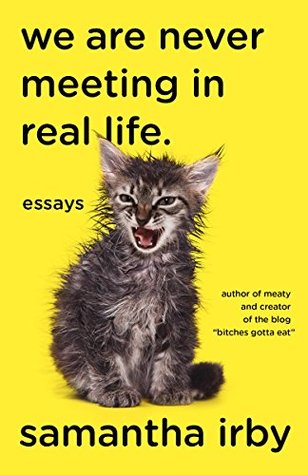
wearenevermeetingGet out your plastic and go use the restroom, because this book will leave you holding your sides. Samantha Irby mines what ought to be old material but isn’t, at least not by the time she is done with it, and her edgy, plain-truth humor may leave you breathless by the time the last page is turned. My thanks go to Net Galley and Knopf Doubleday for the DRC, which I received free and early in exchange for this honest review. This book has just been released and is available for purchase.
Much of the base level subject matter is eternal and well worn: needing to use the bathroom while stuck in traffic; dating; racism; attempting to lose weight. But Irby has a fresh take on everything. She refers to herself as “old”, and since at 36 she is the age of this blogger’s eldest child, I suspect that I am not her target audience. But so much of what she says is eternal, and her take on current social concerns such as cop violence and the horror of stumbling upon a bunch of white people in the hinterland performing a Civil War reenactment complete with Confederate flags is welcome and resonant. The thread in which she voices the horror of being away from a major urban center is one I share. I have not laughed at potty humor since I was twelve, but the essay containing the traffic jam bathroom emergency on the way home from the dorm made me laugh hard enough to shake the bed, and my husband—a silver-haired Japanese gentleman old enough for Social Security—laughed hard enough that he was doubled over. The passage where she discusses having squandered money on things she doesn’t need just to prove she can do it is just one instance where I laugh because I am surprised. What writer ever admits this? Irby does.

Other aspects of this wonderful collection of essays were more educational than resonant, but also good to read. Can Black women admit they have mental health issues and still be Black?

Her cover model represents the cat from hell, Helen Keller:

“’I know where they keep the euthanasia solution,’ I whispered into the downy fur on top of her head.”

Every book blogger knows the pressured feeling that comes with scooping up a galley right before publication. When I begin the book, all I want is to read it fast so I can review it in a timely manner; yet by the time I turn the final page, I am disappointed that we are done here.

Highly recommended to strong women with an offbeat sense of humor, and those that love them.

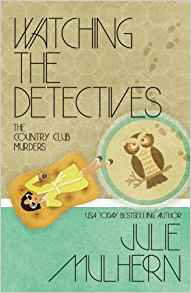
Watching the Detectives, by Julie Mulhern*****

“’There’s been an incident…Mrs. White in the study with a revolver.”

watchingthedetectives
Mulhern is on a roll. This is the fifth book in the Country Club Murders series, but I plunged in without having seen the first four, and it was still a treat. Thank you, thank you to Net Galley and Henery Press for the DRC, which I snagged free and in advance in exchange for this honest review. It is now available to everyone.

The story is set among the Caucasian upper middle class of the 1970s, and Mulhern renders the period—when this reviewer was a mere, blushing wisp of a girl—so well that I checked twice to see whether it was an older title being re-released.

Ellison Russell is our protagonist, and people keep dying at her domicile. It’s become a nuisance, and there’s a cop that thinks it’s too great a coincidence. Ellison’s in a jam, and her thirteen-year-old daughter Grace isn’t helping. She sulks when they are told they must leave the house for a few days because it’s a crime scene, exclaiming that people have died at their house before and they didn’t have to leave. It’s just not fair!

Ellison is a widow, and a merry one at that; she has a flirtation going with a local cop whose name is Anarchy—a guy who believes in rules– but her main man is Mr. Coffee. He’s always there for her.

I moan when Ellison’s mother is introduced—yet one more overbearing mother, I thought, and authors always blame everything on mothers, just like everyone else does—but then I am surprised by where she takes it. I won’t say more lest I ruin it for you. But I will say this: every overused or overworked plot element is here for a reason, either to take it apart, or to make fun of it. Mulhern considers every word in this dandy novel carefully, and the result is splendid.

As the story unfolds there are other witty tidbits tucked in here and there, such as a character named Margaret Hamilton who is such a witch. But the frippery and snarky humor aren’t the whole package; while the mystery is a romp, serving up the snobbery of the petit bourgeoisie with a sharp skewer, this excellent novel is also a nicely turned feminist manifesto. While the mystery is a fine 4-star beach read, the author’s purpose is a strong one that’s delivered well. It is for this aspect that the fifth star is given.
Highly recommended for strong women and those that love them.

The Half-Life of Remorse, by Grant Jarrett*****

TheHalfLifeofRemorseHere is a story for our time. It’s fresh, moving, fall-down-laughing funny in places, and has the best character development I’ve seen lately. I was growing cranky from having to pan other people’s bad books, and I requested this DRC from Net Galley and Sparkpress almost as an afterthought; then it nearly knocked me off my feet with its voice and sheer creative power. It was published last week, and you should get it, read it, and then make other people do the same thing. It’s that strong.

The format is a simple one, and because there’s not a lot of plot or setting, everything boils down to the inner monologues of the three characters here. We start and conclude with a brief narrative in the third person omniscient, and in between we have the staggered monologues of two homeless men and a professional single woman confined to a wheelchair. Sam has blocked out a traumatic past, likely suffering from PTSD and who knows what else. His monologue is a literary sounding one, and indeed, he was once an academic. Now he calls himself a wizard, and at times, we nearly believe him.

The other homeless man calls himself Chick. He is not a young man either, and is running from his own misdeeds, and Sam tells us that Chick “…is a testament to life’s unrelenting desperation to continue.” Chick is not literate, but he manages to communicate brilliantly in his own tumbledown, roughshod, clumsy manner. Every now and then he tries to use a slightly larger vocabulary than he possesses, and ends up referring to “the persecuting attorney” and not wanting to “cast inspersions” upon the characters of others. Though he is thoroughly profane and limited grammatically, in his own way Chick is as eloquent as Sam.

The third character, a less developed but still important one, is Claire. Claire lost the use of her legs when her family was invaded by criminals during her childhood. Both Sam and Chick were there, but at the time, they did not know each other.

Jarrett writes in a way that is wholly original, and the juxtaposition of Sam’s monologue with Chick’s is startling and very funny. Somehow this author manages to slam tragedy and humor right up against one another without diminishing either. Most importantly, he is able to portray both Sam and Chick as men that still have purpose and a personal code of honor despite the horrors they have experienced and the bad choices they have made. Jarrett’s prose is the sort that grabs me by the hair and doesn’t release me until the story is finished. At one point, I found myself lightheaded because I had forgotten to breathe.

This novel is highly recommended to everyone that loves strong fiction.