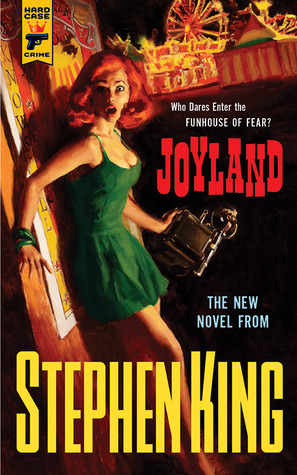
Joyland, by Stephen King *****

joylandHow many Stephen King stories have I read over the decades he’s been writing them? More than ten. A dozen books, maybe, or perhaps more; if we start counting single stories, then certainly more than twenty. And since he has become more sentimental as a writer as he’s grown older, I thought I knew what to expect from this one.
Mind you, I still wanted to read it; even had I guessed its contours, King tells a story with the humanity and every-day realness, despite his chosen genre, unlike anybody else, and so I would not want to miss it.

We have a young man who’s taking a summer job at an amusement park in North Carolina. And we have a past murder on one of its rides, its only “dark” ride. A young woman whose throat was sliced during a brief unlit interlude; she was cast over the side like someone’s leftover lunch sack, and found later.

I was pretty sure at some point all of the rides would come to life and do terrible things.

I was pretty sure the climax would occur on the dark ride, or the place where it was housed.

I was wrong on both counts.

Joyland was a quick read, and a deeply satisfying one. The teaser he wrote to sell his book promised I would consider mortality and be deeply moved, and I can’t say that occurred, but it surely left me thoughtful, as well as grateful that the master of the horror genre is still writing after all these years.

I was able to get a library copy, but would have purchased it if I had to; King is so reliably enjoyable.

If you love stories with supernatural elements and things that go bump in the dark, get this book and read it.

Duma Key, by Stephen King *****

dumakeyThis is half horror story, half love story. For every young person who wants to scream because they think King has lost his edge and doesn’t write as brutally as he did when he was younger, there is a woman out here like me, a member of the boomer generation who likes it this way. The song lyrics and the nostalgia resonate for me like no other writer anywhere. The love that binds members of a family together seem so near and so precious in his hands.

No matter what King writes, it gets placed in the Horror section of bookstores. He says so himself. It’s a given. But the stories he writes, while they almost always (maybe always; I haven’t read everything he has written yet) invoke the supernatural, are not always geared toward horror. Sometimes the supernatural is almost secondary. And in this story, I’d call it fifty-fifty.

To be sure, the climax is one that ought to satisfy any diehard horror fan. But there’s something more, too. And you may never look at the waves of the sea in quite the same way again.

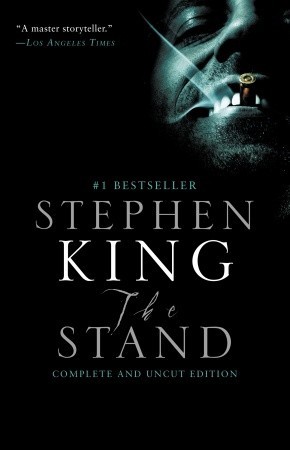
The Stand, by Stephen King *****

thestandOctober spooky stories continue! I am nearing the end of some interesting galleys, but until I have new material to review, I am posting some old and creepy favorites. And who better than Stephen King? If this book were published today, it might get categorized as post-apocalyptic fiction rather than horror (or fantasy; it was nominated for the World Fantasy Award in 1979). By now, it’s legendary. If you haven’t gone there yet, what are you waiting for? It will surely keep you off the streets and out of trouble for quite some time. Here’s my take on it.

In the two part introduction, King tells the reader not to buy the book unless they either have never read it, or wish to reread it with the bits he really thought made the story stronger, but that in his less prominent days had been edited out for marketing reasons. And I thought oh hell yes. I love King’s work, and I trust his judgment.

What I didn’t think about was the copyright date and the fact that I am no longer young. Three quarters of the way through, I went back to the prefaces again to see if I could ascertain what was new here. And it was then that I realized that I had already read this version–only the cover was really new, it’s been out for quite some time–and by then I was so far along, remembered so little of the original plot anyway, that I decided to go ahead and finish it. It’s entirely  worth reading twice.

He refers to it (again in part 2 of the intro)as a “tale of dark Christianity”. And that it is. It’s really well done. If you are a Christian and take the bible quite literally, you may not appreciate the liberties he has taken. From a literary point of view though, this is a beautifully integrated plot. His memoir says that he pretty much just pounds his novels out, start to finish, and given the complexity and number of characters, I can’t believe he didn’t start this one with a flow chart. It boggles the mind.

So without ruining the ending, let me ask you: if hell were going to be in the continental USA, which major city would you choose? Among the major US cities you have visited, which one screams to you of wrongness most clearly?

I think King chose well. When the devil takes a major hit because his prisoner refuses to be impressed and laughs at him, it rings absolutely true.

I have changed my mind many times about which Stephen King novel I love best. This one is definitely a contender.

(A caveat: read it first before you give it to your precocious reader. Some Stephen King books work just fine for the clever 6th or 7th grade mind; personally, I’d save this one for high school, given my preferences for my own family).

Heart-Shaped Box, by Joe Hill *****

In the spirit of October, I am using days when I have no newly released or about to be released books to cover creepy stories with ghosts, demons, or just really creepy people in them. I read Heart-Shaped Box a year ago, and it remains one of my favorite horror titles. It’s is an outstanding piece of work, and it also answers a question I held for a long time.

Okay, so here I start talking about the author’s father, heart-shapedboxSteve King, which is dreadful, because Hill is such a fine writer in his own right, and his style and King’s share nothing but the genre, and the assumption at the core of it, which is what I was idly reaching for, and not finding, for decades. It answers the question as to why I always took King for a good human being, long before his memoir was written. Before this, I would have guessed at his obvious distaste and anger toward domestic violence and objectification of women, for example. But Hill’s narration gives it to us in a nutshell, and he does it in this book:

Sympathy lies at the heart of horror.

Forehead slap! OF COURSE! Why didn’t I get that before now? Even as we read faster, flip those damn pages, we do it because we care about the protagonist, or at least about someone there in the story. We want the very best for them in the midst of all the horror. Ultimately, so does the writer.

As for this novel itself, the pacing and characterizations were splendid, flawless to my eye. I could have done without the brief part played by the snuff film, but one can skim through these parts and come out in time for the build up, climax, and resolution. There is tremendous originality even as the writer also draws upon tradition. Fascinating.

Hill has an edgy writing style, and he has guts. Long may he write!

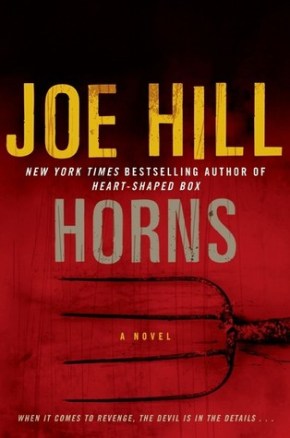
Horns, by Joe Hill ****

hornsjoehillI have to start with three things the reader should know. Then I’ll get on with it.

First, if you are looking for Stephen King II, you won’t find it here. The horror genre is the only thing I can see to connect these two gents, besides DNA. Well, if we’re picky, they both choose New England settings all or most of the time. But this writer does not use his father’s voice or style.

Second, if you have deeply held beliefs that include supernatural events, beings, and/or places, including the possibility of a bad afterlife, you may be offended by this book. He is bold, and puts it right out there in the first few pages. If you’re thinking of buying it and it may or may not push your buttons, read the first chapter before buying, or look at the first few pages online. You’ll know right away. (A taste is in the quote below).

Last but not least, if like me, you have a genuine phobia of snakes, step aside. They didn’t show themselves till the last half of the book, and I was hooked by then. If this book had been out there ten or fifteen years ago, I would have had to give it up because of them, & it would have disappointed me, because the plot is engaging and also because I paid for the book. Once they show up, they show up a lot, in vivid detail. I skimmed where I could during their scenes and read the rest a little quickly, and I got through it without the nightmares that used to plague me.

Okay. So that’s out of the way. I will tell you, I like the guy’s writing. It isn’t seamless, doesn’t mesh fluidly like the finest artists produce; I found a couple of forced elements at the end, and there is a dream sequence that is way too long and that the writer leans on way too hard to explain the list of questions he’s piled up. That said, this is a very fun ride.

The plot feels original to me, perhaps because I have never seen anyone address this subject matter with wry humor. It is cynical yet engaging. Who hasn’t wondered what hell might be like, should it exist? “Hell” is the title of the first section, and we see it immediately. Here’s a sample from page 9, which is really the third page of the story itself. He is looking at a roadside memorial, the type you see along the highway where somewhat met with mortality and their loved ones have been drawn there. It is his sweetheart that has died, and the protagonist is hung over, physically altered (title), and he sees what has been left for his beloved:

“Someone—Merrin’s mother probably—has left a decorative cross with yellow nylon roses stapled to it and a plastic Virgin who smiled with the beatific idiocy of the functionally retarded.

“He couldn’t stand that simpering smile. He couldn’t stand the cross either, planted in the place where Merrin had bled to death from her smashed-in head. A cross with yellow roses. What a fucking thing. It was like an electric chair with floral-print cushions, a bad joke. It bothered him that someone wanted to bring Christ out here. Christ was a year too late to do any good. He hadn’t been anywhere around when Merrin needed Him.”

At some point, the reader must wonder… how much of his thinking is really him, and how much of it has to do with the growths on his head? I won’t tell you, but ultimately, Hill lets us know to some degree.

If there is an echo of any writer, it is that of Michael Chabon, who is quoted twice, once at the beginning of the book, and once later, where he uses a quotation from The Yiddish Policemen’s Union about guilt. (He does not cite the work, only its writer, but I recently read it and recognized it). There is some of Chabon’s playful language and the way that he teases us with the plot, but Hill is his own writer, and it’s just as well, because no one will ever be able to replicate what Chabon does. Were Hill to try, he would find himself kneeling at the feet of the master (Chabon, not the devil, LOL).

I loved this story, warts and all, and suspect that this writer will do some really fine things in the future. As an early literary effort, this is strong.

I should add that because I am not religious at all, nothing here that is said about God or Satan disturbs me; it may be an obstacle to others, but Hill is gutsy and true to himself in his writing, even if it costs him readers. The language is crafted skillfully, and I suspect it will remain so throughout his career.

In an age of virtually unchallenged censorship, it is refreshing to see a man tell his story the way he wants to tell it.