Lucky Us, by Amy Bloom *****

This story is a winner. I defy anyone to read it and not love it! I was fortunate enough to read my copy free of charge from Net Galley, but sooner or later I will have to pony up and pay for Bloom’s work, because having read this little gem, I will follow her anywhere.

The setting is the Depression Era through the end of the second world war; the story takes place all over the United States, from the midwest to California to New York. The protagonist, Eve, and her sister, Iris are girls (and then women) who are what social workers euphemistically call people who have fallen through the safety net–not that much of one existed back then. Their father and Evie’s mother are almost more liabilities than assets, and from almost the get go, they are on their own.

A large cast of secondary but engaging characters weaves its way through the sisters’ adventures, but each is so believable, so palpable that there is never the slightest danger that the reader will mix one up with another, anymore than you might inadvertently mix up your own family and friends. These flawed but fascinating characters often do things that startle us, leave one’s jaw hanging (“Oh no, you DIDN’T just do that!) yet their behaviors are always consistent with what they have said and done before. Just as with a ne’er-do-well relative, I found myself sometimes grimly nodding and saying, “You know, it doesn’t surprise me a bit.”

Eve and Iris see others betray them and commit every possible venial sin and perhaps a few mortal ones into the bargain, and indeed, they themselves become charlatans, thieves, snake oil salesmen (of a sort) in order to survive. All of this is depicted with such a winning narrative, changing perspectives and yet never the overall truth.

In most circumstances, Eve is set apart in her effort, when possible, to do the right thing, and by her loyalty to those she loves best.

Ultimately of course, it is not the storyline or the setting that sets this story apart from whatever other fiction has recently been released. It is the voice, Bloom’s sassy, ironic, and sometimes devilishly understated narrative that hooks the reader, leaves us unable to let go till the last page is turned.

Bloom is an award winner for other work, and it wouldn’t surprise me at all if she receives another for this. If I were to compare her work with anyone’s, it would be Fannie Flagg, because of the character development and the whimsy.

In the end,I realized she does not mean the title to be entirely ironic. We are indeed lucky to have even flawed and difficult people in our lives. Loneliness is the ultimate cause of sorrow. Bloom convinced me that I am lucky too. What a wonderful message, and from a truly gifted writer! I can’t wait to read the rest of her work.
 

Tara Revisited: Women, War, and the Plantation Legend by Catherine Clinton *****

 tararevisited First of all, if you are planning to visit Georgia with your family, don’t ask the tourist bureau to help you find Tara! It isn’t there. Neither is Scarlett or Mammy. They’re all fictional.

Thank you; I feel much better having cleared the air. But nobody can make it clearer than author Catherine Clinton, who bursts the myth of the antebellum belle and her loyal house-slaves better with greater heat and light than I have ever seen done by any one historian before. In a time of increasing apology and revisionism that makes the American Civil War seem to have been merely a dreadful misunderstanding, and that decreases the social and material weight of the slaves it freed, Clinton’s historical smack back to reality makes me want to stand up and cheer! And also to thank Net Galley and Abbeville Press for the ARC.

Clinton focuses primarily on Southern women, but she takes just about all of the myths of the “Lost Cause” and puts them through the shredder, introducing them and their origins, and in a manner meticulous but never, ever dull, demonstrates why each of them is incorrect. She doesn’t pussyfoot or hesitate to call bigotry by its name, but the tone is of the compelling storyteller rather than that of the lecturer. In a day when Caucasian Americans sometimes carelessly discard the complaints of people of color as “playing the race card” without first examining to see whether it has in fact been called out righteously, this succinct yet thorough narrative is refreshing, as if someone has opened the windows and let some of the cobwebs sweep away.

Clinton uses the voices of Southern women, both Caucasian and Black, and recognizes that there is a dearth of the latter, but she has turned over every possible rock and ferreted out every last resource in the back stacks of government libraries dating clear back to the WPA to access what is available. She also quotes Mary Chesnut, a Caucasian Southerner whose diary is a mainstay of Civil War historians, enough and in enough interesting ways to make me want to go dig up my own copy, which bored me to tears the first two times I tried to slog through it. Filtered through Clinton’s prose, it is a lively and interesting vantage point. And she quotes WEB DuBois, one of my greatest heroes.

There is one area where most US historians dislike to tread (or are perhaps unaware), and I read on with interest (this being the field in which I taught for many years) to see whether she would go there. She did. Not many American historians can bring themselves to discuss the deepest Southern shame (and by extension, America’s for having accommodated it so long) of slave breeding, a practice done in no other part of the world. In a time in which slavery was dying out across Europe, US border states, which had difficulty growing crops year ‘round to sustain the (minimal but still existent) expenses incurred by slaves, had turned to trafficking in human flesh, going so far as to select who should sleep with whom out in the quarters so that they would have the best possible product to sell once the progeny was born and weaned. Clinton does not use the word “breeding”, but she does describe it accurately.

She also points out that actually, most white Southern women did not lead the lives of idle privilege that the cinema would have us believe; though their lives were many times better than that of slaves, they had a large household to manage without the labor saving devices technology would bring. And of course, most white households were not those of planters. She discusses the various social crumbs that were dropped for less affluent whites by the aristocracy in order to keep them from crossing the color line in solidarity with other toilers.

I usually must abbreviate my reviews for fear I will give away all the meaty parts of a book and leave the reader no real purpose in checking it out personally. There is no danger of that here. This narrative is so deftly and expertly crafted that I found myself bookmarking more than half of its pages, because so many had a salient fact, interesting quote, or well-turned interpretation. I constantly found myself thinking, “Yes!”

When Clinton mentioned the Southern fear of “miscegenation”, or racial intermarriage, this reviewer could not help a small intake of breath, given that in other times, I would be deemed guilty and my husband would likely be dead.

If you have any interest whatsoever in the American Civil War, you need this book. If women’s history is of interest to you, get this book.

If you care about issues of race in the United States, there are two recently published books that should adorn your shelves and be next-read if you have not done so: this book is one, and Isabel Wilkerson’s The Warmth of Other Suns. In a sense, Wilkerson picks up where (chronologically) Clinton leaves off. And if you have already read Wilkerson, you still need to read Clinton.

What are you waiting for? Get out your credit card and order the book. You won’t be sorry.

The Trials of Lenny Bruce ***** by Ronald K.L. Collins, David Skover

 thetrialsoflennybruce I cannot remember the last time I felt so strongly about a book I had bought. I have never, ever felt this strongly about a CD! I found, by a rare bit of luck, this hardcover book in brand new condition, in a used book store. The CD inside the cover was still sealed. It is not just an actor on the CD; it is actual footage of Bruce’s voice performing (along with narration by someone else). It cost me all of five bucks. Unbelievable!

If you are a champion of free speech, you have to know that this amazing (though oh yes, profane) comedian broke new ground. It could be (and has been) argued that he paid with his life, that performing in a nightclub LINED with cops all up and down ultimately broke him, but he did not go gently.

The first time I heard the material was in the movie “Lenny”, starring actor Dustin Hoffman in the title role. I knew it was good, but I was also young, had very tender ears, and I think there were times when the one-two punch of some of the words that I hadn’t heard much, caused me to miss some of the point. Even then, I understood that this was a powerful thing, though.

This book and ESPECIALLY the CD, which provides not only the words, but the all-important inflections (transcribed, for those who miss some of what goes by in the snappy nightclub patter, in the book), is one of the most important pieces of primary evidence I have ever been privileged to hear, see, and own. I cannot believe the clarity of the sound! For those, like me, to whom the early sixties are not within the realm of memory, the book is essential for context. There are people who were well known at the time whose names go by like gunshots in his routine; two who come to mind were a cardinal and a bishop. The context that the CD does not provide is in the book.

The text itself is 442 pp. in length; the rest is meticulous documentation. Pictures of everyone…this is a treasure!

The Last Outlaws: the Lives and Legends of Butch Cassidy and the Sundance Kid****, by Thom Hatch


I read this interesting nugget on an e-reader. I found it fascinating, but for some folks it will be considered tmi. It depends how much detail you are up for, and how well you deal with ambiguity.

If you want a real cut-to-the-chase telling, you may do better to look for historical fiction, because the thing about famous outlaws is the whole not-getting-caught part. You can’t leave a broad, wide trail for historians to trace while remaining safely anonymous while the law is looking for you. Consequently, Hatch gives us what is believed to have happened at the end, along with a couple of other remote possibilities, and an outright case of fraud, just to cover the bases.

The story does not start with Butch and Sundance, but with their predecessors. Actually, the writer starts clear back in 1866 in order to set context. 50,000 people in the USA die from Typhus, and before the Latter Day Saints, or Mormons, head west, they first send missionaries to Europe to recruit amongst the mill workers. Hatch does a fine job of painting the setting for us: all those dirt-poor city slickers from England come over, desperate, ragged, and ready for a new start, but being city folk, they ignore the seventeen-pound-per-adult and ten-pound-per-child limit, and instead haul all sorts of stuff with them, so they are trying to shove four hundred or five hundred pounds across the plains and up the mountain sides in handcarts. Well, a lot of them die. Of course they do. There’s no Medic One. But the reader should be prepared to slog through a lot of detail in order to get to the shooting and the robbing. It’s not an action movie, it’s good solid history. Be ready.

The 1969 movie reawakened a certain amount of interest in the public, and so there were historians checking journals and anthropologists checking bone and metal fragments in South American graves. In short, the lives of two interesting thieves somehow inspired the expenditure of all sorts of money.

Hatch wants us to understand that neither of these men, nor the Wild Bunch with whom they often associated, was a Robin Hood sort. Whereas it is true that they avoided robbing poor folk (and where’s the margin in that anyway?) they mostly robbed from the very rich for their own benefit. They focused on the railroads at first, because stage coaches and railroads were, before technology reached in and touched us all to one another, incredibly easy to rob. Unlike most of the Wild Bunch, neither Butch nor Sundance approved of the use of gratuitous violence. They tipped generously and were kind to children. Who can say whether it was heartfelt sentiment motivating them, or good sense? The neighbors are much less likely to point their finger in your direction when the sheriff comes calling if they remember that you helped put up their fence or paid for your drink.

One way or another, I found myself cheering them on as they boarded a ship with the Pinkertons darting around, one step too many behind them. But guys like this don’t settle down and become gentleman ranchers for life. Their whole lives have been adrenaline rushes; they become addicted to being in a perpetual state of emergency.

If you want to know more, you can get the book and read it yourself. Our local library had a digital version available. But roll up your sleeves, and be prepared to dive into an in depth version.,

Fierce Patriot: The Tangled Lives of William Tecumseh Sherman, by Robert L. O’Connell*****

 fiercepatriot I was able to read this in advance of its publication, thanks to Net Galley. If you can’t find it, I am sure you can pre-order it. And you should!

This is a brilliant analysis of American history’s most controversial, complicated, and I would add, heroic general. In writing it now, rather than waiting till I am finished reading the book, I break one of my own rules; I am an academic, and I pour over prose; sticky note pages (or mark them electronically); make little notes; and only then, when I have thoroughly analyzed every single page, do I set down my review. To do so when I am only 25 percent finished, as I am doing now, means that the book is worth having if you pay the full cover price and read only a quarter of it (though I plan to finish at my happy leisure, and hope you will too); and that I want to promote it badly enough to leap into an early review.

I spent a decade of my life teaching about the American Civil War, and my fascination with it is still not sated. However, because I have read the trilogy by Catton, along with Battle Cry of Freedom, Sears’ tomes on various individual battles, Liddell’s biography of Sherman, Sherman’s own memoirs, and Grant’s as well, I sat down to read O’Connell’s book thinking that perhaps I would find nothing new, but only a rehashing of the information I already have. I could not have been more wrong.

O’Connell takes a fresh new viewpoint, and he looks at Sherman in a more dynamic way than any other writer I have seen to date. He takes him from his beginning career, which was lackluster, he points out, due more to being in the wrong places at the wrong times, consigned to a bureaucratic position during the war with Mexico, and he takes him forward. He starts with the Seminole War, through the Mexican War; and into and through the US Civil War, where he would earn his place in history.

O’Connell manages to synthesize Sherman as a man who hailed from a powerful family, along with the Sherman who suffered from periodic depression (which O’Connell believes to have been similar to that from which Lincoln himself suffered); and does not drop a stitch or miss a beat in threading these important factors and nuances into his role as a key general at a critical time in history. He finds ways to inject Sherman’s character and personality into the narrative without letting it become the story. And most importantly, he notes key instances in which Sherman develops and morphs into the leader he becomes by the end of his career. It is a rare gift to be able to craft a nonfiction narrative into as compelling a story as a well-written novel might be, but O’Connell does it well.

More than anything, the author notes that Sherman was ambitious, but only as a “wing man”. Sherman’s depression took over any time he was placed at the very top of the ladder of authority, and Sherman knew this, and positively begged, again and again, NOT to be given the top job. He had no interest whatsoever in politics; he was a strategist, and though charming enough to run for office (apart from his somewhat understandable hatred of the press, which was quite different then from now), he had no interest in holding office or crafting policy. He was a military man, from the top of his spiky red hair to the soles of his well-worn boots, and he knew it. All he asked was to have one man above him, and at Fort Donelson, he found his perfect match in US Grant.

I began to skip through the book so that I could tell you exactly how O’Connell approaches Sherman’s march through Georgia and to the sea and a dozen other things, but I can’t stand to skim anything this strong. I am going to take my time with it, savor it, and I suggest you do the same. The one other piece of advice I offer the reader is that you spring for a hard copy of this marvelous volume. The maps are important, and utterly unreadable on an e-reader.

There are many books that I recommend to readers only if they can get them cheaply or free. Not so here. This is a real treasure. Buy a good, solid copy that will endure for years. It’s worth it!

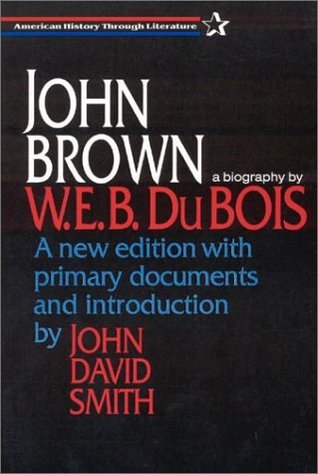
John Brown, by WEB DuBois *****

johnbrownThe class I took in college that featured John Brown as a small figure in American contemporary history dismissed him fairly quickly. He meant well, but was not stable, they said; in the end, he took extreme, hopeless measures that were destined for doom. He remained a hero to Black families (they admitted), South and North alike, as the first Caucasian man who was willing to die for the rights of Black people. Whereas many White folks (those with enough money for a fireplace and a portrait to go over it) featured a family ancestor or a painting of George Washington, Black homes often had a picture of John Brown.

The problem with that education is that no African-American scholars were included in this very central, pivotal part of the prelude to the American Civil War. I doubt anyone would doubt the credentials of this writer, whose urgent and compelling defense of Brown as a selfless but sane man with a perfectly good plan that went wrong due to a couple of the people in key positions of responsibility for the taking of Harper’s Ferry held my face close to the book (it is not the edition pictured; mine is so old, we’ve had it for so long, that the plastic lamination on the paperback has half peeled off, and it is not featured here!). The writer’s words forced me to read it, though I am no longer a student, with a pen in hand to underline and star key passages.

It’s tempting to leave it here, but I think I need to give you a couple of instances that may draw you, if you like history, care about the rights of Black people in the USA–because the oppression that started here is still not over (that’s me speaking; DuBois died in Ghana in 1963), if you are interested in the Civil War or Brown in particular, you have to read this book.

Tidbits that do not spoil, then: Harriet Tubman planned to be there with him. She became seriously ill and was confined to bed; otherwise, she meant to fight alongside him.

White writers have all assumed that his escape route was impossible. They have the WRONG escape route; DuBois explains the actual plan.

The Underground Railroad was run almost entirely by Black people, some of them wealthy, in the Northern US. DuBois points out that free Blacks owned over a million dollars worth of property, free and clear.
It was this same large body of free Blacks who provided the funding for Brown. He would have had more, if he had not become ill, and the loss of momentum removed most of his Canadian backers. Indeed, DuBois states that Brown most likely went to Harper’s Ferry physically ill and “racked with pain”, that he was very gaunt due to illness and poverty, but felt that to wait longer would be to lose his support and those he had gathered (a small group) for the initial attack.

To say might make you feel as if you have little reason to read this book. It is eloquently laid out as only a wordsmith such as DuBois is capable of doing. I am deeply sorry I waited so long to find time for it.