
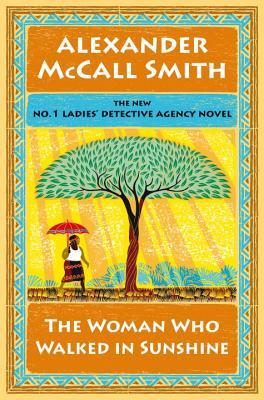
The Woman Who Walked in Sunshine, by Alexander McCall Smith*****

thewomanwhowalkedThe first week or two after Christmas is a sumptuous period for me as a reader. Nearly every book I read these days, fiction or non-, is a DRC, or Direct Reader’s Copy sent to me digitally by publishers via Net Galley in exchange for an honest review.  However, each year there are invariably half a dozen titles, sometimes more, that I really want to read and haven’t been able to obtain free of charge. Sometimes I discover a book after it’s already been published some time ago, and sometimes it’s a book that I couldn’t get as a DRC. These books land on my wish list, and my family is faithful in purchasing them and placing them, clad in pretty paper and ribbon, beneath our Christmas tree. By Christmas night, I’m snuggled deep beneath a pile of fluffy covers, my spouse and hound dog snoring sonorously while I immerse myself in the books I am just about guaranteed to love, bathed in a soft yellow bedside light. This ritual is as significant to me as the more widespread traditions of feasting, wrapping gifts, and hanging stockings. I can’t recall a Christmas without it.

This year we had our gift exchange on Christmas Eve, and by bedtime I was snuggled up in flannel and reading this paperback book, the 16th in the series. The series, for those unfamiliar, is of the cozy variety rather than the pulse-pounding thrillers that absorb a good portion of my reading life. Precious Romotswe is the owner and founder of the #1 Ladies Detective Agency, and a good portion of those that read this book will already be familiar, as I am, with the main characters and their stories. Mma (Ms.) Ramotswe is married to JLB Matekone, who owns and runs the automobile repair shop adjacent to the detective agency; Mma Makutsi , Mma Ramotswe’s eccentric but capable assistant, believes that it’s time for her mentor to take a vacation. And indeed, Precious has never gone on holiday before; it’s about time, isn’t it?

Mma Ramotswe is reluctant. She hates to leave her business in anyone else’s hands; then too, she’s disconcerted when she learns that her husband, his employees, and her own assistants have discussed her need for time off when she wasn’t present. Is it a conspiracy, or is it loving concern?

The mysteries to be solved include the problem on which the temporary assistant hired on for the duration of Mma Ramotswe’s holiday stumbles; an additional situation involving a child named Samuel, an orphan who’s been trained to shake down drivers for coins in exchange for not damaging their cars; and a new school bearing her signature “#1 Ladies” logo, which appears to be not only misappropriating her trademark, but shady in other ways as well. Yet much of the story is dedicated to character development and the personal lives of the main characters, and it’s this that keeps me coming back.

Ultimately, the story is about trust, kindness, and learning to let go sometimes.

It occurred to me for the first time that I don’t know how the majority of Botswana feels about this series. McCall is a native-born Botswanan with Scottish predecessors. Are these characters true to the way the people of color in Botswana see themselves and their people?

Yet another part of me recalls that we are in the land of fiction. Unless I see some sign that the series is objectionable or offensive to those it represents, it will continue to be a happy retreat for me.

Highly recommended to those that love a cozy mystery and an opportunity to drop their blood pressure; the mesmerizing cadence here is better for us than any bottle of pills, and far cheaper than therapy.

Best of 2016: Mystery

This category includes everything within the same zone: thrillers, suspense, detective fiction, crime fiction. If it’s related, I’m rating it here. I expected this to be my toughest call because I read so many books of this genre, but when I had a look at the original titles I’d seen this year, and then eliminated those crossover novels that had already been awarded as the best of some other genre on this site, it was down to three books. Unbelievable…but not at all mysterious.

MY TOP THREE:


The Big Book of Christmas Mysteries, edited by Otto Penzler*****

TheBigBookofXmasNote to the reader: I originally posted this when my blog was just a few months old, and I was still struggling with basic issues, such as how to insert the book cover into the text. Now the holiday season is here again, and I am running my review–with some basic technical adjustments–one more time, because in the past two years, I haven’t found a Christmas book I like better than this one. It’s the only book I’ve found since I’ve been writing reviews that I found worth actually buying not just one but two copies at full price to give as gifts. For those that love Christmas stories and mysteries, this one’s for you!
I received this wonderful collection last year as an ARC from the “first read” program via the Goodreads.com giveaways. At the time, I didn’t have a blog; I reviewed it on Goodreads and because I liked it so well, I also reviewed it on Amazon. Then, while I was on the site, I bought two copies to give as gifts. I have never done that with an ARC before or since (so far), but it is so wonderful that I wanted others to have it, and I wasn’t willing to share mine.

Now the season is upon us. This blog will be punctuated by worthwhile Christmas books of a secular variety. I guess it is a typical retired-teacher behavior to decorate my home with brightly jacketed Christmas books when others are getting out their craft supplies and hot glue guns. At any rate, if you buy just one Christmas book for yourself or someone else, and if the reader enjoys mysteries, this is the best you will find.

The stories are organized according to category in a format and layout that is congenial all by itself. There are ten sections, starting with “A Traditional Christmas”, with the first entry being one by Agatha Christie; it is a story that has aged well, and I don’t remember having read it even though I thought I’d read everything by that writer. There are a few more, and range from just a few pages, double columns on each page, to 25 or 30 pp. Then we move on to “A Funny Little Christmas”. The first there is a story by the late great Donald Westlake, and I gobbled it up and then felt bad that I hadn’t saved that story for last, because I adore his work and he’s gone and can’t write anything more. But I perked up when I noted that yet another section, “A Modern Little Christmas”, has an unread (by me) story by Ed McBain. There are many others. The final section, “A Classic Little Christmas”, bookends the anthology neatly by finishing with Dame Agatha. All told there must be about sixty stories, maybe more.

The anthology, edited by the brilliant and acclaimed Otto Penzler, is billed as having a number of rare or never-published short stories, and I think it’s a true claim. There are many mystery writers I’ve read and enjoyed here, and others I had never even heard of, but found immensely entertaining. I haven’t skipped any yet, but even if I find something I don’t care to read, the book is worth owning. I know that already. It is also billed as an anthology to warm the heart of any grinch, and indeed, there has been at least one story with a satisfyingly creepy ending.

One of the charming things about anthologies is that one can read a single story in a sitting and not feel too bad when it’s time to put the bookmark in and go get something done. Then it waits there to greet us as we return from executing less pleasurable tasks, a reward that invites us to sit down, curl up with good cup of coffee or the dog or both and have a cozy read. It also makes the book a lovely thing to keep where guests can access it, because they can enjoy it even if they haven’t time to read more than a story or two in between other activities.

…but I’m keeping you. You could be reaching for your car keys, your bus pass, or even better, going to another window to find this book online and order it. Once you see it, you will most likely feel as I do…unwilling to part with your own copy, yet yearning to get at least one more for somebody else! Get the plastic out and do it right away.

Doubt in the 2nd Degree, by Marc Krulewitch*****

doubtinthesecondThis is the fourth and best installment to date in the Jules Landau series. Thank you Net Galley and Alibi for the DRC, which I scooped on the date of publication in exchange for an honest review. This title is for sale now, and if you like a good whodunit, you should get it too.
The shores of Lake Michigan are inhabited by rich white people, and Jackie Whitney is one of them. Once she is found dead and stuffed on the shelf in her own walk in closet, however, the good times are over.  Kate, Jackie’s girl Friday who hails from Appalachia, is arrested and the public defender asks Jules to look into the case. She doesn’t trust the state’s own people to find reasonable doubt without some outside assistance, but she cautions him that she isn’t going to pay him to find out who did it; all she needs is for him to muddy the waters enough to prevent conviction.

She might as well spit into the wind.

Landau is fired up, and he knows that Kate will be convicted if he can’t find another suspect. Partly this is because cops like to wrap up a case, and once they think they have someone they can convict, they stop looking anywhere else; but there’s another reason, too:

“Corruption and Chicago followed each other like conjoined twins.”

The more rocks Landau turns over, the more suspects he finds. It’s getting to the point where he hardly has time to get home and feed the cat. There are many wry remarks that give this story its kick; it’s a novel that’s part noir, part cozy locked-room-mystery, and whereas the author’s disinclination to settle himself neatly into one area of the genre may cost him in sales, I have to admit that I really like it this way. His clear eye on class divisions and his snarky sense of humor lit me up like Christmas, and I can’t wait to see what he does next.

Although this is the fourth book in the series, I think it works just fine as a stand-alone novel.  Highly recommended!

Murder in Dragon City, by Qin Ming**

murderindragonIs there a killer on the loose in Dragon City, one that’s trailing body parts everywhere he goes?  I received my DRC in exchange for this honest review, thanks to Net Galley and Amazon Crossing.  This collection of stories l is written by a Chinese medical examiner, translated to English by Alex Woodend. I’m always up for something new, and so I took my galley and curled up. Unfortunately, this one just never gelled for me. I tried setting it aside, reading other things and coming back to it, hoping that with fresh eyes I would like it more than I had before; finally I had to face the fact that I couldn’t write a happy review and also be honest.

It happens.

Undoubtedly the strongest aspect of this story in my view is, as one might expect, the forensic detail and physical knowledge the author commands. But that can cut two ways, if you’ll pardon the expression. Some of us just love gore, and the more fleshy fingers or toes that land in sizzling oil, the more we eat it up.

On the other hand, some of us are completely grossed out by frequent, grisly findings, and this author put his thumb on my “ick” button and never took it off.

One other thing I like and that’s consistent is that Chinese cops that find corpses or find themselves in strange, scary situations don’t feel compelled to feign indifference. There’s no noir to be found here, just honest cops that yelp when they are scared and that dive when they hear a loud noise near a crime scene. The candor is refreshing and sometimes funny.

Obviously, each story has a different spin to it, but the tone overall is much the same.

I confess that the last time I studied Chinese government and culture was in the post-Mao period, before the largest Stalinist types of government fell apart; I don’t know what life is like for women these days in China. But the author never seems comfortable portraying women as people that are female. Women are featured and discussed as political bigwigs, servants, and technicians, but we never see them acting in concert with men or each other. There’s a clump of men, and then…there’s this woman. Sometimes. The woman is always featured as “other”. The male cops gather and discuss whether any woman would be ruthless enough to commit the crime in question, but by this point I was so green around the gills that I didn’t want to find out whodunit or why. I just wanted to be done, which I am.

Combustion, by Martin J Smith*****

combustionPaul Dwyer is dead, a floater that has only been found because his construction business diverted the water from the place where his body is dumped, and it dries up in the Southwestern desert heat, leaving his body exposed to the world.  I was lucky to be able to read this book early, thanks to an invitation from Net Galley and Diversion Publishing, in exchange for this honest review.  I am overjoyed to rate it five stars. I knew nothing at all about either Smith or Diversion, but it turned out to be a risk that worked out in my favor and the author’s.
Our detective is Ron Starke, a single man whose father has Alzheimer’s. The reader cannot help but warm to him as we see him appear in his father’s room, hamburgers in a paper bag, prepared to patiently have the same conversation with his dad that he had with him several times yesterday and most likely will have tomorrow too.

Shelby Dwyer, the victim’s widow, is a very wealthy woman now. She isn’t sorry that he’s gone, and neither is their teenage daughter Chloe. Dwyer was a violent, ugly man in private, regardless of the shine he demonstrated publicly. Naturally, Shelby is the chief suspect, a thing made more difficult by the fact that she was Starke’s girlfriend a decade ago, when they were in high school.  But it’s a small town, a tiny exurb of Los Angeles, and everyone really does know everyone, aside from Starke’s supervisor, Kerrigan, a recent transplant from the big city. To make matters even more awkward, Starke had been considered a shoo-in for the job Kerrigan now occupies, and Kerrigan knows it.

He has a feeling that his new boss is gunning for him.

The story is told from alternate points of view, and Smith creates whiplash tension by shifting between them at key points.  Character development is solid, and it makes me wonder about the possibility of a series emerging from this debut.

Shelby may be rich now, but she is in tremendous personal jeopardy. All of the lonely nights spent holed up in the study, cruising online for connections she can’t find at home, have led her to expose herself in a horrifying way. And as she is forced to confess to Chloe about the unwise things she has said to another visitor in a chat room, a person using the handle LoveSick, and despite the horror of the moment I had to smile, as the traditional tables are turned and 17 year old Chloe has to tell her mother that you should never, never provide a stranger with personal details.

Smith’s debut is hot as the desert sun, a page turner that will live in your head after the last page has turned. Those that know me are aware I finish an average of three titles weekly for review, and so months or even weeks later if I am contacted by the writer’s publicist, I sometimes have to flip back through my records to remind myself…wait, this what which book again? And this is especially true of mysteries, which no matter how unique, tend to share a certain sameness. But in this case, that didn’t happen. The settings are so resonant, the characters so well sculpted that I felt as if I were an unseen guest among them.

It’s for sale today, and I highly recommend that you read it.

A Long Time Dead–A Mike Hammer Casebook, by Mickey Spillane and Max Allan Collins*****

 alongtimedead  “The evening sky was gray and growling but I had left the trenchcoat behind and my suit coat was unbuttoned. This was the kind of sketchy gin mill where I wanted easy access to the .45 under my arm. The waterfront bouquet greeted me, salt air, grease, oil, sweat and dead fish drifting like a ghost with body odor.

“If you needed to know anything about the harbor facilities stretching from the Battery to Grant’s Tomb, or wanted a line on anybody in the National Maritime Union or the Teamsters, this was your port of call. If you wanted to get laid or make somebody dead, that could be arranged, too. You know the place. They have them in London and Mexico City and Rome and Hong Kong, with smaller variations in smaller locales. But none were meaner or dirtier than the bar run by Benny Joe Grissi.”

Spillane was the prototype for noir fiction, and even though he’d been hiding in plain sight, I never read Spillane because he wrote so many books that I assumed he was cranking out something formulaic, a pot boiler special. I am delighted to find I was mistaken; this set of short stories, an atypical medium for Spillane, was provided to me free courtesy of Net Galley and Open Road Integrated Media in exchange for an honest review. I’ve had a few DRCs that didn’t measure up to my expectations lately, and this particular galley was my bright spot, the reading I considered my dessert after I had dutifully choked down the stuff I was only reading because I’d said I would.

Collins was a close friend of Spillane’s, and at the author’s request, he rounded out some rough drafts that had been left behind when Spillane died. Collins suspects that they had been left dormant because the author’s church would not have approved of the brief—and by today’s standard, very tame—sexual content included. Whatever. We can read them now, and Collins has used Spillane’s style seamlessly. Only one of these stories is more his than Spillane’s, and he tells us which one it is. He did a great job with it.

The author is legendary for the call-and-response style dialogue associated with the genre as a whole now. His use of it and other figurative language is so sweet that I found myself—a retired language arts teacher whose highlighter is the modern day equivalent of the red pen—noting passages where it’s artfully used, and sometimes I got so caught up in watching the language that I had to go back and reread a few pages, because I had lost track of the plot. But it was worth it. Here are a couple of examples:

“’Sure you aren’t seeing ghosts?’

“’Once I’ve killed this guy—really killed him—then maybe I’ll see a ghost.’”

And on the same page, more of the same; Lincoln followed by Lincoln, salesman followed by salesman. Together with the alliteration and the brisk, no nonsense yet curiously intimate prose, I found myself mesmerized. Spillane doesn’t care about preserving evidence, and he usually won’t call cops, at least not until his own business has been concluded. Given today’s social climate and mistrust of urban cops, I suspect this newly issued work by the famous writer will find a wide audience.

Although it’s been decades, I can nearly swear that the Carol Burnett show did some spoofs of this type of narrative during the 1970s, when I was just a kid. If one uses too much of the repetition it becomes ridiculous, and of course Burnett and her colleagues could spot fodder for satire a mile away. But although I kept my antennae up, I never found a weak place in the text that took the lyrical repetition to the point of silliness. It’s carefully meted out so that it reels the reader in rather than appearing ridiculous and distracting. And if you look at my last sentence, I can promise you the alliteration there was unintentional. Good writing stays with us, as any teacher will tell you; this is one reason we have students read something before they write. And thus it is that a tiny nugget of Spillane’s technique has made its way into my review.

Most people don’t want to analyze detective stories; they just want to read them. If so, then you should be good to go here. I was additionally pleased by the lack of racial and ethnic slurs which some writers of the genre would include in the name of authenticity. Likewise, the gorgeous receptionist is actually Spillane’s partner in both senses of the word, and she listens to what people reveal when they believe no one important is listening.

This is the very best of the noir genre. If you enjoy great detective fiction and can stand some graphic violence, this book is for you.

Two Miles of Darkness, by Earl Emerson****

twomilesofdarkness Fans of Emerson’s Thomas Black mysteries will be as pleased as I was to see this, the 14th in the series. Black took a very long nap and seemed to have all but disappeared for awhile, but then he was back with Monica’s Sister, followed by this title. There was no DRC for this one, so I picked it up free using my Amazon Prime digital credits. It was a good way to spend them. The book was released in 2015, so of course you can get it also.

We start out with one of my three most tired devices for a mystery novelist: Black and his sidekick, Snake are hogtied in the trunk of a car. I rolled my eyes in the way that made my second grade teacher caution me might make them stick that way forever—an outstanding science lesson that remained with me long after the legitimate curriculum had drifted away—but because I like this series so much, I kept reading anyway. And it was worth it.

Eventually of course Black stops discussing being stuck inside the trunk, and he remembers back, back, back to how all this came about. And that’s the story that is great fun and also well written.

Black grew up in the working class here in Seattle, but his father did errands and handyman work for a wealthy widow that went by the nickname Doda. Dad is long gone, but Doda is still there, and she hires Black to find Pickles, a dog she gave to Mick and Alex Kraft. The Krafts, by peculiar coincidence, had also tried to hire Black recently in order to find out who was harassing them; Mick had experienced a string of terrible luck that he believed was too sudden to be a coincidence. Black told him that sometimes bad luck really is just bad luck, but the next thing you know, they’re both dead. Police are calling it a murder and suicide; Doda just wants the dog back. She’ll pay a pretty penny if Black can find Pickles and bring him safely home.

In this matter, Black’s friend Snake, usually the irresponsible party where the two friends are involved, is the sensible one that points out the truth, a very good reason to turn the dog job down:

“You hate rich people. Think about these guys. The rest of the world works for a living, but these guys have nothing to do all day but drink Mai Tais and sit around the pool waiting for their dividend checks to arrive in the mail. It burns you up. I know it does.”


Snake is right. Black hates the rich, and I have a sneaking hunch that Emerson does too.  So in this tale, we have a couple of spoiled men—no longer young enough to be called brats—known as Chad and Binky. One is Doda’s son, and the other is the son’s best buddy. Their massive resources coupled with a life of leisure and surfeit of free time give them the capacity to play elaborate pranks, and both show a solipsistic disregard for the effect their games have upon the lives of others. They fit Snake’s description to a tee.

Nevertheless, Black takes the doggy job, and so we have two mysteries, the official dog-finding mystery, and the unofficial mystery Black’s conscience requires him to tackle regarding the Krafts.

One small fact-checking blooper hit my I-don’t-think-so-button, and that was the widely-believed myth that all juvenile records are sealed once the doer of the crime turns 18. In reality, after a number of years, a hefty filing fee, and a ton of complicated paperwork, the person in question can have the particulars of their crime locked away, but if it was a relatively small offense, that may make matters worse, because anyone running the background check will see that the person did something in their youth that they want concealed. Most juvenile offenders never want to see a courtroom again when they are older, and most don’t have the extra money to throw at a court procedure anyway, so the misdeed stays on the record until they grow old and die. It never vanishes from the record, as some folks, sadly some of them juveniles looking for trouble, believe. At least, that’s the truth in Washington State, and that’s where Emerson lives and where his story is set.

Now back to our story. Emerson is a champ when it comes to pacing, and he’s one of the best there is when it comes to bouncing a straight man off a colorful sidekick like Elmer “Snake” Sleazak. The story would be no fun at all without Snake, but with him, it’s immensely entertaining. The sly banter and the unexpected, off-the-chain behaviors will put a smile on your face; if you don’t find him funny, check your pulse to make sure you aren’t dead.  Add another side character, a neighbor kid named Charlie that was friends with Pickles the dog, and there’s charm all over the place. People often underestimate kids, who are often our best observers: “Charlie knew the neighborhood like a cheating husband knew every creaky stair on his front porch.”

This is a page-turner that will make your own troubles seem oh so small, and for those that find themselves with a long weekend at hand, this book will provide the excuse you may need to just chill for awhile. One way or the other, this is a well written story, deftly handle with just the right balance of mirth and suspense. My records tell me I have read over 700 mysteries since 2012, and that doesn’t even take into account most of what I read during the previous decades of adulthood, and so I am picky. I see a device that I’ve grown tired of, and a star falls of my rating. But as for you, if you lean leftward and love a good private eye story, this could well be a five star read.

Recommended to those that lean left and enjoy detective fiction and comic capers.


A Time of Torment, by John Connolly*****

ATimeofTormentI had never read anything by John Connolly before, but this eerie thriller has made a forever-fan of me. Thanks go to Net Galley and Atria books for the invitation to read and review.  Connolly cooks together a hair-raising thriller with a handful of horror, a smidge of fantasy and a dash of magical realism; the resulting brew is one that nobody else could possibly cook up. For those that write, reading this dark redemption tale is likely to produce both admiration and despair, because this novel is born of a talent that no creative writing workshop will ever be able to produce. You may write, and I may write, but nobody else will ever, ever be able to write like Connolly.

Our story is part of the Charlie Parker series, but I have not read any of the others and found I was able to hop into this story as a single read with no difficulty. Connolly provides just enough background to catch us up without dragging us through the book using promotional paragraphs some lesser authors might indulge in. I suspect not enough is repeated here to annoy his faithful readers.

Parker is a private detective that has been through a triple-death experience and come out the other end, but not unchanged. He’s hard enough to confront the ugliest nemesis, and it’s a good thing, because soon a trail of corpses will persuade him to leave his home in Maine for the dark place that is Plassey County, West Virginia.

The people of Plassey County have learned over the years—and centuries—to leave The Cut alone. Evil things are brewing there; it is there that the Dead King waits in an ancient building, and it is there that Oberon and Cassander struggle for dominance of this insular, cult-like community.  After all, “…the Cut looks after its own.”

This is a high voltage, hyperliterate read. Your middle-schoolers can’t read this, and it is so infused with violence that I’m not sure you’d want them to have it. But though I sometimes am put off from gory prose, I found that Connolly measured out these passages in small enough batches that my “ick” threshold, that little voice inside that tells me when a story isn’t fun anymore, wasn’t tripped. Spare but strong spots of irony and humor help lighten things up before they get dark, dark, dark again.

If I were to compare Connolly to any other writer, it would be James Lee Burke. The similarities that exist are a brilliant capacity to craft character, and the use of strongly resonant setting to reinforce character and move the story forward. The small but potent religious references are also similar. I highlighted the characters that were introduced throughout the course of this novel and found more than two dozen of them, and yet at the end of the book I still knew who each of them was without having to go back and reread. Connolly draws characters so real that by the time the book is done, the reader knows them as if they were family; yet thank goodness they aren’t.  This reviewer particularly enjoyed Parker’s assistants, Angel and Louis, as well as side characters Perry Lutter and Odell Watson.

Throughout the story, the pacing is swift and the plot absorbing. There is never a word that could be cut from the text and have the same result. If anything, the spare prose creates a sense of tension not only for that which is said, but also for that which is not.

This creepy tale was released this week, so you can have it to curl up with over the weekend if you’re quick about it. But before you commence, you’ll want to make sure that all the lights in your home are burning, and that all your doors and windows are locked.

Highly recommended.

Salvation Lake, by G.M. Ford*****

salvationlakeFord is the rightful heir to the late great Donald Westlake, a writer of monstrously amusing mysteries full of quirky sidekicks and kick-ass, zesty dialogue. There’s nobody like him in Seattle or anywhere else. I gobbled up the DRC when it became available via Net Galley and publishers Thomas and Mercer,  so I read this free in exchange for an honest review. But I’ll tell you a secret: if I’d had to, I’d have paid for this one had it been necessary. And so should you. It’s for sale today, and you can get it digitally at a bargain rate.

But back to our story.  We open at a bar called the Eastlake Zoo. The band of misfits to which detective Leo Waterman is tied through bonds of family history and quixotic affection are rocking the house in “well-lubricated amiability”. In fact, there’s a story being told right as we begin, and if it doesn’t hook you, check your pulse, because you’re probably dead. Here:

“Red Lopez was a spitter. When Red told a story, it was best to get yourself alee of

something waterproof, lest you end up looking like you’d been run through the

Elephant Car Wash.

‘So we was comin’ down Yesler,’ Red gushed. “Me and George and Ralphie.’

Everyone had found cover, except the guy they called Frenchie, who was so tanked

he  probably  thought it was raining inside the Eastlake Zoo…”


Right?

As it happens, Waterman, who’s inherited his old man’s ill-gotten wealth, has been lying low and enjoying the good life, but now his late father’s hideously distinctive overcoat has been found on a corpse, and  Timothy Eagen of the Seattle Police Department want to talk to Leo. Now.  There’s bad blood between them:

“…he hated my big ass the way Ahab hated that whale…Eagen was a skinny little turd with a salt-and-pepper comb-over pasted across his pate like a sleeping hamster.”

Since SPD has been under the eye of the Feds lately, Eagen can’t give full rein to his attack-Chihuahua impulses. SPD needs to provide “the kind [of law enforcement] that doesn’t look like Ferguson, Missouri or Staten Island, New York.” So Waterman doesn’t get shaken down or tossed into a cell, but his curiosity is piqued, and since he has no paying job and time on his hands, he finds himself checking into a few things. One thing leads to another.

What relationship does the victim, known as the Preacher, have to Mount Zion Industries, whose pamphlet is found among his effects? Before we know it, Leo is off and running, checking out Salvation Lake, located at the end of Redemption Road. Events tumble one upon the next, and I found that instead of reading in my bed that evening, as is my usual bedtime custom, I was reading on it, bolt upright and clicking the kindle to go a little faster please.

Waterman may have come into money midway through life, but his perspective is a working class perspective. His take on the city’s thousands of homeless denizens and the relationship that cops have to those in need strike a sure clear note that must surely resonate with anyone that’s been paying any attention at all.

Meanwhile, Salvation Lake is written with warp speed pacing, sharp insight, authority, and the kind of wit that can only come from a writer that has tremendous heart.

Don’t miss it. Get it now.