The Next One is for You, by Ali Watkins****

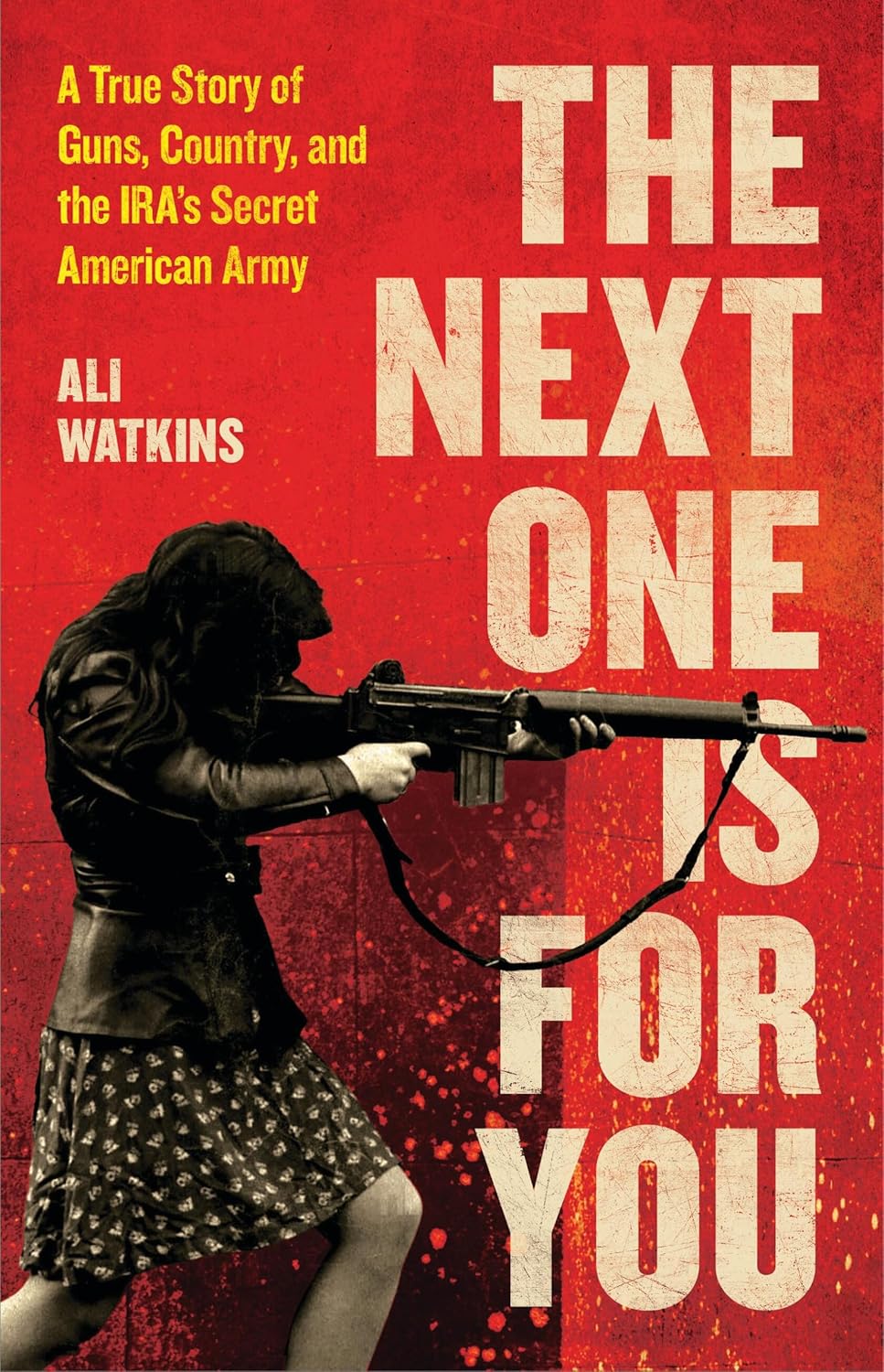
One of the most hotly contested political issues for English speaking people during the 1970s and 1980s was the battle taking place in the North of Ireland between its original inhabitants and the British government. This reviewer was deeply interested in the conflict while it took place, and so when I saw this book, The Next One is for You: A True Story of Guns, Country, and the IRA’s Secret Army, by Ali Watkins,my heart began to pound before I’d read a single page. My thanks go to NetGalley and Little, Brown and Company for the review copy. This book is for sale now.

The fight between the working-class citizens of Belfast and the middle-class Protestants, who worked hand in glove with the British Crown, has roots that are centuries deep. Watkins reviews these without going into the weeds, and leads us up to modern times succinctly. I appreciate her fair discussion of the manner in which the Irish Republican Army, or IRA, developed and burgeoned. (U.S. readers new to the topic should know that ‘Republican’ was part of the name due to a desire for the Irish Northern counties to be restored to the Republic of Ireland, not because of any political similarities to the Republican party in the U.S.A.) Initially the movement was modeled on the Civil Rights Movement of the United States, with large, peaceful marches; there were signs, songs and speeches given. People packed lunches and took their children with them. But these protests were violently repulsed, with police and the military surrounding the participants so that there was no escape, and then shooting them like wooden ducks in an arcade.

Poverty was widespread in Belfast and its surrounding areas, with few jobs, and miserable living conditions in government subsidized apartments. “A Catholic surname got you passed over for jobs, if you even got the chance to apply.”  There was no Bill of Rights, and when armed forces chose to search someone’s home, they announced themselves by kicking the door in. The situation was intolerable.  And so, when peaceful protest was no longer possible, there were two choices remaining: armed struggle or defeat. “The goal: to expel the British from Northern Ireland, whatever the cost.”

Because such a large portion of the U.S. population is of Irish descent, these circumstances were of great interest in America. When the IRA broke off from the more traditional, less militant (and ineffective) organization that already existed, it wasn’t long before many Americans wanted to help in some way. Two organizations developed in the States, and this is much of what Watkins discusses. Clan na Gael was an Irish solidarity organization that had existed in the U.S. since 1867. It became an important element in the Irish struggle, organizing politically, and raising funds. But in order to gain widespread appeal, there needed to be an additional organization that existed for those that wanted to contribute financially to the poor of Belfast without also supporting the armed fight. In 1969, NORAID was born.

A disclosure: this reviewer was a great supporter of both organizations during that time. In fact, I once won a raffle from the Clan, which netted me a wheelbarrow of whiskey! Since I don’t drink, I took one bottle for my spouse and donated the rest back to the Clan. I never joined the Clan, primarily because I wasn’t asked.

Watkins discusses the history of both organizations as well as the key individuals that brought them about. She does a magnificent job and brings a treasure trove of outstanding documentation, right up until nearly the end of the book, at which point she inexplicably lapses into the journo-speak of the period, blathering about “senseless violence” in an abrupt shift that made my jaw drop. She had already explained, very capably, just why a nonviolent struggle was completely impossible. The devastating numbers of Irish youth that died during this campaign is indeed heartbreaking, but at the same time, just what else were they supposed to do? No foreign government was even remotely interested in assisting them; the British government was a key ally of the U.S. government, and had something of a headlock on its protectorates. And while I respect that the author had to conclude the book in one way or another, just admitting that there was no clear solution would have been vastly better than parroting American mainstream media of the time period. What the what?

Nevertheless, those with an interest in this struggle should get this book and read it. Just bear the ending with a grain of salt.

Genghis: Birth of an Empire, by Conn Iggulden*****

Though I usually review books that are either newly published or are about to be, once in awhile I reach back and discuss books that have been around for awhile. This one is excellent, and I consider it unmissable.

This book is phenomenal. How much do any of us know about Genghis Khan?

One thing I learned in discussion with my spouse, who is a Japanese citizen, is that whereas we from Western cultures pronounce the warrior’s name with a hard G, Asians–including the Mongolian culture from which the Khan emerged–pronounce it softly, like a J. I figure Mongols know how the name should be pronounced, so I have begun to pronounce it that way, too.

I wanted to read this series, or at least the first entry, because although I have read at least something about most of the greatest warriors in the world over time, I had read nothing about Genghis. We have a nonfiction tome, but it’s the sort of slog one only undergoes out of desperation, or as assigned coursework.

The first two or three chapters seemed fine, but not great. I wasn’t even sure if I would read the rest of the series. By the halfway point, however, my mind had changed completely! I found myself online doing image searches for the housing, clothing, and other parts of the nomadic life.

I have purchased the next in the series. I rarely buy books for myself, because I have so many already and have such constant access to galleys that it isn’t necessary; yet now and then, there’s a book I’ve gotta have, and that’s how I feel about this series.

Highly recommended for those that are interested in this time and place in history; in Genghis himself; or in military history.

To Wake the Giant, by Jeff Shaara*****

“It’s the admirals, sir, playing with us like this is their own big-assed bathtub and we’re just toys.”

Jeff Shaara has written some of the best war stories ever published, and he’s done so for almost 25 years. I have read every last one of them. When I was invited to read and review his new novel about the Japanese attack on Pearl Harbor by Random House Ballantine and Net Galley, I was delighted, but also slightly apprehensive, because even after all these years, the subject remains an incendiary one; I needn’t have worried. This may be Shaara’s best book, and that’s saying a lot.

I’ll share a brief note about my own biases going in. My father was among the last men called to serve during World War II; he never left the U.S., however, where he was tasked with training new recruits to the still-new U.S. Air Force. But I grew up hearing about Japanese atrocities, and many of the bizarre stereotypes and misconceptions based on pseudoscience were told to me as fact. When as an adult I announced that I was about to marry a Japanese citizen, I sounded the waters with my family to see if there was resistance. I was told that my parents “still remember Pearl Harbor.” Meanwhile, my husband’s father also served during World War II—in the Japanese army. The topic was never raised by his parents around me, or at all as far as I know; but I asked my spouse a few questions to help me understand the Japanese perspective about this horrific conflict, and then I understood exactly how erroneous most of what I’d been raised to believe actually was.

So I was primed to read this book, and also a little afraid of what I might find. My internal map of Pearl Harbor was studded with emotional landmines, and at the book’s conclusion, none of them had been tripped.

Shaara tells this story primarily through the eyes of three people: Cordell Hull, U.S. Secretary of State under President Franklin Delano Roosevelt; Admiral Yamamoto, the Japanese architect of the invasion; and Tommy Biggs, a 19-year-old naval recruit from an impoverished Caucasian family in rural Florida.

Shaara faithfully incorporates a character from the rank and file in every story; he does this even if there is nobody on record that he can report on, and so often, he is forced to create a fictional character based on experiences and characteristics from several people. When I saw no such disclaimer in any of his notes, I grew curious and wrote and asked him whether this is the case with Biggs. He replied that this time there is a Tommy Biggs (though the name is not the same), but that he did add the experiences of others in order to flesh him out. So this time, each of the three chief characters is based on an historical figure.

I learned a great deal. Though it’s well known that this attack profoundly crippled the U.S. Navy, sinking or badly damaging most of the fleet, I had never considered it from the Japanese perspective. Looked at in that way, it was not only audacious, it was immaculately planned and wildly successful. I also had never considered what a blunder it was on the part of the U.S. military to leave its equipment, ships, planes, and more so unguarded. In the fallout after the attack, we learn that the Navy considered security to be the job of the U.S. Army and vice-versa. What a colossal bungle.

Japan had emerged victorious from the Russo-Japanese War, and its leadership was suffused with overwhelming confidence. Japanese racial superiority would lead to Japanese dominance throughout the China, Indochina, and across all of Asia, they claimed, because they were meant to dominate their portion of the globe. Japanese leaders were convinced that the U.S. would not seek retribution following an attack on its soil because American isolationist sentiment was so strong. They genuinely hoped that this attack would result in an end of the U.S. embargo that crippled Japan, and which existed in order to halt Japanese expansion and force Japan to withdraw from its alliance with the Axis powers. Americans, the Japanese brass told one another, were too big, too slow, too lazy to retaliate. There were voices of dissent, however:

“For any of you who believe the Americans are not worthy of a fight, that they do not have the stomach for blood, perhaps you are familiar with the American Civil War? In the 1860s, they divided and fought each other in the bloodiest war in their history. They did not require any enemy to inspire them. They fought each other. Are you familiar with football?”

Meanwhile the U.S. military, press and popular culture treated the Japanese as a bad joke. One myth dressed up as science suggested that Japan would never be able to build an air force because of an inherent defect in the inner ear of all Japanese. It was physically impossible for them to become pilots! The condescension was rife, everywhere one turned. Hollywood depicted the Japanese as ridiculous, rodent-like creatures with minds that didn’t function properly. The Chicago Tribune stated that for Japan to attack the U.S. was “a military impossibility.” Japanese were said to be too myopic to be effective against a military target. And it goes on.

There’s all sorts of blame to spread around. Nobody in Washington, D.C. had told the top brass at Pearl Harbor, Admiral Kimmel and Lieutenant General Short, about the project named Magic, which intercepted and broke Japanese code. They had no idea that Japan was rattling its sabers to such a degree.  And these two men appear to have been lazy, bureaucratic fools that ignored what little intelligence came their way. For example, shortly before the attack, the man on watch sees a Japanese sub in the water. Kimmel immediately assumes that the guard has seen a whale, and he goes back to bed.

There are three aspects of this novel that keep the pages turning for me. The first, of course, is my interest in military history. Shaara’s research is meticulous. The book is historical fiction at its best, which is when the contours of the story, even fairly detailed aspects of it, are correct, but the fictional genre is chosen so that dialogue and inner monologue can be added. Second is Shaara’s perceptive nature, and it’s this that permits him to choose the best details to include and cut what is inessential so that pacing never flags. And finally, his capacity to develop a character so that we feel we know him is matchless; in particular I bond to poor Tommy Biggs, a guy that can’t catch a break, until he can.

Nothing I can say will serve as well as what Shaara says himself. Get this book, even if you have to pony up full cover price. This is hands down the best fictional representation of Pearl Harbor on sale today. Believe it.

The War That Ended Peace: the Road to 1914, by Margaret MacMillan ****

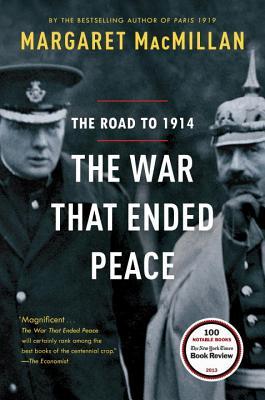
the war that ended peaceMacMillan’s hefty, well-researched tome has been nominated for prestigious awards and received rave reviews from the New York Times Book Review and the Christian Science Monitor. It is the most scholarly and thorough a treatment of the period from 1900 to 1914 of any I have seen. Thank you to the first reads program at Goodreads and to the publisher for a chance to read it and review it free of cost.
If I were planning to teach a college seminar on the causes of the first world war, I would absolutely include this book in my assigned reading. It is made more interesting and approachable with occasional photographs—primary documents—as well as political cartoons to abbreviate the text. (I believe this time period is also the starting gun for the use of political cartoons in journalism.) I suspect that in the future it will be regarded as the go-to source for this topic and time period. MacMillan’s organization and documentation are spot-on.
That said, I was a little disappointed to see this subject addressed so singularly and steadfastly from the top down. Of course, while discussing tension among the ruling classes of the most powerful imperial nations, along with those who are up-and-coming, like Japan and the USA, one must discuss the interests of those who hold the most wealth and power, since it is they who will call on the workers and peasants of the world to go fight in their interests. That said, it would have been interesting to see more of these popular sentiments included also. After all, wars have been won and also lost by how badly the working classes did or didn’t want victory. Every soldier has the opportunity to lag behind or forge ahead at some point.
That being said, MacMillan does a fine job explaining the configuration of the nation states that existed before the war, and the numerous tensions that were near the breaking point before the assassination of the archduke. For those who have scratched their heads and wondered at exactly why such a monstrous conflagration should arise over the murder of Ferdinand, MacMillan sets context and perspective expertly.
If you are researching a subject that overlaps or includes this time period, this is a great source, and the index will help you find the information you need without attempting to tackle the whole volume. And though other reviewers have referred to a novel-like narrative, I did not find it that absorbing; my sense is that this is better used as a research source.
A job well done.