
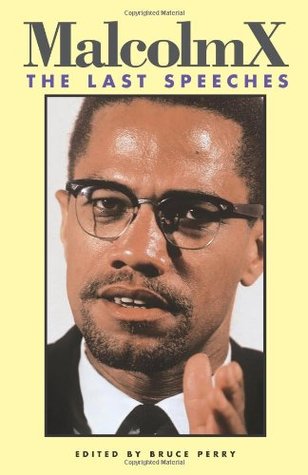
 If you read The Autobiography of Malcolm X, the most widely-read of the books about Malcolm, you will get an idea of the general development of his self-education in prison, and of his attraction to, and eventual prominence in, the Nation of Islam. This volume, in contrast, shows the speeches he made when he broke with the Nation of Islam and decided that the struggle for racial equality was tied to class struggles, and that this meant that people who were not Black could still be part of the fight that he believed was necessary. It shows his attraction to socialist ideas, and these are speeches that were not published until recently, when his widow found them buried amongst a lot of other things in storage, and called the publisher she wanted to distribute these ideas. If you read The Autobiography of Malcolm X, the most widely-read of the books about Malcolm, you will get an idea of the general development of his self-education in prison, and of his attraction to, and eventual prominence in, the Nation of Islam. This volume, in contrast, shows the speeches he made when he broke with the Nation of Islam and decided that the struggle for racial equality was tied to class struggles, and that this meant that people who were not Black could still be part of the fight that he believed was necessary. It shows his attraction to socialist ideas, and these are speeches that were not published until recently, when his widow found them buried amongst a lot of other things in storage, and called the publisher she wanted to distribute these ideas.
For example, for awhile there were posters and tee shirts available for sale showing Malcolm X and Dr. King standing together. The implication inherent in overemphasizing this photograph is that the two were comrades and brothers in struggle. I can’t believe the number of young people I taught believed that Malcolm “wanted peace”. Whereas this is true in the long run, it isn’t what he talked about. When middle class Caucasians were interviewed on TV and they pontificated that it was important for those Black demonstrators walking across the South, being confronted with tear gas, firehoses, police dogs, and arrest, to remain nonviolent, Malcolm responded, “I will be nonviolent when the White man is nonviolent.” In contrast to the ideas of Dr. King, Malcolm was ready to fight for his rights. It was in the last year of his life that he realized that the material interests of the entire working class dovetailed, and he targeted the ruling rich as his oppressors, (correctly so in my view), rather than blaming all members of any ethnicity or race. This was an enormous change from the belief system he had espoused while he was with the Nation of Islam. These speeches serve as the clearest documentation of this change. These speeches are important, though their context was quite different from today’s, because they break up the myth that mainstream media and US government sources have built up surrounding Malcolm X. If you can’t stamp out someone’s speeches and memory, what do you do instead? You co-opt them, sanitize them, find a way to make more in tune with what you wish they’d been. And that’s what has been done to Malcolm X’s legacy, by and large. For those who are seeing a big difference between his earlier speeches and the ones published here, it is not hypocrisy, it is development. It takes a lot of integrity for someone who is famous and controversial to admit he has been in error, and explain what his new viewpoint is, and why he has changed his way of thinking. If you don’t read this book, you will not know the whole evolution of the ideas and political program embraced by Malcolm X over the span of his life. All of this has more relevance than ever now that we are in the midst of a second, perhaps even more vital civil rights movement. Malcolm’s philosophy and political perspective should be widely read. He’s been gone for a long time, but nothing can kill his ideas, and we need them now. |
Category Archives: black rights
Life in Motion: An Unlikely Ballerina, by Misty Copeland ****-*****
 I rate this four stars for general audiences, five for those interested in the ballet.Misty Copeland, star ballerina with the American Ballet Theatre, wants us to know that when she enters a stage, she thinks, “This is for all the little brown girls.” And rightfully so. She is the first Black ballerina to rise to this level of prominence in twenty years, and the first ever to star in The Firebird.
I read this book free courtesy of Net Galley. I approached it not as a fan of ballet, but as an avid reader of autobiographies and memoirs. When I rate this book a five-star read, I do so not for a niche audience, but for anyone who enjoys reading stories of personal struggle, triumph, and success.
Copeland, who is racially mixed but identifies primarily as African-American, is famed for her work on the stage, but she can really write, too. I kept half an eye open to see if a byline or as-told-to would crop up somewhere. Copeland’s education was often disrupted by a chaotic childhood; her mother, a loving but apparently capricious individual who seems to have had terrible taste in men, had trouble staying in one place. Dramatic departures that took all of Misty’s “tribe” (her loving term for her siblings) in as co-conspirators, became a pattern, but they never seemed to leave the first “daddy” until Mama had a second one already waiting for them. How does a young woman whose life—and education—are tossed up and thrown down into increasingly tenuous situations , become this literate?
I can only conclude that the label of “prodigy”, one she heard from an early age, did not apply solely to her dancing talent, but also to her intellect and capacity to pick up information quickly.
Copeland begins her ballet training in California, in a working class neighborhood at the local Boys and Girls Club. Her ability is breathtaking, and a mentor arranges for her to receive further, more advanced training.
At one critical juncture, Copeland’s mother pulls another rip-up-our-roots-and-leave number, and the family, now nearly destitute, lands in a motel room in a seedy area. There are six children and their parent (and boyfriend, at first) living in a single room, and Misty survives emotionally by compartmentalizing her life, fronting at school as if her home is the same as everyone else’s, avoiding prurient details, and doing the same, more or less, at her beloved ballet lessons. (Her mentor is covering some expenses for her, but she does not know this at the time; she thinks it is all free.) Misty ‘s sisters and brothers are increasingly finding other places to spend the night; the integrity of the family is unraveling. Misty survives those nights in the grungy motel by looking forward to school and above all, ballet, the following day. That is, until her mother tells her to quit.
The mentor is having none of it. She confronts Misty’s mother and asks to bring Misty home with her instead. And with a poignant note of pain, Misty tells us, “She let me go.”
Turns out, it isn’t so bad that way. Life in the middle class opens up new possibilities for her, once she is in Cindy’s condo with her husband and toddler. She learns which fork to use, how to set a good table, and watches ballet on video. She has nice clothes and a full belly. Her confidence increases.
But visits back to the motel room to see the family are tense. She is perceived by her siblings and mother as arrogant. She has a new hairdo, and this sets off all sorts of bells and whistles. (Those of us who have been through foster parent training were told: never mess with the kid’s hair without checking with bio-mom first; for some reason, it is a button-pusher.)
After years in the bosom of a new and loving family, in which she is included to the extent of having studio portraits of a family of four framed on the walls, herself, the two new (Caucasian, Jewish) parents, and the little brother, her mother decides to take her back.
This reviewer has been there, and nearly wept at this juncture, though the author puts a professionally polished distance between the feelings she had then; those she had subsequently; and those she has now. Social workers will tell you that a parent who is more than ready to see a child go, a kid who is one more mouth to feed at least, and at times, maybe creates extra work or trouble, often sees their newly-acclimated offspring when they are successful and happy, and they suddenly want them back, as if they can pull a little piece of that success back to themselves. Maybe that’s what occurred here.
Perhaps other, less subjective reviewers may feel differently, but I was surprised to see Cindy wiped out of the story, more or less, once Misty went back to live in the motel, and then not brought back except peripherally at the end. I get it; this is a ballet memoir, but it’s also an autobiography, and when she tells us that she had “been seeing” Cindy and her family off and on, I wondered what kind of interactions took place, and whether she felt turmoil at such times.
One thing was sure, though: just as she took to ballet with remarkable speed and talent, she also took to Manhattan in a New York minute. Though it was expensive and hard to afford an apartment with any natural light or air, she hooked into the city, once invited to study, then perform there, and claimed it as her own.
But culturally and economically, she felt the disparity between herself and other dancers:
“Ballet has long been the province of the white and the wealthy. Our daily, toe-crushing exercises made pointe shoes as disposable as tissues, and they can cost as much as eighty dollars a pair. I came from a family that didn’t always have enough food to eat…[her peers] summered in Europe…their families had weekend homes.”
At one point in her development as a ballerina, when a bigoted reviewer indicates that she doesn’t fit in with the white dancers, members of the Harlem cultural community ask her why she doesn’t come there to dance instead. Why does she put herself through it, they wonder. And in time, she is formally invited to jump ship and come on board the Harlem dance organization.
But she has learned the negative lessons of her mother’s tendency to cut and run when adversity strikes, and she decides she will fight to maintain her position in the USA’s premier ballet company.
International fame follows, along with the opportunity to work with the musician Prince. And there is more, but I should leave a thing or two for the reader to discover.
I appreciated the author’s deft juggling of her personal story and her professional one, although of course they mesh in many places. There is never a point where the story drags or too much information (old grudges or love life details) make me want to skim.
Like the ballet, the story is lean, trim, and full of joy, despite hardship. You should read it.
Buck: A Memoir by M.K. Asante *****
|
There are spoilers coming. There’s just no other way to review this one. MK Asante was born in Zimbabwe, but the first time we meet him is in “Killadelphia, Pistolvania”. His family is out of control, and consequently, so is he. His brother is deep into gang life, running guns and drugs. By the time he is 12, MK has “favorite” porn artists, is sexually active, and doesn’t think twice before leaping into a stolen car alongside his brother, who goes by “Uzi”. He adores his brother. His brother is 16 and assumes that he won’t stay long behind bars for the things he does because he is a minor. We never learn for sure whether he is sent to live with a relative in Arizona to keep his influence from affecting MK (too late) or because the local heat has a real itch for him. Once he is there, however, he is tried as an adult for rape, for having sex with a 13 year old Caucasian. He thought she was 16. It’s a huge blow to everyone when he draws hard time. Let’s pause here a moment. If you know absolutely no street lexicon (USA), and if you regard the Philadelphia police force as brothers and comrades, keep your wallet in your pocket. If you aren’t sure, or have seen the cops in major metropolitan cities do low-income teenagers (and even those from the middle class) irreparable harm and no good (or not much), you might be in the right ballpark. I hope you are, because this is a powerhouse of a memoir. But there is no glossary, so for example, if the word “blunt” means something that is not sharp-edged, and nothing else, you may get dizzy and give up. If you don’t know the difference between “nigga” and the N word, and who can say it and who can’t, move on to the next selection on the shelf. But if these things have become either part of your own lexicon, or are familiar because of young people in your life who say them, you can read this just fine and Google any parts where you have difficulty. It’s well worth it. Oh, and lest I forget, here it is: YES! I got this book free, from the Goodreads giveaway. If this had been a lousy read, my gratuity would have been withholding my review. Nobody gets five stars out of me unless I think what they have to offer is worth five stars. The one question I have about this one, is where this urban jewel has been hanging for the last several years. All of hip-hop lyrics, the songs of urban protest, are from the 90’s. It is true that Tupac lives on forever, but in 2013, it seems to me that some years have gone missing nevertheless. I hope Random House hasn’t bought the rights to this book and then parked on it for awhile, and I hope it comes out soon. I began reading within 48 hours of the Trayvon Martin verdict. My own large family is multiracial, and my youngest son, who is African-American and 25, was just packing to move out of the house and in with some friends. Reading the first chapters of this book gave me such an anxiety attack that the man did well to get out of the house before I started sewing name tags into his hoodies and packing him a plastic lunch box to take to school and work. I’m exaggerating, but only a small amount. I think this is a time when family members of young Black men are watching their own closely and holding their breath. Carole/Amina, the mother who provides counterpoint to Malo’s (MK’s) narrative, is anxious too, but mental illness and a deteriorating marriage have deprived her of her voice. She loves her son, but has lost all authority and communication with him. She begs him to take care of her, and he recognizes, when his father leaves, that he is the “man of the family”. He has been deprived of his childhood somewhere along the way. He learns his mother’s thoughts only by reading her diary. He is chronically truant from the private Quaker school she and her husband have sent him to, but she isn’t worried about that. She isn’t worried about the fact that he and a friend regularly steal her car and ride around in it until dawn, even though he is way too young to even have a learner’s permit. I want to scream at her, “Why the hell not???” That’s the easy part. The school principal wants to talk to his family, but nobody is available. Ultimately, MK’s mother attempts suicide (not for the first time) and is institutionalized, as her daughter has already been. When she comes home, Malo’s father, a man known and respected as a civil rights activist and scholar, leaves her. His sole remaining child is enraged by his abdication. Every time his father loses control of the household, his response is absence. The hard part is to say, “What would you do here?” Can you correct the problem with social workers and foster homes? I don’t think so. Most foster kids vote with their feet. They stay for dinner, maybe try to round up some cash, then hit the bricks and don’t go back. Can you fix the problem with a good school? Yes, no, and maybe. I send my own children to a really wonderful alternative school. It has made a huge difference for my kids who were at risk, and also for the child who was always the perfect example. But if other things get bad quickly enough, the school can’t do a damn thing. The Quaker school was majority Caucasian at a time when the author of “Why Are All the Black Kids Sitting Together in the Cafeteria” says is actually when Black teens need an immersion experience to foster their sense of self. The Quaker school, though some of the staff appeared to mean well, either wrote Malo off as a bad seed (and face it, how many academics want to hear “fuck you” from an angry student?), or decided that he could not produce, as the high school basketball coach gives him permission to spend his class time shooting baskets if he’d prefer. A gym is a safer place than the streets…but what kind of education is that? Is this really the best a gifted young Black man can expect? Not only no, but hell no! The alternative school is one his mother finds after he has been arrested. He agrees to give it a try, and for (amazingly) the first time, he is asked in a friendly, personal yet not invasive environment to write something–anything. As a retired language arts and history teacher, I find this dreadful. Every kid should be given this type of opportunity. I am appalled by the public school teachers who flatly tell the students they don’t want to be there and only show up for the paycheck. Are they expecting the students to react with understanding? I taught in high poverty schools, too, and you can bet your bottom dollar that I apologized to my students if there wasn’t a desk for everyone, and I found a spot for everyone to sit down until I could rectify the situation. Malo was robbed both by the Quakers and the public school system. The alternative school helps him find his own voice. He discovers that until he has begun to read, he has no vocabulary, and without a good vocabulary, he wasn’t able to express himself. But the other critical factor is the reemergence of his father, who to be fair has been trying to call him, trying to get in touch with him, but Malo has been unable to forgive him for abandoning the family and leaving his mother to flounder unaided in an untenable situation. When Malo is arrested, he refuses to phone his father, not wanting to give into his own need, or to see his father’s disappointment. His father finds out and comes to pick him up anyway. And though I have given away a large part of his story, I will leave the climactic scene between the two of them for the reader. Later, Malo performs at a spoken word session when his girlfriend signs him up. The poem “Buck” is one of his own. He tells us that he finally understands why it was illegal to teach a slave to read and write, because there is so much power in the written word. And he decides that he wants to be a writer. He is. |
John Brown, by WEB DuBois *****
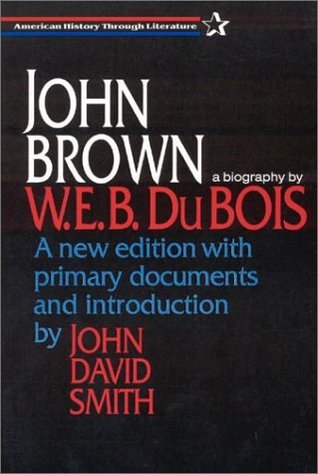 The class I took in college that featured John Brown as a small figure in American contemporary history dismissed him fairly quickly. He meant well, but was not stable, they said; in the end, he took extreme, hopeless measures that were destined for doom. He remained a hero to Black families (they admitted), South and North alike, as the first Caucasian man who was willing to die for the rights of Black people. Whereas many White folks (those with enough money for a fireplace and a portrait to go over it) featured a family ancestor or a painting of George Washington, Black homes often had a picture of John Brown.
The problem with that education is that no African-American scholars were included in this very central, pivotal part of the prelude to the American Civil War. I doubt anyone would doubt the credentials of this writer, whose urgent and compelling defense of Brown as a selfless but sane man with a perfectly good plan that went wrong due to a couple of the people in key positions of responsibility for the taking of Harper’s Ferry held my face close to the book (it is not the edition pictured; mine is so old, we’ve had it for so long, that the plastic lamination on the paperback has half peeled off, and it is not featured here!). The writer’s words forced me to read it, though I am no longer a student, with a pen in hand to underline and star key passages.
It’s tempting to leave it here, but I think I need to give you a couple of instances that may draw you, if you like history, care about the rights of Black people in the USA–because the oppression that started here is still not over (that’s me speaking; DuBois died in Ghana in 1963), if you are interested in the Civil War or Brown in particular, you have to read this book.
Tidbits that do not spoil, then: Harriet Tubman planned to be there with him. She became seriously ill and was confined to bed; otherwise, she meant to fight alongside him.
White writers have all assumed that his escape route was impossible. They have the WRONG escape route; DuBois explains the actual plan.
The Underground Railroad was run almost entirely by Black people, some of them wealthy, in the Northern US. DuBois points out that free Blacks owned over a million dollars worth of property, free and clear.
It was this same large body of free Blacks who provided the funding for Brown. He would have had more, if he had not become ill, and the loss of momentum removed most of his Canadian backers. Indeed, DuBois states that Brown most likely went to Harper’s Ferry physically ill and “racked with pain”, that he was very gaunt due to illness and poverty, but felt that to wait longer would be to lose his support and those he had gathered (a small group) for the initial attack.
To say might make you feel as if you have little reason to read this book. It is eloquently laid out as only a wordsmith such as DuBois is capable of doing. I am deeply sorry I waited so long to find time for it.
 Seattle Book Mama