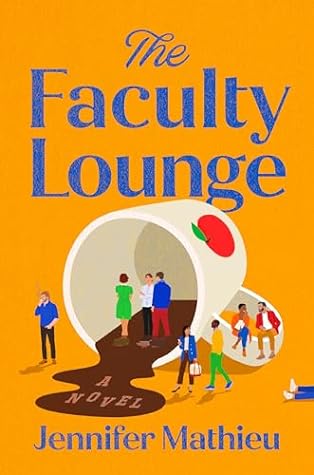
The Faculty Lounge, by Jennifer Mathieu****-*****

“You really had to hand it to Mr. Lehrer. While dying at work is never ideal, he had the decency to do it during his off period. And not only that, but at the start of it, too, giving the clerks in the main office plenty of time to find someone else to cover Ms. DeLaRosa’s Spanish II classes, even as they scrambled to figure out who should be telephoned when an eighty-two-year-old substitute teacher lies down on a ratty couch in a high school faculty lounge and dies. “

Jennifer Mathieu’s new novel, The Faculty Lounge, has been described as love letter to teachers. Though it is darkly funny in a number of places, the description isn’t wrong. By the ten percent mark, I had cackled out loud twice, it was so strangely accurate.

My thanks go to Penguin Group Dutton and NetGalley for the review copy. This book is for sale now.

Our school is Baldwin High, a Texas school with a solid reputation. After the stage is set, with poor Mr. Lehrer breathing his last breaths during his planning period, and another teacher being cranky when the paramedics make her leave before her photocopies are done so that they can work on him, the story is organized with a single chapter per character. Obviously there are a lot more people on Baldwin’s staff, but this method works quite nicely, and since the characters interact, the chapters that come later in the book are richer, because there’s more backstory to help us understand them.

The youngest teachers have grown up with the knowledge that they might be shot to death at school; first they grew aware of this when they were students, and now, as teachers, the danger is still there. While older staff members tend to be rattled by a lockdown, younger ones see it as almost routine. Take attendance, salute the flag, and whoops, there it is. Herd any students outside of your door into the room, then lock it. Everyone on the floor. Pull your window blinds. Wait till it’s over.

I appreciated every character in this book, and I was sorry when it ended.

There are crises at Baldwin, just as there always seem to be fires to put out in real schools; there are high maintenance parents with absurd complaints, as well as idiotic district directives. Bureaucrats! Toward the end, a veteran teacher explains to a newer one that some days, “the best you can do is show up and hang on.” So true! Your reviewer is retired from the profession, and I can recall a wise older teacher saying to me privately during difficult periods, “I’m here. And I’m dressed.”

The whole thing seems so familiar.

How much will this resonate to readers that aren’t educators? I have no idea, but I know that the in-jokes, the sense of the familiar, can’t be as strong. For a general readership, I’d say this is a four star read. Possibly this is true as well for those that have always taught early childhood, because many of the parameters are different. But for those of us that have taught middle and high school, particularly for those that are veterans, this is a solid five star read.

Cheerfully recommended to all, and highly recommended to veteran secondary teachers.

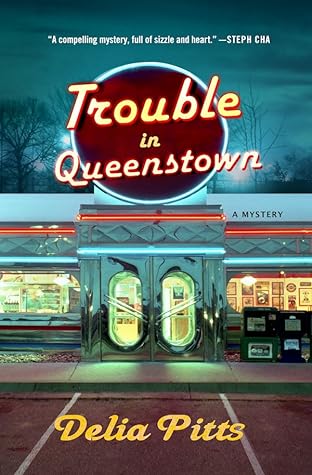
Trouble in Queenstown, by Delia Pitt***-****

Delia Pitts has been writing mysteries for quite some time, but she is new to me. In Trouble in Queenstown, she introduces hardboiled sleuth Evander Myrick. Myrick’s friends call her Vandy, and that helps to distinguish her from her elderly father for whom she is named; he’s in a memory care unit.

My thanks go to NetGalley, Macmillan Audio, and St. Martin’s Press for the review copies. This book is for sale now.

At first glance, I thought that this detective fiction was set in New Zealand. Queenstown, right? But in this case, the locale is Queenstown, New Jersey. The story opens with Vandy cleaning up a mess in her office just as Leo Hannah storms in and wants to see Evander Myrick. He assumes Myrick will be a Caucasian male, and that Myrick herself is a member of the cleaning staff.

Oops.

Hannah comes to hire Vandy in the wake of his wife’s murder. He knows exactly who did it, he tells her, and he wants her to prove it, starting with some surveillance. Vandy isn’t sure she should take this job, but she has to pay top dollar to keep her daddy in the best facility, so she reluctantly signs on. As the story progresses, there are numerous twists and turns, and the violence escalates. By the story’s end, three different people have tried to hire her for exactly the same case!

The thing I appreciate here is the way Pitts addresses cop racism. So many detective novels require the reader to suspend belief, to assume that every cop is fearlessly dedicated to finding out the unvarnished truth and arresting the perpetrator of the crime, regardless of race, ethnicity, or sexual orientation. But as Vandy conducts her investigation, Pitts keeps it real. At one point the detective speaks with a salon stylist that worked on Ivy’s hair, and he tells her that Ivy was afraid of someone at home. Vandy asks if he contacted the police.

“’The police?’ He jerked his neck, pursing his lips as if I’d farted. ‘Girl, you think the cops came here?’ He sniffed. ‘You don’t look like a fool. Maybe I read you wrong.’”

Sadly, the second half of the book doesn’t impress me as much as the first half does. I have a short list of tropes that I never want to see again in a mystery novel, and she trips a few, including my most hated one. I won’t go into details because it’s too far into the story, and I don’t want to spoil anything, but when it appears, I sit back, disengage from the text, and roll my eyes. Ohhh buh-ruther. As I continue reading, I can see who the murderer is well in advance, and the climax itself is a bit over the top, though without the tropes, I mightn’t have noticed this last issue.

In addition to the digital review copy, I have the audio. The reader does a fine job.

The more mysteries a person reads, the staler tropes become. I am perhaps more sensitive than most readers, having logged over a thousand novels in this genre. Readers that have not read many mysteries are less likely to be aware of, and therefore bothered by overused elements, and so this book may please you much more than it did me. But for hardened, crochety old readers such as myself, I recommend getting this book free or cheap, if you choose to read it. Newer readers may enjoy it enough to justify the sticker price.

Middletide, by Sarah Crouch*****

Sarah Crouch makes her authorial debut with Middletide, a mystery set in the Pacific Northwest near where she grew up. Atmospheric and tense, it’s a damn fine start to what is sure to be a promising career.

My thanks go to NetGalley and Atria Books for the invitation to read and review. This book is for sale now.

The premise is that Elijah Leith leaves home when he reaches adulthood, eager to flee his violent alcoholic father, and make a name for himself in San Francisco. But his father dies, and when his first novel goes nowhere and he runs out of money, Elijah returns and takes up residence in the cabin where he grew up. He hopes to rekindle a relationship with his teenage sweetheart, but she has moved on, and since he was unreliable the first time around, she is reluctant to trust him anyway.

Then the cops find the body of Dr. Erin Landry hanging from a tree on Elijah’s property.

This whodunit is original and intelligently written. The pacing is perfect, and I never would have guessed the ending, at least not until nearly the end when the author spells it out. Elijah is not the most lovable protagonist, but Crouch develops him so that, although not a prince or a hero, he is nonetheless a decent human being by the end. Some will consider the solution to be over the top, but it’s only far fetched if the author fails to convince us that it’s true, and I am persuaded.

Those looking for a fun read to pack for a vacation, or just to occupy a weekend at home, here you go. Grab your book, your lemonade or your whatever, and head for your happy place. You can thank me later.

Guilty Creatures, by Mikita Brottman*****

Tallahassee, Florida is a city with more than its share of horrifying murders, which Brottman tells us has earned it the nickname, “Tallanasty.” Is it something in the water? No, wait. That’s the gators. One thing that we know is true: in the far right, conservative Christian enclave there, two upstanding young people decided to forego the disgrace and humiliation of divorce by committing the perfect murder. One of their spouses would have an accident while out duck hunting, and he would never be heard from again.

My thanks go to NetGalley and Atria Books for the review copy. This book is for sale now.

The four of them met when they were just kids, and while attending a private Christian high school, they developed a tight bond. Mike and Denise, Brian and Kathy were constantly in one another’s company, and they stayed tight after graduation. The two couples married, and then they cut loose, the four of them partying and engaging in edgy sexual practices that could make an old lady school teacher like me blush. Mike, a hardworking young man from the working class, and Kathy, who wanted to start a family, were ready to settle down and behave themselves; Mike’s wife, Denise, and Kathy’s husband, Brian, were not. In a heartbeat they began carrying out an affair, making elaborate arrangements to avoid shame within their families, church, and community. Ultimately, they decided that Mike, who was a stickler for a structured life and extreme attention to even the smallest financial expenditures, simply had to go. They devised a plan to disappear him, and although suspicions were raised, they got away with the crime for nearly twenty years, when they turned on each other and all hell broke loose.

I had never heard of the case before reading this book, though the author tells us that it has received extensive media coverage. Brottman does a fine job of relaying the story, with perfect pacing and just enough attention to detail. There’s extensive documentation in the end notes, and she relies primarily on primary sources. It reads almost like narrative nonfiction, with suspense building to where I couldn’t look away during the last 25% of the story. This is especially impressive given that I can usually walk away from murder mysteries and thrillers at any time.

I seldom read true crime, and when I finished reading this book, I recalled why that’s so. While I was reading it, it was a fine, trashy wallow, steeping myself in the misdeeds of people that live lives very different from my own. It’s riveting stuff. But once I was done, I felt as though I should take a shower and perhaps gargle.

A little of this type of story goes a long way, but for those that love true crime, it’s a hard one to beat. Highly recommended for those that enjoy the genre.

Beep, by Bill Roorbach****

Beep is squirrel monkey, born and raised in the rain forest of Costa Rica. He’s not a baby anymore, and his old uncles have informed him that all the females are spoken for, and he must travel to a new area to mate and propagate. It’s tricky business, though, because human encroachment has separated the forests from one another, so Beep cannot get to the next forest without going through areas developed by humans. Beep’s odyssey takes him much farther than anyone imagined, and in the end, he finds fame and satisfaction.

My thanks go to NetGalley and Algonquin for the invitation to read and review. This book is for sale today.

Much of the book is devoted to the relationship that Beep develops with a human child named Inga. While traveling through neighborhoods, a bit lost and unsure where the next forest might be, he spots her eating some delicious fruits in her backyard, so he introduces himself in order to get lunch. Inga’s mother comes out and meets him also, and this passage provides an idea of the story’s character:

“’Squirrel monkey,” the mother said warmly, ‘Ooooh. They aren’t usually solo. Oooh, ooh. Keep your eyes peeled, there will be more.’

“Ugh, eyes peeled? ‘I’d like some fruit,’ I said clearly.

“’Oh, how charming,’ said the mother. ‘Hoo-hoo, monkey.’ She’d wiped most of yesterday’s blood from her lips, but at the edges of the enormous mouth some remained (probably she’d caught and eaten a bird). Also, part of her outer wrappings had come loose and her poor chest looked more distended than ever, wrapped in a bright banner of some kind. Somemonkey once said they look like us, but come on: they do not.”

But this is not Inga’s permanent home; she is on vacation. When her family returns to New York, which Beep calls Nyork, she smuggles him in with her carry-on items and it is in New York City that he meets fame after surviving several harrowing situations.

For the most part, I find this novel charming. There’s no need to concern ourselves about the credibility of the overall story line, because after all, we’ve begun with a monkey providing the narrative, so it’s clear that we just need to roll with it. It is funny in places, a bit dark in others, and then—as with the above quote—sometimes it’s darkly funny. Some of the reviews I’ve read take issue with the ending, but I’m good with it. My sole dissatisfaction, and unfortunately it’s one of my pet peeves, is Roorbach’s failure to develop Inga appropriately in keeping with her age. There’s a scene at the airport when she starts to cry because her stuffed animals are being taken away to be scanned by security, and another soon afterward where she is walking her doll buggy in Central Park, so I’m figuring she’s maybe six years old; but subsequent scenes make her seem much older, and finally we’re told that she’s eleven years old. It doesn’t take years of study to know that an eleven year old girl doesn’t wail about her stuffed animals or take her dolls for a walk in the park. Get real.

Happily, as the story unfolds from there, Inga settles into being a real eleven year old, and my irritability ebbs so that I can enjoy the rest of the book.

All told, this is a delightful read. Because of its dark characteristics, which I will not provide because they’d be spoilers, this is not a book to read to your little ones, but if you have a young Goth in your home who is able to read alternate spellings and dialects, then this book would likely be that kid’s happy place. The overall message is a worthy one, although Roorbach is probably not going to change hearts and minds about the environment, since those in favor of unchecked development in the face of environmental devastation and disaster aren’t going to buy this book. All told though, it’s a fine read for those that are ready for something a bit different and that can handle dark humor.

The Stepford Wives, by Ira Levin*****

Ira Levin, legendary novelist and playwright, published The Stepford Wives in 1972, a time when feminist ideas were at a fever pitch for many, and a frightening development for others. Women’s rights were at the forefront in a way that they had not been since the suffragists had won the right for women to vote over 50 years earlier. Now the book is re-released in audio format, at a time when the advances won during that time have been rolled back in some places, and appear to be under attack everywhere. So although I was already familiar with this book, I jumped at the chance to listen to it and promote it; I wish Levin was still alive today, because we can use men like him.

Version 1.0.0

My thanks go to NetGalley and Blackstone Audio for the review copy. This book is for sale now.

Stepford, Connecticut appears to be idyllic; beautiful homes; rolling lawns; good schools. There’s no crime to speak of in Stepford, and Joanna and Walter jump at the chance to move their young family away from the city and into a lovely new home. The children make friends almost immediately, but for Joanna, it’s a little harder. All the women are stay home mothers—not unusual in 1972—but they are insular, preferring housework and beauty regimens over any outside interests, including other women. She finds two women that are friendly, and that have moved here fairly recently themselves, and she turns to them for solidarity. But then one of them begins to change, and Joanna has become suspicious. Is it something in the water? Why are Stepford women such docile, ornamental drudges?

This is a brief book, more of a novella than a novel, and that’s part of what makes it so effective. Levin uses spare prose and doesn’t let anything clutter his central message. In doing so, he creates a more spine chilling effect than a more description laden, dialogue rich novel could have done. And once you read it, you’ll never forget it.

I highly recommend this classic work of horror for women and those that care about them.

Summers at the Saint, by Mary Kay Andrews****

Summers at the Saint is the latest novel by veteran author Mary Kay Andrews. I am not usually a fan of what I think of as light and fluffy books, but over the last couple of years, I’ve developed an appreciation for this author’s work. This story centers on a fashionable beach resort hotel and those that run it, with the focus primarily on the women. It’s a good summer read—not a bad choice to take to the beach, actually. My thanks go to NetGalley, Macmillan Audio, and St. Martin’s Press for the invitation to read and review. This book will be available to the public May 7, 2024.

Our protagonist is Traci Eddings, the young widow of Hoke Eddings, heir to the Saint Cecilia resort. Traci has inherited part of the business from her late husband, but there is a power struggle in play as the book opens. The old man is dying, and the surviving heirs are scheming. The business seems to be on the rocks, or near to it, and Traci can’t figure out why. She makes several smart changes, hires good people, and yet…

We have interesting side characters. Parrish is Traci’s niece, whom she persuades to postpone her studies for one more summer as Traci implements the changes that are needed. We have the new cook, Felice, as well as Livvy, a capable young woman that Traci hires away from the diner where she is waiting tables; and we have Livvy’s mother Shannon, who used to be Traci’s best friend. Shannon completely dumped Traci many years ago, leaving Traci bewildered and hurt; she still feels that way. Lastly we have Whelan, who is working at the Saint as a pretext while he tries to unravel the circumstances that led to the death of his younger brother at the resort’s pool many years ago.

The book’s strongest aspect is the side characters, particularly Felice, Shannon and Livvy. Other characters are one dimensional, either entirely good or entirely awful. Rather, this is a plot based book. There are a great many moving parts, with a blend of genres that include romance, mystery, beach reads, women’s fiction, and contemporary family drama. It is in weaving the many pieces of this story that Andrews’s experience shines through. If there is a plot element that conflicts with another, or that is simply illogical, I didn’t spot it. At the end, everything and everyone is accounted for; in fact, I might have preferred not to have every single aspect resolved, and every positive character quite so perfectly happy. I seldom argue in favor of ambiguity, but in this case, it wouldn’t hurt.

I was fortunate enough to receive both the Kindle and audio versions, and once more, Kathleen McInerney does a fine job of narration with all of the women characters and the internal monologue. Her voice isn’t deep enough to voice the men’s characters well, and I suggest adding a second, male narrator next time around.

The story held my attention quite nicely as I did my morning bike ride, and I recommend it to Andrews’s loyal readers, and to those that enjoy a good beach read.

The Backyard Bird Chronicles, by Amy Tan****

My thanks go to Net Galley and Alfred A. Knopf for the review copy. This book will be available to the public April 23, 2024.

I probably should have read the promotional blurb more carefully, because here’s a fact: I have very little interest in birds. But I saw the name Amy Tan, and her work is always wonderful; I figured that the birds would sometimes be metaphors for other things, and that there would be a significant nonbird component to her essays. However, this little book is exactly what the description indicates: a book about the birds she’s seen in her backyard, along with her very own illustrations. And so, even though the book is by an iconic author, I soon found my eyes glazing over. I tried changing sections, since sequential reading isn’t important here; no joy.

It’s really just birds.

So, as a general read for fans of Tan’s writing, I have to call this a three star read. However, as a niche read for birding aficionados, particularly in California, this might well be a five star read. I’ll split the difference and call if four stars.

Recommended to those that love birds and bird art.

Darling Girls, by Sally Hepworth****

Sally Hepworth writes creepy, spooky stories involving families, and I have friends that swear by her, but this is the first of her books that I’ve read. My thanks go to Macmillan Audio, St. Martin’s Press, and NetGalley for the invitation to read and review. This book will be available to the public April 23, 2024.

Jessica, Norah and Alicia are closer than most sisters, even though they are not biologically related. All three spent most of their formative years at an Australian foster home called Wild Meadows, under the gimlet eye of Miss Fairchild, an abusive foster parent. Miss Fairchild was adept at keeping up appearances, but once a visitor—an infrequent occurrence—was gone, the place got dark. The woman was cruel and unpredictable, dreaming up horrifying punishments for even slight perceived infractions. Open rebellion was unthinkable. But it was when she began accepting babies that they resolved to turn her in.

Now all are grown, but they remain tightly bonded, and the call comes in: bones have been found under the foundation of the razed house. They must all report to the local police, which in turn means returning to the vicinity of Wild Meadows.

I can see why this author has such a loyal following. The way the narrative flows is flawless, and although we transition often from the past to the present as well as between the three girls’ stories, there’s never even momentary confusion. The list of characters is kept manageable, and all of them are believable. I begin reading via audiobook because that’s the version that was offered me, but once I began, I asked for and received the digital galley also. Usually this is a necessity in order to keep up with what I am hearing, but I scarcely needed it. Narrator Jessica Clarke provides the perfect listening experience.

For me, the joy of this well written novel is somewhat dampened by the horrors of the girls’ experiences. The child abuse is so cruel, and so specific that I sometimes stopped listening early and went away with a ball of lead in my gut. I suspect that this is something most likely to be experienced either by those that were themselves abused as children, or—like me—those that have worked with such children. Although part of me still wanted to know what came next, another part of my thought that if I wanted this kind of nightmare, I should just go back to work!

Reader, you probably know what you can read and what you should stay away from. If this sort of novel is unlikely to haunt you, go for it. I doubt there are many that can do this thing better. With that caveat, this book is recommended to those that enjoy the genre.

Butt or Face? Volume 2, by Kari Lavelle****

This engaging little science book for early readers is a gem. My thanks go to Net Galley and Sourcebooks Landmark for the review copy. This book will be available to the public April 2, 2024.

The title is the content in a nutshell. One page has a large, sometimes whole page photograph, but we don’t know what animal it belongs to, or what end we’re looking at. These are cleverly chosen and stumped me about half the time. When I set it down, my spouse picked it up, began leafing through it, and I heard him say, “What? You’re kidding!”

There is no real story here. You open the book, and you leap right in. Picture, then the solution, right down the line. Whereas I like a bit of scaffolding and accompanying narrative myself, I also know that there are children that will prefer this book exactly the way that it’s written. Children in early elementary school that are in the stage of development in which they find potty jokes gut-bustingly funny will absolutely adore it.

I was previously unfamiliar with Lavelle’s work, and hadn’t seen the first in the series, but after perusing this one, I knew my grandsons had to have it, and since this one won’t be out till spring, I bought the first volume of Butt or Face for the second grader’s Christmas gift. That’s a strong endorsement.