Paris Never Leaves You, by Ellen Feldman**-***

2.5 stars rounded upward. I was invited to read and review this novel by Net Galley and St. Martin’s Press.

World War II fiction is a crowded place, and I have left it, for the most part, having had more than my fill. I am initially interested in this story because it takes place in 1950s New York, and that’s a setting I haven’t seen much. However, this setting alternates with the protagonist’s memories of Paris during the war, and so there I am again, back in Europe during the war.

Charlotte is a young widow, working in a bookstore to make ends meet. Her infant daughter, Vivi, is often with her. A German soldier is drawn to her, and she snubs him repeatedly, but when he brings food and milk for her starving child, she caves. When Vivi becomes sick, he smuggles in medication. Yes, this is one of those I-hate-you-but-I-love-you stories. This isn’t new; I’ve seen plenty of forbidden love stories, especially with regard to German soldiers. I’ve also seen plenty of love-hate romances.

But what strength I see in this one is in the grey areas. Is it all right to fraternize with the soldiers that are responsible for the deaths of loved ones, if those you’re befriended by can save other loved ones, particularly children? Is it all right to let someone think you’re Jewish, once the war is over, if that means they will save you? Is it acceptable to be Jewish, whether inobservant or otherwise, but pretend you are not, if it increases your odds of survival? What if that means taking other Jews prisoner, serving your enemy?

I’ve said this before in other reviews, and I’ll say it again here. It irritates the bejesus out of me, this World War II forbidden-romance storyline that is always, always, always between a Caucasian European, or Euro-American, and a German. Maybe someone has been wildly creative and included an Italian, but I haven’t seen it if they have. What do we never, never see? Ever? Never? (I could go on all night like this, and don’t provoke me or I’ll do it!) We never, ever see a WWII relationship between a Caucasian civilian from an Allied nation and a Japanese soldier. Or civilian. Or anything. It’s almost as if there’s a whispered subtext that insists, “It’s okay. After all, we’re both white, and that’s what really matters.” And authors that are far too progressive, too modern, too civilized to use any of the zillion ugly epithets that were common usage at the time by Allied service people and citizens toward Germans and Italians, nevertheless decide it’s somehow acceptably authentic to use the J word for Japanese. You know the one I mean. And Feldman is a serious offender here.

Because I was having trouble plodding through this story’s text, I visited Seattle Bibliocommons and borrowed the audio version. (Laurie Catherine Winkel does a fine job as the reader.)  I had listened to about seventy percent of this story when Charlotte has a conversation with her landlord, sponsor, etcetera about his own war experience, and boy does he pour it on. I think I must have found the J word on damn near every page, sometimes more than once. I nearly stopped reading, and I nearly gave this book a single star. I fast-forwarded a bit, and when the passage involving this veteran’s way-too-long speech ends, I don’t hear the word again, so I take a deep breath and forge onward to see how it ends.

The ending is bittersweet, and it’s not formulaic.

So there it is. This book is for sale now, but my advice is to either give it a miss, or read it for free or cheap. And if another forbidden WWII white-on-white romance turns up in my inbox, it’s going straight to my round file. Stick a fork in me, cause I am done.

One by One, by Ruth Ware*****

We can’t party this Halloween, but I have the perfect pandemic book for you. Ruth Ware has been called the modern Agatha Christie, and her latest mystery, One by One, is like a modern version of Dame Agatha’s And Then There Were None. There are plenty of differences, naturally, so you won’t be able to figure out the ending. Personally, I think it’s Ware’s best book to date, and when you curl up with it tomorrow, you’ll forget about your usual Halloween activities. Get your bag of treats, the beverage of your choice, and your favorite quilt, and you’re good for the evening.

 Big thanks go to Net Galley and Gallery Books for the review copy. This book is for sale now.

Erin and Danny work for a resort company, running a European ski chalet that caters to small companies and the well-to-do. A start-up company called Snoop schedules a retreat, but no sooner have the loud, entitled Snoopers disembarked and gone skiing, than an immense avalanche thunders down, leaving the vacationers stuck. Nobody can get cell service; everyone is grumpy. And one of them hasn’t come back from the slopes.

From there, things only get worse. At least there’s enough food to last awhile; but then the electricity goes off, and someone else is found dead in their room, most likely murdered! Oh, it surely isn’t pretty. Erin and Danny are scrambling, trying to improvise amid the bickering guests, whose in-groups are becoming more rigid; small hostilities increase. But it isn’t just about personalities; there’s a company buyout on the table, and a great deal of money is at stake. They have to hold everything together until the authorities can reach them.

This is a fun book, with lots of snappy dialogue and just the right number of variables. We backtrack after the murder is discovered, figuring out who was in the right place at the right time; and with the missing person still gone, it’s increasingly likely that we have two murders, not one. But as the alibis and witness statements unfold—all unofficially, since the cops can’t reach the chalet, which is still nearly buried in snow—it becomes evident that most of what’s offered is hearsay. Person A couldn’t have done this, because they were somewhere else. But…do we know for sure that’s true? They say so, but they could be lying. And as more murders and more stories unfold, we have a tasty little puzzle indeedy.

I have read and reviewed all but the first of Ware’s novels, and in each case I was drawn in, reading avidly, only to throw up my hands at the preposterous revelations and developments that I found in the last twenty percent of the book. But that doesn’t happen this time. I go all the way through it, and in the end the story stands up and I feel as if Ware has played fairly. The suspense is palpable and it builds steadily leading up to the climax. This is a good solid mystery, and I have new respect for this writer.

So there you go. Get your copy, and you can thank me later. But turn on the lights and lock the doors before you commence, cause this one is a humdinger.

Queenie Malone’s Paradise Hotel, by Ruth Hogan****

When I requested the galley for this book, I was taking a chance. I do love good historical fiction, but I seldom enjoy a cozy mystery, and this story is but a whisker away from being one. I was afraid the story might be cutesy instead of quirky, cloying instead of life affirming. And how delightful it is to be wrong! I received my copy free and early, thanks to Net Galley and Harper Collins. It’s for sale now.

The premise is that Tilda has returned to the town where she and her mother lived after her parents separated. She was an only child, and her mother is dead, and so it falls to Tilda to tie up the loose ends of her mother’s small estate. And at this point, my snark is already peeking its beady eyes out, saying Oh geez, another story that starts with an only child cleaning up the estate. Lots of those lately! And a mean mother? That’s got to be my number one eye-roller right now!  And I tell you these things, reader, because it underscores what a job Hogan had ahead of her in order to break down my resistance; and yet, she did.

The narrative is divided into two points of view which alternate. The first is young Tilly, the little girl that doesn’t understand what is happening between her parents, and is devastated when her father moves out. The second is the adult Tilda, whose capacity for trust in other people is limited.

The first part of the book is a hard read in places, because Tilly is in so much pain, and it feels drawn out, although one could argue that time passes more slowly when we are young. Tilly’s parents are always quarreling; then her daddy moves out, and Tilly, who was a daddy’s girl, takes out all of her hurt and rage on her mother. Her mother is brittle and not very stable, and she’s at wit’s end. First they move from the house where the family had lived to the hotel in the title; then, against her wishes, Tilly is sent off to boarding school. Tilly had loved living at the hotel and didn’t understand why she was exiled.

Tilda learns what her mother was thinking when she finds and reads the journals that her mother had left for her, and again, it’s not exactly an original device on the author’s part, but it’s done so well that it doesn’t matter. Tilda also finds one of her mother’s old friends, and she learns some things that way as well.  There are some genuine surprises that are also believable and fit the characters and setting. It’s artfully done.

As to the quirky bits, they are what makes the story unique and successful. For starters, Tilly (and Tilda) see ghosts, not just now and then, but in some cases regularly. Let’s take, for example, the little dog named Eli. Not everyone can see Eli; Tilly can, and some others can as well, but most cannot. And our suspicion that Eli is not a corporeal critter is affirmed by the fact that decades later, this woman still has exactly the same dog, and he is as spry as ever.

Then—and I have saved the best for last—there’s the child’s narrative. Tilly explains things to us in the language, and with the frame of reference, of a small child of six or seven years. She is a bright girl, but she’s a child, and so her explanations for things are often a bit twisted, and her conclusions are often far-fetched ones that are based on the limited amount that the girl understands. My favorite bits are the mondegreens, and there are many. (A mondegreen is the word or phrase that results from someone that hears words that aren’t in her vocabulary, and thus replaces them with words she does know; one well known example is the American Pledge of Allegiance, starting with “I led the pigeons to the flag.”) My favorite of Tilly’s mondegreens is when she attends church and sings “The Old Rubber Cross.” And the thing I love most about Tilly’s mondegreens is that Hogan doesn’t explain them or beat them to death; she drops them in and then moves on as if nothing unusual has occurred.

I started reading this book using the review copy provided me, but because I was running behind, I checked out the audio version at Seattle Bibliocommons when I was a short way in, and I alternated versions. I especially want to give a shout out to Jane Collingwood, who reads the audio version. I can think of no more challenging narration than that of a child. Collingwood had to sound like a little girl half the time, but nobody wants to hear an actor’s version of baby talk at all, and surely not for half of a novel, so she has to walk a very fine line, not sounding like an adult, but also not sounding inane. On top of that, she must also voice the adult version, sounding like the same child, except grown up.  It’s a tricky assignment and she carries it off perfectly; I tip my hat to her.

The ending is optimistic, yet credible. Those in need of a feel-good story—and there are an awful lot of us that do, right now—could do a whole lot worse. Recommended to those that enjoy quirky novels and historical fiction.

Behind the Red Door, by Megan Collins**-***

I enjoyed Collins’s debut, The Winter Sister, and so when I was invited to read and review this second novel, I jumped on it. My thanks go to Net Galley and Atria Books for the review copy. This book is for sale now.

Have you ever had someone in your life that’s a hot mess and makes terrible decisions, one after another? This felt a little bit like that, at least during the periods when I believed the character; and I did, some of the time. But whereas The Winter Sister held together beautifully until the implausible ending—a common issue with mysteries and thrillers—this one is riddled with difficulties throughout.

Fern had a traumatic childhood. Her father used her to conduct cruel experiments, deliberately terrifying his daughter in a variety of ways so that he could write about her responses. Now she’s grown and gone, though not surprisingly plagued by serious mental health issues, but healing nonetheless, and he summons her home. He says he needs her. Against the advice of stable people in her adult life, Fern packs her bags and comes a-runnin’. Who knows? Maybe her daddy wants to say sorry; perhaps he is terminally ill and set on making amends.

Well, um, no.

Upon her return, three terrible things happen almost immediately. First of all, her father, Ted, has not changed a bit, and he only called her back because he’s moving and doesn’t have time to pack. He wants her to pack for his move. He doesn’t plan to help pack his own crap, and he doesn’t plan to pay her for her time. Plus, he still plays cruel tricks on her, just like bad old times.

On top of this, her best friend’s sadistic brother, Cooper, is still around, and he’s still not a real nice guy. She discovers this almost immediately firsthand.

And on a trip to the store, she runs across a book, a memoir written by Astrid Sullivan. Flash! Bang! She knows that face, doesn’t she? Did she know Astrid?  Now Astrid has been murdered, and Fern has been having dreams about her, which might be flashbacks. Has she buried memories of the murder? And…WHO would have DONE such a thing?  Nobody SHE knows would do a mean thing like that! Unless…naw.

Oh dear.

The story is told in alternate narratives, Fern’s and Astrid’s, courtesy of her memoir. This method does build a sense of dread, but it feels a little choppy in the telling.  In addition, I had difficulty believing the character’s motivation. I could see reflexively running home—I’ve known people that would do the same—but what I cannot understand is why, when she found out what Ted’s big emergency was, she didn’t toss her bag back in her car, say Buh-bye and good luck with the move, and hightail it home.

There’s a lot of extraneous business here; we have Fern’s mental health problems, and on top of it all, she’s pregnant. (Oh, good idea. A baby. What could possibly go wrong?)

I believe Collins has a great book in her, but this isn’t it. That’s okay; back to the drawing board. Life is long. But reader, as for you, I recommend you either pass this one up, or read it free or cheap.

Anxious People, by Fredrik Backman*****

He’s done it again, only better.

My thanks go to Net Galley and Atria Books for the review copies. You can buy this book today, and I suggest you do it. The world around us may have gone nuts, but Backman helps us to remember the good in ourselves and in those around us, even in the most unlikely people. For that alone, this book is worth its weight in gold.

We start with an attempted robbery at a cashless bank; as with so many crimes done on impulse, nothing goes the way it’s supposed to. There’s no money to be robbed, and with the cops on the way, the best thing to do is to duck out quickly…until you realize that the door you chose isn’t an exit. Then there are these hostages, an insurance policy to prevent your being swept away to prison, but “it’s harder than you might think to take people hostage when they’re idiots.”

Backman often creates complex situations with huge numbers of characters in his novels, and he does better than hardly anyone else when he does it. This book, by contrast, has a more manageable number of characters, and perhaps that’s a big part of its even greater success. We have the robber; the hostages, who are the people viewing an apartment for sale, and the seller and realtor; a pair of cops that are also father and son; the therapist that sees one of the hostages; and a couple of other people. The first that we meet is Zara, a sharp-tongued, wealthy woman that is viewing the apartment even though she is obviously too rich to want it. Just about everything that comes out of Zara’s mouth is smart, mean, and very funny; we gradually learn that she does this to deflect the conversation away from herself. With apologies to Dickens, Zara is as solitary as an oyster.

Besides Zara, the prospective buyers include two dysfunctional couples. There’s an older couple, man and woman; and there’s a pair of women, one of whom is hugely pregnant. When this is revealed I roll my eyes, convinced that the climax is almost certainly going to include the obligatory emergency birth. But I should know better, by now, than to underestimate Backman.  He doesn’t use tired tropes or formulas, and Julia isn’t going to give birth during this crisis.

I don’t want to give away any of the details here, but as we get to know our collection of hostages and others, it’s pretty clear, as the title suggests, that everyone’s misbehaviors come from their anxieties, and when they criticize and pick away at others, they are actually dissatisfied with themselves. But of course, Backman’s writing is much more magical than my own, and the result is the sort of feel-good denouement that doesn’t insult our intelligence or become maudlin. At this moment I can only bring to mind three writers that consistently do this for us. (The other two are Alexander McCall Smith and Amy Poeppel.) And right now, friends, we need all of this magic that we can get.

Buy this book if you can; if your wallet is too thin right now, then get on the list at your library. Highly recommended to everyone.

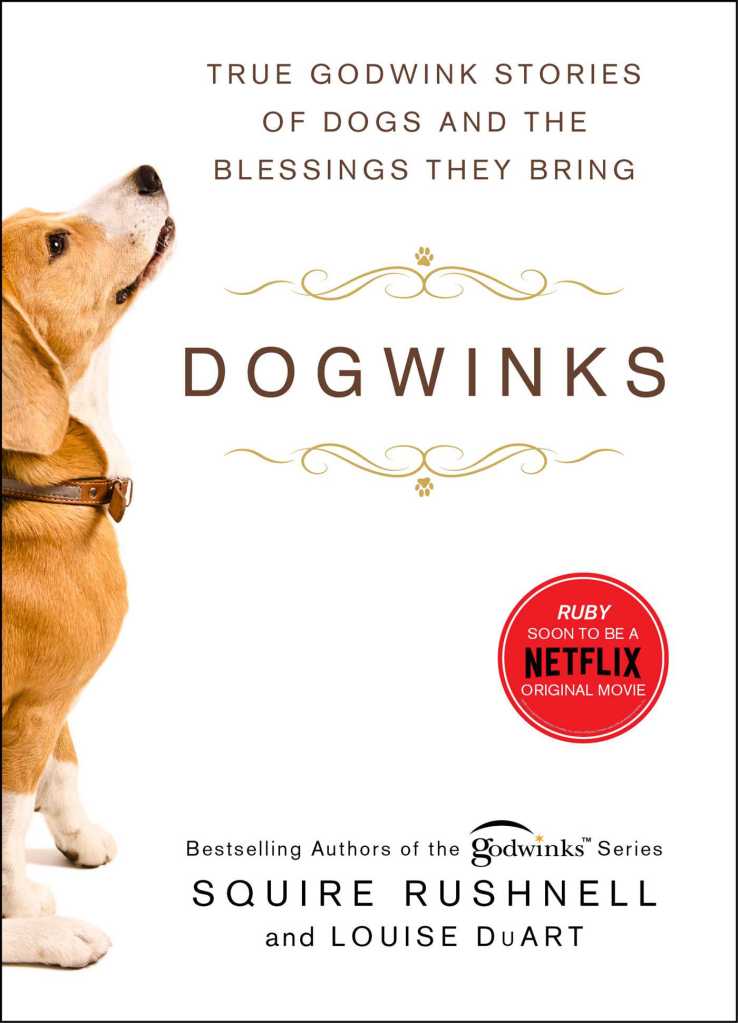
Dogwinks, by Squire Rushnell**

The old saw about not judging a book by its cover has come home to me in a big way. I was invited to read and review, and although I usually do some homework before accepting or disregarding such offers, I saw the beagle on the cover and leapt on the widget. And somewhere out there, at least one publicist must have my love of said dogs on file, because otherwise it would make absolutely, positively no sense to offer me this book. Dubious thanks go to Net Galley and Atria Books; I know you meant well. This book will be available to the public October 20, 2020.

Here’s the thing I didn’t understand when I signed on. This is not merely a book of dog stories, as I had supposed. Apparently, there is a “much-loved” series known as “Godwinks,” and so the title of this one is a play on that name. Since I read no religious material ever, it’s unsurprising that this fact eluded me.

Having foolishly committed myself, I tried to keep an open mind, because in addition to being religious in nature, this is also a collection of dog stories.  I want to be fair, and I hoped I could disregard the preaching and focus on the hounds.  But it’s impossible to enjoy these stories; the writing seems formulaic, the sort of thing you’d read in Reader’s Digest. The figurative language is stale, and the story arc of each is transparently manipulative. Guys, I just can’t.

By wild coincidence, my current reading includes Richard Dawkins’s The God Delusion, and I’m finding it to be better written and infinitely more agreeable than this superstitious bilge.

If you have a MAGA hat in your closet and a firm belief that your prayer group is protecting you from COVID19, then this collection may suit you down to the ground. Otherwise, I’d suggest you steer clear.

I Let You Go, by Clare Macintosh**

I read this book free and early; thanks go to Net Galley and Berkley for the review copy.

Ordinarily, a book that I don’t enjoy or admire gets reviewed when it’s released, the same way I would with a book I love. However, on this one, I choked. The protagonist is a woman who’s grieving the loss of her little boy, and the author’s notes mention that as she wrote it, she was thinking of her own child that had died. How do you pan a book like that? And so I made a conscious choice to bury it. It was released in 2016, and it is by far the oldest novel in my backlog.

Since that time, this book has made bestseller lists and received acclaim from far more auspicious (and lucrative) sources than this humble blogger, and I realized this evening that I can go ahead and write my review with little likelihood of rocking this writer’s world.

What I found is some competent use of setting, but the plot was all over the place, both choppy and unfocused. I realize it is the author’s intention to build suspense by revealing the past in increments, but it didn’t build suspense for me; I felt irritated instead. The protagonist never became real for me, and ultimately the story was mostly predictable, increments or no. There was tired figurative language and a lot of cliches and truisms. I looked everywhere for the magic, but I never did find it.

I don’t recommend this book to anyone but the author’s diehard readers. The good news is that you can probably score a used copy inexpensively by now, if you’re going to go there.

Louisiana Lucky, by Julia Pennell**

Three sisters buy a winning lottery ticket and it changes their lives. Thanks go to Net Galley and Atria Books for the review copy.

Every now and then, my collection of galleys gets too dark, and so I turn to Net Galley in search of humorous reading to lighten things up. This novel caught my eye with its engaging cover, and sadly, I didn’t realize that the cover was its only positive attribute.

The word choice, character development, and even basic ability to use correct grammar came up short here, and I find myself wondering what’s up with the editor? But even a strong editor can’t help this book, because there’s nothing to salvage. None of the sisters came alive for me, and the tired old trope about money not buying happiness draws an eyeroll of epic proportions. If my mama was right and my eyes could get stuck up there, this would surely have done it.

This book is for sale now, but I’d keep my card in my wallet if I were you.

You Are Not Alone, by Greer Hendricks and Sarah Pekkanen****

I read this novel free and early, thanks to Net Galley and St. Martin’s Press. It’s for sale now.

Shay Miller has watched a woman die, and now life will never be the same. She is alone in the big city, barely getting by like so many working class women. She is in love with her roommate but doesn’t rock the boat by propositioning him; she has no friends or family nearby. Then one terrible day, she is waiting for her subway when a sinister looking man turns in her direction. Imagine how glad she is to see Amanda, a normal-looking woman who’s also headed her way. But instead of providing the security Shay is hoping for, Amanda jumps onto the tracks in front of a moving train.

It happens so quickly!

Shay is the sort of person that relies on information to deal with stress. She has a little notebook, what she calls her “Data Book,” filled with all sorts of oddball statistics that she quotes from at the start of each chapter and throughout the novel. (Frankly, I could have lived without this feature, which began to feel like filler at times.) She deals with the stress of having witnessed a suicide by finding out every single detail she can about the late Amanda.

And this part is the hardest aspect for me to buy into. She’s haunted by what she saw; okay. Amanda looked a lot like Shay, which made her more fascinating to our protagonist. Fine. But the obsessive way she pursues information—even once she finds she has the dead woman’s necklace, which she had forgotten momentarily—doesn’t jibe with me. She goes to her apartment, visits the woman’s mom…huh. Go figure.

Now, once I quit rolling my eyes and allowed myself to buy this premise, things flowed a lot more smoothly. Cassandra and Jane, friends of Amanda’s, hold a memorial service for her, and it is by attending this event that Shay comes to know these two sisters. They are kind, they are solicitous, and they are caring. Before Shay knows it, they are her new best friends, and because she herself is a good person—if a little odd—it doesn’t occur to her that their motives might not be as benevolent as they pretend to be. They are the spiders, and she is the fly.

Here’s the thing I like best about this story. Shay’s character has to be rock solid for it to work, and once we get past the stupid parts at the beginning, it is. I half expected her to be dumb as a box of rocks all the way through, but not so much. The way she is developed, neither too unrealistically savvy nor ultra-naïve, is admirable. There’s a thin path through the middle between these two extremes, and I wondered if she would be the dithering idiot that has to be saved by someone smarter, but that’s not how it shakes out. There are a couple of loose threads that are left dangling, but it’s the way Shay’s character is crafted that wins the day.

Those that enjoyed this authorial pair’s other books will like this one too; those in search of a good beach read or a fun weekend book should consider this one. All told, big fun, and delightfully original.

Dear Emmie Blue, by Lia Louis***

I read this copy free and early, thanks to Net Galley and Atria Books. From time to time I find myself reading too much dark material, which is the direction I’m generally drawn toward. I found this title and thought that it might balance my selection. And for what it’s worth, it did that.

The premise here is that Emmie has fallen hard for a young man that she met years ago by pure chance. At age 16, she had written a secret that she needed to share on a scrap of paper, along with her email address, stuffed it into a balloon and launched it into space. (How does one get a slip of paper inside a helium balloon without losing the gas inside it? But let’s not dwell there.)  Rather than falling into the ocean and choking a seabird to death, the balloon makes it to dry land, and Lucas finds it. The two become fast friends, and as time progresses, she is sure they are meant to be more.  She is devastated to learn that his plans are different from hers.

This story is a quick read with lots of dialogue. One of my pet literary peeves right now, however, is the terrible-mother-who-ruins-everything. Oh. Come. On. You can do better than this. However, other aspects of the story are more congenial. In the end Emmie takes control of her own life, as she should have done all along, and good things result.

Those looking for a pleasant beach read could do worse. However, the publicist that compares this book to Eleanor Oliphant is Completely Fine is completely delusional.

It’s for sale now.