 That was the best horrible story I ever read. Holy War is set in Lebanon during the civil war. There are three protagonists whose stories and points of view interweave throughout this complex, highly literate novel. The plot centers on these individuals, each with one or more relationships whose ruin runs parallel to the destruction and chaos of Lebanon by various opposing forces (with the author’s emphasis on the religious disparity as opposed to the political differences, and indeed it’s a pretty fine distinction to make in this case). I requested the book from Net Galley because I haven’t read anything set in Lebanon. I am aware of the tendency of US citizens to focus over-much on our own enormous nation, and since I haven’t had the opportunity to travel beyond North America physically, I make a point to read contemporary novels set in other places. In this case, it paid off. I learned a good deal. I had never regarded Beirut as having once been a thriving cosmopolitan city; all I’d ever heard on the daily news in past years was “war-torn”. I live in a city that’s so scenic it’s nearly magical, and I am hard to impress when I travel. I have never thought of Beirut as having been lovely, but the writer describes it as breathtakingly beautiful, and the descriptions that he inserts into the story, without breaking stride in his pacing, convince me that it is much more than just some arid chunk of rock and sand. Bond makes the reader want to weep for Lebanon, and for the characters whose lives are coming undone as they attempt to do the right thing; this is considered different, naturally, by each of the protagonists. During the first third of the book, I was distracted by trying to figure out the writer’s political line. He doesn’t really have one, though, apart from the wish that this beleaguered place might have peace. I also initially wondered why all the sex and relationship material was jammed into what is otherwise essentially a thriller; then I began to see the parallels (although I could really, really live without ever seeing the “c” word applied to women’s anatomy ever again). In the end, inevitably, the protagonists find themselves in the same place together after having missed each other by mere inches at times throughout the story line. I won’t tell you how that plays out; you’ll have to see it for yourself. By the story’s end, though, each of the main characters seemed so utterly lost and hopeless to me that I found myself rooting for the dog, which was supposed to be peripheral. I engaged enough with Bond’s novel that I had to go look at a world map (and happily, we have one on the wall in our hallway) to see where exactly Lebanon is located. As it happens, Israel is smack in the center between Lebanon and Palestine; hence the struggle of the Lebanese Palestinians. I also found myself wondering why Britain (one protagonist‘s homeland) and France (another’s) feel they have any right to determine what happens here. There is no American protagonist, and yet I know the USA hasn’t exactly kept its hands off or its voice silent, either. But Lebanon is a tiny, tiny place, dwarfed by Syria, and practically a fly on the wall in contrast to Saudi Arabia. So why are all the big dogs interested in this tiny place? Are the Americans looking for a military base to replace the one they lost in Iran when Reza Pahlavi was chased away by the Iranian people? Or is there money involved? (At one place fairly early in Bond’s plot, a character says that wherever there is a war, profit is driving it, and I agree.) A trip to Wikipedia tells me that there’s oil in the Mediterranean. Hypothetically, then, the whole thing should be left to the countries that border the Mediterranean, but it would be naïve to believe it could shake out that way. And just as the great cedar forests of Lebanon have been razed for the betterment of Europe, one wonders just what shape the Mediterranean will be in once the next great oil disaster occurs there. Of course, you can read this book without examining all of those questions. It’s a fine read right on the surface level, but you’ll need a strong literacy level and full attention for it, regardless. This is not a beach read. It’s serious stuff. For those who enjoy a good thriller or have an interest in Beirut, you should get this book as soon as you can.
Author Archives: seattlebookmama

Red Hook, by Gabriel Cohen *****
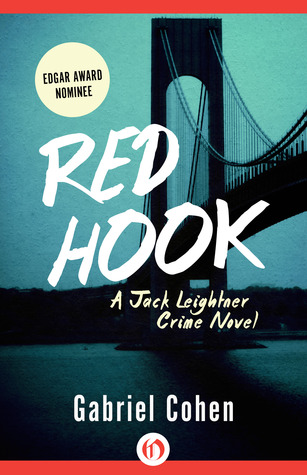 I am generally a six-book-at-a-time reader. I have different books in different rooms; books on my e-reader, paperbacks, and hard covers. Red Hook is one of those unusual books, though, that has kept me from my other reading. Once Net Galley gifted me with a free copy, the story picked me up by the front of my shirt and kept me reading, even when the normal demands of daily living beckoned. So you say it was nominated for the Edgar Award? Why am I not surprised?
No, there are no ghosties or hobgoblins or other supernatural things that go bump in the night, but the story packs enough goose pimples in the plot alone to make it an October-worthy read.
The story is police procedural in format, and bounces between two points of view, that of the protagonist, a New York City cop named Jack, and his son Ben, who lives close by, but with whom he has a remote relationship. Jack’s fear of losing control of himself stands in the way of his capacity to develop and maintain close relationships; to say more would be a spoiler.
Son Ben, now (barely) grown and 23, is a documentary film maker, and is interested in producing a documentary on Red Hook, the Brooklyn neighborhood in which his father grew up. Jack, on the other hand, has too many ghosts that await him there, and he avoids the place like the plague. And from there, the story builds to a place that may keep you awake long into the night.
Cohen does masterful work at developing character, plot, and pacing, and setting, while not quite as deft, is still stronger than most writers. This is a must-read for anyone who enjoys police procedurals. I look forward to reading the rest of his work.
The Counter-Revolution of 1776: Slave Resistance and the Origins of the United States of America, by Gerald Horne *****
| Generally I don’t review a book till I have read every last word. I make an exception only when I find work so excellent that I am convinced that if the book ended right where I am, right now (about 75 percent through, and of course I checked the sources), it would still be worth the full cover price. I will read the rest, but you need to know about this book RIGHT NOW.
Reading this galley, courtesy of the publisher, New York University, via Net Galley, made me feel as if the American history I studied as an undergraduate and then taught for twenty years in the public school system was so incomplete as to be incorrect. If you care about American history; if you have ever wondered why Black anger still runs so deep, especially in certain parts of the USA; if you scratched your head over parts of American history as it has been presented and the ways it did not make sense, then you must read this book. The fact is that America’s early Black population, as well as that of Blacks in the Caribbean, behaved with much more courage and savvy than they are given credit for in standard history texts. The role of Spain that Horne explains here, as well as that of the Catholic Church, and of the Cherokee people, is startling news. And the fact is, what I read here makes me ask questions about all sorts of other events, such as the Louisiana Purchase (the significance of having included Florida in the deal is a monster once this new information is merged with what we knew before), to the Trail of Tears and banishment of the Cherokee Nation from Georgia, to the question I was never able to adequately answer for my own bright students: “Where did the free Blacks come from?” It’s here. It’s all here. America’s students have been robbed, up to this point. If you are a teacher, you have to get this book, even if it means buying it out of your own pocket. You can’t tell the truth without this book! In reading this outstanding work, knowledge of basic place-name geography is critical. A lot of people these days have no idea, for example, where the Bahamas stand in relationship to North America, which US states are where, or even which European nations are closest to the Caribbean and the USA, and if you are fuzzy in this regard, you may need to pull out a map or grab a globe so that you can see how much that proximity matters. Those miles are important miles, and this information is massively different from what I was taught, and it is well enough documented that I am convinced it is true. And it makes so much sense. I can’t hold this review until I have finished the book. I want all scholars who have been stuck in the dark through wrongful and errant selection of information in their own educations to know this book is available, and that what it imparts is huge. Black students deserve to know the truth; their history in the US is not one of pure terror and subjugation; their ancestors fought, and they thought, and they behaved politically. This knowledge is a basic right, not only for them, but for anyone who cares about the truth! |
The Promise, by Ann Weisgarber *****
 Romance is not my genre, generally speaking. But for every generalization, there is an exception, and Ann Weisgarber’s The Promise is an exceptional novel. Set primarily in Galveston, Texas in 1900, it’s beautifully voiced. Other reviewers mentioned Willa Cather, and I could see some of that. My first thought was the similarity in tone to Helen Hooven Santmeyer’s epic And Ladies of the Club, one of my favorites.
Right about now I am required to tell you that I received this luscious hardcover novel absolutely free via the Goodreads.com first reads program. I hate doing that, because it implies that this is the source of my high rating and compliments. But if you check my first reads record (and I recently changed my privacy settings so that anyone can do that), you will see that I don’t routinely give high ratings or praise. If the cover letter asks me to write a review “if you like what you read here”, then I only review the book if my review will be a good one. If I am asked to review it no matter what, then that’s what I do. One of my ratings (over which the local newspaper here raved) was two stars, and another was so badly edited that I left the stars blank and documented the fact that the book needed extensive editing before it should be sold.
This touching story of a woman who is “ruined” and forced to leave town and marry down (an old expression and my own, not the writer’s) touched me in a way I can’t entirely understand. I generally carry a strong working class bias, and yet the first person story of this formerly pampered musician, a member of the intelligentsia during a time when such a thing was a rare luxury for women, really grabbed me from the start. Maybe it’s because it was so easy to imagine being that person. A different time period, a different set of rules, and hey…who knows?
The characters were all so tangible, so vivid, that I felt I could step into the pages and have a conversation with them. This is really strong writing.
So even if you aren’t one for romances generally, you might give this a try. The awards mentioned in the author’s blurb were what led me to take the chance. It’s what, back in the day, would have been called a three-hanky–story, because by the time you were finished sobbing, you’d have gone through three handkerchiefs. For you? Keep a box of facial tissues at the ready, and settle down by the fire, because once you’re more than halfway in, you’ll be there for the duration.(
Lucky Us, by Amy Bloom *****
This story is a winner. I defy anyone to read it and not love it! I was fortunate enough to read my copy free of charge from Net Galley, but sooner or later I will have to pony up and pay for Bloom’s work, because having read this little gem, I will follow her anywhere.
The setting is the Depression Era through the end of the second world war; the story takes place all over the United States, from the midwest to California to New York. The protagonist, Eve, and her sister, Iris are girls (and then women) who are what social workers euphemistically call people who have fallen through the safety net–not that much of one existed back then. Their father and Evie’s mother are almost more liabilities than assets, and from almost the get go, they are on their own.
A large cast of secondary but engaging characters weaves its way through the sisters’ adventures, but each is so believable, so palpable that there is never the slightest danger that the reader will mix one up with another, anymore than you might inadvertently mix up your own family and friends. These flawed but fascinating characters often do things that startle us, leave one’s jaw hanging (“Oh no, you DIDN’T just do that!) yet their behaviors are always consistent with what they have said and done before. Just as with a ne’er-do-well relative, I found myself sometimes grimly nodding and saying, “You know, it doesn’t surprise me a bit.”
Eve and Iris see others betray them and commit every possible venial sin and perhaps a few mortal ones into the bargain, and indeed, they themselves become charlatans, thieves, snake oil salesmen (of a sort) in order to survive. All of this is depicted with such a winning narrative, changing perspectives and yet never the overall truth.
In most circumstances, Eve is set apart in her effort, when possible, to do the right thing, and by her loyalty to those she loves best.
Ultimately of course, it is not the storyline or the setting that sets this story apart from whatever other fiction has recently been released. It is the voice, Bloom’s sassy, ironic, and sometimes devilishly understated narrative that hooks the reader, leaves us unable to let go till the last page is turned.
Bloom is an award winner for other work, and it wouldn’t surprise me at all if she receives another for this. If I were to compare her work with anyone’s, it would be Fannie Flagg, because of the character development and the whimsy.
In the end,I realized she does not mean the title to be entirely ironic. We are indeed lucky to have even flawed and difficult people in our lives. Loneliness is the ultimate cause of sorrow. Bloom convinced me that I am lucky too. What a wonderful message, and from a truly gifted writer! I can’t wait to read the rest of her work.
Tara Revisited: Women, War, and the Plantation Legend by Catherine Clinton *****
 |
First of all, if you are planning to visit Georgia with your family, don’t ask the tourist bureau to help you find Tara! It isn’t there. Neither is Scarlett or Mammy. They’re all fictional.
Thank you; I feel much better having cleared the air. But nobody can make it clearer than author Catherine Clinton, who bursts the myth of the antebellum belle and her loyal house-slaves better with greater heat and light than I have ever seen done by any one historian before. In a time of increasing apology and revisionism that makes the American Civil War seem to have been merely a dreadful misunderstanding, and that decreases the social and material weight of the slaves it freed, Clinton’s historical smack back to reality makes me want to stand up and cheer! And also to thank Net Galley and Abbeville Press for the ARC. Clinton focuses primarily on Southern women, but she takes just about all of the myths of the “Lost Cause” and puts them through the shredder, introducing them and their origins, and in a manner meticulous but never, ever dull, demonstrates why each of them is incorrect. She doesn’t pussyfoot or hesitate to call bigotry by its name, but the tone is of the compelling storyteller rather than that of the lecturer. In a day when Caucasian Americans sometimes carelessly discard the complaints of people of color as “playing the race card” without first examining to see whether it has in fact been called out righteously, this succinct yet thorough narrative is refreshing, as if someone has opened the windows and let some of the cobwebs sweep away. Clinton uses the voices of Southern women, both Caucasian and Black, and recognizes that there is a dearth of the latter, but she has turned over every possible rock and ferreted out every last resource in the back stacks of government libraries dating clear back to the WPA to access what is available. She also quotes Mary Chesnut, a Caucasian Southerner whose diary is a mainstay of Civil War historians, enough and in enough interesting ways to make me want to go dig up my own copy, which bored me to tears the first two times I tried to slog through it. Filtered through Clinton’s prose, it is a lively and interesting vantage point. And she quotes WEB DuBois, one of my greatest heroes. There is one area where most US historians dislike to tread (or are perhaps unaware), and I read on with interest (this being the field in which I taught for many years) to see whether she would go there. She did. Not many American historians can bring themselves to discuss the deepest Southern shame (and by extension, America’s for having accommodated it so long) of slave breeding, a practice done in no other part of the world. In a time in which slavery was dying out across Europe, US border states, which had difficulty growing crops year ‘round to sustain the (minimal but still existent) expenses incurred by slaves, had turned to trafficking in human flesh, going so far as to select who should sleep with whom out in the quarters so that they would have the best possible product to sell once the progeny was born and weaned. Clinton does not use the word “breeding”, but she does describe it accurately. She also points out that actually, most white Southern women did not lead the lives of idle privilege that the cinema would have us believe; though their lives were many times better than that of slaves, they had a large household to manage without the labor saving devices technology would bring. And of course, most white households were not those of planters. She discusses the various social crumbs that were dropped for less affluent whites by the aristocracy in order to keep them from crossing the color line in solidarity with other toilers. I usually must abbreviate my reviews for fear I will give away all the meaty parts of a book and leave the reader no real purpose in checking it out personally. There is no danger of that here. This narrative is so deftly and expertly crafted that I found myself bookmarking more than half of its pages, because so many had a salient fact, interesting quote, or well-turned interpretation. I constantly found myself thinking, “Yes!” When Clinton mentioned the Southern fear of “miscegenation”, or racial intermarriage, this reviewer could not help a small intake of breath, given that in other times, I would be deemed guilty and my husband would likely be dead. If you have any interest whatsoever in the American Civil War, you need this book. If women’s history is of interest to you, get this book. If you care about issues of race in the United States, there are two recently published books that should adorn your shelves and be next-read if you have not done so: this book is one, and Isabel Wilkerson’s The Warmth of Other Suns. In a sense, Wilkerson picks up where (chronologically) Clinton leaves off. And if you have already read Wilkerson, you still need to read Clinton. What are you waiting for? Get out your credit card and order the book. You won’t be sorry. |
|---|
How to Tell Toledo from the Night Sky, by Lydia Netzer *****
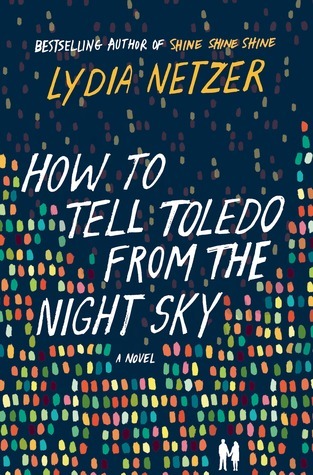
| Imagine a complete collection of the Great Books. Add in all those that have won Pulitzers and the National Book. Do you see room for one more? If not, you’ll need to grab the title you never really thought belonged in this collection and toss it. Now, go ahead and slide this title in there, because it is where How to Tell Toledo from the Night Sky belongs.
The story is about a pair of astronomers who were meant for one another on a whole lot of levels, but if, like me, astronomy bores you, this wonderful, quirky romance won’t. It contains a number of story elements that don’t usually appeal to me; the presence of a very unscientific sort of clairvoyance is one that usually causes me to close my book abruptly. This time, the story had me from hello, and it was going to take a lot more than that to turn me away. In the end, I didn’t want to. I received my copy electronically via Net Galley in exchange for a review. I’ve read and written about dozens of free books either there or via the Goodreads first reads program, and I have never suggested that any other book was worthy of a place among the timeless classics by which we define ourselves as a society and pass down to our children. I’ve read some really good books, but I haven’t read one this great in years. The suggestion that ancient Babylon was once where Toledo is seems a bit cheeky in some ways; typically American to assume it must be here somewhere. Those who hail from other countries won’t find it nearly so disturbing, I imagine, as will New Yorkers. But for our story’s purpose, the setting shouldn’t be anywhere except Toledo. Irene, the protagonist, returns to Toledo from her position in the south to take a prestigious position. She also arrives in time to deal with her dead mother’s remains and clean out the house. Don’t miss it. |
S Street Rising: Crack, Murder, and Redemption in D.C. by Ruben Castaneda *****
 This book is remarkable, and I am not the tiniest bit surprised that its writer has won multiple awards. He began life as a journalist, and in part, that’s what this is about. It is a memoir at least four times over. Seamlessly, Castaneda weaves the history of S Street, a formerly down-and-out part of Washington, DC that holds deep personal meaning for him; his own personal story ; the history of local police and in particular, the use of gratuitous violence and what happens to those who try to shut that shit down; and also the memoir of a local street ministry and after school program linked to S Street and the area’s revival. It is braided together evenly and I cannot find a flaw in it (and I am picky). At the end, he ties the whole thing together and puts a bow on it, and my jaw dropped. Did he just do that? Yes, he did! Many thanks to Net Galley and Bloomsbury USA for the DRC. My initial thought was that it takes titanium cojones to not only write about the DC crack epidemic while being addicted to it (as well as alcohol), and THEN to come out and write a risky but much lauded magazine article about his own journey doing same, and his subsequent recovery (sixteen years, at the time this was written), and then, after all of that, to write a book about it. But it’s not just about guts. There are multiple essential messages he wants us to receive, and his strong word-smithery and pacing make it easy to keep turning the pages. The narrative is smooth as glass, transitions so natural they are hard to find. Twice I went back to the opening pages to make sure this was actually nonfiction, because it bears the crafting of a well-paced thriller. And it is highlighted by the journalistic integrity of the writer in what he recognizes is a dying craft: the investigative newspaper reporter. Looking through the pages of my own city’s less-than-laudable local press as well as TV news coverage, I see two types of journalists, for the greater part. One is the phone-it-in writer. Typically, it is an article about a corporation or organization and the subject of the piece has really done the writing. It shows up as news without anybody double checking the self-aggrandizement done by the firm in question. Easy story. The other is the heartless story-at-all-costs. Castaneda confesses to being an adrenaline junkie, and the reader must recognize that to keep the hours a journalist keeps for the salary provided, there would have to be a secondary payoff, that of satisfaction. But I do see journalists who go too far, the ones who will approach a mother whose babies have perished in a fire moments before, stick a microphone in her face, and bark, “Tell us how you are feeling at this time, ma’am.” Our author has a couple of sticky ethical decisions he has to make, decisions of integrity versus alpha-journalistic behavior, and he comes down more often than not on the side of the angels, and at least once, he does so at great cost to his career. This is really admirable. I have read over 200 memoirs, and yet there has never been one like this one. I cannot recommend it highly enough. |
The Nanny Diaries, by Emma McLaughlin and Nicola Kraus ****
| This was an awesome vacation read. I got it (as often happens) purely by chance, and I found it hugely entertaining.
This is written by two actual former nannies who have removed all the names and created a sort of amalgam of the typical “Type A” nanny experience. I was fascinated by the coded language that makes the very rich able to look themselves in the mirror every morning and value themselves for doing absolutely nothing, including take care of their own child, at all, ever, despite his or her desperate needs, and their capacity to utterly dominate the lives of their servants, even when clear boundaries have been initially set as to times they are supposed to be working. It sounds like a nightmarish story, and in some ways it is at its most dreadful peak, but it is put together with such wry, deft storytelling that one feels one is at a slumber party getting the juicy tale rather than being dragged through the muck by the overly entitled wealthy New York jet set. I found myself going to sleep later and later on my trip because frankly, who could put it down? I can’t give it the fifth star, because I am one of those finicky reviewers who has to limit that category to literature that is amazing, either in its timelessness or occasionally, because it made me laugh sooo hard, or actually changed my world view. But what this is, is a really fun romp. And for those of you on this site while your nanny is keeping your child from making any noise in the house or touching any furniture outside his or her room…go be a parent! |
The Lost Get-Back Boogie, by James Lee Burke *****
Whoa. Okay. I can’t BELIEVE what it says in the preface, that this novel was REJECTED 111 times…and then nominated for the Pulitzer. It’s raw, it’s vivid, and in places so painful that I had to read it in small jags at a time to break it up. That’s okay; it made this excellent novel last longer.
This is not a recent publication, but it’s one that has stood the test of time. It is also one of the first novels I read by this writer, and I became such a fan that I went back and read his entire Dave Robicheaux detective series in order. Sooner or later I will enter those books here, but for now, this stand-alone story is one of the best I have ever read, and it gives me an easy way to make sure this outstanding writer is on my blog somewhere.
Here it is clear that the protagonist (and likely the writer) has ABSOLUTELY NO use for the American prison system or cops in general, though he is careful to avoid stereotyping his characters, and even his bad guys have their better moments as well. Since I agree with his perspective, I found myself nodding in synch with the bald, raw statements made by the narrator as well as multiple characters within the story line.
But the guy is no bleeding heart; he also recognizes that people sometimes make some terrible choices to get inside those walls, and that those newly emerged often wreak a lot of damage to themselves and sometimes to others before they hit their stride, supposing that they do.
This is brilliantly written, and I don’t know what more to add to those who say that it is as much fun to read what he leaves unsaid as what he says outright. This early work shows a real gift, and it’s fun to go back and find out where he started.

