Unknown's avatar

About seattlebookmama

Greetings! I am Donna Davis, a retired teacher living in my favorite city in the world. I've found that one of the greatest comforts in life is a good book. We can all use a little of that. Welcome, and enjoy! Donna Seattle Book Mama

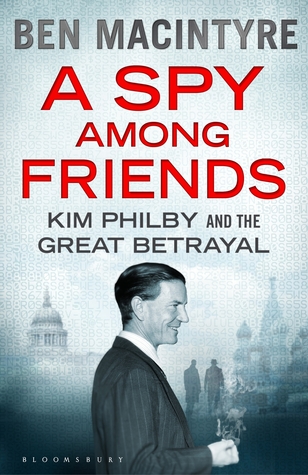
A Spy Among Friends: Kim Philby and the Great Betrayal, by Ben Macintyre *****

A Spy Among Us Kim Philby     This was a real page-turner, which says a lot, given that I already knew how it would end. I read the historical fiction version by another author and was fascinated by it, but also wondered what was fact and what was invented. Macintyre take his job so seriously that 25% of the book is citations. You KNOW he’s not making this up!

A great big thank you goes to Net Galley and Crown Publishers for the free read; that said, yes, this one is worth buying. I haven’t read anything else by Macintyre, but now that I have seen what he can do, he’ll be on my to-read list!

Kim Philby is considered by many to have been the world’s greatest spy. Perhaps the phrase should be “best known spy”, since the best spies are never found out. But that’s a digression. The fact is that this British-born, upper-class man was drawn to the ideas of Bolshevism at exactly the time that Lenin’s legacy became corrupted and Stalin held sway. It didn’t matter to Philby, nor did the purges and the reign of terror that occurred when Stalin went slightly bonkers and began seeing betrayal in every corner, executing lifelong friends over imagined treason. And one has to wonder, given the level of material comfort and exclusive old-boy club pampering that Philby enjoyed on the ground, exactly how much he truly believed in the class struggle, and how much of what he did was done for the sheer joy of deceit and skullduggery.

The most amazing thing to me, in reading this excellent, compelling narrative, was how much he did and how many lives he cost before he was discovered, and even then, that his life was spared. I can well understand that the British government preferred not to endure the public humiliation of having its grievous errors known to the world. Why they didn’t cap the guy behind the ear or arrange for a dreadful tragedy is harder to understand. And it all boils down to class: Elliott, who believed himself to be Philby’s closest friend for decades, from fresh-scrubbed youth to middle age, simply said, when later interviewed, that Philby was “One of us.”

If you are a U.S. citizen and are patting yourself on the back because you live in a ‘meritocracy’ in which antiquated notions like breeding are not factored into one’s fate, think again. How many millionaires, let alone billionaires, do you see on Death Row in the US of A?

Exactly.

The skill of the writer became most apparent to me when I read the ending, including a passage by the famous John le Carre. The passages in which Elliott is quoted verbatim set my teeth on edge. What a detestable individual, so smug! “Stiff upper lip” indeed. A stick stuck somewhere else came to mind.

Yet Mcintyre reinvents him in order for us to have a sympathetic protagonist to offset our villain. His nonfiction narrative reads like a spy thriller; in making his text as readable as well written fiction, he joins the formidable ranks of Barbara Tuchman and Isobel Wilkerson. Not many people are capable of such pacing and plot-spinning when confined by the actual facts.

Highly recommended to general audiences.

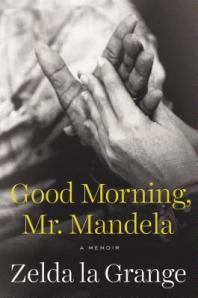
Good Morning, Mr. Mandela! by Zelda la Grange *****

Good Morning Mr MandelaZelda la Grange, an Africaner, grew up in South Africa under apartheid. Her family was steadfastly right-wing, and she was brought up to believe that Africaners were fighting against the “black communists”. She had been taught to fear them. The family servant, Jogabeth, was black, but she fell into a slightly different category, since she had a large role in raising la Grange while her parents, who were low income and struggled financially despite their white privilege, were working. But Jogabeth was not permitted to touch Zelda’s skin. When Zelda needed carrying, she climbed on the woman’s back, but already knew not to touch her hair, her hands.

It might rub off. It might soil her.
When she was finished with school, she got a secretarial position in the government, and it was there that she found herself working for a new president after the death of apartheid. She worked for Nelson Mandela’s personal assistant. White South Africa was in turmoil; some Africaners were progressive and welcomed the change, but her own family was outraged and frightened. La Grange needed her job and assured herself that because she was fairly far down the food chain, she would likely never actually see President Mandela.
And the very thought of running into Black people in positions of authority terrified her. How much must they hate her and all of the Africaners who had kept them down for so long? Would they hurt her? And when the day finally came that she saw the president, she kept on moving, eyes averted, but he asked one of his staff to bring her in for a conversation.

When she arrived, she burst into tears of mortification and fear. He took her hand, ending her lifelong habit of never touching a black man before she even realized what she was doing, and he made a point of holding that hand until he was ready to give it back to her. And in his kindly, genial manner, he told her, as she stood sobbing in terror before him, that she was overreacting. It would not be the last time he would tell her this.
When I began reading la Grange’s memoir, I was initially disappointed. She spoke of her own life and told the reader that this was not Mandela’s memoir but her own. I didn’t want to read about the daily doings of some Africaner functionary. If I hadn’t received the book in exchange for a review, I’d have abandoned it, and it would have been my loss. Because soon after she found herself working for Madiba, her job became inextricably intertwined with his, and it continued through his retirement. Her life was, in many ways, his life. But because Mandela did not address his presidency when he wrote Long Walk to Freedom, and because he would never brag or dwell upon his own successes unless they were important historically, her story about life with him is different from his own. And because he would never name-drop, she does it for him.
I reflected upon his choice of la Grange when he chose the entourage with which he would travel. He made a point of having a multi-hued staff around him, blacks, browns, golden toned and Africaner. She and a professor were the two Africaners he chose. So initially, he had just wanted her to be the Africaner who would represent her own race and culture on the new presidential staff. And it was a smart move. A man in his position must watch constantly for security risks. When choosing an Africaner for the staff, he needed not only someone who was organized, hard working, and competent—which she was. He also needed the least likely individual to be an assassin! La Grange describes herself as very young (I think she was short of age 20), but also shy and much inclined to blushing. Duplicity was beyond her. She also says she was plain looking and overweight.
Madiba was a really smart guy. He understood that her youth made her more malleable than some, and that she was no part of anyone’s plan for a coup. In time she replaced his private secretary, and over the course of twenty remarkable years, she developed a steel spine as she became the gate-keeper to Mr. Mandela both during his presidency and after his retirement.
La Grange has a lot of stories to tell. She traveled with Madiba to many places, and tells of his friendships with other members of royal families abroad, with celebrities, and with ordinary people. She also speaks of his tireless effort, even after the age of 80, to raise funds for clinics (especially for AIDS patients) and schools in what was still an underdeveloped nation. There was (and probably still is) a tremendous amount of corruption in government, but Madiba was completely clean, as one might expect, and made a point to keep his charity funds separate from those of the government. His travel abroad and frequent appearances sometimes caused political friction with those who succeeded him, who felt he had no right to speak for South Africa anymore; Madiba insisted he spoke for himself alone. And la Grange points out that it was the ANC that chose to make him the icon of anti-apartheid struggle, and thus they had no business complaining when international figures asked for Madiba rather than Mbeki or others who currently held office.
There is a part I skipped through at the beginning that explains what apartheid was, and how it affected the lives of those who lived under it. I didn’t read it because there was nothing there I didn’t know; I was an anti-apartheid activist once myself. But for those who were too young to recall it or whose attention was elsewhere, it may help plug the gaps.
But the vast majority of her story is of her life with Nelson Mandela. For two decades she was on the go, 24/7, and served at such a frenetic pace that she often could not take 20 minutes for a meal. The phone often rang in the middle of the night, and sometimes she worked all night long as well. Her transformation and dedication were complete.
At the very end, a fracture within Mandela’s family formed, and a couple of his daughters decided that she could no longer see him, but she had been there for him right up until he was well into his decline. The memories she shares are ones you will find nowhere else; Madiba had attempted to write a second memoir, but was unable to complete it. And even had he done so, he would not have proudly told the world about the good that he did the way that la Grange does for him.
Highly recommended to everyone.

Bringing Down the House: The Inside Story of Six MIT Students Who Took Vegas for Millions, by Ben Mezrich****

Suspenseful and great fun; nonfiction. My son has a good friend who has been a professional gambler for years. He doesn’t do what these guys do, though, because it’s true, you do become unwelcome once you have won too many times, or if you come in as a team.(It seems credible, too, that it might be illegal to signal someone to come join a card game at the very moment you know the shoe is loaded with face cards and aces).

It’s an exciting book to read–and I’ve read it twice–simply because it is so daring, and Vegas seems like such a powerful entity to challenge. I am glad the writer did not include all the casino names and the minutiae that others seemed to crave. For one thing, the urban topography of Vegas changes constantly. The MGM burns to the ground, is rebuilt further up the street. A couple of casinos don’t do well and go under, but then Steve Winn throws up some brand new ones…I think if the writer had become too specific with each and every casino, color scheme, manager’s name, etc., it would have become irrelevant within a year, as employees change, walls are repainted, casinos are razed to put up mega-casinos.

For the rare few, like the fellow I know, who have such brilliant memories and math skill that they always remember what each player at a table has played and how many face cards and aces have shown out of a six-deck shoe (set of cards the casino uses for its patrons), the only way to win consistently, though of course not every time, since luck is a factor, is to go and play at tables with other players, never against the house. Our friend of the family also makes it a point to order one strong drink and nurse it steadily throughout the night, so everybody else is drunk and he is sober.

This reviewer, being a liberal arts type and no kind of math wizard, spent an entire week in Vegas once and did not gamble a single penny. Saw lots of great shows, watched other people bet astonishing amounts of money…and then went out to eat somewhere awesome. I spent a lot of money, but lost none of it. But teachers are generally sensible that way.

Obviously, this book was not published because of the writer’s skill with prose, but with such an interesting story to tell, I am glad it was published. I greatly enjoyed it, and passed my copy on to a couple of friends before I sent it to a charity used-book sale. This is light reading, but also a page-turner. If it sounds like something you might enjoy, read it. Just don’t regard it as an instructional manual that will lead to great riches, unless your skills are similar to those of the folks at MIT.

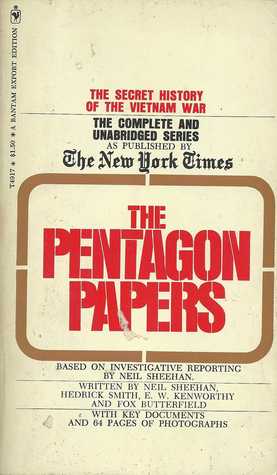
The Pentagon Papers: The Complete and Unabridged Series as Published by the New York Times, by Neil Sheehan *****

The Pentagon PapersThis book is a MEAL. Undertake it for purposes of research, or if, like me, you feel the need to own and read a set of government documents that the US government tried so hard to keep its citizens from seeing. The documents themselves are not written to entertain or to be readable; they were written candidly in most cases, under the assumption they would remain of limited availability.

Parts of these lengthy epistles have been edited down and quoted from by Neil Sheehan, the New York Times journalist who fought to get them and make them accessible to the public. I was just a kid myself when the earthshaking ruling by the U.S. Supreme Court came down saying that the documents should be printed and available, and I used my lunch money to hustle down to the local bookstore as soon as it was out in paperback. I have that copy still.

Some of the scariest moments come in memorandums discussing the possibility of using nuclear weapons on the Vietnamese. The dryly written notes about a policy toward “exfoliation” belies the human and environmental holocaust Washington brought down when it became clear that the Vietnamese people actually did NOT want a Western-style government, and that the only way to force it upon them was to destroy the jungles in which they hid.

One plan considered is to withdraw the bombing raids from Hanoi and Haiphong Harbor. Too many pilots are being killed, and it takes a long time to train a pilot. That’s the actual reason, along with a desire not to ramp up aggression toward the Chinese.

HOWEVER, the plan is to tell the American people (“the public”) that the bombings have been moved from north to south because all the targets that were bombed in the north were destroyed. There is discussion about the fact that this is untrue, but would look better in the press.

Small wonder the US government fought so hard to suppress these damning documents! The loss of credibility and innocent trust toward government in the USA did not start with the Watergate break in; it started during the US war against Vietnam.

There is a point at which it is acknowledged (in a document, not by paraphrasing), that the only reason the US government remains in Vietnam is to prevent US “humiliation”, even though the KIA (“Killed In Action”) figures are projected to be 1,000 US lives lost (and of course innumerable Vietnamese, 80% of whom will be civilians) per month. Even General Westmoreland, the most tireless advocate for more troops, calling up the reserves if necessary, cannot project a date the U.S. can declare a victory, or even gracefully withdraw without a clear and obvious loss of this war.

The risk of staying in: possible war with China, also “world-wide revulsion against us” (Memorandum #96, prepared by John McNaughton for Sec. of Defense McNamara, who would become disillusioned with the whole mess and advocate for withdrawal).

The guerilla fighters in the mountains are at one point compared (Memorandum #101, p.447) to the Irish freedom fighters who were defeated after WWI.

This tome is a treasure trove of primary documents, and the NY Times narrative is carefully written to honor the original meanings of quotations that have been pieced together and make it possible to publish the events and documents in a single volume. Don’t bother with it unless you have a serious interest in the US war against the people of Vietnam, and the deceit regarding same of the American people whose tax money paid for it.

I have seldom stayed with a book so difficult for so long when there was no academic requirement involved. I began this book for the second time (didn’t finish it the first time, when I bought it) in Oct. 2012. Because it was so dense and important, and because I didn’t want my mind to wander, I only read a few pages daily till I hit page 500. At that point I picked up a pen and could not put it down. I have no idea why this is so, but I just HAD to finish it. I did that in May 2013, and am glad I followed through.

Calling, by Joe Samuel Starnes *****

callingDo you know the Four Spiritual Laws? Do you believe that Jesus died for your sins? Are you washed in the blood of the Lamb?

If so, this is not your book. Move along; scoot! I am serious.

I’ll just wait for you to gather your things…have a nice day.

(pause)

Are they gone?

Good. So, this book is for the rest of us. Well, most of the rest of us. It all depends where your “ick” threshold is. I’ve mentioned this before, in other reviews. Here’s your litmus test: if you can get through at least one Stephen King novel, or if you read The Silence of the Lambs without a sick lump forming in your gut, you’ll be fine here. What Starnes has written is seriously funny, but the humor is really, really dark. It won’t be everyone’s cup of tea, but those who like it will love it!

Our setting: a commercial bus, riding cross country heading northwest toward Utah. Our protagonist: Timber, a failed disc jockey confronting middle age. He is joined in the back of the bus by a Southern preacher named Zeke, who brings with him a suitcase (oh that suitcase!), a foot-long razor-sharp Bowie knife, a briefcase with a Bible in it, and a bottle of Jim Beam. Timber wants to be left alone, but once Zeke makes it clear that he wants, and intends to have, company, Timber is surprised at how much they have in common. They both grew up in poor but very religious households in the deep South, and both of them had abusive fathers. And that’s just for starters.

Unlike Timber, though, Zeke has been through seminary, where he learned to be a “front man for Jesus…His marketing team”. In ministering to prisoners, “a captive audience”, he gains a somewhat different set of skills, but once you learn to rationalize the things you learn as a seminarian, hell, you can rationalize anything.

Have you ever noticed the similarity between a church and a Vegas casino?

Does it embarrass you when your mama speaks in tongues? Be honest here.

But the most important thing to remember is that “…our God and his son are so gracious as to forgive our sins, whatever they may be…so I shut her in the trunk and drove off.”

Hmmm.

Reader, dear reader, letmetellyathis: I have never, no never in a very long time, to be absolutely, positively candid, laughed so hard. The mattress shook beneath my aging couch potato body, and it was not caused by the Holy Spirit, it was caused by the enormously amusing prose of Joe Samuel Starnes.

For those who are not easily offended and would like to be amused, this book is calling. You’d better listen. You don’t want to miss that bus!

Confessions of a Failed Southern Lady, by Florence King *****

Bear in mind that this review is being written by a Yankee. My mother was born in the south, but I have not even visited since I was five years old, so I can’t claim any real sense of heritage, apart from a few really kick-ass, cholesterol laden recipes. And the one southerner to whom I loaned this book was deeply, deeply offended by it.

Suffice to say, it is edgy humor, graphic in places. King is not particularly afraid of boundaries, and this clearly is what accounts for some of the ‘failure’ that she really isn’t all that upset about. I have labeled my blog “G” for general audiences, and it applies to what I write here at Seattle Book Mama, but not to all of the books I review. Certainly you won’t find erotica or porn here on my blog, but this book is scarcely “G” rated; it’s edgy, bawdy, and also not entirely heterosexual. If you can’t stand the heat, stay away from the book!

Now that all the caveats are out of the way, let me say I have seldom laughed so hard. Not deep inside, as with some really fine humorists. This isn’t subtle humor; it is bawdy and wicked.

Speaking for myself, I’d say Ms. King is welcome in the Pacific Northwest anytime!

Apprehended, by Jan Burke ****

I really enjoy Jan Burke’s writing, have been reading her Irene Kelly series since the get-go. This little collection is different; she writes with a variety of disparate, yet entirely authentic voices and also experiments with different settings than the usual. And all of it is really good.

In fact, the only reason star number five is missing is because a hundred pages isn’t a whole book, as far as I am concerned, it’s part of a book, or maybe a large pamphlet. I felt I was just getting warmed up, ready to go on to the next story, and..oh. It’s over. I guess that’s it.

I am grateful to Net Galley for the free read, but I would not pay cover price for 100 pages, not even for Burke.

It is good to see Ms. Burke back in action. Her work is always skillful and holds my interest till the dead last word on the very last page.

The Battered Bastards of Bastogne: the 101st Airborne and the Battle of the Bulge, by George Koskimaki ****

When I opened this military treasure trove,a complimentary read from the fine folks at Net Galley, I expected to see what had been described, which is the story of Bastogne during World War II. Two other World War II memoirs had been written by the same author, but I have not yet read them. The teaser that advertised The Battered Bastards of Bastogne claimed that this recounting was the result of many, many letters, interviews, and other primary documents collected from the participants themselves; it is a researcher’s dream to run across something like this, and Mr. Koskimaki deserves a great deal of credit for sorting through it all and then piecing it together in a readable, generally interesting narrative. Nearly all of the veterans of World War II are gone now, and not all of the remaining veterans are reliable resources anymore. To be able to come up with the whole story, impeccably documented, is a real achievement.

The writer says that he wrote this third volume, the completion of a trilogy, because other old soldiers urged him to do it, and this is the audience to whom he appears to be speaking much of the time. The informative lists and charts provided at the front of the book, with a glossary, list of maps, key to ranking, and photographs, is useful for those of us who have not served in the military, or perhaps even to those who have, but may have forgotten bits and pieces.

If anything is missing here, it is a more descriptive narrative, admittedly a very tricky business when writing nonfiction. Perhaps to add the feelings, scenery and sensations that would make this tale a bestseller would be considered unprofessional or unmilitary to those who are in a position to do so. I can think of just two nonfiction titles in which the narrative is as well done as a good novel, a compelling read with rising action and a climax: The Guns of August, by Barbara Tuchman, and The Warmth of Other Suns, by Isabel Wilkerson. The Battered Bastards, though colorfully titled, loses its fifth star because the writing is dry in places, transitions sometimes bumpy. Though it becomes more colorful as one reaches further into the text, there are other lengthy sections that feel like quotations that have been hurriedly shoved together.

In addition, assumed knowledge, despite the excellent resources earlier mentioned, left me scratching my head. Why would parachutists consider themselves superior to those who used gliders? A lot is left to the imagination of the general, nonmilitary public.

For World War II veterans, a waning target audience, this might well merit five stars. For the general reading public—even those who teach or have taught American history, as I have—it is a four star read, important and informative, and very useful to researchers and scholars, but a little dry around the edges.

Still, a good read in my book, and recommended.

What Women Want, by Deborah L. Rhode *****

What Women Want

Yes, thank you, I am a feminist. And in the wake of the Supreme Court’s decision around the Hobby Lobby’s so-called “right” to deny its female employees the contraception of their choice via their health insurance, Rhode’s manifesto could not be more timely. The book is not only right on the money politically, but it is scholarly, accessible, and written by a woman whose credentials cannot be questioned. Rhode is a Stanford law professor who clerked for Thurgood Marshall. She founded the school’s course on gender, but still sees plenty of room for improvement…everywhere. She’s right. Thanks to Net Galley for promoting this important book.

Rhode points out that in spite of the all-too-common mistaken perception that gender bias is a thing of the past, women constitute less than one half percent of the content in the average history textbook. Furthermore:

In virtually every major dimension of social status, financial

well-being, and physical safety, women still fare worse than

men. Sexual violence remains common, and reproductive

rights are by no means secure.

Women are still primarily responsible for child care, and they are still penalized for this on the job. Abortion providers are rare due to local laws and increased insurance premiums, courtesy of virtually unfettered terrorism against women’s health clinics. Wealthy women will always be able to terminate an unwanted pregnancy because they can travel, but the poor, who often have the most urgent need to exercise this choice, are stuck if they can’t get to a county or state where the service is available, and pay for attendant travel costs associated with other red-tape hurdles such as waiting periods.

The USA has the second-highest rate of reported rape in the world, and a quarter of all women experience violence from their intimate partner; a fifth are raped or experience attempted rape.

Are you listening?

Rhode carefully delineates every problem faced by women in the USA today, and she argues, blow by blow, citation by citation, what is needed. Women should be organizing. We aren’t, at least not in the numbers that we need to in order to bring about social change. In fact, this reviewer would suggest that we are losing ground, and it is because so many of us don’t show up to carry a sign, wear an armband, or carry a bullhorn.

The only weak place in Rhode’s release, if there is one, has to do with women of color. Her analysis there is shallow. However, the other sections apply to all women, regardless of color or ethnicity. We all need respect in the workplace and parity with our male coworkers or colleagues in pay and advancement. We all need affordable–if not free–childcare. We all need reproductive freedom that is between ourselves and our doctors. And we all need to be able to speak up and be perceived as “assertive” rather than “aggressive”. We are not there yet.

This reviewer has twice marched in Washington DC for women’s right to reproductive freedom, and cannot believe that the Equal Rights Amendment is dead. What’s that about?

If you are female or care about someone who is, you should get this book. Rhode is crystal clear and absolutely correct; if women cannot be equal now, then when?

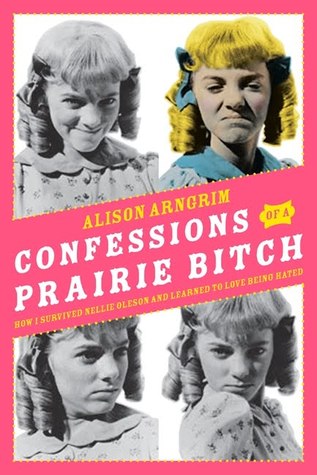
Confessions of a Prairie Bitch, by Alison Arngrim *****

confessionsofaprairiebitchThey say actors tend to have high IQs. This book is one more piece of evidence. Arngrim is super smart, and she can really write. And she is very, very funny.

Like a lot of comedians (which is what she did after being a child actor,at least for a time), her unerring comic instinct developed as a survival skill. Terrible families come in a wide range of dysfunction, but if domestic atrocities were a contest (and thank goodness they aren’t), Christina Crawford (Mommie Dearest) would be left eating Arngrim’s dust. The enormous temper tantrums and other vile forms of acting out inherent in the character she played were a recipe for mental health. How many other people get to go out and scream at other people for a living? And trust me, she needed all the help she could get. For the specifics, get this book and read it. It is worth the cover price.

Public reaction to Arngrim ranges from the hysterically funny to the almost unbelievable. She and her Prairie mom went to a fair as part of a publicity effort, to sign autographs etc, but they were attacked by an angry mob and had to slide out of there quietly. On a French television program, she was asked to explain her bad behavior, and she explained, as if she were her character, that she had been raised by a dreadful mother and was jealous of Laura. The studio audience and talk show hosts all understood entirely. It’s just too hilarious!

In real life, she has been close friends with Melissa Gilbert since their early days together on the set, and she spoke so well of Gilbert that I think I may read her memoir, too…and I was not even remotely interested in doing so before this! She also has some interesting things (I am dying to divulge, but won’t…READ THE BOOK!) about Michael Landon. Wowzers.

Not-so-funny is her experience losing a good friend to AIDS. I lost an old high school chum in the late 80’s, when a whole generation (or more) of gay men were unknowingly exposed to a deadly virus that at the time had no useful treatment. I applaud the years she has served as an advocate for HIV awareness and treatment. She has gone to bat for abused children, too. Again, you have to get the book! You just have to read it!

I always have 4-6 books on a string at a time, and I float more or less freely from one to the next. The only time I put this one down for another was at bedtime, because for awhile it was rollicking enough not only to keep me awake, but to keep me awake and laughing, or shaking the mattress with suppressed gales.