

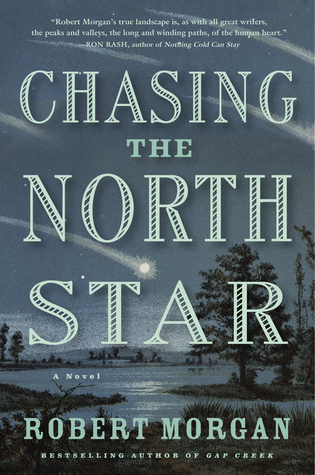
 Chasing the North Star is a compelling narrative of two teenagers escaped from slavery on their flight toward the North. Thank you to Net Galley and Algonquin Books for the DRC, which I received in exchange for an honest review. This book becomes available to the public April 5, 2016.
Morgan begins with the story of Jonah, a man who leaves the horrific plantation on which he has been kept. His story is told in the third person omniscient, and so there is virtually no dialogue for a long time. I waited to see how well it would hold up; it isn’t easy to keep a reader’s attention for long passages in which everything is told within a narrative, and even more so when it is told in the third person, as opposed to first person, where the character himself tells us the story. And because the narrative combined strong character development, near-tangible setting, and a series of brilliant moves to elude pursuers, I found that my attention was held quite well.
The book is in fact both accessible and a surprisingly quick read.
Part of the way into the story, Angel, our second protagonist, joins Jonah, and she tells us her own story through the first person. I found this device—of switching from third person for Jonah’s story to first person when telling Angel’s—both unusual and congenial. We watch him and cheer for him, but then she talks to us and just lays it all out. And Angel is nobody’s helpless damsel. She tells us up front that it’s a good thing for Jonah that she loves him, because he is going to need her to save his butt, and she does so more than once.
The sparseness of the dialogue makes sense when one thinks about it. Two escaped slaves that do nothing but talk, talk, talk all the way north are going to be caught in a hot minute. The writer takes an intelligent risk in using so much narrative and so little dialogue, and it pays off.
Stories involving slavery are often really painful for African-American readers to mow through, because they recall a time that was so demeaning, not only a physical horror but one that assaulted their dignity. The “N” word appears here, but is used sparingly considering the time in which it is set, and the topic. I appreciated the autonomy with which Jonah and Angel operate. Too many stories of freedom from bondage feature white saviors more prominently than are appropriate.
In fact, my sole criticism of this story is that it does not portray the extent to which the Underground Railroad was run by free Black men and women in the north; but then, this isn’t a story of organized escape, but an independent one, and it is possible that the region in which our characters travel was different in that respect.
Those that love good historical fiction should read this book. Morgan has done a fine job with a difficult topic, and the story is one of triumph and glory.
 Sarah and Jack Quinlan are called to his family’s home in Penny Gate, Iowa when Jack’s aunt is in a serious accident. Julia is not just any aunt; she has been his surrogate mother following the death of both his parents in a car accident. At least, that’s what he tells Sarah. But as she soon finds out, she has been misled about Jack’s early life; in fact, she’s been lied to. What she has to find out on her own is where the lies end and the truth begins.
 I was invited to read and review this compendium of articles from long ago by my friends at Open Road Integrated Media and Net Galley. I appreciate the invitation. The articles in the collection were really published in a tabloid by the title above during the period after World War II ended, and they are presented here as a bit of humorous nostalgia, rather like the spirit of Punch or The Onion. These articles will tickle the funny-bone of some of its readers, but it wasn’t a good match for me.
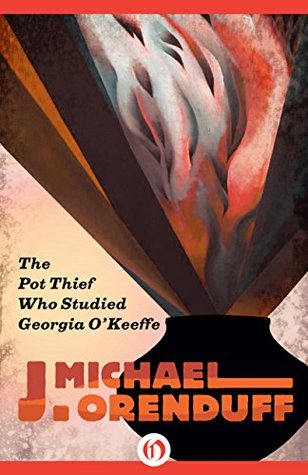 I read this book at the invitation of Open Road Integrated Media and Net Galley. Thank you to both parties. This title is one of several in a series that I had not encountered before. The pot in question is the ancient artifact sort, not the type that people grow and smoke. The author manages to work several disparate and esoteric topics into a single novel, but not necessarily to its benefit. My own viewpoint is that a high profile editor might be of great use here.
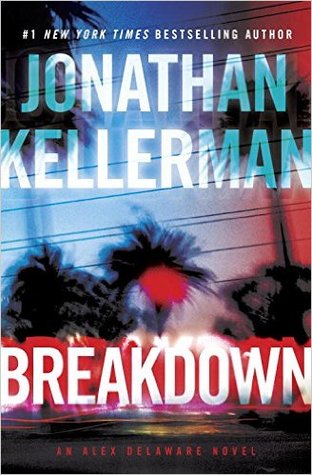 Breakdown is #31 in the Alex Delaware series, and Kellerman’s long-running series still has plenty of gas left in the tank. The premise this time is that six years ago, Delaware was called in to evaluate the parental fitness of a mother; custody issues have become his bread and butter, done on a case-by-case basis. The boy’s mother, Zelda, was an actress plagued by mental health issues, but seemed to be doing a competent job of raising Ovid. The actress’s psychiatrist wanted to be sure, so he called in Delaware to spend time with the child in question. Now things have gone downhill, and the psychologist that treated Zelda is dead. Zelda isn’t doing so well herself.
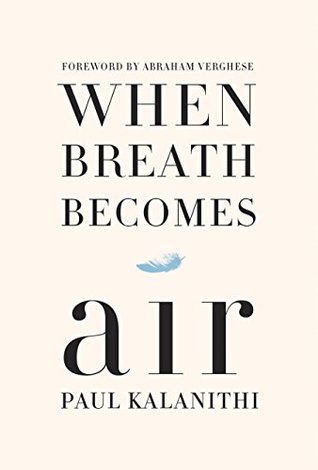 Paul Kalanithi was a promising young physician who had nearly finished completing ten years of training as a neurosurgeon when he was diagnosed with Stage IV lung cancer. His twin ambitions had been to become a neurosurgeon and to write. When he realized how little time was left of his too-brief life, he decided to spend his remaining time writing this book. Thank you, Net Galley and Random House Publishing House for the DRC. Dr. Kalanithi died in March 2015, but he left this luminous memoir behind as part of his legacy. It is available to the public January 19, 2016.
 If Fannie Flagg worries that she has no heir, she can relax; Richard Fifield is here. The Flood Girls is his brilliant debut, and you have to read it! Fifield will cut out your heart and feed it to you with a rusty spoon, and he’ll make you like it, too. Hell, he’ll even make you laugh through it. I got the DRC free via Net Galley and Gallery Books in exchange for an honest review, and I’m going to read it a second time before I archive it as I am supposed to. This is only the second time I have done so after hundreds of galleys have come my way; that should give you a measure of how impressed I am with this title.
 This book is the fourth in the series featuring Peter Bragg; the series was nominated for the Edgar Award and twice for the Shamus Award. I’ve read three others in the series already, so imagine my delight when I located this book, formerly published as Sausalito, among the DRC’s offered by Brash Priority Readers Circle.
 I was already a Barbara Neely fan when I received this DRC, courtesy of the Brash Priority Reviewers Circle, in exchange for an honest review. I’ve been reviewing books for Brash Books and others for the past couple of years, and had read three other Blanche White mysteries out of order, so when I saw that the first in the series—which I think was the only one I hadn’t read yet—was up for grabs, I nailed it right away. It’s available for purchase now.
