
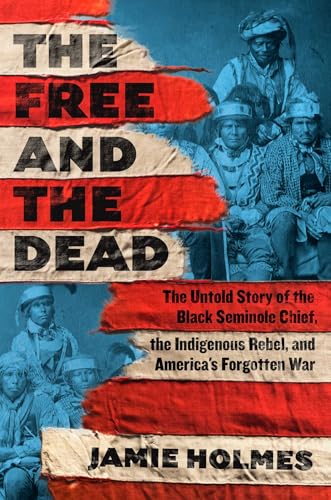
Author Jamie Holmes has written a history of the Seminole Wars, and since I had long intended to read a bit more about the Seminole tribe, I dove in. My thanks go to NetGalley and Atria Books for the review copy; this book is for sale now.
Generally speaking, reading about the depredations of the U.S. and local governments upon Native tribes is demoralizing, depressing, and on occasion, guilt-inducing. After a certain amount of it, I turned ostrich and decided I wouldn’t do it anymore. But I was aware that of all the tribes in what is now the U.S.A., the Seminoles were the only ones that had never been entirely dislodged from their original homes. This is what made me want to read this particular history, the knowledge that in the end, the Seminoles would not be completely vanquished.
The operative word there is “completely.” Yikes! There’s still plenty of gore, death, and heartbreak, as I would have recognized from the title had I been more attentive. Here’s one of the more searing samples, which deals with the death of a Seminole leader named Osceola following the conclusion of the war:
“Before he passed, he asked the physician a favor. He wished to be buried in the Florida Territory, at a site where his bones would not be disturbed. The surgeon, finding himself alone with the body, cut off Osceola’s head as a personal keepsake, took it home, and embalmed it. Later, the doctor would hang the head on his children’s bedstead, as punishment for misbehaving.”
Holmes does find ways to break up the horror occasionally with irony and humor, usually at the expense of the tribe’s would-be conquerors, but at the same time, he’s writing nonfiction, and he can’t make this thing any prettier than the truth. A whole lot of Seminoles died, either from battle, disease—so much disease! —or while imprisoned. The consolation, if there can be any, is in knowing that they took a whole lot of U.S. fighters with them. The U.S. government, led by President Andrew Jackson, whom I believe is remembered far more positively than is deserved, spent a wildly disproportionate amount of its funds while attempting to dislodge the tribes, but the Seminoles had a way of vanishing into the Everglades, a place they knew infinitely better than the invaders. And this is one more thing I appreciate about Holmes’s narrative: he tells the stories of individual Seminole leaders, and includes as much information about Natives as he does about the Caucasian interlopers.
This work was published last winter, so I am terribly late with my review; I had to take it in small amounts in order to get through it. However, it is very well researched and its documentation is excellent, and Holmes is a writer of formidable ability. To those with the fortitude and interest, this book is highly recommended.
 Seattle Book Mama