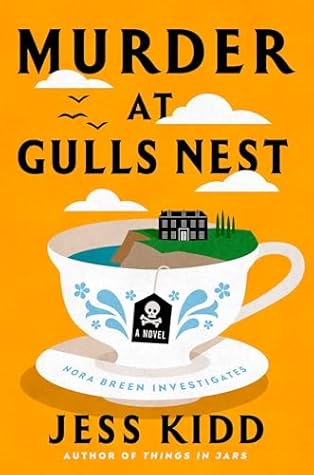
Murder at Gull’s Nest, by Jess Kidd*****

Nora Breen has sprung the coop, run away from her home of the past thirty years and come to Gull’s Nest, a rooming house near the sea. “Gull’s nest is that sort of place, isn’t it? Where the dreamers and schemers wash up.” And indeed, that’s our Nora. “A washed up nun…An abandoned friend. Flotsam and jetsam.”

Murder at Gull’s Nest is the first mystery in a series by one of my favorite novelists, Jess Kidd. I’m grateful to NetGalley and Atria Books for the review copy. This singular story will be available to buy in the U.S. April 8, 2025.

Nora is indeed a former nun; she’s shed her holy orders along with her tunic and scapular; she’s asked Christ for a divorce. Now she’s middle aged, and dressed in whatever castoffs were available when she departed. She has very little money, and is appalled at what inflation has done to prices between the time that she entered the monastery and the present day. Her first order of business now is clear, regardless: she must find her beloved friend Frieda, who left the order, came to live at Gull’s Nest, corresponded faithfully, then apparently dropped off the surface of the earth. If she’s alive, Nora will find her; if not, Nora will find her anyway.

She settles into the rooming house, and as she gets to know the other boarders, we get to know them along with her. The owner is a stickler for rules, and the cook and housekeeper—one person—is a tyrant. The food is dreadful! Nora resolves to float along beneath the radar for a bit, get the lay of the land before she does any obvious snooping about. However, since this is a murder mystery, someone dies while she’s still getting her bearings. And in time honored tradition, she irritates the very bejesus out of the local law man, Inspector Rideout, who is still deciding whether this death is due to murder at all.

“’I am not yet investigating a murder, Miss Breen.’

“’Are we not?’

“’No, I am not.’”

Don’t ask me to give away anything else about what happens here, because I won’t. I will tell you, however, that it crackles. Jess Kidd writes everything well: internal monologue? Check! Dialogue? Check! Denouement? Check, check, check!

Get this book and read it. You won’t be sorry.

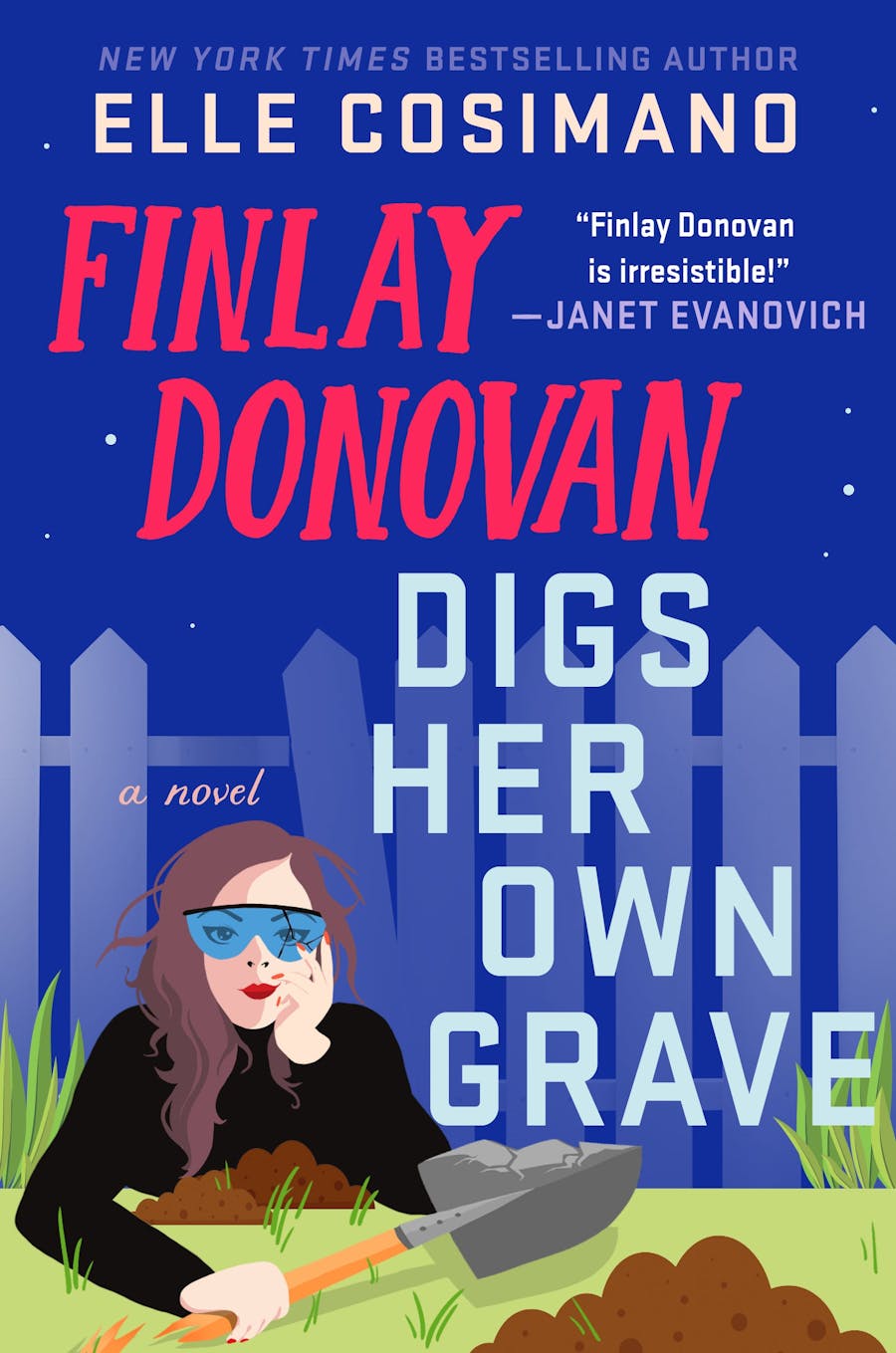
Finlay Donovan Digs Her Own Grave*****

Finlay Donovan is a full time mom who finds herself short on resources after her attorney husband leaves her for someone else. In the first episode, she finds herself with a corpse that she may or may not have killed; fearing the worst, she disposes of it, and the next thing she knows, her name is on some sort of dark web list of killers for hire. By the time she realizes she’s innocent, it’s too late to put the toothpaste back in the tube.

Other things have happened since then, of course, as we find ourselves now on the fifth installment. Present and accounted for is her nanny and close friend, Vero Ruiz, a woman with the kind of street smarts that can come in handy when the chips are down. In this episode there are several recurring characters, and the reader is strongly advised to go back and read the first Finlay before diving in. It’s not as if you can’t just start with this one, but you’ll be missing half of the jokes and jibes if you do.

My great thanks go to St. Martin’s Press Early Readers program and NetGalley for the review copy. This book will be available March 4, 2025.

Finlay’s nosy neighbor, Mrs. Haggerty, assumes a central role this time around when a body is exhumed from her backyard. Her home is declared a crime scene, and before Finlay even has time to react, the woman has installed herself in Finn’s guest room. A beat or two later, Stephen, Finlay’s ex, husband of her two children, is arrested for murdering the corpse that’s been found!

One of my favorite parts of this series is watching the dynamics between Finlay and her ex. On the one hand, the guy is philanderer, and he’s kind of a weasel. Yet, though Vero urges Fin to let justice take its course and stay out of it, Finlay has to defend him. Stephen is the father of her children, and they don’t need to grow up being told their daddy is a murderer. Also? The child support will dry up quick as a whistle if Stephen no longer makes money. And part of what I love about this, is that, in broad strokes, it outlines a dilemma that any number of women with children face. Life is full of nuance, and although this is not literary fiction, not intended to be known for its depth, it does honor the shades of gray faced by so many women. It makes the whole story more relatable.

Mrs. Haggerty also proves to be far more interesting than we previously believed, and that’s all I’m going to say about that. However, I do admire Cosimano’s capacity to juggle a million tiny, moving parts without creating inconsistencies. Once or twice I have seen what looks like an inconsistency, but then it turns out to have been written that way for a reason, usually to expose someone or something.

As the series progresses, I see more critics howling that the series isn’t what it was. Of course they’re right, in a way; when the series grows, the author has to make changes to prevent becoming a one trick pony. But I admire the way Cosimano handles the growth.

One small moan: yes, yes, yes. We can see that Finlay is hot for Nick, her cop boyfriend (the only trite element so far.) And yes, yes, yes, we can see that Vero is madly in love with her sweetheart, a fellow who she’s adored since her teens. We get it. Finlay and Vero are not a couple. We don’t need it hammered in any further, or at least, I don’t. For that matter, I wouldn’t be all that disturbed if they were. But the increased emphasis on their two romances bears just the tiniest whiff if hysteria. It’s not necessary. Finn’s love for Vero and vice versa, is not a lesbian love, but about the family we choose. So, let it rest already. Relax! The lesbian role is fulfilled by Finlay’s cop sister, Georgia, who stays firmly in the background where, apparently, some in the industry believe lesbian characters belong.

Sheesh!

That wee rant aside, I enjoyed this book very much. I heartily recommend it to you, and I cannot wait to read the next in the series.

The Damages, by Shelley Costa****

Shelley Costa, one of my favorite cozy mystery and humor writers, gave us No Mistaking Death, a new series introducing amateur sleuth Marian Warner in 2023. Here she is back with the second in the series, The Damages. My thanks go to the author, NetGalley, and Level Best Books for the review copies. This book is for sale now.

Marian was confused and hurting when last we saw her; that’s what happens when a normal person shoots someone. She blew out of Carthage, Ohio like the devil was on her tail at the end of the first mystery, but now she’s back, answering the call of a kid who wants her to find his missing sister, Beth. Beth is a courier for a medical testing company, ferrying blood samples from point A to point B. She’s well liked, lives a stable existence, and has told nobody of travel plans, but despite the fact that Carthage is a dinky little town, nobody has seen her lately.

It doesn’t look good.

Marian’s investigation dovetails with a big trial that’s taking place. A local obstetrician is being sued for millions by a couple whose baby he delivered. She has Cerebral Palsy, will never walk, talk, or lead a normal life. The medical malpractice suit is a money grab, plain and simple; if it is successful, Dr. Barish won’t be able to practice anymore. His premiums are already killing him. Is he the reason that Courtney Clemm is in such dire condition? Because she certainly is. It’s hard to look away.

This is a complex tale with a lot of twists and turns, but it’s not the mystery that keeps me engaged, it’s the protagonist. Given that this is just book 2 of a series, Marian is unusually well developed and immensely engaging. Add to this Costa’s trademark wordsmithery, her wry observations and quirky figurative language, and the case is almost beside the point. I’m here for Marian. And that’s good, because—for reasons I cannot understand myself—the pacing here is a little slow in places, though it ramps up to an arresting climax and powerful ending.

All told, this is a well-crafted novel, and I look forward immensely to book 3 in the series. Recommended to all that love a good cozy.

Identity Unknown, by Patricia Cornwell*****

Patricia Cornwell’s Scarpetta series is among my favorites. Identity Unknown, the 28th in the series, is every bit as riveting as her earlier ones, and I am thrilled to have received a review copy. My thanks go to Grand Central Publishing, NetGalley, and Hachette Audio. This book is for sale now.

First, I have to offer a shout out to January LaVoy, who reads the audio version. I was unsure how I would feel about this one, because I read the first 27 installments with my own eyes, and so I had developed the voices for each character in my head. Would I be thrown by the way they were voiced by a professional? As it happens, no. The protagonist and her ever present sidekick, Pete Marino, who is now her brother-in-law, sound exactly as I had thought they would. Of course, much of this comes down to excellent writing. The voices of her niece, Lucy, who now occupies the top echelons of governmental spookdom, is softer and slightly higher pitched than I had expected, but it fits, and I made the mental transition easily. Kay’s husband, Benton, doesn’t have as deep a voice as I would have thought, but to make his voice that deep would require a second, male reader. All told, LaVoy does a fine job, and I didn’t feel distracted from the story.

I have begun reading the DRC when I am provided the audio, and so from there forward, I switch to the audio, referring occasionally to the DRC to make notes or highlight possible quotations. Once the climax comes, however, the tension gets the better of me, and because I know I can read faster than LaVoy can talk, I switch back to the text.

The premise is that there have been two deaths. The first is an old boyfriend of Kay’s, a man named Sal Giordano. They have remained friends over the years, and she saw him recently when she dropped off a basket of goodies for his birthday. He has been the victim of a death flight, which is new to me but apparently, according to Wiki, is a thing. It involves killing someone by dropping them from a plane.

Holy crap!

Now we get into aspects of the case that make it an even better October read, as well as darkly funny. The prose itself doesn’t appear to be intentionally humorous, and yet I cannot, for the life of me, imagine that Cornwell didn’t snicker a bit as she wrote it. The area where Sal is dropped is inside an abandoned amusement park with a Wizard of Oz theme. It’s been vandalized, and is seriously creepy. The higher ups within the U.S. military are in on the investigation, and so:

“’Let me make sure this is clear,’ General Gunner says to me. ‘He landed on the Yellow Brick Road in the middle of an apple orchard.’

“’Inside the Haunted Forest. Yes.’”

I couldn’t help myself. I squawked out loud!

Soon another corpse is identified, a child belonging to a pair of wealthy, powerful people that are also terrible human beings, and as it happens, horrible parents. The two deaths are connected. The parents throw their weight around and try to manipulate the investigation, but of course, they don’t succeed.

Ultimately it seems that one of the guilty parties is Kay’s nemesis, Carrie Grethen. Carrie was once Lucy’s true love; later, her evil nature became apparent, but nobody can seem to keep her locked up, and she has become Kay’s Moriarty. I mention this here because it is raised early in the story, so I don’t think it can be called a spoiler, but I won’t say more about that.

To the faithful readership, I will also say this. As the book opens, two of Cornwell’s old standbys, ones that I’d be happy to see her retire, appear. First, she has to be driven to the scene in a helicopter, but oh no, there’s a storm coming. I was irritated. Can Kay not go anywhere without there being a storm? Just once? Please? And then something has to be retrieved by diving, which harks back to an earlier book in which she’s attacked with a spear gun. But friends, neither of these turns out to be key to the story, and we’re done with them in a heartbeat, so be patient.

I like to read a few books at a time for variety, but once this one began, it edged out the others—except at bedtime, because when I go to bed, I need to sleep! It’s among her finest work, and I recommend it wholeheartedly to you.

Spirit Crossing, by William Kent Krueger

Spirit Crossing is the spellbinding new novel in the Cork O’Connor series by William Kent Krueger. The book starts with two missing women, and an accidental discovery of a fresh grave. Readers faithful to the series will recognize the characters; there are enough of them, mostly related to one another, to provide depth and interest, without confusing the reader or making the plot too complex.

Lucky me, I read it free and early. My thanks go to NetGalley and Atria books for the invitation to read and review. This book is for sale now.

The story begins innocently enough, with the series protagonist, Cork, out berry picking with his son, son-in-law, and grandson, who is known by the Ojibwe nickname Waaboo. While searching for blueberries, they come across a fresh grave. Waaboo sees the victim standing before him, as if she is still alive, and he’s distraught because she is so unhappy. Waaboo is not the first one in his family to have this ability; nobody doubts that he sees what he says he sees. And so the men immediately wonder whether this is the grave of Olivia Hamilton, daughter of a wealthy Anglo, who’s been reported missing with massive headlines everywhere; or that of Crystal Two Knives, a missing Native girl whose name barely elicits more than a yawn from law enforcement.

And so right away, we are looking at not only the characters, but the longtime issue of missing Native girls and women, and the way that law enforcement neglects their cases for those whose families have money and connections.

One of the things I admire most about Krueger’s writing is the way that he incorporates urgent issues that especially impact the place where he lives—northern Minnesota—into the plot, blending them in so seamlessly that the reader isn’t distracted, because the issues are part and parcel of the mystery to be solved. He does the same thing with pipeline protests similar to the Dakota pipeline that lit up the headlines in recent years. Other aspects of the story include Ojibwe (Chippewa) culture and history, which is part of every book in the series, since most of the family is Ojibwe, and in this case, a character with a brain tumor. When significant events occur and the woman with cancer is the only one to witness them, did they really happen, or is it the brain tumor talking? This adds a layer of psychological tension not present in most of Krueger’s book; I’m not a fan of that subgenre, and am pleased to see that this doesn’t take over the plotline. It’s dealt with tastefully and without sensationalism.

Those that read my reviews know that I have an interest in seeing how authors develop child characters, particularly in a story such as this one, in which the child plays a major role. It makes me crazy when an otherwise competent author searches for shortcuts, such as a child that’s precocious or gifted, to explain away their own failure to craft the child’s character in a way that is honest developmentally. This is one more reason I enjoy this series. Yes, Waaboo has unusual powers, but he is still a small boy. The notion of going home without blueberries is a major blow. Tears threaten. I love the way Krueger develops this kid, and I can’t wait to see more of him in the future.

My one criticism involves a specific passage between the 88th and 90th percentiles, just as we rise toward the climax. Without going into spoilerish details, I will say that one character does something that everyone in the family agrees they must not do, and without any explanation, everyone in the family is fine with them doing it this time. This, of course, puts the character in danger, which anyone that’s paying attention can predict the very moment the action commences. It’s clumsy in a way that is atypical of this author, and I have no idea why he makes the choice he does, but it affects my enjoyment of the book, because suddenly I am not thinking as much about the characters as I am about the author. Having this occur a split second before the climax is especially grating.

On the other hand, I am picky. Very picky. I suspect that this passage will annoy only a small percentage of readers.

I do recommend this book, and this series, to those that love a good mystery. Although it can be read as a stand-alone, those with the time and inclination might enjoy going back a few titles, or even to the beginning of the series.

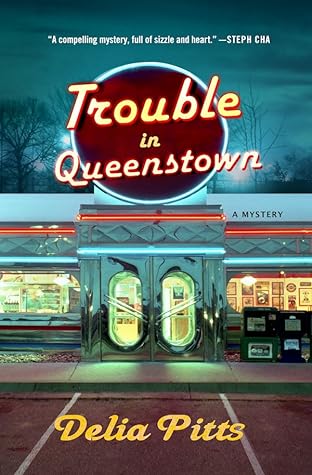
Trouble in Queenstown, by Delia Pitt***-****

Delia Pitts has been writing mysteries for quite some time, but she is new to me. In Trouble in Queenstown, she introduces hardboiled sleuth Evander Myrick. Myrick’s friends call her Vandy, and that helps to distinguish her from her elderly father for whom she is named; he’s in a memory care unit.

My thanks go to NetGalley, Macmillan Audio, and St. Martin’s Press for the review copies. This book is for sale now.

At first glance, I thought that this detective fiction was set in New Zealand. Queenstown, right? But in this case, the locale is Queenstown, New Jersey. The story opens with Vandy cleaning up a mess in her office just as Leo Hannah storms in and wants to see Evander Myrick. He assumes Myrick will be a Caucasian male, and that Myrick herself is a member of the cleaning staff.

Oops.

Hannah comes to hire Vandy in the wake of his wife’s murder. He knows exactly who did it, he tells her, and he wants her to prove it, starting with some surveillance. Vandy isn’t sure she should take this job, but she has to pay top dollar to keep her daddy in the best facility, so she reluctantly signs on. As the story progresses, there are numerous twists and turns, and the violence escalates. By the story’s end, three different people have tried to hire her for exactly the same case!

The thing I appreciate here is the way Pitts addresses cop racism. So many detective novels require the reader to suspend belief, to assume that every cop is fearlessly dedicated to finding out the unvarnished truth and arresting the perpetrator of the crime, regardless of race, ethnicity, or sexual orientation. But as Vandy conducts her investigation, Pitts keeps it real. At one point the detective speaks with a salon stylist that worked on Ivy’s hair, and he tells her that Ivy was afraid of someone at home. Vandy asks if he contacted the police.

“’The police?’ He jerked his neck, pursing his lips as if I’d farted. ‘Girl, you think the cops came here?’ He sniffed. ‘You don’t look like a fool. Maybe I read you wrong.’”

Sadly, the second half of the book doesn’t impress me as much as the first half does. I have a short list of tropes that I never want to see again in a mystery novel, and she trips a few, including my most hated one. I won’t go into details because it’s too far into the story, and I don’t want to spoil anything, but when it appears, I sit back, disengage from the text, and roll my eyes. Ohhh buh-ruther. As I continue reading, I can see who the murderer is well in advance, and the climax itself is a bit over the top, though without the tropes, I mightn’t have noticed this last issue.

In addition to the digital review copy, I have the audio. The reader does a fine job.

The more mysteries a person reads, the staler tropes become. I am perhaps more sensitive than most readers, having logged over a thousand novels in this genre. Readers that have not read many mysteries are less likely to be aware of, and therefore bothered by overused elements, and so this book may please you much more than it did me. But for hardened, crochety old readers such as myself, I recommend getting this book free or cheap, if you choose to read it. Newer readers may enjoy it enough to justify the sticker price.

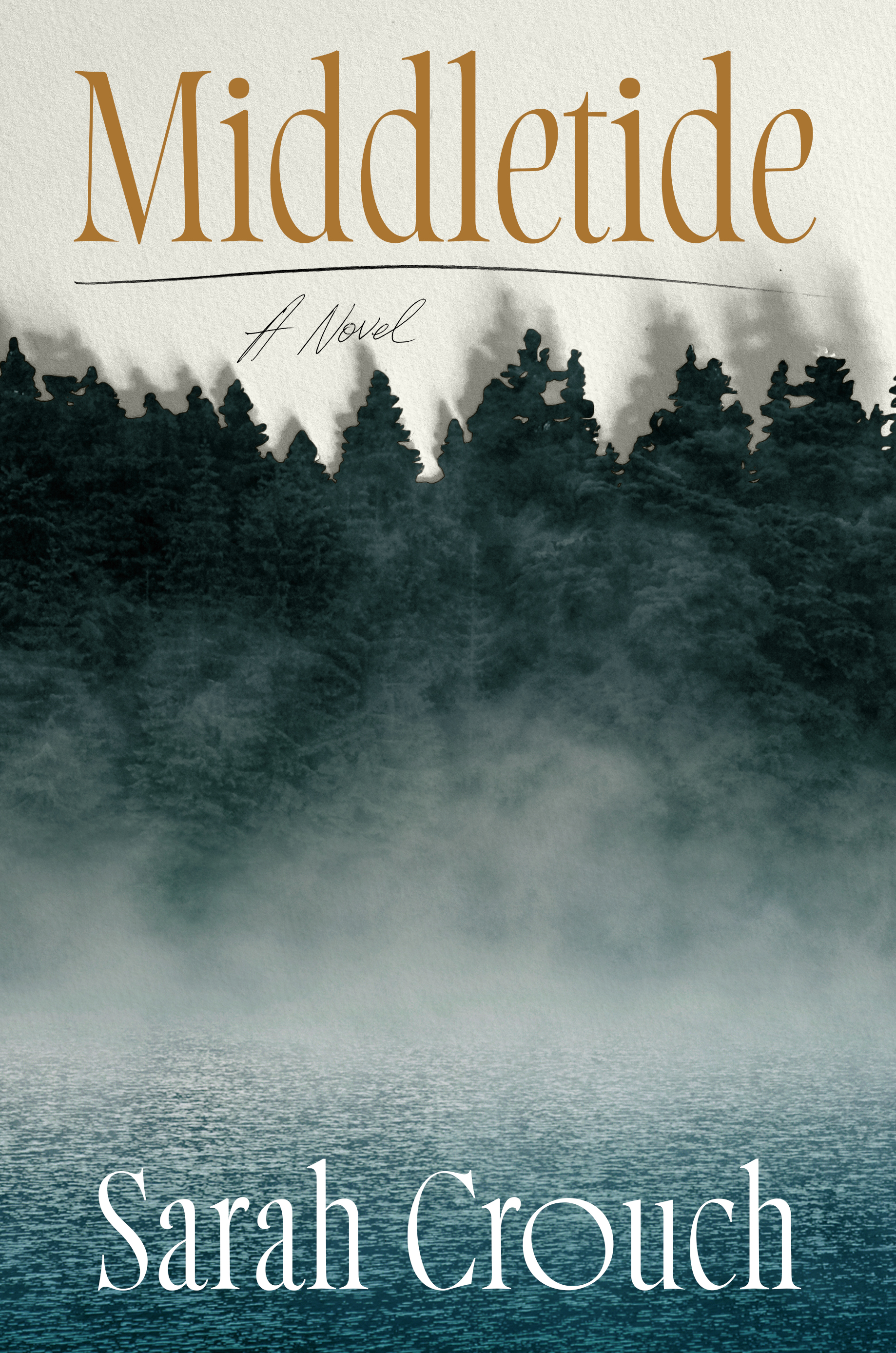
Middletide, by Sarah Crouch*****

Sarah Crouch makes her authorial debut with Middletide, a mystery set in the Pacific Northwest near where she grew up. Atmospheric and tense, it’s a damn fine start to what is sure to be a promising career.

My thanks go to NetGalley and Atria Books for the invitation to read and review. This book is for sale now.

The premise is that Elijah Leith leaves home when he reaches adulthood, eager to flee his violent alcoholic father, and make a name for himself in San Francisco. But his father dies, and when his first novel goes nowhere and he runs out of money, Elijah returns and takes up residence in the cabin where he grew up. He hopes to rekindle a relationship with his teenage sweetheart, but she has moved on, and since he was unreliable the first time around, she is reluctant to trust him anyway.

Then the cops find the body of Dr. Erin Landry hanging from a tree on Elijah’s property.

This whodunit is original and intelligently written. The pacing is perfect, and I never would have guessed the ending, at least not until nearly the end when the author spells it out. Elijah is not the most lovable protagonist, but Crouch develops him so that, although not a prince or a hero, he is nonetheless a decent human being by the end. Some will consider the solution to be over the top, but it’s only far fetched if the author fails to convince us that it’s true, and I am persuaded.

Those looking for a fun read to pack for a vacation, or just to occupy a weekend at home, here you go. Grab your book, your lemonade or your whatever, and head for your happy place. You can thank me later.

The Ghost Orchid, by Jonathan Kellerman****-*****

4.5 stars rounded upward. My thanks go to Random House Ballantine and NetGalley for the review copy. This book will be available to the public February 6, 2024.

The Ghost Orchid marks the thirty-ninth entry in the Alex Delaware series, one of the longest series in publication. It’s easy to see why it’s lasted so long. The protagonist and side characters are engaging, and the dialogue never loses its sparkle.  In this one, Alex has been recovering from a savage beating that he took at the hands of the murderer in our last mystery. Milo, his BFF, is a homicide cop who often hires him to assist the LAPD with cases where a psychologist is needed, but now Milo is so mired in guilt that he can hardly look at his friend. Finally, with a nudge from Delaware’s longtime (and slightly boring) girlfriend, Milo includes him in another case, and we find snappy dialogue that never fails to entertain.

This time it’s a double homicide in Bel Air. The man and woman are found by the pool, naked and dead. The investigation reveals that he is the son of a mega rich European shoe magnate; she is the wife of another rich man, a young, socially awkward member of the ruling elite who isn’t pleased to learn what his wife has been doing when he’s away on business. But then we learn that she was using an assumed name, and so the whole thing is even more mysterious. Who is this dead woman, and who killed her?

At the same time, Alex is engaged to interview a child in his early teens whose adoptive parents have decided to bail. They are divorcing; neither of them wants the kid.

The main storyline is a lot of fun. Everyone enjoys seeing the super-rich suffer. With wealth of this magnitude, there’s no chance any of Kellerman’s readers will identify with the male murder victim or the husband of the female victim, either. The way it’s resolved is believable, and it’s done without any of the prurient or kinky sex that Kellerman inexplicably included for a handful of books in this series a few years back. The half star is withheld from my rating because the other storyline, the one about the teenager, sort of fizzles without going anywhere, and it’s hard to see why he included it in the first place. Kellerman’s career, and this series, were originally launched around crimes where kids were involved, often as witnesses, and those initial books are fascinating. I’d love to see the author return to his roots, write some more episodes that incorporate his credentials and experience in child psychology.

You can read it as a stand alone novel if you choose, but you’ll want to read the others afterward.

Nevertheless, if you are looking for a fast, fun whodunit, this book is a hard one to beat. I highly recommend it to those that love the genre.

The River We Remember, by William Kent Krueger*****

William Kent Krueger has been writing since the late 1990s, but he only came onto my radar in 2019, when he published This Tender Land. To read Krueger once is to want to read him again and again, as often as is possible, and that’s what I’ve been doing. The River We Remember is his most recent mystery, an achingly atmospheric novel set during the 1950s in rural Minnesota. My thanks go to Net Galley and Atria Books for the review copy. This book is for sale now.

The protagonist in this stand alone whodunit is the local sheriff, Brody Dern. Brody is a thoroughly believable character; there’s nothing of the TV sheriff about him. When the wealthy, universally hated Jimmy Quinn is found floating dead in the river, Dern does not lose sleep while vowing to find and reveal the entire truth. His first response is his own deep resentment that Quinn had to go and die in what had been, until now, Brody’s favorite spot to relax. How dare stupid, rotten Jimmy Quinn ruin this special place with his bloated corpse? And his second instinct is to minimize the damage to everyone else concerned. For example, the Quinns are Catholic, and if Jimmy committed suicide, they can’t bury him with the family. If not suicide, then perhaps a family member could stand it no more and shot him dead. Again, if so, no great loss, and let’s make sure the family is taken care of. And so, Brody’s first instinct is to wipe down Quinn’s truck so that, if other authorities should become involved in the case, none of these poor people will have to suffer for it.

Then, he goes to the evidence cabinet and removes some of the confiscated drugs so that he can get a decent night’s sleep.

Part of what fascinates me here is the culture of small town Minnesota during this time period. People don’t lock their doors most of the time. When a prisoner that Brody knows is almost certainly innocent requests a sharp knife in order to carve something, Brody gives it to him, right there in the cell. There are a number of interesting secondary threads, and all contribute to the steamy, smoldering ambience in which this story is set.

But oh lordy, the racism. And in this, I know there is no exaggeration. The culture among the Caucasian population of this tiny town, with regard to Native peoples and those of Japanese descent is not so very different from what I experienced as a child, growing up in the 1960s and even the 1970s in suburbs on the American West Coast. It’s bad. It’s really bad.

A feature of Krueger’s work—a signature aspect, in fact—is the inclusion of American Indian cultures and sociopolitical issues in Northern Minnesota. In other stories I’ve read, it’s been the Chippewa; this time, it’s a Dakota Sioux man named Noah Bluestone, and his Japanese wife, Kyoko. The author develops his characters well, with no stereotypes or hackneyed pop culture. This alone makes his work worth reading, but there’s so much more.

Over the course of just a few short years, Krueger has joined other luminaries on my list of authors whose work I read without question. I highly recommend this book to all that love the genre.