
The Slate, by Matthew FitzSimmons*****

Author Matthew FitzSimmons is a veteran novelist, but he is new to me. I picked up on the buzz generated by his most recent book, a political thriller titled The Slate. What a ride! This is a true thriller, one that gripped me at the outset and didn’t let me go till it was done with me. I’d had surgery and was dealing with a lot of drowsiness from the various medications and anesthesia, but this book didn’t care about any of that. This book—aided and abetted by narrator Mia Barron– made me read it anyway, and I’m glad.

My thanks go to Net Galley and Brilliance Publishing for the review copies. This book is available to the public now.

Agatha Cardiff is retired. She used to be a political mover and shaker, but many years ago, she was roped into doing something she didn’t want to do, and should not have done. Since then, she’s been hiding. A neighbor offers her some bedding plants, and she takes his damn head off in a single bite, because she does not want to get to know him. She doesn’t want to get to know anyone.

To make ends meet, Agatha rents out her basement flat to young Shelby. Shelby is late with her rent, and has done something regrettable in order to rectify the problem. Now, Agatha learns, Shelby is in deep trouble, being held captive on board a ship.  Well, there’s no choice, not really. Agatha has to save the kid, even though it means stepping out of seclusion. And sure enough, all hell breaks loose.

As Agatha emerges from her self-protective exile, we begin to see exactly what she’s capable of. It’s a revelation! Our point of view changes occasionally, but make no mistake, this is Agatha’s story. FitzSimmons is such a badass writer that he even manages to develop this character, something I rarely see in a thriller, because it’s hard to maintain rapid pacing while dealing with backstory and internal monologue. He makes it look effortless, but you try doing that. Go on, give it your best shot.

See?

I often shy away from political thrillers because so many of them have a hugely conservative bent that sets my teeth on edge. The Slate, in contrast, plays it right down the middle, and shouldn’t offend red hats, the woke, or anyone anywhere else on the political spectrum.

Because of the narrator’s skill, I lean toward recommending this as an audio book foremost, but if you are a visual reader, don’t let that stop you, as the print version is also excellent. Highly recommended.
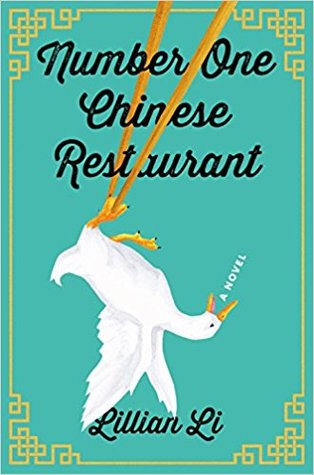
Number One Chinese Restaurant, by Lillian Li*****

NumberOneChineseLillian Li’s debut novel , a tale of intra-family rivalry, intrigue, and torn loyalties is a barn burner; it captured my attention at the beginning, made me laugh out loud in the first chapter, and it never flagged. Many thanks go to Net Galley and Henry Holt Company, from whom I received a review copy in exchange for this honest review.  Don’t let yourself miss this one. This book will be available to the public Tuesday, June 19, 2018.

The book opens with bitter scheming on the part of Jimmy, one of two brothers that fall heir to the family restaurant after their father passes away.  Jimmy has waited for the old man to die so that he could run the restaurant his own way. The Duck House serves greasy, cheap Chinese food, and he is sure he can do better. He craves elegance, a superior menu with superior ingredients. He wants renown, and he doesn’t want his brother Johnny to have one thing to do with it.

Johnny’s in China. Johnny runs the business end of the restaurant, and he takes care of the front of the house. He’ll come back to Maryland in a heartbeat, though, when the Duck House burns down.

Li does a masterful job of introducing a large cast of characters and developing several of them; although at the outset the story appears to be primarily about the brothers, the camera pans out and we meet a host of others involved in one way or another with the restaurant. There are the Honduran workers that are referred to by the Chinese restaurant owners and their children as ‘the amigos’, and we see the way they are dismissed by those higher up, even when it is they that pull Jimmy from a burning building. There’s a bittersweet love triangle involving Nan and Ah-Jack, who work in the restaurant, and Michelle, Ah-Jack’s estranged wife, but it’s handled deftly and with such swift pacing and sterling character development that it never becomes a soap opera. Meanwhile Nan’s unhappy teenage son, Pat, pulls at her loyalties, and she is torn between him and Ah-Jack in a way that has to look familiar to almost every mother that sees it in one way or another. But the most fascinating character by far, hidden in the recesses of her home, is the sons’ widowed mother, Feng Fui, who serves as a powerful reminder not to underestimate senior citizens.

Li is one of the most exciting, entertaining new voices in fiction since the Y2K, and I can’t wait to see what she writes next. Gan bei!

S Street Rising: Crack, Murder, and Redemption in D.C. by Ruben Castaneda *****

sstreetrisingThis book is remarkable, and I am not the tiniest bit surprised that its writer has won multiple awards. He began life as a journalist, and in part, that’s what this is about. It is a memoir at least four times over. Seamlessly, Castaneda weaves the history of S Street, a formerly down-and-out part of Washington, DC that holds deep personal meaning for him; his own personal story ; the history of local police and in particular, the use of gratuitous violence and what happens to those who try to shut that shit down; and also the memoir of a local street ministry and after school program linked to S Street and the area’s revival. It is braided together evenly and I cannot find a flaw in it (and I am picky). At the end, he ties the whole thing together and puts a bow on it, and my jaw dropped. Did he just do that? Yes, he did!

Many thanks to Net Galley and Bloomsbury USA for the DRC.

My initial thought was that it takes titanium cojones to not only write about the DC crack epidemic while being addicted to it (as well as alcohol), and THEN to come out and write a risky but much lauded magazine article about his own journey doing same, and his subsequent recovery (sixteen years, at the time this was written), and then, after all of that, to write a book about it.

But it’s not just about guts. There are multiple essential messages he wants us to receive, and his strong word-smithery and pacing make it easy to keep turning the pages. The narrative is smooth as glass, transitions so natural they are hard to find. Twice I went back to the opening pages to make sure this was actually nonfiction, because it bears the crafting of a well-paced thriller. And it is highlighted by the journalistic integrity of the writer in what he recognizes is a dying craft: the investigative newspaper reporter.

Looking through the pages of my own city’s less-than-laudable local press as well as TV news coverage, I see two types of journalists, for the greater part. One is the phone-it-in writer. Typically, it is an article about a corporation or organization and the subject of the piece has really done the writing. It shows up as news without anybody double checking the self-aggrandizement done by the firm in question. Easy story.

The other is the heartless story-at-all-costs. Castaneda confesses to being an adrenaline junkie, and the reader must recognize that to keep the hours a journalist keeps for the salary provided, there would have to be a secondary payoff, that of satisfaction. But I do see journalists who go too far, the ones who will approach a mother whose babies have perished in a fire moments before, stick a microphone in her face, and bark, “Tell us how you are feeling at this time, ma’am.” Our author has a couple of sticky ethical decisions he has to make, decisions of integrity versus alpha-journalistic behavior, and he comes down more often than not on the side of the angels, and at least once, he does so at great cost to his career. This is really admirable.

I have read over 200 memoirs, and yet there has never been one like this one. I cannot recommend it highly enough.