
Identity Unknown, by Patricia Cornwell*****

Patricia Cornwell’s Scarpetta series is among my favorites. Identity Unknown, the 28th in the series, is every bit as riveting as her earlier ones, and I am thrilled to have received a review copy. My thanks go to Grand Central Publishing, NetGalley, and Hachette Audio. This book is for sale now.

First, I have to offer a shout out to January LaVoy, who reads the audio version. I was unsure how I would feel about this one, because I read the first 27 installments with my own eyes, and so I had developed the voices for each character in my head. Would I be thrown by the way they were voiced by a professional? As it happens, no. The protagonist and her ever present sidekick, Pete Marino, who is now her brother-in-law, sound exactly as I had thought they would. Of course, much of this comes down to excellent writing. The voices of her niece, Lucy, who now occupies the top echelons of governmental spookdom, is softer and slightly higher pitched than I had expected, but it fits, and I made the mental transition easily. Kay’s husband, Benton, doesn’t have as deep a voice as I would have thought, but to make his voice that deep would require a second, male reader. All told, LaVoy does a fine job, and I didn’t feel distracted from the story.

I have begun reading the DRC when I am provided the audio, and so from there forward, I switch to the audio, referring occasionally to the DRC to make notes or highlight possible quotations. Once the climax comes, however, the tension gets the better of me, and because I know I can read faster than LaVoy can talk, I switch back to the text.

The premise is that there have been two deaths. The first is an old boyfriend of Kay’s, a man named Sal Giordano. They have remained friends over the years, and she saw him recently when she dropped off a basket of goodies for his birthday. He has been the victim of a death flight, which is new to me but apparently, according to Wiki, is a thing. It involves killing someone by dropping them from a plane.

Holy crap!

Now we get into aspects of the case that make it an even better October read, as well as darkly funny. The prose itself doesn’t appear to be intentionally humorous, and yet I cannot, for the life of me, imagine that Cornwell didn’t snicker a bit as she wrote it. The area where Sal is dropped is inside an abandoned amusement park with a Wizard of Oz theme. It’s been vandalized, and is seriously creepy. The higher ups within the U.S. military are in on the investigation, and so:

“’Let me make sure this is clear,’ General Gunner says to me. ‘He landed on the Yellow Brick Road in the middle of an apple orchard.’

“’Inside the Haunted Forest. Yes.’”

I couldn’t help myself. I squawked out loud!

Soon another corpse is identified, a child belonging to a pair of wealthy, powerful people that are also terrible human beings, and as it happens, horrible parents. The two deaths are connected. The parents throw their weight around and try to manipulate the investigation, but of course, they don’t succeed.

Ultimately it seems that one of the guilty parties is Kay’s nemesis, Carrie Grethen. Carrie was once Lucy’s true love; later, her evil nature became apparent, but nobody can seem to keep her locked up, and she has become Kay’s Moriarty. I mention this here because it is raised early in the story, so I don’t think it can be called a spoiler, but I won’t say more about that.

To the faithful readership, I will also say this. As the book opens, two of Cornwell’s old standbys, ones that I’d be happy to see her retire, appear. First, she has to be driven to the scene in a helicopter, but oh no, there’s a storm coming. I was irritated. Can Kay not go anywhere without there being a storm? Just once? Please? And then something has to be retrieved by diving, which harks back to an earlier book in which she’s attacked with a spear gun. But friends, neither of these turns out to be key to the story, and we’re done with them in a heartbeat, so be patient.

I like to read a few books at a time for variety, but once this one began, it edged out the others—except at bedtime, because when I go to bed, I need to sleep! It’s among her finest work, and I recommend it wholeheartedly to you.

Unnatural Death, by Patricia Cornwell*****

Unnatural Death is the twenty-seventh installment in the Kay Scarpetta series by Patricia Cornwell, and it’s as good as they get. My thanks go to NetGalley and Grand Central Publishing for the review copy. You can get it now.

For those not conversant with the series, Scarpetta is a medical examiner for the state of Virginia. She’s moved around over the course of the series, decamped to Boston, and come back. So now she’s in her old stomping grounds, but all is not well. The obnoxious, obstructive secretary she was saddled with in the last book, a miserable woman that blamed her for the ouster of the corrupt man that came before, has been—finally—fired, but somehow, she is back in a different government position in the same building, along with the corrupt guy she likes working with, so it’s tense.

Our other permanent characters are Pete Marino, who’s worked with Kay forever and is now married to her sister, Dorothy, who’s a hot mess; Benton Wesley, Kay’s enigmatic husband, a forensic psychologist that works in extremely high level situations that he can’t tell Kay about, even when they have a bearing on her life; and Lucy, her adult niece whom she has raised as her own, and who is the daughter of Dorothy. Lucy is a wunderkind, a tech wizard employed by the FBI, sometimes on loan to the CIA.

I won’t go into the premise for this installment because you can get that in the promotional blurb, but I will tell you that by the ten percent mark I was riveted, and before the halfway point my notes say, “I hate being away from this thing.” A shocking development occurs that is much more impactful to those of us that have followed the series from the start. I have heard other reviewers say that they used to read the series, then lost the habit, so I will say this: if you have read most of the series but missed a book here or there, you can still get the full measure of this thriller. If you just missed the most recent one, that’s okay. But if you go into this book cold, your very first time reading a Scarpetta book, some of the magic will be missing. Perhaps you will read it and be impressed enough to go back and binge read the whole series. It’s not a bad idea!

Any author that writes a long running, successful series like this has to flesh out the main characters to keep readers’ attention. For the first few books, pure plot-based adrenaline rushes are possible, but at some point, there’s going to be a credibility issue continuing that way. I would have difficulty believing that a forensic coroner had been kidnapped by bad guys and hurled into the back of a vehicle, bound and gagged, even once, but when it happens over and over, I’m done and I’m done. Cornwell does the smart thing instead, developing crises that are sometimes more about others in Kay’s family, but that nevertheless spill over onto her in a big way. In doing this, she forces us to examine questions that have no easy answers. For example, if an extremely dangerous development comes up that could affect you or your family, but it is also a matter of national security, and one family member knows, should they break the vows of their office in order to let you or other family members know? Or should they keep it ambiguous, along the lines of, “Maybe you should stay home today?” What if two know, and you don’t?

One way or the other, this story is a wild ride. The tension is occasionally broken up by Marino’s fixation on Bigfoot. He’s obsessed, and it cracks me up when we’re worried about killer drones and enemies unseen, and then Marino pipes up about the big ole footprint he found in the woods. For quite awhile I have wondered why Cornwell hasn’t been made a Grand Master by the Mystery Writers of America. Hopefully, this outstanding novel will serve as a clarion call. Highly recommended.

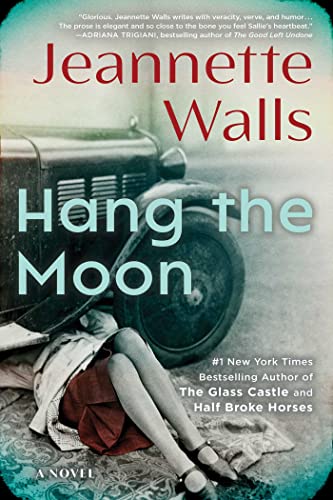
Hang the Moon, by Jeanette Walls*****

Jeanette Walls is the author of outstanding memoirs, most notably The Glass Castle. Her new novel, Hang the Moon, is brilliant, and you should read it. My thanks go to Net Galley and Scribner for the review copy. This book is for sale now.

Sallie Kinkaid is born and raised near the turn of the twentieth century in a tiny backwater in Virginia, daughter of its wealthy scion, “Duke” Kinkaid.  Her mother has died, and Duke has remarried, and now Sallie has a younger half-brother, Eddie. Sallie is a daredevil, given to occasional recklessness, whereas Eddie has a gentler, more introverted nature, with a love of learning and music. But one day, hoping to awaken some more adventurous aspect of his personality, Sallie takes Eddie out for a ride in her cart, and he is injured. Just like that, Sallie no longer lives with her father; she is cast out to live with an impoverished aunt, and there she remains for nearly a decade.

Sallie is a young woman when she returns, and now she must navigate the shoals of local politics, keeping clear of Duke’s sometimes unpredictable temper.  Duke owns nearly every property in the county, and he is deft at doling out favors and keeping the local peace, always in a way that works to his own advantage. Sallie has a hundred questions, some longstanding, and others that develop as she works for her father. However, questions are discouraged in the Kinkaid home. An aunt tells her, “Honey, there are some rocks you don’t want to look under.”

When the local economy is shaken by the unthinkable, Sallie must make some hard choices as she comes into her own. Moonshine has long been an unofficial, yet pivotal way that the local working class makes its living, and when feuds erupt and the government attempts to intervene, Sallie must choose sides. As she comes into her own, she discovers some hard truths about the family she thought she knew. Walls is at her best here, with a strong, resonant setting, a clear, credible plot, and unforgettable characters. This is the sort of book that one comes back to. Highly recommended.

Livid, by Patricia Cornwell*****

I really enjoyed this, the 26th entry into the Kay Scarpetta series. From time to time, people publish unhappy reviews, but for me, it never gets old. In this one, a terrorist attack is made locally, and it’s associated with an attempt on the life of the U.S. president, who is in town at the time it occurs. Kay is, of course, the chief coroner, and she’s forced to perform the autopsy on someone she knows.

The ending isn’t satisfying, and with any other author, I’d knock off the last star. But with Cornwell, I know from experience that when she does this, it’s because it isn’t really over. This will come up again, if not in the next book, then in another soon after it.

Because I couldn’t get the galley, I checked out the audio book at Seattle Bibliocommons. The audio is kind of a mixed bag. I like how the narrator voices the protagonist, and she also does recurring character Pete Marino well. I thought it was wrong to read the voice of Lucy, Kay’s badass adult niece, with a higher pitched voice than any of the other characters. She is a daredevil that doesn’t suffer fools, and if anything, her voice should be lower in pitch than Kay’s. I also thought she made the judge a bit too languid sounding, which is at odds with the things she says. In short, if you are a reader that enjoys both audiobooks and print ones, go with the print. If you like only audiobooks, then go ahead.

If you haven’t read this series, I do suggest you begin with the first and work your way up. I might not have enjoyed this one so much if I didn’t know the characters.

Autopsy, by Patricia Cornwell*****

Autopsy is number 25 in the Kay Scarpetta series, the first forensic thrillers ever to see print. This series began in 1990, and I have read every single one, but this is the first time I’ve scored a review copy. My thanks go to William Morrow and Net Galley.

When the series began, Scarpetta was the chief medical examiner in Virginia. When last we saw her, she was working in Massachusetts, but now she’s come full circle, brought back to her old position in order to root out corruption and restore the office to the integrity it held when last Scarpetta was in charge. She didn’t expect it to be easy, and it surely isn’t.

There are long running characters that have been so well developed over the years that I almost feel as if I would know them on the street. Her husband, Benton Wesley, holds a sensitive position within the FBI, and the necessary secrecy and sudden need to pack a bag and go somewhere has led to marital tension over the course of the series, but not so much this time. Kay’s niece, Lucy, is more like a daughter; she has been estranged from her mother at times, a high-strung, self-absorbed woman that looks out for number one every minute of every day. The mother—Dorothy—is now married to Pete Marino, with whom Scarpetta has worked closely for the length of the series, and they live nearby.

At this juncture, new or inconstant readers may wonder if there’s any point to jumping into a book this far into the series. I read it with that question in mind, and whereas you won’t have the background and depth of context that faithful fans possess, you can understand everything that happens here; Cornwell doesn’t burden the reader with assumed knowledge.  And if you are a new reader, likely as not, you’ll find yourself headed to the library or bookstore to pick up others from this series. It’s that addictive.

The only background information that might make a difference is that from the outset, Kay’s whole family (except Dorothy, of course) fears for her well-being. A murder occurs in the area, and the victim is a neighbor of Pete and Dorothy’s. Immediately, there’s this sense of urgency, and it’s more than one would ordinarily expect. A neighbor has been killed; the circumstances are weird, and we don’t know whodunit; everyone is edgy about personal security, and again—especially regarding Kay’s safety. So let me help you out, if you’re new: over several of the most recent episodes, someone has attempted to kill Kay, nearly succeeding more than once, and though the occasional thug has been caught, the schemer behind the attempts is still out there somewhere. The narrative makes no specific references to any of this, which I appreciate. It’s obnoxious when a book costs as much as new books do these days, for the author to insert what amount to advertisements to buy her other books. But for those not in the know: If the beginning seems a little overwrought, that’s why.

Add to this that the old guard is still entrenched in Kay’s workplace, with people whispering behind her back, and her secretary clearly plotting against her. She’s just arrived, but she is on the back foot, trying to find out what’s going on and who can be trusted, and trying to establish her own authority without making enemies unnecessarily. As I read, I find myself urging her to assert herself. Because to me, Scarpetta isn’t a fictional character at all. I believe in this character, and I believe in Benton, Lucy, and Marino, too. I’ve known them longer than a lot of people I see in real life, after all.

Those of us that read a lot of mysteries, thrillers, and so forth become accustomed to timeworn plot devices. I have a little list of things I hate to find in books of this genre, and Cornwell avoids them all. There is no alcoholic protagonist that just wants a drink, a drink, a drink. There’s no kidnapping of the protagonist and stuffing her in the trunk (or backseat, or whatever,) nor does this happen to any of her loved ones. Scarpetta is not being framed for a murder she didn’t commit, nor is anyone she loves.

Instead, we get an autopsy in outer space, supervised remotely by Scarpetta. How cool is that?

One other aspect of this book, and this series, that I love, is that there is just enough interesting information included about forensic investigation without the story turning into some tedious science lecture, as I have found in books scribed by Cornwall’s imitators.

The pacing is swift, the dialogue crackles, and a new character, Officer Fruge, is introduced. Hers is the last word in the book, and for some reason, it made me laugh out loud, a first for this series.

Welcome home, Scarpetta.

Blood and Treasure, by Tom Clavin*****

Daniel Boone’s story is legendary, but few of us know any of the particulars of his life and achievements, beyond the forging of the Cumberland Gap. When I saw this book, I leapt at the chance to read it. My thanks go to Net Galley and St. Martin’s Press for the review copy; this book is for sale now.

Boone’s life is often held up as a testament to what an individual can accomplish if he is hardworking and determined; yet though he was both of those things, this bit of lore is also partly myth. Boone is born into a well-to-do family, pioneers to be certain, but not ones forced to build fortunes from scratch. After parting ways with the Quakers in Pennsylvania, the family moves south.  Daniel is in love with the wilderness, and his physical strength, health, and stamina, combined with courage, resourcefulness, and a capacity to think on his feet make him a natural born explorer. He is an excellent hunter, and so he makes his living by selling animal pelts; also, it turns out that bears are delicious. (Sorry, Smokey.) But as others move westward, the game begins to dry up, and so he moves further westward than anybody else.

Boone is renowned as an Indian fighter, but the truth is complicated, and it’s political. There were a great many tribes involved, and often as not they were enemies with one another, at least in the beginning. In some cases, land was sold by a tribe that actually had no claim to it in the first place. This explodes the notion taught to us as children, that the Native peoples found the notion of selling land incomprehensible because of its sacredness; we see one tribe for whom this is true, but there were plenty of instances where a treaty was knowingly made, yet other factors also made it unenforceable. Most of all, Caucasian Americans failed to understand the lack of a top down decision-making structure within the tribes, and so often a chief or other leader would sign, but others within his tribe weren’t bound by his individual decision.

Then too, there’s the little matter of the American Revolution. Alliances are constantly made and broken, involving the British, French, Spanish, and Patriots. At one point, Boone loses his considerable acreage because his land is granted him by the Spanish, but the Louisiana Purchase renders his title null and void.

But it is the detailed recounting of Boone’s explorations (almost never alone, except in an emergency, so there goes the myth of the rugged individual) that makes this book fascinating. The scrapes he gets into, and how he gets out of them; the harrowing fates that befall those around him. He is captured and escapes multiple times.  And although the women in his life get little ink, my heart goes out to Rebecca, his wife, who is left alone with the younger children for months and months on end, often without any idea as to where his travels have taken him, and whether he’s coming back. There are so many ways to die out there, and it’s not like anyone can send her a telegram to let her know if everyone is killed. At one point, she gives him up for dead, and when he finally shows up, she is pregnant, and the baby cannot be his! She tells him that she believed herself a widow, and so she turned to his brother; Boone decides this is understandable, since that’s pretty much what widows are expected to do, and since his brother looks like him, it won’t be obvious to others that he isn’t the father.

Even more interesting, however, is his daughter, Jemima. Her strength and cunning in dangerous circumstances—particularly when she is kidnapped and plays a part in her own rescue—make me wish she had her own biography. Were gender roles not so restrictive, she would have made an outstanding lieutenant, and perhaps successor to her father.

I initially didn’t believe I could give this work a five star rating, because the sources provided aren’t well integrated, and Clavin has relied tremendously on one source, a biography written long ago by Draper. But after I read the endnotes, I realized that even if he had been merely rewriting Draper’s book for a modern audience, it would be a great service. The social and political perspectives dominant when Draper’s book was written would make most of us blanch today, particularly with regard to race and gender, and yet, Draper did a masterful job with research, extensively reviewing Boone’s family and others still living at the time. I came away convinced that Clavin knows his subject well, and though I taught American history and government for decades, I learned a great deal from this one nifty book.

Highly recommended.

The Water Dancer, by Ta-Nehisi Coates****

By now, nearly everyone that loves reading has heard of this debut novel by one of the century’s most celebrated writers. Not every strong journalist can also write fiction, but Coates can. I read it free and early thanks to Net Galley and Random House. It’s for sale now.

The concept is a strong one. Why have we seen so little historical fiction set during the period just before the American Civil War and from the point of view of a slave? In an earlier essay Coates has pointed out that African-Americans need to reclaim this time period, that shrinking back from studying it is in a way a concession that shouldn’t be given. That’s the perspective on which this novel is built. It isn’t an easy read by any means; readers need strong literacy skills and a cast iron gut. The level of pain and violence—especially at the outset—is wrenching, and it should be. I took a long time to read this book because I could only swallow it in small portions. You may not want it for mealtime or bedtime reading.

Our protagonist is Hiram Walker, and he is the progeny of an enslaved mother and the plantation’s owner. Hiram is strong, capable, and attractive. When his father pulls him from the “tasked” and brings him home, other slaves warn him to be on his guard; he will never be considered a full member of this family, and he’ll never be considered an equal with Maynard, his Caucasian half-brother whose work ethic, talent, and intelligence could fit together in a thimble with room to spare. Hiram is assigned to prevent Maynard from going off the rails; however, since the authority runs in the opposite direction, Hiram is ultimately unable to save Maynard, who drowns after overindulging.

Hiram has an unusual gift, a supernatural talent that lends interest to the story without becoming its central focus.

Ultimately our protagonist is going to have to run for his freedom. During the years just before the Civil War, owners of large plantations in Virginia and the Carolinas find themselves in desperate straits. The land has been badly over farmed, and both cotton and tobacco are demanding crops. The soil is used up; farmland that once produced bountifully is no longer productive. The solution that most of the large owners seize is to expand their holdings westward. Vast numbers of slaves are either sold and sent to the deep South “Natchez Way” or moved there to work for the same owner on different land. Those that go are treated severely, and their families are fragmented without a moment’s hesitation. While some slaves were able to negotiate for their own manumission in earlier years, this option is no longer on the table. Coates does a stellar job keeping this aspect of his story consistent with historical fact.

Hiram’s escape is ultimately successful after a number of nightmarish experiences, but he is persuaded to return and to assist in the Underground Railroad, and he does so partly with the goal of freeing those that mean the most to him. Along the way he meets Harriet Tubman, and the way Coates depicts her is credible and fascinating. But the thing I love most, apart from the story’s basis and the eloquent word-smithery that shines here and there, is the way Coates condemns the hypocrisy, the culture of the slaveowner that makes the most horrible men able to look at themselves in the mirror and like what they see:

For it is not simply that you are captured by slavery, but by a kind of fraud, which paints its executors as guardians at the gate, staving off African savagery, when it is they themselves who are savages, who are Mordred, who are the Dragon, in Camelot’s clothes. And at that moment of revelation, of understanding, running is not a thought, not even as a dream, but a need, no different than the need to flee a burning house.

My one concern is with the dialogue. This historical tale will spin along beautifully, but then one person will tell another, “Trust me on that,” or “Sounds like a piece of work to me,” and the effect this has on me as a reader is that the spell is broken, and I am no longer transported to the time and place of the story.  And to be sure, everyone that writes historical fiction has to decide how much language of the period to use, and when to use current grammar and sentence composition so that the modern reader can follow it. But this is something that jumps out at me at the beginning, in the middle, and even at the end. I tell myself to forget about it and I immerse myself in the story once more, but then there it is again. No other reviewers seem to have noted this, but a part of me thinks that the braver course would have been for Coates to write this story under a pseudonym, because I suspect that without the famous name attached to it, more genuine criticism about this single, pervasive glitch would have been forthcoming.

Be that as it may, this is one hell of a fine story, and it’s told just when readers need to see it most. I recommend it to you without reservation.

The Quantum Spy, by David Ignatius*****

“America is a country where race matters. The more people say they are, what, color-blind, the more it is a lie.”

thequantumspyDavid Ignatius writes gripping spy fiction, and this is his best work.  The basis of this one is the longstanding intelligence war between the CIA and its Chinese counterpart; the story is fictional, but his careful research ensures that this could have happened.  Lucky me, I read it free thanks to Edelweiss and W.W. Norton and Company Publishers. This book will be available to the public tomorrow, November 7, 2017.

Harris Chang is Chinese-American, raised to respect the red, white and blue.  He works for the CIA, and has been sent to investigate a leak in a quantum research lab. As the USA and China struggle to achieve technological dominance, tensions rise. Chang wonders if he has been chosen to investigate based on his ethnicity, since he knows very little about China or even his own family tree; why yes he has. The Chinese expect to be able to turn him because of it, and over the course of time, his bosses begin to suspect that it’s happened.  Harris is loyal, and he chafes at the unfairness of his treatment, but is determined to succeed. After all, what could prove his loyalty more clearly than to perform above the standard to which most of the Agency’s employees are held?

The setting changes constantly as spies chase other spies all over the world, but the story takes place primarily in Arlington, Virginia and in Singapore. There are also some especially tense, intriguing scenes set in Mexico, and I love the side details about Trotsky’s house, which is now a museum.

Ignatius dumbs down nothing for anyone, and so the reader should have literacy skills that are sharp and ready. Don’t read this one after you take your sleeping pill. Trust me.

The story can be read—and mostly will be, I think—as an enjoyable bit of escapism. With current events so intense, we all need some of that, and it’s what I expected when I requested the DRC. But I find it much more rewarding because of the racial subtext. It’s an area that’s important to me, and at first my back was up when I saw hints of it without knowing what the writer’s intentions were. So many are astonishingly clueless, or worse, when it comes to this aspect of fiction. But as I saw where he was taking it, I had to completely reevaluate my opinion. I would love to be surprised in exactly this way more frequently.

The ending made me want to stand up and cheer.

Highly recommended to those that love strong thrillers, and even more so for those that also cherish civil rights in the USA.