
Longstreet, by Elizabeth Varon*****

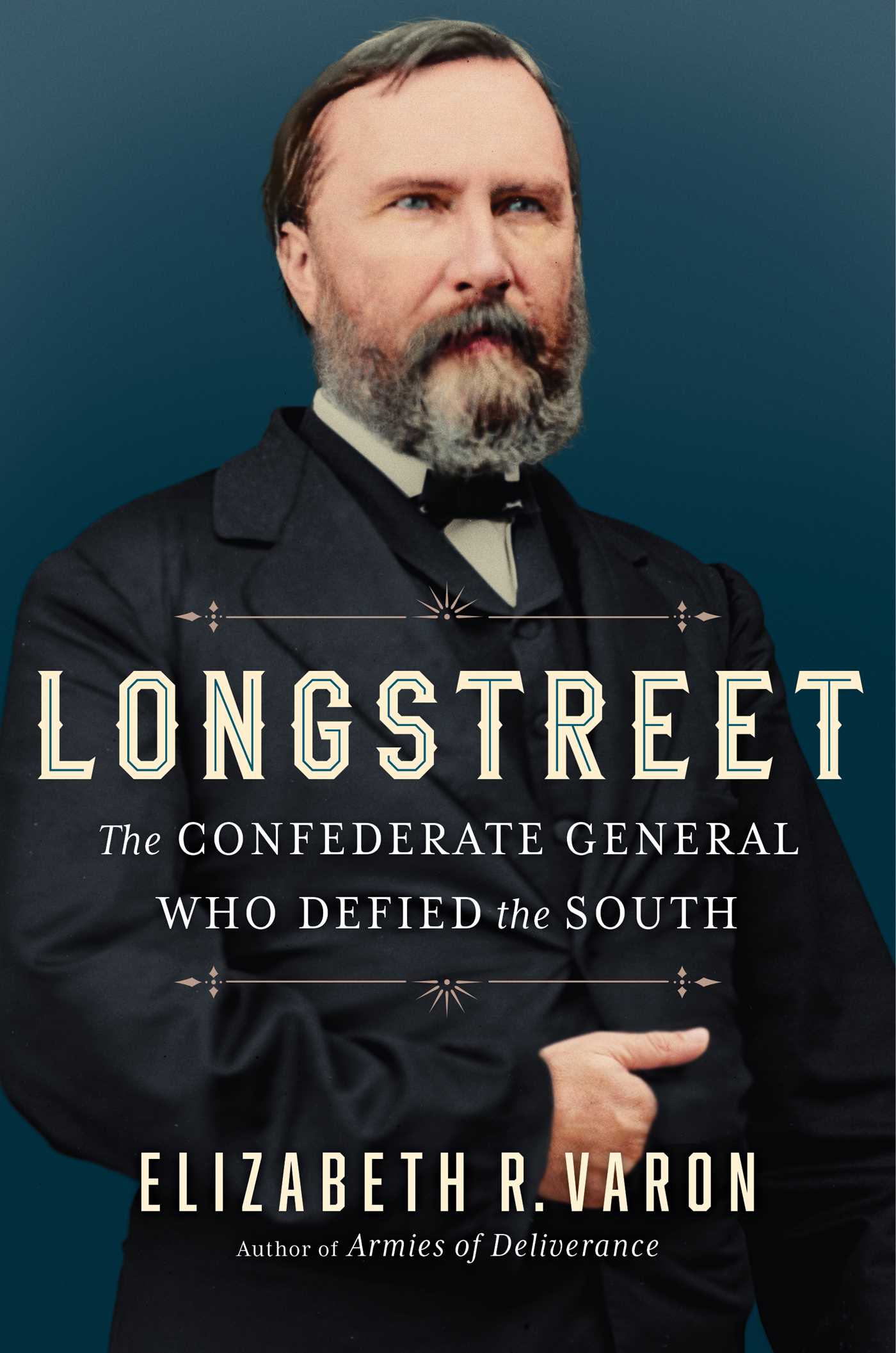
Longstreet: The Confederate General Who Defied the South is a biography that focuses on Longstreet’s military service in the American Civil War, and his political life thereafter. It’s meticulously researched, and the documentation is among the best I’ve seen anywhere. Students, Civil War buffs, and other interested readers won’t want to miss it.
My thanks go to NetGalley and Simon and Schuster for the invitation to read and review. This book is for sale now.

James Longstreet was one of the most able and respected generals for the Confederacy, serving as General Robert E. Lee’s right hand officer. Lee called him “my old war horse.” However, a disagreement between them about strategy at Gettysburg has made Longstreet a convenient scapegoat for Lost Cause types that accuse him of treachery, of deliberately sabotaging the deadly three day fight, and thereby causing the rebels to lose a key battle. Varon sets the record straight, and then goes on to explain what he did following Lee’s surrender and the Confederacy’s failure.

When I saw the subscript in the title, I wondered whether Varon might be overstating Longstreet’s postwar behavior in order to draw readers. Having read it, I can say that she has not overstated one single thing. This is a fair and balanced account. In essence, Longstreet recognized that, while the Confederate Army fought long and hard, it had in fact lost, and there was no good to be gained from further destruction at a time when reconciliation was more important. He basically said that having lost the war, the best thing for the South to do is recognize that the war is done, and proceed to obey the laws of the United States and rebuild the ruined Southern states.

I was unaware, before reading this biography, how extensively defeated Caucasian Southerners were inclined to sabotage the U.S. government. Guerilla actions were common, along with the passage of local laws that directly conflicted with Federal ones. Acts of terror against African American former slaves, as well as free Black Southerners, were frequent whenever Federal troops or other peacekeepers were not present to see to their safety and their rights. And though I had not realized it, Longstreet hailed from Louisiana, which seems to have had the ugliest resistance of all, with the White League and the Knights of the White Camelia wreaking havoc against Blacks that occupied governmental posts, became too prosperous for the liking of local Whites, or that in any way displeased any White person of any social standing. Longstreet did his best to shut that down; he failed.

Varon discusses the role played by Longstreet’s personal friendship with U.S. Grant, one which predated the war; he was best man at Grant’s wedding to Julia. She suggests that although the friendship was important, Longstreet was also acting on principle.

Varon doesn’t overstate her case, and is measured and fair in her assessment. She points to the occasions when Longstreet folded and cooperated with the local racists in that well-traveled road of U.S. politicians: I have to do this terrible thing in order to get elected, or I can’t do any good for the former slaves or anything else. This habit, both past and present, sets my teeth on edge, but she doesn’t defend it. She also points out that had the Confederacy won the war, Longstreet would have remained a Dixie racist for the rest of his life, more likely than not.

Those looking at the length of this book—over 500 pages—should be aware that about the last twenty-five percent of it is endnotes, with documentation, bibliography, etc. And while it may be more than a general reader that simply enjoys a good biography might appreciate, those interested in the Civil War should get this book and read it.

A Fever in the Heartland, by Timothy Egan*****

Timothy Egan, winner of the Pulitzer Prize, is one of my favorite historians to read. His most recent book, A Fever in the Heartland occupied the bestseller lists for months, and rightly so. I took my time with it because it is a very uncomfortable read most of the way through, with the first half being much rougher than the last. I learned a lot from it, and this is clearly a case of truth being stranger than fiction.

The Klan was originally formed by former Confederate officers after the Union’s victory in the American Civil War. However, it was stamped out during Reconstruction, and was gone for fifty years. It was revived on Stone Mountain, Georgia, and the horrifically racist film by D.W. Griffin, The Birth of a Nation, which depicts African-American men as crazed rapists that drink to excess and lose their minds when a Caucasian woman is anywhere nearby, not only aided its reincarnation, but contributed one of its most feared symbols. No crosses were burned until it showed up on movie screens around the United States; the pointy hoods were shaped that way to make the men underneath them appear taller. Later, the women’s organization had robes with cardboard forms in their own pointy hats, because a night of terrorism is no excuse for a woman to let her hair get out of control.

At one point, one Caucasian man in three belonged to the Klan. There was even a children’s organization, with activities similar to boy and girl scouts.

The woman that is at the center of this story, Madge Oberholzer, was the secretary in the office of D.C. Stephenson, the Grand Dragon of the newly revived Klan. Despite the hugely moral speeches he gave around the country extolling traditional values (for the time) including the avoidance of alcohol; women that remain virgins until marriage and then live their lives in service to their husbands and young children; Protestantism, with regular church attendance; Caucasian separation from other races and ethnicities; and unquestioning patriotism, Stephenson himself was a drunk, as well as a serial rapist and sexual sadist, fond of using his teeth to mutilate the women that he savaged. Madge was the one victim that would not crawl into the shadows, and she literally used her last dying breaths to expose him.

I was given a hardcover copy of this book when it was at its height of popularity, but it took me a long time to get through it, because I could only stand to read a few pages at a time. The end was enormously satisfying, however, and even in the worst parts, there are occasional moments that made me want to stand up and cheer. For example: the Klan plot to go the University of Notre Dame—a Catholic university– and burn the golden dome there was foiled by its football team, and the melee that ensued when they physically attacked the Klan is the origin of their nickname, The Fighting Irish. (The dome survived.)

Often when I read nonfiction history, I can’t help imagining how much more interesting it would be if it were written as historical fiction. That was never the case here. Firstly, if this were a fictional account, reviewers everywhere would have been brutal, because nobody would ever believe a story like this one. But the fact is, it’s entirely true, and Egan is second to none when it comes to research. Also, his conversational narrative style is as interesting as the best historical fiction; the pace here is slowed in places, not by any lack of authorial fluency, but by the horrifying nature of this true story.

For those that have the capacity to read something like this without becoming morbidly depressed or coming unstuck, this book is highly recommended. For everyone else, I recommend finding something lighter and more uplifting to alternate with it, and to never read this at bedtime. You won’t want it in your dreams.

The White House Plumbers, by Egil “Bud” Krogh and Matthew Krogh

Egil “Bud” Krogh was one of the men known as the “White House Plumbers,” which was a small group of operatives that dressed as tradesmen in order to illegally break into and ransack private offices for the purpose of digging up dirt on political opponents. Krogh’s job, together with E. Howard Hunt, was to lead a small team of men to burglarize the office of Dr. Fielding, the psychiatrist that treated journalist Daniel Ellsberg, in search of a way to discredit Ellsberg, whom President Richard Nixon regarded as an opponent.

My thanks go to Net Galley, St. Martin’s Press, and Macmillan Audio for the review copy and audio book. This book is for sale now.

Few people shy of the Boomer generation will have personal recollection of the Watergate scandal that brought down a sitting U.S. president for the first time, and the burglary of Fielding’s office was the first illegal event that set it all in motion. Nixon was furious that the Pentagon Papers had been released and that the U.S. Supreme Court had come down on the side of the First Amendment and the free press. Consequently, the president decided that the executive branch must go it alone, and sought a way to discredit the journalists behind it. That was how all of this came about. He howled about national security, and may or may not have believed it; or, he may have sought to cover up lies he had told to the American people about the war in Indochina, and  since he couldn’t force the publication out of circulation, the next best thing would be to persuade the public that its authors—or annotators, at any rate—were crazy and not to be believed. This background information comes from me, not from the book.

At any rate, this political memoir comes to us courtesy of Bud Krogh, and also his son Matthew, who completed it after Bud’s death. For the purpose of this review, I will use the name Krogh to refer to Bud, unless otherwise noted.

Krogh was brought into this mess by John Ehrlichman, one of the two advisors that were nearly as close as a second skin to Nixon during his time in office. Other accounts refer to both as cold-blooded thugs, and my earlier reading leads me to agree with them, but to Bud, Ehrlichman was a noble soul dedicated to his country and his president, a fine, devout individual that was like a second father to him growing up. It didn’t occur to him, initially at least, that anything he was being asked to do was corrupt or scandalous; here, I find myself shifting in my seat. Surely he must have wondered why this secret little group of men, not even government employees, were being tasked with this job, rather than the agencies that ordinarily do the cloak-and-dagger jobs? He claims that Nixon couldn’t trust FBI director J. Edgar Hoover, who was a slimy character, and that makes at least a little sense to anyone familiar with him. Yikes.

The writing as well as the accountability are uneven throughout this book. The prologue sounds sketchy to me. Those of us that have spent any time at all watching criminal trials take place is familiar with the vaguely nebulous language I see and hear at the beginning of this thing. Instead of saying that he has done something very wrong and is sorry, he says he has made bad choices, and he is sorry about “what happened.” This is the language that guilty people use when their attorney has told them to show remorse. Someone not listening carefully might think that the speaker has apologized, but they’ve actually distanced themselves from wrongdoing. During this portion of the memoir, I glanced at the text and also the device playing the audio, half expecting to see a little slime leaching from its margins.

And yet, at the end, the prose is more eloquent, and the accountability rock solid. Krogh goes to the psychiatrist in order to apologize in person, once he is out of prison. He visits Nixon to apologize to him (which baffles me, but okay.) He claims to have declined a presidential pardon. He never loses an opportunity to put on a hair shirt prior to his many speaking engagements. And so it goes.

One could surmise that the early portion was written by Krogh, and the end written by his son, but even if that is true, those speaking engagements were taken by Bud, not by Matthew, and likewise the specific apologies rendered. So who knows?

The narrator for the audiobook is Peter Krogh, who does a fine job.

If you are interested in studying the Watergate scandal and haven’t read any other books about it, this is not the one. Krogh’s involvement ended with the break-in to Fielding’s office, and he helped cover it up, lying under oath as he was told to do, but he had nothing to do with the Watergate Hotel burglary of the Democratic National Committee’s offices. In short, though famous enough to be remembered for his actions, he was not a central player. For those interested in reading just one book about this scandal, I’d go with All the President’s Men, by Woodward and Bernstein; The Nixon Defense, by John Dean; or Nixon: The Life, by John A Farrell. These are all fairly lengthy; if you are looking for something less lengthy, try One Man Against the World, by Tim Weiner.

As a general read for the uninitiated, I’d give this book 2.5 stars. For Nixon and Watergate buffs, I rate it 3.5 stars.

Being Nixon: A Man Divided, by Evan Thomas ****

beingnixonSuddenly, everyone is writing Nixon biographies; it’s a Watergate junkie’s dream come true! Here Thomas does his best to take us inside Nixon’s skin and tell us what motivated some of the decidedly strange things he did. It makes for highly engaging reading. 3.75 stars get rounded up to 4, along with my thanks to Net Galley and Random House for the DRC. This book is available for sale now.

When I signed on for this galley, I imagined that perhaps Thomas had a background in psychology or psychiatry and was going to take a stab at diagnosing a mental illness that might explain what in the world Nixon was thinking when he did the things he did; if he’d had different meds, would things have shaken out differently? But that isn’t what this book is about. Instead, it is a glimpse at Nixon’s life, including his early childhood and adolescence, postulating that childhood experiences may have shaped the politician Nixon became.

To this, I will admit that I said, “Psssh. Right. Whatever.”

Because it’s a plain and simple fact that many presidents had lives that were scarred by events as bad or worse than what Nixon experienced, and most of them still managed to do their jobs without coming within a hair’s breadth of impeachment. So I don’t buy that theory.

Nevertheless, there are so many interesting tidbits and stories in this memoir that even if the reader doesn’t buy the overall thesis, it’s a compelling read. The conversational narrative kept me rolling along, and every time I found an opinion I thought was baloney, I made a note of it and kept going. I would have continued reading even if I didn’t have an obligation to the publisher, because it really is fascinating stuff.

Imagine, for instance, a solitary candidate with a love for classical music, sitting all by himself in his hotel suite, with the 1812 Overture blasting away, with his arms furiously directing an unseen orchestra. Just one aide saw this, and Thomas ferreted the incident out and presented it here. I doubt you’ll find these tidbits anywhere else!

In addition, few other biographers have managed any insights into what went on in the Nixon residence. I often wondered about Pat, Tricia, and Julie. When he showed up to home, did he storm in and turn the coffee table over? Get quietly drunk? Blame his family for all his ills? Drawing heavily on the memoirs written by family members that I am unlikely to ever read, Thomas gives us a little voyeuristic peek behind the curtains, and I found it intriguing indeed.

When it comes to Watergate, Thomas holds Nixon responsible for what he did, for the greater part, but I rolled my eyes at the repeated claim that if he hadn’t been too shy to socialize with the staff, with the Washington socialites who invited him to dinners, and so forth, maybe he would not have become so isolated…if his childhood hadn’t been so poor, and if his father hadn’t kept him home from his Yale scholarship because there was no money for dorm fees…if…if…if…

I felt much more certain that the author’s research, which is mostly done via secondary sources and the Nixon family’s memoirs, including heavy use of Nixon’s own (RN), was based on fact when he dealt directly with Nixon’s personal life. Although various quotes by the Watergate conspirators were interesting, some are more believable than others. I found one fact in this bio that directly conflicts with that of biographer Tim Weiner, and it has to do with the choice of Spiro Agnew as a running mate. Thomas cites reasons personal and political; Weiner documents that the choice was bought and paid for by Greek financial interests. Here, I believe Weiner. It’s just one directly conflicting fact, but when I found it, just as a humble reviewer rather than as a researcher, it called other things into question, which is where ¼ star fell off this review.

The author thanks a number of people in his after-notes. I always read those, because you can pick up little things lost elsewhere. He especially thanks the man that told him to beware the various items found in the prodigious memoirs by “that old thespian”, Richard Nixon, who was a student actor before he went into politics. It was strong advice.

In perusing this biography, I realized two things. The first is that the reason Nixon had so little domestic policy, and the reason the country moved so smoothly without him during the tortuous period prior to his departure, is because he didn’t have much of a tool kit to start with. The author notes that although Nixon has gained a sinister reputation as an evil, sneaking genius, in fact there were areas in which he really wasn’t all that smart, and this was one of them. He focused on three things: foreign policy, in which he was better equipped to carry out the wishes of the bourgeoisie than most presidents have been; running for office again and when that was done, honing his legacy, about which enough has been said; and of course, revenge, revenge, revenge.

The second thing I realized is that the reason he was virtually cast out of office in a situation in which other presidents might have been able to pull their chestnuts out of the fire, had to do with the fact that he believed himself, as US president, to be more powerful than the ruling bourgeoisie. He misjudged the relationship of power between himself and those that rule us quietly, usually in an unseen way. In attempting to yank the broadcasting license of CBS as part of a personal vendetta against the owner of the Washington Post, he took on a sector of the ruling rich, and he made of himself an object lesson.

By my count, this was my twelfth Nixon biography, though I may have read and forgot about some others. It’s neither the best nor the worst, but for those fascinated with Nixon’s rise and fall, and with Watergate, it should go on the to-read list. It’s just too good to miss!