
You’ll Never Believe Me, by Kari Ferrell**-***

My thanks go to NetGalley and St. Martin’s Press for the invitation to read and review. This book will be available to the public January 7, 2025.

The blurb for this book had me at hello. Korean baby girl adopted by Caucasian Americans, who then become Mormons; a childhood and adolescence rife with alienation, discrimination, and ultimately a life of crime; prison time, followed by social crusades, among them prison reform, which is hugely necessary. I was all in, but that was before I read this thing. My own daughter is half Japanese and has to listen to “Where you from?” a fair amount, so this is a sensitive area for me, too. Racial teachings within the LDS (Mormon) church are a veritable minefield, and indeed, I can see how Ferrell’s upbringing would have been fraught.

And yet, the memoir that I read was not what I expected. The memoir, the blurb said, would be laugh out loud funny; I chucked a few times at the outset, and then was mostly just horrified. I received both the digital and audio galleys, and halfway through I abandoned the audio, because Ferrell, who provides her own narration, sounds so ebullient, so proud of herself, that I couldn’t take it. Reverting to the digital made it doable, but I found myself finishing it from a sense of obligation rather than a desire to read more.

Ferrell’s friends during her adolescence are what most adults would consider to be the wrong crowd. Truancy, petty theft, lying, drinking, and drugs are hallmarks. But Ferrell neither stays there as an adult, nor reforms herself once she reaches adulthood, though her parents, even though they divorce, likely can provide her with psychiatric treatment or counseling. Instead, she escalates, and commences stealing and defrauding her friends, pretending to need an abortion, pretending to have cancer, receiving so-called loans and gifts from those that don’t have a lot of money but love her dearly, and then disappearing. Steal in Utah, move to New York City. Steal in New York, go home to the folks in Arizona. And it continues until, at long last, she is arrested, tried, and convicted.

I tried to put my finger on what it is that makes me edgy here. Why do I not believe she’s all that sorry? Partly, it’s that other people appear only briefly and vaguely here. Of course it’s Ferrell’s life that’s the focus, but I would have expected some passages that flesh out the people that have loved her and tried to help her, even if it is necessary to conceal their identities as a matter of their own preferences. What happens to them later? What hardships, if any, do they suffer because of her actions? Instead, all of them come across as shadows, and as if they don’t really matter. I would have expected some emotion around reconnecting with some of these people, trying to make amends and financial restitution, even if they don’t want to see or hear from her. She talks a fair amount about the realization that her behavior is a form of self-sabotage, cutting herself off from positive relationships, but she doesn’t talk much about how she has sabotaged, or even completely blown up, the lives of others.

Lastly, I’m disturbed by some of her assumptions. The one that comes immediately to mind is when she reminds us—as if this is well known—that lying is fun. What??

In order for a memoir to be successful, the reader must be able to bond with the author. I have been unable to do that, either because Ferrell enjoys talking about her crimes and betrayals a little too much, or because she is unable to convey remorse in her writing; either way, I cannot recommend it to you.  
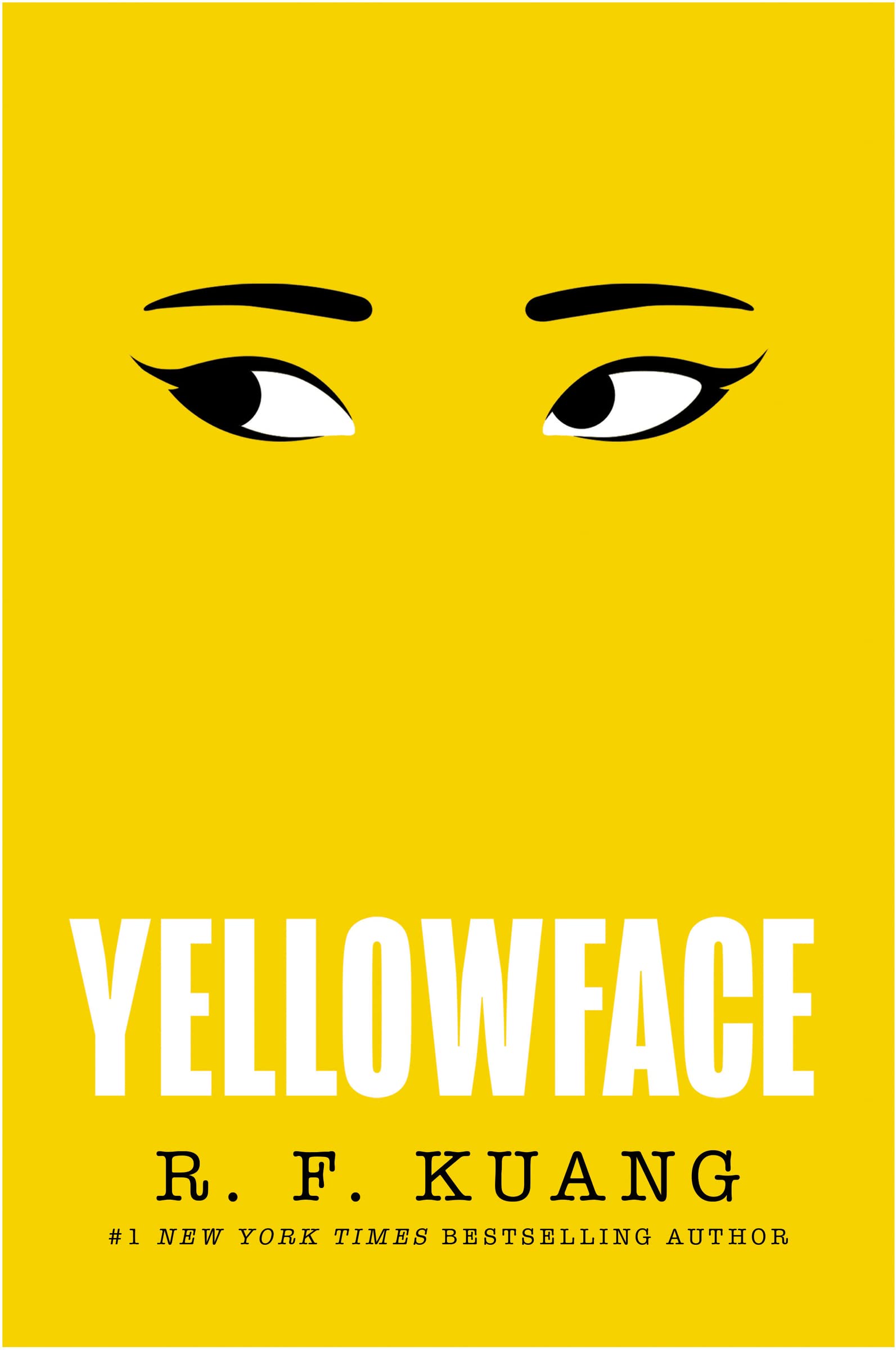
Yellowface, by R.F. Kuang****

Rebecca F. Kuang lights a match, and the literary world explodes! Her new novel, Yellowface, takes on issues of racism, cultural appropriation, cancel culture, and identity politics. My thanks go to Net Galley and William Morrow for the review copy; this book is for sale now.

Our protagonist is Juniper Hayward, a struggling writer. June’s longtime friend, Athena Liu, is spectacularly successful, and though June tries not to be bitter, Athena is a bit oblivious to June’s distress, and so although June likes her, she also kind of hates her. Then one day, as the two of them are discussing Athena’s newly completed masterpiece, which took a decade to create and has been seen by no one yet, Athena chokes to death on a bit of food. June employs the Heimlich maneuver, but it doesn’t work. Now Athena is dead, and June has in her possession the unpublished manuscript.

What comes next makes my jaw drop! June leaves with the manuscript, which still needs cleaning up before it can be published, and using every lame attempt at justification one can imagine, she edits it and publishes it under her own name. She rationalizes:

“The truth is fluid. There is always another way to spin the story, another wrench to throw into the narrative. I have learned this now, if nothing else…My only sin is loving literature too much.”

To make matters worse, her publisher suggests she use her middle name, Song, as a pen name. (Oh, snap! There’s already a mystery series that stars Juniper Song, though this doesn’t make it into the novel.) The book is a brilliant success, but during her book tour, audiences cannot help noticing that June is, well, Caucasian.

Man your battle stations!

Initially, June seems like a decent enough person that has made one self-serving mistake, but as the narrative unfolds, her judgment, behavior, and moral character deteriorate. The suspense is thick and absorbing as I wait to see just what will happen next.

In places, this story is drop dead funny.

I recommend this book to those that love to see good fiction based on current events.

Bird Uncaged, by Marlon Peterson****

I’ve never felt so ambivalent about a Civil Rights memoir. I read this book free and early, thanks to Net Galley and Public Affairs. It’s for sale now.

At the outset, Peterson describes his early years as the son of Trinidadian immigrants living in Brooklyn. His family belongs to the Jehovah’s Witnesses, and so that is an angle I haven’t encountered before. He describes his brilliance as a student, and the glowing future that has been predicted for him, scholarships, fine schools, and a ticket to the top. It doesn’t happen that way, though. He is involved in a robbery that becomes a homicide, and he wants us to know none of it was his fault.

What?

This is what concerns me throughout most of the book. He describes the limitations on young Black men in America, the limitations of poverty; the racist assumptions; and the “toxic masculinity.” He is sexually assaulted as a youngster, and he considers that an element in his decision-making, the trauma of his past informing the crimes he commits later. He talks about this at length, but I’ll tell you what he doesn’t talk about much. He doesn’t talk much about the near-rape in which his was the pivotal role. He asks a “chick” out, and he and his friends are planning to “run a train” on her. But she is alarmed when she realizes that there are other men in the bedroom where they’re making out, and she gets away fast. He doesn’t recall her name, and he wants us to know he wasn’t that interested in her, anyway. She wasn’t “the pretty one,” she was the friend of the pretty one. And I keep wondering why he includes this if he feels so badly about what he and his homies nearly did to her. He pleads ignorance; he was a virgin. He just wanted to lose his virginity. He had believed she would welcome a roomful of men lining up to use her.

Uh huh.

There are also a good number of solid aspects to this memoir, most of them having to do with the dehumanizing American prison system. There’s not a lot that I haven’t seen before, but obviously, the system hasn’t been significantly altered as a result of the other memoirs that have seen publication, and so there’s a further need for stories like his. He speaks of how, while doing his time, after a visit from his mother, he kisses her on the cheek, and the guards swarm him to check the inside of his mouth before his mama is out the door. I’m guessing that after that farewell, the woman is out the door in a matter of seconds. What would it hurt to hold him there for 30 seconds, let the parent get out of the room, and then check him? It’s little things like this that increase the alienation felt by those that are incarcerated. Other countries don’t do it this way, and you have to wonder why the U.S. has to be so ugly about it. He leads a program and conducts protests while he’s inside, and is successful in making small changes. Other men learn from his work and are improved by it, and that’s something to be proud of.

But back to the robbery. He keeps reminding us that he was only nineteen years old, and I cannot, for the life of me, think why he considers this a mitigating circumstance. Ask a youth psychiatrist or counselor when men are at their most dangerous, and they will tell you that the teenage years are the worst, hands-down, because young men haven’t developed impulse control. And Peterson himself points out, later in the book, that when ex-cons get out of prison after spending a long time inside, they don’t go straight because they’re rehabilitated; they go straight because they’re older, and have outgrown that nonsense. It’s inconsistencies such as this one that weaken the narrative.

Toward the end, he pulls it together and claims responsibility, and he does so eloquently. But it makes me wonder why he didn’t go back and rewrite the earlier passages. Because there are a lot of red flags back there, things that those of us that have worked with at-risk youth know to listen and look for. For example, there are a lot of passive references to his crimes, things that “happened” rather than things that he did, or things that went differently than he expected; there’s an awful lot about his trauma, the environment, and allll the “toxic masculinity,” but thefts, robberies, and the homicide for which he was the lookout man but “didn’t even have a gun,” are given relatively little ink.

I’m carrying on quite a bit about this, but I have seen glowing reviews, and he’s gotten awards for this book, and nobody is talking about the red flags, and so I feel it’s important to mention them. The fact that the book ends with much more accountability is what’s kicked my rating up to four stars.

Read this book, but do it critically. There are lessons here that are intentional, and others that aren’t.