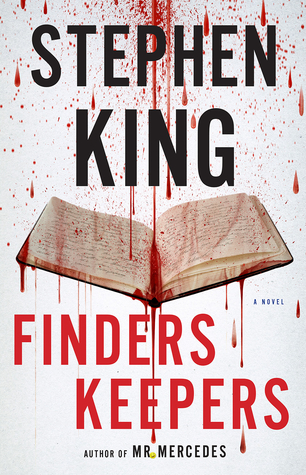
Finders Keepers, by Stephen King *****

finderskeepers“For your family, you do all that you can.”

When I read that one, simple sentence, it occurred to me that this common thread runs through a lot of Stephen King’s work, and it’s one reason he has developed such an easy simpatico with much of his readership, despite the murky waters his books bob into. It’s about our family, and about our common humanity, and the bad guys are the ones that can’t be tapped into, that violate that sacred reality.

As the book opens, we have our killer—or one of them—from Mr. Mercedes. And at this point, I have to tell you that if you haven’t read Mr. Mercedes yet, do that before you do this. (Mr. Mercedes is reviewed by me here: https://seattlebookmamablog.org/2015/04/24/mr-mercedes-by-stephen-king/.) Seriously. I’ve seen clueless-seeming individuals out there on social media wondering if it makes a difference, and oh my stars. Why, why, why.

I suppose if you are just stone flat broke and have no access to a public library, and by some stroke of luck you have a free copy of this book but cannot get the first in the series, then yes, King gives you just enough of the back story here to enable you to start midstream. But if at all possible, you really ought to read the first book first. There were so many little poignant moments—for example when Hodges thinks about Janey—that just made my insides do a back flip, and if you plunge into this story first, you’re going to miss so much of that. And in the end, you’re going to want to hunt down Mr. Mercedes and read it anyway, so why not try to do it in order?

All righty. So as our story opens, Morris, one of the murdering thieves from Mr. Mercedes, is an old man now, and he’s just getting out of prison. He’s been waiting a long, long time for this, because he has buried a whole lot of money as well as the last, hand-scribed novels of John Rothstein, a now-dead author whose work he has loved his whole life. He isn’t sure what he wants more, the money—well yeah—or oh my god, those notebooks! To read them! He knows the sensible thing to do is try to sell them, because they’re doubtless worth a small fortune, but first, just to read them. And now he’s out.

What he doesn’t know is that all those buried goodies have been found by a kid who happens to live and play in the area where Morris buried all of that. Nature has changed the contours of the woods where the trunk was interred, and a corner was revealed, just enough to make a naturally bright, curious kid want to know what it was. So that money is gone. It’s gone. In fact, it’s all gone.

The tension in this story builds a lot more slowly than most of King’s work, and at first I thought it was a sign that our author was slowing down. Au contraire, Pierre. Because really, it’s more about the pacing of the genre. When King writes his supernatural baskets o’spiders, he puts that pedal down on the floor, sometimes on the very first page, and it’s like the world’s most terrifying roller coaster until after the climax. The reader’s heart won’t stop slamming till the problem is essentially solved, at least for the moment—I’m talking about his horror novels here, not his mysteries, including this one—until that brief period at the end in which the loose ends are tied up, and the protagonists can laugh about the whole thing over coffee, or whatever.

The tension in a mystery like this one, on the other hand, is a much more gradual climb. It’s supposed to be that way. We get the tingle of dread, the near-misses, but instead of going from zero to eighty in chapter one, it’s more of a traditional hill, building, building, building. It never gets dull, but the reader will actually be able to put the book down to go make dinner, to do homework, to answer the phone. And that doesn’t make it weaker writing; it’s just a different type of story.

Once King gets to the top of that hill somewhere close to the 80% mark, we really have to stay with the book and finish it. Just finish it.

I did not read this as a galley; it was a Mother’s Day gift from one of my sons. They never miss a year, my boys, and they almost always get me one of my most coveted titles. I don’t put a lot of books on my wish list these days because I can get so many outstanding books free, but I had to have this one, and am glad my eagle-eyed son ferreted it out of my list and ordered it for me. Thanks, Benj.

Is it worth your hard-earned dollars? If you like really good mysteries and thrillers, absolutely, positively yes. BUT. You have to read Mr. Mercedes first!

The Longest Night: A Novel, by Andria Williams***-****

thelongestnightanovelIn her debut novel, Andria Williams gives a fictionalized account of a meltdown that occurred (in real life also) in Idaho Falls, Idaho. The narrative is intimate, the characters palpable; all told, this was a strong read. Many thanks go to Random House and Net Galley for this galley, which I was given free of charge in exchange for an honest review; I rate this novel 3.5 and round it up. The book becomes available for purchase January 12, 2016. You’ll see this post again sometime nearer publication.

Those of us that lived through the 1960’s will recognize how authentically Williams renders even the smallest details in setting, both the physical and social, of the Unites States during that time period. Home, clothing, and point of view are rendered expertly. This writer personally loved the depiction of a blend of meat, starch, and dairy with some canned fruit tossed in as a “balanced meal”. Yes, yes, and yes. Even more, I love the moment when our protagonist, Nat, tells her children, “A little sugar will perk you right up.”

I swear to you…this is what it was like!

Add to the extremely narrowly defined social mores of Caucasian Americans living in middle income homes during this time, the even more rigid expectations of military wives at that time, and a woman could nearly suffocate. And people grew up much faster back then; in one’s mid-twenties, it was usual to be not only out of the house and married, but to have a couple of kids, maybe not to even live near any family.

So when Nat’s husband, Paul, is transferred from sunny San Diego to Idaho Falls, Nat knows she and the girls will just have to make the best of it. She puts on her cheerful-helper smile and launches herself wholeheartedly into this new, stark environment. And Paul will be working at the Idaho Falls nuclear research facility. Note that this was not a place that generated power for anyone or anything; further, it was outdated. And we experience a definite chill when Paul sees things that are dangerous and should be reported, and he is cautioned not to make waves.

A particularly attractive character (from a literary standpoint) is Paul’s boss’s wife, Jeannie, a complex, fascinating character who would have had a lively career of her own had she been born in another time. At one point she loses it with her husband:

“Oh, how I wish I had your job,” Jeannie sneered. “I would be so much better at it than you.” And you know she would have been, too. Not any nicer, but definitely more proficient.

There are so many other fascinating details here, but I can’t spoil the surprises. A small but frustrating discrepancy toward the story’s end left me a bit confused at an otherwise exciting time in the story, and that is where half a star fell off my rating.

But don’t let it stop you from reading this gem. This will be an author to watch in future years!

Hard Rain, by Peter Abrahams ****

hardrainHard Rain is a nail-biter of a suspense novel, part mystery and part espionage thriller, and Peter Abrahams is a writer with credentials as long as your arm, including being Stephen King’s favorite American suspense novelist. After reading this skillfully woven tale I can see why. My thanks go to Net Galley and Open Road Integrated Media for the free galley. It was one wild ride!

Hard Rain is set in the period after Vietnam, but prior to the time when satellites revolutionized our means of communication. Our opening scenes involve a mysterious, sinister fellow named Bao Dai. His murder of a stranger for no apparent reason sets the reader on edge, and the surreal tone the writer lends is better than anything I have ever seen. In fact, the writing style and pacing are so brilliant that until I stumbled across some unexpected but fairly glaring problems in the last quarter of the book, it was headed for a five star review and a home on my favorites list. But more about that later.

Our chief problem, once the initial set up flashes past us, is that Jessie’s daughter is missing. Her ex-husband, Pat Rodney, took her for the weekend. They were going to go fishing, and then she was going to be returned to Jessie in time for a birthday party. But they never made it to the fishing boat, and there are some ominous messages on Pat’s answering machine. Kate never came home, and Jessie has no clue where she is.The cops aren’t all that concerned, seeing it as a routine custody violation that will surely be resolved on its own, but Pat has never been responsible, and has never ever wanted full custody; Jessie just doesn’t think he would snatch her. Her best friend, Barbara, is a no-holds-barred lawyer, and she’s ready to get down to business, but she is killed by a hit and run driver as she goes to cross Jessie’s street, wearing Jessie’s yellow rain slicker. That one person was the entire cavalry; now Jessie is on her own.

It just doesn’t look good.

The trail takes Jessie to Bennington College in Vermont. Pat was originally from Vermont, and she thinks he may have gone home, or at least contacted his family. And once there, all hell breaks loose. A particularly harrowing scene involves a chase scene in a subterranean tunnel beneath the dormitories.

A parallel storyline that blinks in and out has to do with an aging spy named Zyzmchuk, who is about to be sent out to pasture. Keith and Dahlin, a snappy, younger pair of more business-like spooks, plan one further adventure for “Zyz” in the hope that when it’s over, he’ll either be dead or leave quietly. These two, for some reason, made me think of Haldeman and Ehrlichman, the two sinister advisers that did President Nixon’s bidding at times, and at other times kept him on a leash to keep him from acting crazier than he already was. Maybe it’s because I am also reading Tim Weiner’s galley about the Nixon presidency. I have to say that of all the myriad characters that wink in and out of this complex, deliberately disorienting story, Keith and Dahlin are my favorites.

The imagery, with water and falling being constant themes throughout this spooky story, is among the best I have read, together with a deceptively simple sentence pattern that creates suspense in something of a house-that-Jack-built fashion. I still can’t figure out how he does it. It’s uncanny, and really absorbing.

So, even with the problems toward the end, is this creepy novel worth your time and money? Assuming you enjoy this sort of story, I have to say yes, it is. In fact, this writer won the Edgar earlier in his career, and that early title is now on my to-read list. I probably won’t find it as a galley, which means I have to hunt it down at the library, or fish around for it on my annual pilgrimage to Powell’s City of Books. So what follows was not enough to cross this writer off my A list, by any means. And now if you read further, there are going to be spoilers, so if you want to read this yourself and not know how the ending shakes out—or at least bits of it—this is the place to quit reading. And for those skimming, I will make it more obvious:

*****SPOILERS AFTER THIS POINT!!!*****

We are 75% of the way into the story. Jessie has been beaten by bad guys, and has been rescued, medical attention sought by our very own spook, Zyzmchuk. He is keeping an eye on her partly for her own good (awww), but also so that she doesn’t get in his way, because her mission interferes with part of his. He sets a guard to watch her when he has to go out, but otherwise, he sits in a chair in her hotel room there in New England, keeping watch over her. She is a sweet young thing still; he is retirement age.

And so there she is, with a nasty concussion and a number of other bad injuries, worried about her missing child, and so what would be more natural than inviting this duffer, a man as ancient as I am now, to come climb in bed with her so they can have great sex?

What the hell?

“’Shit,’ said Dahlin.
“’Fuck’, said Keith.’”

Okay, that quote belongs much earlier in the book (and more than once), but I like it here just as well, so I have taken the liberty of inserting it. Because really…what is that about? Did someone in marketing decide the book needed some gratuitous sex in order to sell properly? Go figure.

At the 85% we have to wonder whether some bad editor also cut out a chunk of story that should have been more judiciously and lightly pruned, because when Jessie sneaks out of her hotel room to try to find her daughter, she returns to find that Zyz, the guard Zyz posted while he stepped out, and all other apparent spooks and body guards have decamped. We, the readers, know that the guard in her hotel room was killed after she snuck out, but we don’t know where the hell Zyz went. And the next time we run across him, he is strolling into his office in Washington as if nothing untoward ever occurred. There is never any real explanation for this bizarre leap in the plot.

All that said, once again, I would happily read more of this author’s work. His capacity to create a frisson of chilly suspense far outweighs the Hollywood-like choice to dump the hot chick in bed with the old guy, as well as what may have been an editor’s error toward the conclusion.
*****END OF SPOILER ALERT!*****

This book will be released digitally July 28, and you can get a copy anytime you like now. What better way to spend a vacation, or even a staycation? Just stay out of the water, and definitely keep an eye on your kids. You won’t want them out of your sight while you read this story!

The Goldfinch, by Donna Tartt *****

thegoldfinchI didn’t want to read this book. I resisted it until it had the Pulitzer; then I caved. And once begun, Tartt’s spellbinding tale owned me until I had turned the final page.

The story begins in an art gallery, which explodes in a manner reminiscent of 9/11. It kills many people, including Theodore Decker’s mother.

I don’t like art galleries. I don’t blow them up; of course not. But they bore me unbearably. I avoid them, and I avoid books that are set there.

Theo hasn’t seen his father in nearly a year; for a long time, it had pretty much been his mother and him against Dad, who came and went at irregular times, drank way too much, and was bad tempered. When he left, they were relieved. He never paid a dime of child support, didn’t even leave a forwarding address. Theo’s short, bad memory of Dad’s parents tells us they would make even worse guardians, and his mother’s folks are dead. With whom, then, will he live?

The teacher in me engaged fully when the process of dealing with Theo’s loss and custody issues commenced. Every counselor, teacher, and government bureaucrat wants him to confide in them about his feelings, his grief. Talking about it is supposed to make him feel better. But it’s a hot-stove topic for Theo, and they go about it all wrong, face to face, brightly lit rooms with fluorescent lights, and in one horrific case, an entire panel of earnest professionals at a big board-meeting table waiting to grill this one, introverted, shy child.

His one hope at first is that the Barbour family will take him in. He’s been skipped a grade in school, and Andy Barbour is his one friend. Together they braved the hazing by resentful older students. The Barbours live quite well, in opulent yet tasteful surroundings. Theo walks on eggshells, avoiding becoming an imposition. It’s awkward; when he needs lunch money or a bandaid, he feels funny asking. But gradually, a consensus seems to emerge; he is good for Andy, and Andy is his mother’s favorite. And just as they are ready to set the lawyers and bureaucratic adoption wheels in motion…Theo’s rotten, irresponsible father turns up to claim him. And there is nothing that Theo or the Barbours can do about it.

By the way, I also don’t read books about affluent people. I like regular folks, people who work hard for shelter, food, and other essentials, and a few simple pleasures. And so this book reminded me that for every rule, there is an exception. I don’t read about art galleries or art, and I don’t read about the rich, but I would be much poorer had I not read this book.

Now, back to Theodore Decker.

Theo has never been out of New York City for more than 8 days, but now he is going to Vegas. He watches horrified as his apartment home, once so secure and comforting, is taken apart, thrown into boxes…and his father takes his girlfriend into his mother’s bedroom, where he hears them rustling through her clothes, the girlfriend giggling over his late mother’s effects. The horror!

Ultimately, Theo’s greatest source of consolation, apart from the Barbours, is a furniture restorer. One of the victims of the bombing asked him to take something there with his last dying breath. And in learning to restore furniture, Theo learns to restore himself. There is a fair amount of philosophical musing toward the end of the book, but by then we care so deeply about Theo that we listen carefully. And whereas some of the somewhat nihilistic ponderings went against my grain, I read every word, because I wanted to know what Theo thought.

My favorite character in this massive, painterly tome is Boris. Boris becomes Theo’s friend in Vegas, where both of them live the lives of feral children, sometimes having to steal food, and taking terrifying risks of all sorts. Boris is fearless, and 99 percent of the time he is loyal. They are nearly killed together multiple times, but Boris pops up again, time time time and again, to stand by his comrade once more.

Those that don’t care for literary fiction won’t like this story. The descriptions were so well done that I sometimes found myself forgetting to breathe. It doesn’t happen a lot, and I read a great deal, but it happened constantly as I read this book. If instead you prefer action, action, action—a book that thinks it’s a video game, perhaps?—then leave The Goldfinch on the shelf for someone else.

I got my copy at the library, but I may buy a nice hardcover copy for my daughter at Christmas. It should be in every library, at least among those that love literature.

To sum up: simply brilliant.

Escape the Night, by Richard Patterson ****

EscapethenightEscape the night? Envision being trapped in a tunnel, inside of a tunnel, inside of a tunnel. Some are metaphoric or symbolic, but there’s a whole lot of darkness in this espionage thriller, a suspenseful tale that will play with your head more than once before the author is done. Thank you to Net Galley and Open Road Media for the ARC.

The setting at the outset is New York City during the McCarthy era. Black Jack Carey owns a publishing house that carries work by a left-leaning writer that is being watched by the CIA. Pressure from HUAC comes to scrap the writer’s work. Son Charles, eldest and best-loved son of Black Jack, refuses to yield to the pressure. Resentful younger son Philip, weaker in character and more easily swayed, takes the side of the government. He hopes his sensible nature will cause his father to will Van Dreelen and Carey to him rather than Charles.

At multiple places within this white-knuckle thriller, I had to put the book away because even with the assistance of sleeping pills, I knew I could not fall asleep if this story was in my hands. Were it not for that, I surely would have finished it sooner. This title along with a nonfiction galley have occupied my interest and attention far more than any of the other four books I’ve been reading.

Our villain, a well-drawn government spook named John Joseph Englehardt, becomes obsessed with the Carey family:

“Englehardt had learned that men who spied on other men, out of the loneliness of such a job, came to like or dislike their chosen quarry. But in his soul, he knew that the secret passion for the Careys grew from something stronger.

“The brothers’ rivalry was also his.”

Eventually Englehardt is officially ordered to abandon the Careys, but his psychosis is too thoroughly developed to let go. He turns to the CIA and is able to extend his surveillance. Phillip Carey’s cause has become his own. He despises Charles and is determined to do whatever dark thing is necessary for Phillip to inherit everything.

Generally speaking, I don’t read books about wealthy folk, and this is for a variety of reasons I won’t go into here. But the characters of John, Phillip, Englehardt, and later, Peter Carey, are so intimately sculpted that I had to buy the author’s premise. Once I did so, the pace picked up and the story was unstoppable.

The ending came with hairpin turns and swift kicks to the reader’s solar plexus, but everything that occurred seemed eminently believable, because the main characters and setting were so palpable.

My one small quibble with the writer–and it’s a common problem in literature not specifically geared toward women, but someone has to talk about it–is that the people who were well developed and occupied center stage were all men. Women existed here only as a foil for what was going to happen to someone else. For the novel to go beyond “really good” to “outstanding”, a novelist needs to be able to develop characters of both genders.

That shouldn’t keep you from buying this title, though. It’s one helluva ride. But don’t think you’re going to read it in small easy pieces. Once you pass a certain point, you have to keep going, and you may see the new day dawning and wonder where the night went.

Also, you’ll want to avoid tunnels for awhile.