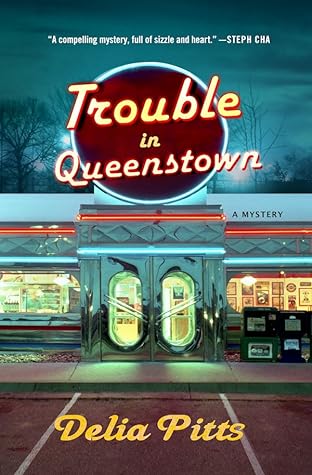
Trouble in Queenstown, by Delia Pitt***-****

Delia Pitts has been writing mysteries for quite some time, but she is new to me. In Trouble in Queenstown, she introduces hardboiled sleuth Evander Myrick. Myrick’s friends call her Vandy, and that helps to distinguish her from her elderly father for whom she is named; he’s in a memory care unit.
My thanks go to NetGalley, Macmillan Audio, and St. Martin’s Press for the review copies. This book is for sale now.

At first glance, I thought that this detective fiction was set in New Zealand. Queenstown, right? But in this case, the locale is Queenstown, New Jersey. The story opens with Vandy cleaning up a mess in her office just as Leo Hannah storms in and wants to see Evander Myrick. He assumes Myrick will be a Caucasian male, and that Myrick herself is a member of the cleaning staff.

Oops.

Hannah comes to hire Vandy in the wake of his wife’s murder. He knows exactly who did it, he tells her, and he wants her to prove it, starting with some surveillance. Vandy isn’t sure she should take this job, but she has to pay top dollar to keep her daddy in the best facility, so she reluctantly signs on. As the story progresses, there are numerous twists and turns, and the violence escalates. By the story’s end, three different people have tried to hire her for exactly the same case!

The thing I appreciate here is the way Pitts addresses cop racism. So many detective novels require the reader to suspend belief, to assume that every cop is fearlessly dedicated to finding out the unvarnished truth and arresting the perpetrator of the crime, regardless of race, ethnicity, or sexual orientation. But as Vandy conducts her investigation, Pitts keeps it real. At one point the detective speaks with a salon stylist that worked on Ivy’s hair, and he tells her that Ivy was afraid of someone at home. Vandy asks if he contacted the police.

“’The police?’ He jerked his neck, pursing his lips as if I’d farted. ‘Girl, you think the cops came here?’ He sniffed. ‘You don’t look like a fool. Maybe I read you wrong.’”

Sadly, the second half of the book doesn’t impress me as much as the first half does. I have a short list of tropes that I never want to see again in a mystery novel, and she trips a few, including my most hated one. I won’t go into details because it’s too far into the story, and I don’t want to spoil anything, but when it appears, I sit back, disengage from the text, and roll my eyes. Ohhh buh-ruther. As I continue reading, I can see who the murderer is well in advance, and the climax itself is a bit over the top, though without the tropes, I mightn’t have noticed this last issue.

In addition to the digital review copy, I have the audio. The reader does a fine job.

The more mysteries a person reads, the staler tropes become. I am perhaps more sensitive than most readers, having logged over a thousand novels in this genre. Readers that have not read many mysteries are less likely to be aware of, and therefore bothered by overused elements, and so this book may please you much more than it did me. But for hardened, crochety old readers such as myself, I recommend getting this book free or cheap, if you choose to read it. Newer readers may enjoy it enough to justify the sticker price.

Blood and Treasure, by Tom Clavin*****

Daniel Boone’s story is legendary, but few of us know any of the particulars of his life and achievements, beyond the forging of the Cumberland Gap. When I saw this book, I leapt at the chance to read it. My thanks go to Net Galley and St. Martin’s Press for the review copy; this book is for sale now.

Boone’s life is often held up as a testament to what an individual can accomplish if he is hardworking and determined; yet though he was both of those things, this bit of lore is also partly myth. Boone is born into a well-to-do family, pioneers to be certain, but not ones forced to build fortunes from scratch. After parting ways with the Quakers in Pennsylvania, the family moves south.  Daniel is in love with the wilderness, and his physical strength, health, and stamina, combined with courage, resourcefulness, and a capacity to think on his feet make him a natural born explorer. He is an excellent hunter, and so he makes his living by selling animal pelts; also, it turns out that bears are delicious. (Sorry, Smokey.) But as others move westward, the game begins to dry up, and so he moves further westward than anybody else.

Boone is renowned as an Indian fighter, but the truth is complicated, and it’s political. There were a great many tribes involved, and often as not they were enemies with one another, at least in the beginning. In some cases, land was sold by a tribe that actually had no claim to it in the first place. This explodes the notion taught to us as children, that the Native peoples found the notion of selling land incomprehensible because of its sacredness; we see one tribe for whom this is true, but there were plenty of instances where a treaty was knowingly made, yet other factors also made it unenforceable. Most of all, Caucasian Americans failed to understand the lack of a top down decision-making structure within the tribes, and so often a chief or other leader would sign, but others within his tribe weren’t bound by his individual decision.

Then too, there’s the little matter of the American Revolution. Alliances are constantly made and broken, involving the British, French, Spanish, and Patriots. At one point, Boone loses his considerable acreage because his land is granted him by the Spanish, but the Louisiana Purchase renders his title null and void.

But it is the detailed recounting of Boone’s explorations (almost never alone, except in an emergency, so there goes the myth of the rugged individual) that makes this book fascinating. The scrapes he gets into, and how he gets out of them; the harrowing fates that befall those around him. He is captured and escapes multiple times.  And although the women in his life get little ink, my heart goes out to Rebecca, his wife, who is left alone with the younger children for months and months on end, often without any idea as to where his travels have taken him, and whether he’s coming back. There are so many ways to die out there, and it’s not like anyone can send her a telegram to let her know if everyone is killed. At one point, she gives him up for dead, and when he finally shows up, she is pregnant, and the baby cannot be his! She tells him that she believed herself a widow, and so she turned to his brother; Boone decides this is understandable, since that’s pretty much what widows are expected to do, and since his brother looks like him, it won’t be obvious to others that he isn’t the father.

Even more interesting, however, is his daughter, Jemima. Her strength and cunning in dangerous circumstances—particularly when she is kidnapped and plays a part in her own rescue—make me wish she had her own biography. Were gender roles not so restrictive, she would have made an outstanding lieutenant, and perhaps successor to her father.

I initially didn’t believe I could give this work a five star rating, because the sources provided aren’t well integrated, and Clavin has relied tremendously on one source, a biography written long ago by Draper. But after I read the endnotes, I realized that even if he had been merely rewriting Draper’s book for a modern audience, it would be a great service. The social and political perspectives dominant when Draper’s book was written would make most of us blanch today, particularly with regard to race and gender, and yet, Draper did a masterful job with research, extensively reviewing Boone’s family and others still living at the time. I came away convinced that Clavin knows his subject well, and though I taught American history and government for decades, I learned a great deal from this one nifty book.

Highly recommended.

Thief of Souls, by Brian Klingborg**-***

I was invited to read this mystery, and my thanks go to Net Galley and St. Martin’s Press for the review copy. I am always looking for something a bit different, and this sounded like it would be. And it is, but it’s not.

Here’s what I mean. A woman has been murdered in a particularly ugly, grisly manner. A hot shot cop who’s been buried in a backwater where nothing ever happens gets the case. Because he is clever and ambitious, he digs more than most cops might, and voila! Turns out this could be the work of a serial killer! But there are higher-ups in the force that would rather have a quick solve than an accurate one. Obstacles! And next thing you know, the cop is in danger too.

Yawn.

Okay. Now, take this same tired thread and drop it in China. With resonant characters, compelling use of setting, and some word smithery, it might come alive, and in the hands of a master storyteller, we might not even notice that the story’s bones are nothing new. Instead, I came away disaffected and mildly depressed. I quit at the sixty percent mark and didn’t even go back to look at the ending, which for me is unheard of, particularly in this genre.

I am no fan of the Chinese government, but the steady flow of negativity wore me down, not to mention the lack of strong character development. We know right away that Lu is a rebel, and as the story progresses, we also know that Lu is a rebel. At the start, we sense that the government, both local and national, is corrupt; as we near the climax, we also know that the government is corrupt.

What, in this story, is worth saving?

I thought it would be fun to see how an investigation works in China, and what sort of rights—or lack thereof—form the contours of the legal system. I came away sensing that the author doesn’t know all that much, either. There’s no Bill of Rights there, surely, but I knew that much going in.

I don’t have to have lovable characters to enjoy a mystery, but there does, at least, have to be someone interesting. Give me a complex, well-developed villain, for example, and I’m a happy camper. But there’s none, and I’m not.

So there you have it. Thief of Souls is one more sad case of an intriguing book cover and title promising more than it can deliver. If you want this book now, it’s for sale, but I would advise you to get it cheap or free unless you have a big stack of money sitting around that you were thinking of burning in the backyard. Otherwise, maybe not.

Best Historical Fiction of 2019: Finding Dorothy, by Elizabeth Letts

Honorable Mentions:

Best Novels of 2018

If I had prize money to bestow, I would divide it between the authors of these two matchless works of fiction, which in my eyes are the best of 2018. Interestingly, both feature strong women as main characters, and both are Southern fiction. If you haven’t read them yet, do it now.