
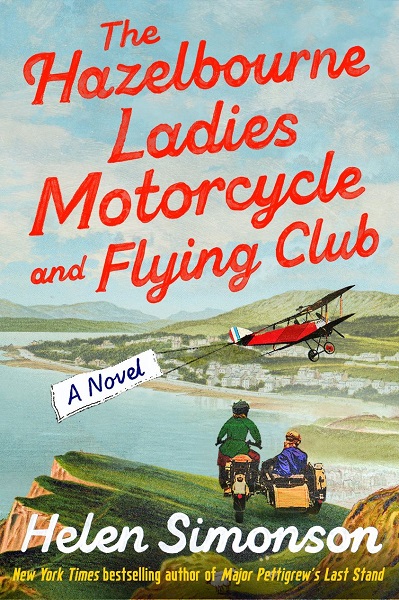
The Hazelbourne Ladies Motorcycle and Flying Club, by Helen Simonson*****

Helen Simonson is the author of the bestselling novel, Major Pettigrew’s Last Stand. With her new release, The Hazelbourne Ladies Motorcycle and Flying Club, she is once more in her element, creating believable characters and using them to skewer the pervasive racism and class snobbery of Britain, and also, in a smaller way, that of the U.S.  With outstanding word smithery and an unflagging pace, this historical novel should be number one on your summer reading list.
My thanks go to NetGalley and Random House for the review copy. This book is for sale now.

The year is 1919; the place is England. Constance Haverhill has been ousted from her job running an estate; the Great War has ended, and now the women that have been gainfully employed and done a fine job are unceremoniously ejected so that their jobs may go to the men that have returned from the conflict. For the time being, she has a position as a traveling companion to a family friend who’s recuperating at the seashore; once this situation ends, she has no idea where she’ll go or what she’ll do.

Out of nowhere comes Poppy, a daring young woman from a wealthy family. Poppy wears trousers and drives a motorcycle; she befriends Constance and sweeps her into her motorcycle club. Things become even more interesting when Poppy purchases a used biplane to bring home to her brother Harris, a handsome but severely depressed young man who’s lost a leg in the war. At one point he laments, “They look at me as if my brain has gone missing along with the leg. Or rather they refuse to look at me at all.”

Poppy is utterly fearless, challenging local authority and promoting women’s rights. She doesn’t care about the opinions of others; her eye is set on the horizon. And she can do that, because she has a soft nest in which to land. At the same time, Constance is always aware of the stark class division that prevents her from behaving as Poppy does.

“Respectability was the currency in which Constance knew she just trade for the foreseeable future. She…did not have Poppy’s wealth and position from which to defend herself against notoriety.”

There are a number of amusing side characters whose less progressive attitudes contrast with Poppy’s. The two women—also very wealthy—on the adjoining estate sniff at her exploits and declare them to be unladylike. The class division is also highlighted when Constance is offered a position with the hotel where she and Mrs. Fox, the family friend she accompanies, are staying. However, she is told that once she accepts the offer, she can no longer be a guest at the hotel, nor may she use the restaurant, which is a frequent gathering place of Constance’s new friends. No hobnobbing with the clientele will be tolerated; she must use the back door. Constance reflects to herself that wherever she goes, her friend Poppy will use the front door.

Britain’s racist attitudes toward people of color is also featured here, but in a way that does not hijack the plot. There’s an Indian guest of the hotel that is snubbed left and right; at one point, an American visitor attempts to have him excluded from the social events to which he’s been invited. This is resolved in a deeply satisfying manner, as is the issue of taboo friendships formed by Mrs. Fox.

If I could change one thing, it would be to add a bit more nuance. The bad characters are oh so bad; and while the good characters make the occasional mistake, we never doubt their complete goodness. However, this is a minor bone to pick, and overall this is a delightful book.

Highly recommended.

Conversations with RBG, by Jeffrey Rosen*****

This is the RBG book I’ve been waiting for. My huge thanks go to Net Galley and Henry Holt Publishers for the review copy. This book will be publicly available November 5, 2019.

Justice Ginsburg wants us to know that the sky is not falling. Though progressive thinkers see great cause for concern, primarily within the executive branch of the federal government, the U.S. Constitution hasn’t changed, and the Supreme Court, she insists, is made up entirely of strong legal minds that revere it. Precedents are still the basis of future rulings; the overturn of precedent is rare and unusual. But for activists—and she loves us—she also points out that public opinion is what alters the course of the law. Congress makes laws based on what their constituency desires. So she isn’t suggesting we put away our pussy hats and our picket signs; she just wants us to know that our advocacy works, and she appreciates everything we do to further women’s rights, civil rights, and gay rights.

Twice previously I read other books about RBG; one is a popular biography that I enjoyed, but that didn’t go deeply enough into Ginsburg’s legal ideas, and the second is just dross, minutiae gathered from her high school year book and whatnot. Whereas part of me just wants her to write an autobiography, I have to recognize that she is very elderly, has faced health challenges lately, and to stand a chance of writing any sort of memoir, she’d probably have to resign from the Court. And goodness knows, I want her to stay there, ideally forever. Instead, Rosen’s series of interviews with this feminist icon serves nicely.

Rosen has been friends with Justice Ginsberg for many years; they were drawn together initially through elevator discussions of opera. His chapters are brief but meaty, organized around key rulings and topical interviews. Rosen explains succinctly at the outset how this friendship formed and grew, but he doesn’t get windy or use the opportunity to aggrandize himself. He keeps the focus strictly on his subject. The interviews flow in an agreeable manner that is literate without being verbose or Byzantine.

We live in politically polarized times, and so even when I am reading about a political figure that I admire, I generally expect my blood pressure to rise a little, perhaps in passionate agreement. But if anyone in this nation has the long view of history and the key domestic issues that have unfolded, particularly with regard to the rights of women, it is RBG. And although I am not as senior a citizen as Justice Ginsburg, many of the changes she mentions that have occurred over the decades are ones that I can also attest to, though I hadn’t thought of them in years. For example, when I came of age in the 1970s, it was still not unusual to try to enter a bar or club only to be barred at the doorway because women weren’t allowed inside. (“Gentlemen only, Ma’am. Sorry.”) I had forgotten about these things; as her recollections unspool I see that she is right. Change happens, but lasting change happens slowly. We are getting there, at least with regard to women’s rights and gay rights. Issues of race and class are something else entirely, and she points up specific instances where justice has not progressed and change is imperative. I could say more, but none of it would be as wise or as articulate as when Ginsburg says it. If you’ve read this far in my review, you should go ahead and order this excellent book now. I highly recommend it to all that are interested in social justice, both formal and informal.