
Maggie, or a Man and a Woman Walk into a Bar, by Katie Yee****

Author Katie Yee makes her novelistic debut with Maggie, or a Man and a Woman Walk into a Bar. A mother of two young children is blindsided when her husband reveals that he is having an affair with a woman named Maggie; almost simultaneously, she learns she has breast cancer, and so she decides to name her cancer Maggie, too. Now she and her soon-to-be-ex each have a Maggie.  This novel is a vivid, authentic, utterly believable narrative that hijacked my attention from the other books I was reading. My thanks go to NetGalley and Simon and Schuster for the review copy. This book will be available to the public on July 22, 2025.

“They talk about women’s intuition…I never suspected a thing.”

The way that she contends with the news is completely different from how I would respond, and yet I believe her entirely. There’s no drama, no crying; at least, not when anyone is there to see her. Instead, she eats a lot and tries to maintain some dignity for herself. The scales are so badly skewed against her; Sam comes from heart stopping wealth, the sort of family that has multiple houses peppered around the U.S., and a couple of favorite places they like to stay in Europe. Our protagonist, whose name I am fairly sure is never provided, hails from the hardscrabble working class. And in leaving, her husband tells her that she can have the house as well as a generous chunk of alimony. If it were me and I were inclined to be nasty about it, all that money might stop me dead in my tracks, since clearly, the guy could get away with giving her far less if she really wanted to push him. 

So instead, she sets some hard new boundaries. She won’t tell Sam about the cancer, at least not yet. She doesn’t want the awkwardness, the one where she witnesses him struggling with what is the right thing to do, versus what he’d rather do. No, she decides, it’s not his business anymore. And then she names the cancer after his girlfriend.

Maybe she’s a little passive aggressive, but who can blame her? It’s all she has left.

This novel has some power behind it, and if this is Yee’s debut, I can hardly wait to see what she writes when she has more experience. I recommend this book to any woman that enjoys contemporary fiction, especially those that have been jilted, and to progressive-minded men as well.

The Morningside, by Tea Obreht****

In 2019, Tea Obreht blew me away with Inland, a work of historical fiction—alternative history actually—so creative that I haven’t stopped thinking about it to this day. Her new book The Morningside is a dystopian novel that, while not as remarkable as the previous effort, is both intriguing and memorable.

My thanks go to NetGalley and Random House for the invitation to read and review. This book is for sale now.

Our protagonist is Silvia, and she and her mother are refugees from a homeland made dangerous by violent political turmoil. They were invited to live in The Morningside, a once grand old building fallen into disrepair by the flooding that comes with climate change. Silvia’s aunt, who arrives first, and her mother are to be caretakers and participate in the resettlement program.

At eleven, Silvia is full of questions. Her mother never talks about her father or about the past. Her aunt has photographs and stories; her mother is like the librarian that just wants everyone to stop talking. She is consumed by her fears. We readers have to wonder which of them is more realistic. Should the aunt stop blabbing, or should Sil’s mother get a grip? Silvia clearly prefers her aunt’s approach, but then, Sil is just a kid.

There’s a considerable wait list to get into school, so in the meanwhile, Silvia is bored, and bored kids have a tendency to get into trouble. Silvia becomes obsessed with the reclusive artist that lives in the penthouse. Nobody talks to her, because nobody is supposed to bother her. The one obvious thing about this neighbor is that she leaves home at the same time each day with her three dogs.

Silvia becomes convinced that the woman is a sorcerer whose dogs transform into humans—her three sons—for a portion of each day. My initial reaction is the same as her mother’s: don’t be ridiculous, Sil. Leave that poor woman alone. But then it dawns on me that this is fiction, after all, and this is Obreht, so…could the woman have supernatural powers?

Silvia is assisted twice in her spying mission, first by a neighbor that goes by Lam, and that is willing to exchange a pass key to enter the artist’s home for mail that was sent to him after he moved out.  I wonder about this; an eleven year old is approached by an adult man for secret purposes. What could possibly go wrong?

Her other confederate is a girl her own age whose family moves into The Morningside.  How starved Silvia has been for a peer!  Yet this girl is even gutsier than Silvia, and she leads her into dangerous waters more than once.

That’s all I’m going to tell you, except that the story is fresh and original, and although I tend to be skeptical when it comes to this genre, there is never a moment when I find myself stepping back and saying, no way.

With a young protagonist, one might be tempted to say this is for young adults, and that’s possible; yet the vocabulary is advanced enough that the younger reader had better have extraordinary skills in reading and comprehension, not to mention stamina.

I recommend this novel to those that love the genre.

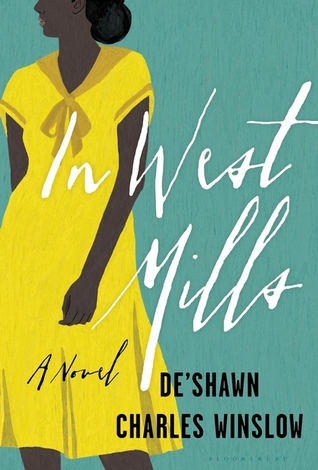
In West Mills, by De’Shawn Charles Winslow***

I received a review copy of this book courtesy of Net Galley and Bloomsbury. It’s for sale now.

Winslow’s debut is set in 1941 in North Carolina. Our protagonists are Azalea Knot, an alcoholic school teacher in an African-American community, a woman shunned by her neighbors and kinfolk for her unconventional behavior and obnoxious personality. Otis Lee has family troubles of his own, but seeks redemption by helping Knot, who has two babies out of wedlock at a time when you really could not do that without terrible social repercussions. Otis is a helpful sort, and ultimately, the story becomes one about the family we choose.

I abandoned and restarted this book three times, and in the end, I never did engage with it much. I read the first thirty percent, the last twenty-five percent, and skimmed the middle. The writing style didn’t speak to me, and I couldn’t understand why Otis would care about Knot. But to be fair, Southern fiction has been a competitive genre for several years, and I was reading books by Attica Locke and Jesmyn Ward at the same time I read this.

I have a hunch Winslow is just warming up. He’ll be one to watch in the future.

Fifty Things That Aren’t My Fault, by Cathy Guisewite****

Guisewite began publishing the comic strip “Cathy” in 1976, the year that I graduated high school. It was a time of high expectations for women, and the unrealistic suggestion that we would be able to “bring home the bacon, fry it up in a pan, and never let you forget you’re a man,” as Madison Avenue decreed, was daunting.  Through her sharply perceptive humor, Guisewite let her peers know that it wasn’t just us; we were judging ourselves with an unfair yardstick. She kept it real, and in doing so, kept us sane.

My thanks go to Net Galley and G.P. Putnam for the review copy.

So how does cartooning translate to prose?  Whereas the cute, punchy single-page entries and single sentence proclamations—and the lists—are her most familiar territory, my favorite parts of this memoir are the least cartoonish ones. Yes, I love the way she takes down the women’s fashion industry and the unhealthy way it affects our body images.  She was good at it forty years ago, and she’s good at it now. But the passages that drew me in and let me get lost in her story are the more vulnerable, deeply perceptive parts of the narrative, her fears for her aging parents; the struggle and triumph of raising a daughter, one with special needs, alone; and the failure of her marriage. I am in awe of the fact that she and her ex made each other laugh until the tears came as they planned their divorce. Who does that? And of course, she made me laugh too.

Guisewite stays inside her usual parameters, never veering outside of the middle class Caucasian realm with which she has experience. Younger women won’t get much joy out of this memoir; women that came of age between 1965 and 1985 are right in her sweet spot, and it is to them that I recommend this book. It’s available now.